Showing posts with label Cistus x skanbergii. Show all posts

Friday, March 31, 2017

Too Many Favorites!

It's the final Friday of the month, the date Loree at danger garden hosts favorite plant posts.  I really tried to winnow down my list to a reasonable level but every trip through the garden presented a challenge for me.  Our heavy winter rains have given us the gift of a truly splendid spring and I can't help but use every opportunity to present it in all its glory.  (Watch out for my wide shots post next week - I expect it's going to be very photo heavy!)

So, here we go with my current (dozen) favorites:

I showed a similar view of dwarf Echium webbii a few posts ago but I can't resist showing the plant as it looks now.  It fits this space next to the back patio much better than the Lupinus propinquus I had in this spot last year (before it was consumed by tent caterpillars).  The Felicia aethiopica at its feet and the over-achieving Lobelia valida 'Delft Blue'  to the right complement it well too.  The Echium is drought tolerant and should get no larger than 3x3 feet.

Given that I live in California, you might think that growing California poppies (Eschscholzia californica) from seed is no mean feat but between the interference of raccoons and inadequate rain in prior years, I've had no end of trouble getting them to bloom.  This year I got a good turn-out from 'White Linen' on the back slope.  They look nice with the Calla Lilies (Zantedeschia aethiopica) that came with the garden too.  The lilies die down every summer but return following our winter rains.

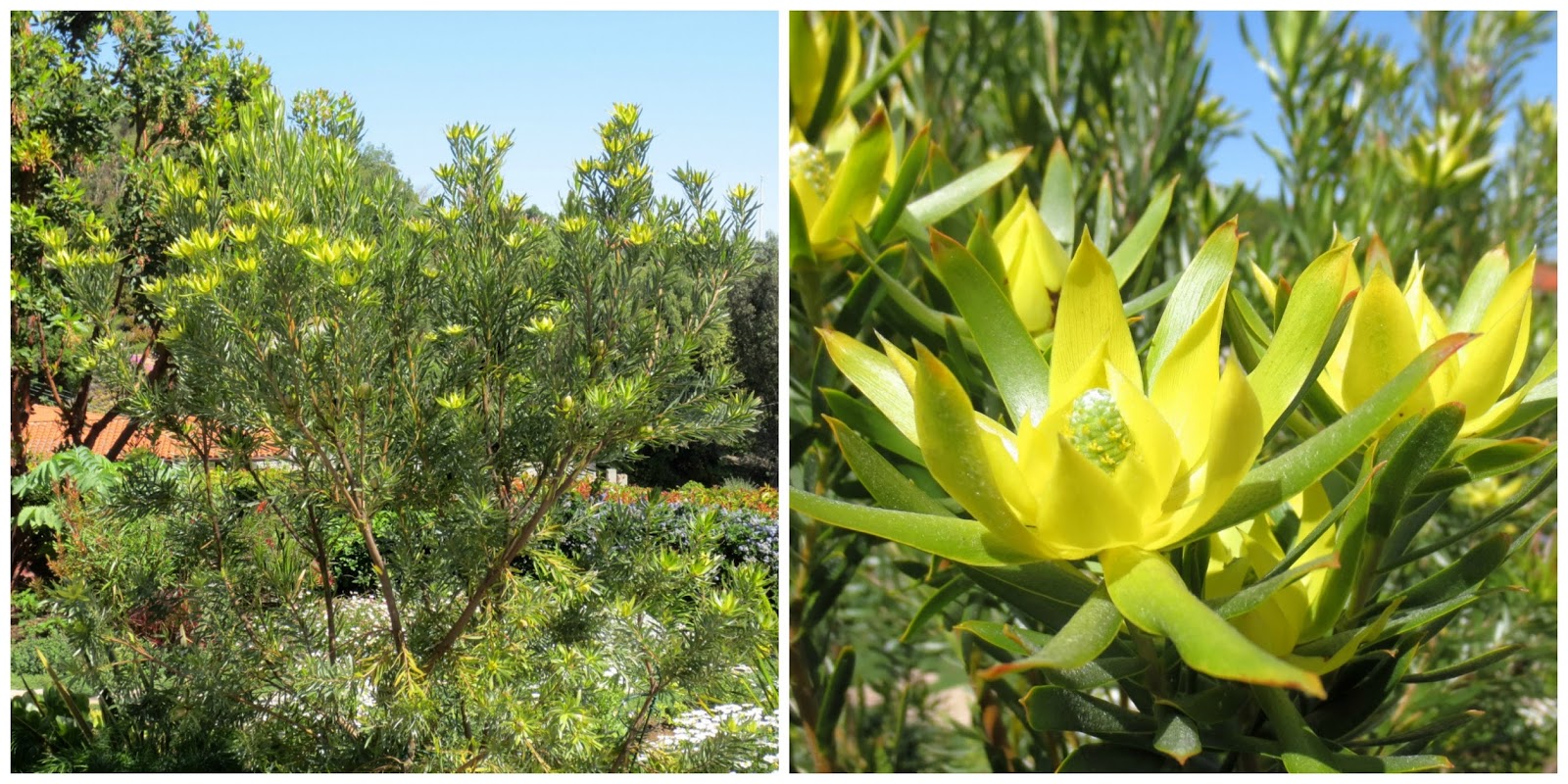
Leucadendron 'Pisa' has produced its cone "flowers" right on schedule this year.  The foliage is a wonderful silver color.  The luminescent yellow "flowers" are actually bracts surrounding a silvery cone.  This plant started out life in my garden in a pot in 2014 and moved into its current location in late winter 2015.  It needs moderate water and can grow to 8x5 feet.  Mine is closer to 6x4 feet.

My last remaining stretch of Ceanothus hedge is in full bloom.  As with the Ceanothus hedge I removed from the front garden when the shrubs began to fail, it's backed by another hedge of Xylosma congestum.  Inherited with the garden, I have no ID for the species or cultivar.  I lost one of the shrubs making up this hedge in 2015 but, so far, the remaining shrubs appear healthy.  Sitting at the edge of the steep back slope, perhaps they have better drainage than the ill-fated specimens that were planted on the front slope.

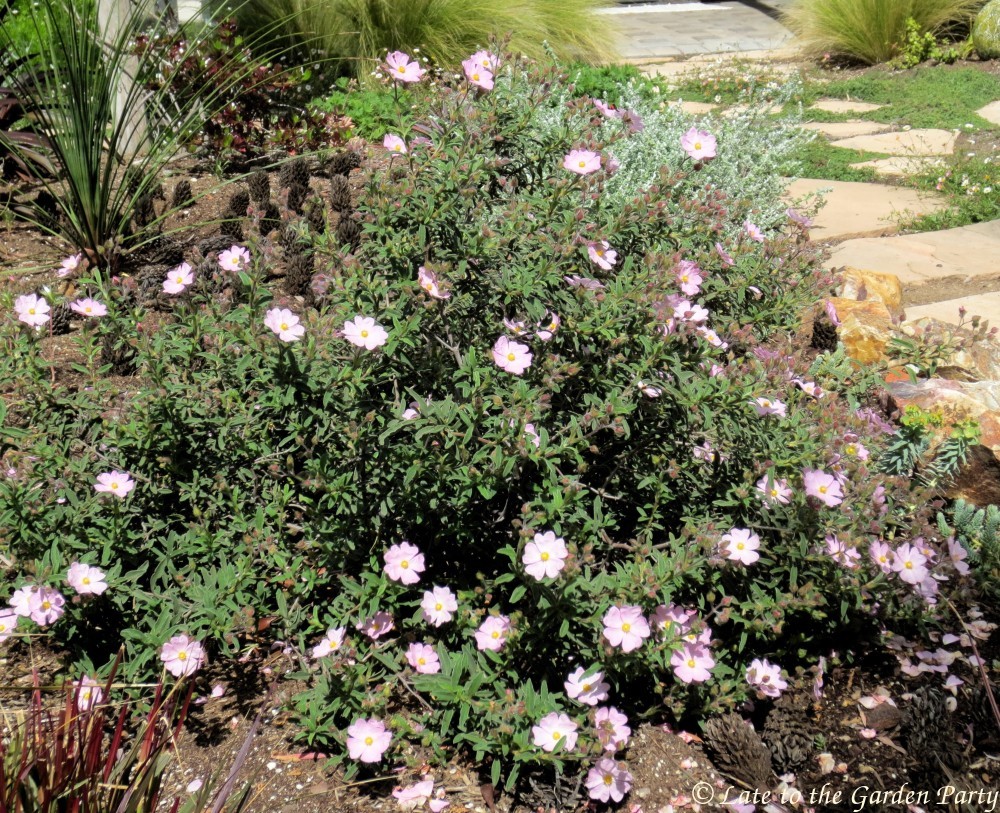
Cistus x skanbergii responded to warmer temperatures by covering itself in pale pink blooms.  Planted in September 2014, it took our drought in stride.  I think I'm really going to like how it looks with the smoke bush (Cotinus coggygria 'Royal Purple') I planted in the same bed last November.  The latter began leafing out this month.

Hellebores aren't common here so I'm really pleased to have 2 varieties bloom for me.  The variety shown at the top of this collage is Helleborus 'Anna's Red'.  It produced its first burgundy red bloom a month ago but it has several buds now.  I love its foliage too.  H. 'Phoebe' (bottom row) was added to my garden soon after I moved in, probably in 2011.  It didn't bloom in its original location and I moved it a couple of years later.  It sulked for a long time.  It produced one, maybe 2, flowers last year but it has close to a dozen blooms and buds now.  'Anna's Red' died down completely last summer but 'Phoebe' was evergreen.

In contrast to the hellebores, ivy geranium (Pelargonium peltatum) is very common here but I still want to share what a terrific show P. 'Pink Blizzard' is putting on along the raised wall we extended last year.  I suspect it likes the improved soil and drainage and of course the winter rains didn't hurt.  It's winding its way around and through Aeonium arboreum and Rosa chinense 'Mutabilis' here.

Here's another common plant, albeit one in a relatively uncommon color.  Anagallis 'Wildcat Mandarin', planted in 2015, is returning for a third run.  It makes a good low-growing ground cover in this partial shade setting and nicely echoes the orange tones in the Arctotis 'Pink Sugar' next to it.

Lotus bertholdii 'Amazon Sunset' is aggressive to say the least but it has been effective in keeping out the raccoons who regularly tore up this bed on the south side of the house.  It seems to take regular trimming in stride but I've found I have to keep at it to prevent the vine-like stems from covering the flagstone path.  I'd thought that the flowers would be less showy when used as a ground cover rather than hanging from a pot but I was wrong!

After months of flaunting buds, Ageratum corymbosum finally burst into bloom just after Garden Bloggers' Bloom Day.  This plant is an evergreen shrub or, as the grower describes it, an "ever-purple" shrub.  It needs afternoon shade in my climate.  When it's done with its spring bloom period, I cut it back hard and the attractive, velvety-textured foliage refreshes itself within a month or so.

Okay, you've made it to the last plant on my list!  This is Acer palmatum 'Mikawa Yatsubusa', a dwarf Japanese maple.  I unceremoniously moved it to a border in the vegetable/cutting garden in December after I replaced it in its former backyard location with a dwarf Jacaranda I'd coveted.  Frankly, I didn't have high hopes for its survival - Japanese maples can struggle here - but it's come back strong, probably aided by all that rain we got.


I'm lucky that my climate has positively affected my garden.  My only complaint at present is with the persistent high winds, which are drying things up quickly now that our winter rains are over.  I know other gardeners, including our host, have faced far more serious weather challenges.  Visit Loree at danger garden to discover what's stood the test of the tough winter she and others have had to face down.


All material © 2012-2017 by Kris Peterson for Late to the Garden Party

Tuesday, March 15, 2016

Bloom Day - March 2016

Spring arrived in coastal Southern California weeks ago and, aided by a little rain, the garden has exploded with flowers.  It's times like these that I'm forced to acknowledge that, yes, I'm addicted to flowers.  I really should confine myself to purchasing only foliage plants for the foreseeable future but I suspect that resolution won't last long.

This month I've organized my photos by garden area.  I didn't realize that I'd done this before until I looked back at my March 2015 post.  There must be something about spring and the multitude of flowers that has me stepping back to evaluate the garden area-by-area.

There are so many flowers in the backyard garden that I had to break things down by section.  In the back border, the Osteospermums continue to dominate but they're not alone.

Osteospermum 'Blue-eyed Beauty', shown here with Geranium 'Tiny Monster' among other flowers, rules the mid-border

Other Osteospermums blooming in this long border include (clockwise from top left): O. '4D Silver', 'Pink Spoon', 'Berry White' and 'Zion Copper Amethyst'

Additional flower color is provided by Argyrantemum 'Madeira Pink', Alstroemeria (noID), Gazania 'Sunbathers Otomi', Rhodanthemum hosmariense 'Marrakech', R. 'Moondance', Hebe 'Patty's Purple', H. 'Wiri Blush', Polygala fruticosa, Verbena lilacina, Phlomis fruticosa, Scilla peruviana, and Narcissus 'White Lion'


The most impressive plant in the area surrounding the backyard fountain right now is Felicia aethiopica but it has plenty of company.

Last year I planted 2 Felicia in 4-inch pots and this year I have a beautiful mound of blue flowers

This long border running half the length of the house also contains: Arctotis 'Pink Sugar' (planted from divisions taken from plants in the front garden), Anagallis 'Wildcat Mandarin', Ajuga 'Mint Chip', Alyogyne huegelii, Bulbine  frutescens, Dutch Iris, Ranunculus californicus, and Veronica 'Waterperry Blue'


The two smaller beds on the north end of the backyard are also joining in on the show.

One bed has blooms of Grevillea 'Ned Kelly', Lobelia laxiflora, and a hot-pink flowered Callistemon (which I may have to move due to the color clash)

Closer to the house is a bed containing Cotula lineariloba, Solanum xanti and Salvia 'Amistad'


By comparison, the south side garden is relatively reserved.

One bed is dominated by a large Cistus x skanbergii (surrounded by prickly cones from the Magnolia tree to discourage the raccoons and skunks from digging)

This one has a mass of Gazania 'Gold Flame' together with Grevillea juniperina 'Molonglo' and Lotus berthelotii


The front garden is competing with the back to draw attention.

More Arctotis 'Pink Sugar'

Echium candicans just about to bloom in front of a noID Ceanothus

'Joseph's Coat' climbing rose

The planting schemes on both sides of the front walkway include (clockwise from top left): Gazania 'White Flame', Coleonema 'Sunset Gold', Coleonema album, Euphorbia characacias 'Black Pearl', Hemerocallis 'Spanish Harlem' and 'Pink Meidiland' roses

On the north end of the front garden, I have: Grevillea 'Peaches & Cream', Grevillea 'Superb', Heuchera 'Bressingham Hybrids', Helleborus 'Anna's Red', Geranium 'Biokovo', and Jacobaea maritima


Even the less-visited corners of the garden have flowers.

In the area behind the succulent bed that runs along the street, I have what I think is Prunus laurocerasus together with Auranticarpa rhombifolia, Euryops 'Sonnenschein', 2 forms of Pelargonium peltatum, and what I think is Rosa chinensis 'Mutabilis'

Osteospermums dominate my dry garden too (clockwise from the upper left): O. 'Sweet Summertime Kardinal', O. 'Purple Spoon', 2 self-seeded Osteospermums (noID), Geranium incanum (a weed in my garden), 'Goodwin Creek' lavender, Limonium perezii, and Leptospermum scoparium 'Pink Pearl'

Even the neglected back slope has some blooms to offer: an Aeonium arboreum flower, Euphorbia 'Dean's Hybrid', a noID bearded Iris, and Zantedeschia aethiopica, which disappears every summer but returns when the rain and cooler temperatures arrive in late winter


Is your head spinning?  Mine is!  For other Bloom Day posts, visit Carol, our Garden Bloggers Bloom Day host, at May Dreams Gardens.


All material © 2012-2016 by Kris Peterson for Late to the Garden Party

Tuesday, September 23, 2014

Planting Bed Facelift #2

My first planting bed facelift involved the bed formerly occupied by an unused wood-fired spa.  Last week, I tackled my second facelift, the bed once occupied by a 60 foot Eucalyptus tree.  I replanted the area in March 2013 after the tree was removed at the request of a neighbor.  It looked fine for a short while but the combination of dry soil (made worse, not better by the addition of the woody remains of the Eucalyptus tree), high winds, drought, nightly digging operations by the neighborhood raccoons, and poor plant selections left it looking sad.  The wood chips and shavings left after grinding down the tree stump had formed clumps with the consistency of dry cardboard and didn't hold water well.  I cleared as much of the remnants of that debris as I could and added lots of soil amendment before replanting.  My fingers are crossed that the new plants will fare better than the bed's previous occupants did.

View of replanted bed looking west

View of the same bed from the side yard patio


Two of the 3 original Coprosma 'Plum Hussey' remain in place along the bed's outer edge.  The third, which was struggling to survive, was removed and replaced with a smaller plant of the same variety, moved from the side yard border.

The 2 original Coprosma 'Plum Hussey' bordered by Pelargonium tomentosum (peppermint geranium)

The smaller Coprosma, moved from a shadier bed, hasn't developed 'Plum Hussey's' striking red color yet


Grevillea 'Bonfire' replaced the sad Acer palmatum 'Purple Ghost,' which couldn't hold up to the winds that whip through this area most afternoons.  The Japanese maple was moved to the vegetable garden, where I hope it has a chance to survive.

Newly planted Grevillea 'Bonfire'


Four Agave 'Blue Glow' and one Hesperaloe parviflora were installed both for their looks and the possibility that their prickly leaves will deter the raccoons from digging in the area in their relentless search for grubs.

Agave 'Blue Glow,' still relatively small

Hesperaloe parviflora (aka red yucca)


To complement the gray-foliage of the Hesperaloe, I added Festuca 'Elijah Blue,' tiny cuttings of succulent Senecio mandraliscae, and pink-flowering Cistus x scanbergii.

Cistus x skanbergii


We raised the height of the wall that borders one length of the bed to reduce its slope and support the additional soil amendments I added.  I replaced the mass of gray Helichrysum petiolare that previously occupied that space with 5 Pennisetum setaceum 'Fireworks' and 2 varieties of Rhipsalis.  The Helichrysum did well in the location but it wasn't particularly interesting.

Pennisetum setaceum 'Fireworks' is reputed to be smaller than the standard variety

Five plants line the top of the wall

This was labeled 'mistletoe cactus' - my best guess is that it's Rhipsalis baccifera aka spaghetti cactus

This one was labeled Rhipsalis salicornioides, aka dancing bones cactus


I moved 3 Hemerocallis 'Spanish Harlem' here from the front yard borders to pick up the red tones of the Coprosma and the Pennisetum.  There's less late afternoon sun in this bed but I hope it will be sufficient to keep 'Spanish Harlem' blooming as I love this daylily's flowers.

These evergreen daylilies are a little sad at the moment as I cut them back prior to transplanting 

Here's a reminder of what 'Spanish Harlem' looked like in full bloom


Unfortunately, the Agaves are still small and aren't yet up to the challenge of keeping the raccoons at bay.  The little monsters dug up a few of the smaller plants and pawed around the base of the Grevillea.  I've put down more animal repellent and temporarily caged the Grevillea for its own protection until it's well-rooted in its new location.

Grevillea wearing a tomato cage


Work continues on the denuded front lawn area, as well as a small bed dug out of the lawn in the backyard.  My lawn removers left a lot of grass roots behind, as well as much of that nasty plastic netting embedded in the sod laid by the former owners.  My husband and I are in the process of clearing out what we can before hauling in supplemental topsoil and soil amendments.  It may be quite some time before I'm ready to plant the front area but, impatient as I am, those grass roots need to go and the soil, pure clay in one area and nothing more than decomposing rock in another, needs work.


All material © 2012-2014 by Kris Peterson for Late to the Garden Party