Showing posts with label squirrels. Show all posts

Friday, January 26, 2024

The bird feeder

I have three bird feeders outside my home office window.  I left them empty during the summer and early fall months until temperatures fell.  In January, the white-crowned sparrows arrived and activity at the feeders picked up.  As the birds tend to fly away as soon as I go out the back door, I used a telephoto lens to capture photos from inside with mixed results.

This is the best wide shot I could get that wasn't blurred by sun glare or fog


The white-crowned sparrows (Zonotrichia leucophrys) live in parts of the western US year-round but they're not generally seen in my area until the winter months.  Unlike many of the birds here, these sparrows know how to strike a pose.

According to TheCornellLab the oldest verified age of a white-crowned sparrow was at least 13 years and 4 months


Apparently, they'll share their territories with some birds but are known to drive others away, including Dark-eyed Juncos.  I noticed Juncos hopping about for awhile but they've been noticeably absent of late.  However, it doesn't seem that the sparrows have any issues with finches.

Based on casual observations, house finches (Haemorphous mexicanus) are the most common (or at least the most visible) of the small birds here

According to Cornell, male house finches get their red color during the molting period from pigment in their food.  The more pigment, the redder their plumage.

Female house finch sharing a feeder with a white-crowned sparrow

This is the best shot I got of a lesser goldfinch (Spinus psaltria), which is also a very common year-round resident.  Lesser goldfinch males in the far west have green backs, unlike those further east (source: Cornell).


About two years ago, I noticed another kind of finch hanging around.  I know it by the common name of spice finch (Lonchura punctulata) but it's also known as nutmeg mannikin, ricebird, and scaly-breasted munia.  Native to tropical areas of Asia, they spread in the US as escaped birds.  They were first sighted in Cocoa Beach, Florida in 1964.  They've more recently been added to Audubon's list of California State birds.  In the US, they're reportedly most common in Florida and California (source: Wikipedia).

Male and female spice finches look similar, although the male's coloring is somewhat darker.  Juveniles are paler in color, lack the dark head, and have buff-colored breasts.


Originally, spice finch sightings were one-off observations.  This year I've seen these birds hanging out in noticeably larger groups but they also seem to get along fine with house finches, lesser goldfinches, and white-crowned sparrows.

Spice finches sharing space with a single lesser goldfinch.  This feeder with an outer cage seems to be the favorite among the small birds.

I noticed that the spice finches often share feeding perches, something I've never noticed among the other birds


Good view of a juvenile spice finch on the right


The California scrub jays (Aphelocoma californica) send all the small birds packing when they visit but, thankfully, they don't stop by often.

Not a great photo but a very interesting, if common, bird.  Like it's relative the crow, it's very clever.  Although its weight can close the seed portals of this "squirrel buster" feeder, it can balance its weight in such a way as to get some seed, even if he can't keep it up long.


At least the scrub jays don't break the feeders.  The same can't be said of the squirrels.

On the left is the squirrel contemplating his leap onto the "squirrel buster" bird feeder.  The weight he (or she) put on the cage surrounding the feeder immediately closed the seed portals as shown on the right. With practice, they learn to hang upside down from the top of the feeder to avoid closing the portals immediately but they've actually broken the springs in some of these feeders.

The squirrels are currently leaving the bird feeders alone, having found another source of food elsewhere in our garden.  The already paltry crop of oranges shrinks more every day.


Meanwhile, my cat Pipig and I had our sixth visit with the vet since November earlier this week.  She continues to improve but still hasn't received an all-clear report; however, absent a new problem, we don't plan to see the vet again for another four months.  She's eating well but her weight is still stuck at six pounds, fourteen ounces.


Have a nice weekend.


All material © 2012-2024 by Kris Peterson for Late to the Garden Party


Friday, November 17, 2023

A colorful end to the week

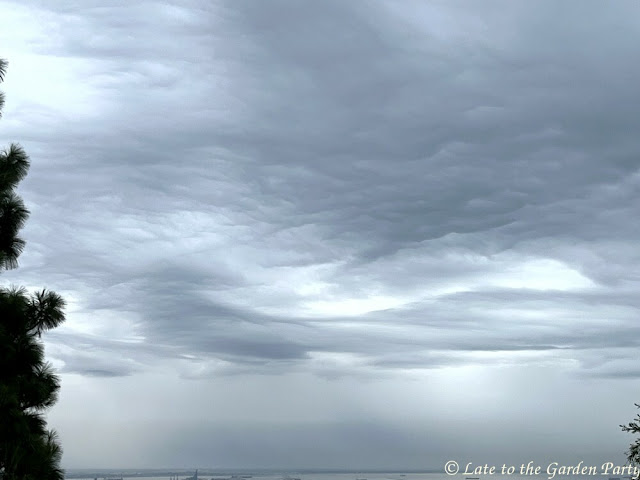
After a long stretch of very warm, dry weather, the temperatures fell and the skies finally turned gray on Wednesday.  Although rain had been in the forecast for more than a week, the chances had been gradually scaled back and, when Wednesday morning started out warm with blue skies and low humidity, I was ready to write off the rain forecast entirely.  But by late morning, conditions suddenly shifted.

View of the Port of Los Angeles from my back garden as it began to sprinkle

The clouds looked like an abstract painting

As the rain came down more steadily, I placed the rain chain in a plastic trug to catch what flowed off the east-facing roof.  Other areas of the house and garage roofs directly feed 3 collection tanks but I try hard to capture every drop I can. 


My November Bloom Day post had already been posted when I noticed two more plants with unexpected blooms.

I'd watered the plants in this barrel on Tuesday and noticed no sign of flowers on Hibiscus acetosella 'Haight Ashbury'; however there were a half-dozen or more flowers early the next morning.  The flowers are more attractive than I'd anticipated.

In the street side succulent bed, I also noticed that Aloe lukeana had a bloom stalk.  It was a gift from Gerhard Bock of Succulents and More when he visited in 2021 and this is the first time it's bloomed.


On the north end of the garden the persimmon tree (Diospyros kaki 'Hachiya') was offering another splash of bright color - until it wasn't.

View of the tree early in the week


I caught sight of movement in the tree from inside the house and went to investigate.  One squirrel streaked by as I approached.  The second was initially too busy to care.

He did try to evade my camera, possibly thinking his tail functioned as a cape of invisibility.  Unfortunately, as I approached from one side, he decided I was too close, dropped his prize, and headed over the fence into the neighbor's garden.

I left the soft fruit in the garden for him and his buddies to eat.  I cut 2 persimmons mainly to prevent the squirrels from dropping them onto the Agave ovatifolia below, making a sticky mess.


The persimmon tree has since been cleared of fruit.  2022 was a banner year for both the 'Fuyu' and 'Hachiya' persimmon trees but this year I never saw a single ripe piece of fruit on the 'Fuyu' and I got fewer than two dozen persimmons from the 'Hachiya'.  The squirrels ate or damaged all of them except two I cut during my squirrel encounter.


Blue skies returned Thursday morning.  

The skyline was (mostly) clear of smog for a change


I made good use of the break in the rain on Thursday.  I moved the rainwater I'd collected in plastic trugs to the largest of my three rain tanks.  I spent an hour on our back slope cutting back masses of Centranthus ruber.  While I barely made a dent in the work required down there, at least I got a start on the long-needed cleanup while the fire ants were inactive.  I received my third (and last!) bulb delivery for the season and got a portion of those potted up, and also sifted the homemade compost in one bin and spread it in the front garden.  Whew!

I'd of course forgotten how many bulbs I'd ordered


Another storm is expected to move in late Friday night with light but steady rain through noon on Saturday.  The break on Friday should allow me to get the remaining bulbs planted and, if it's cool enough, more work may get done on the back slope.  I have a mail order plant delivery due to arrive Friday or Saturday but it may be too much to hope that it arrives on the the early end of that window.


I hope you can enjoy some time outside this weekend, whatever your weather conditions.


All material © 2012-2023 by Kris Peterson for Late to the Garden Party


Wednesday, June 7, 2023

Marine layer or not, summer's on its way

In the US, Memorial Day, which fell on May 29th this year, marks the unofficial start of summer.  Although our persistent marine layer and the cooler temperatures that accompanied it may suggest otherwise, the evidence provided by my garden indicates that we're already on the cusp of summer. 

Achillea 'Moonshine' is one sign of summer in my garden.  Those blooms have already hit their stride.

I consider it summer when the first Agapanthus bloom appears.  Buds have popped up all over my garden.  Clumps in 2 areas are shown here.

Evidence that we're getting very close

My Renga lilies (Arthropodium cirratum) generally appear in early summer.  They've burst into bloom en masse throughout my garden within the past 2 weeks.

Last year, when spring conditions were far drier and temperatures were warmer, I potted up dahlia tubers in mid-March and waited months for them to sprout.  This year, I potted them up in late April and they were sprouting within a couple of weeks, even though our temperatures have remained on the cool side.  At last count 20 had sprouted.  Many are ready to move to larger quarters.

Daucus carota 'Dara' has produced its first flowers from seed

Gazanias are suddenly blooming like gangbusters too.  Last year, a couple Gazania 'Gold Flame' seeded themselves in the succulent bed on the northeast side of my garden so I added a few additional plugs.  They must have enjoyed the extra rain because the clumps have grown huge.  I'm hunting for more plugs so I can continue the theme in the newer section of the bed (shown lower left).

I've yet to plant sunflower or zinnia seeds but I picked up a Helianthus 'Sunbelievable Brown-Eyed Girl' shrub a month ago and it's already jumped into gear

The daylilies are getting their season started.  Shown on the right are the first blooms of Hemerocallis 'Spanish Harlem' (top) and 'For Pete's Sake' (bottom).

The first Hesperaloe parviflora 'Brakelights' bloom stalks have appeared

The Orienpet lilies are well on their way too


Of course, the new arrivals are appearing as other plants move on.  I pulled out the last zillion Aeonium haworthii 'Kiwi' this week as their flowers faded.  I've cleared out most of the foliage of Amaryllis belladonna as it died back - the "naked lady" flowers should appear in July or August.  Meanwhile, a combination of mildew and rust is quickening the removal of the cool season flowers in my cutting garden, most of which got started very late this year.  And then, the local critter cleanup crew is also hard at work as shown below.

Last year, I noticed that critters were removing the mature flowers of Leucospermum 'High Gold', leaving a mess in plain sight  I hadn't noticed any activity of that sort this year - until I walked down the dirt path between the back border and the hedge and discovered the debris shown in the bottom row of this collage.

Yesterday, I caught sight of my prime suspect from the living room through a dirty window pane

I picked up a telephoto lens and headed outside for a clearer view and there he was, holding the evidence in his mouth


Much as I love all the summer blooms, I always feel a tinge of loss as the spring flowers move on.  However, I expect I'll feel better in a few weeks when the summer flowers are in full swing.


All material © 2012-2023 by Kris Peterson for Late to the Garden Party

Friday, March 17, 2023

Between storms

This rainy season has been an extraordinary surprise.  We were given a poor chance of rain again this year but storms nonetheless started piling up in January and kept on coming.  There was another strong "atmospheric river" late last week, which was followed by yet another one this week.

This is the view from my back garden last Sunday morning looking out at Angel's Gate, the entrance to the Los Angeles harbor.  The clouds were sitting atop the ocean and the harbor was invisible.

This photo was taken from the back garden looking northeast.  There was a little blue sky visible from this viewpoint but it quickly disappeared.  In the background on the left you can see the refineries spitting out their pollutants.


After years of severe drought, bemoaning the cold, damp conditions seems almost sacrilegious but I admit I rejoiced when we finally got a bit of sun and blue sky yesterday afternoon.  The soil is saturated, my rain collection tanks are full, and we've tallied more rain this season than we've had in several years.

I've recorded 18.65 inches of rain since our 2023 "water year" began October 1, 2022.  That's well above average for our rainy season in my location.  Other areas got considerably more.  Our rainy season generally comes to an end in early April.


With the last storm, my area is no longer considered in a drought status.

Before the last storm, we were still in the "abnormally dry" category but the western portion of Los Angeles County is now drought-free


Unlike me, the local critters had no trouble whatsoever with the damp conditions and cloudy sky.

I refilled the bird feeders and activity in the garden picked up dramatically

Three house finches monitoring the action at the feeder from the nearby Arbutus 'Marina'

Two finches, a mated pair perhaps, later moved to the feeder pole

The white crowned sparrows were also active at the feeder.  This one was surveying things from the Ceanothus below the feeder.

Of course, once the feeders were refilled a squirrel showed up.  I took this photo from inside my home office but I swear he knew I was looking at him.

He's quite the gymnast.  These feeders are set up to close the seed portals when anything heavier than a small bird attempts to eat from them.

He eventually gave up but managed to jump from the one feeder to the main pole, where he climbed atop the cage surrounding the central feeder

He clearly found something to eat but I couldn't make out what it was


I had an unexpected visitor come up our back slope by way of the canyon below as well.

This is Luna, a champion escape artist.  She and her family moved into a nearby home off a spur road months ago.  She periodically gets out their gate and into the canyon and from there seems to end up on my back slope and ultimately in my back garden.  I now have her family's number in my cell phone.


In addition, I've had near daily (or I should say nightly) visits by what I suspect is an entire family of possums.  They're less destructive than raccoons but nearly as annoying.  Although the invisible owls have reduced the local rabbit population, those voracious creatures are still paying periodic visits.

There's a ninety percent chance of yet an atmospheric river moving through from Monday into Wednesday. For the first time I can remember in the last ten years, I don't think I'm going to save the "extra" rainwater that flows down my rain chain.  I've nowhere else to store or dump it given how saturated my soil already is.  However, our current drought status shouldn't stop the state and local municipalities from furthering their efforts to capture and store rainwater.  The present abundance won't prevent future droughts - and one year of heavy rains isn't sufficient to restore our aquifers either.

Best wishes for a pleasant weekend.  I'm hoping for more sun!


All material © 2012-2023 by Kris Peterson for Late to the Garden Party