Showing posts with label Acer palmatum. Show all posts

Friday, March 27, 2020

Focusing on foliage

Despite my flower fixation, I've been making an effort to focus more attention on foliage over the last few years.  In Spring, it's easy to ignore foliage altogether as there's always another flower making an appearance but during the last couple of weeks (when I've had so much unexpected time at home!) I've paid more attention to the foliage in my garden.  Here are some of the plants that have stood out:

I featured the Cordyline 'Can Can' shown in the background here in my February foliage post but the focal point of this photo is Abelia x grandiflora 'Kaleidoscope'.  I cut this particular specimen back harder than I usually do and it's responded by coming back as a very tidy mound.

I have 3 Japanese maples but this dwarf variety, Acer palmatium "Mikawa Yatsubusa', is the first of these to leaf out

This Aeonium arboreum 'Velour' forms large ruby-tipped rosettes

I added 2 drought-tolerant Astelia 'Silver Shadow' to my back garden in February in the hope that they'll survive in this particularly dry area

I seem to have become a Begonia collector.  From left to right in my shade house I have: Begonia 'Champagne Bubbles', 'B. Escargot', and what I think may be B. rhizomatous 'Nautilus Lilac'.

Several specimens of Calliandra haematocephala (aka pink powder puff bush) came with the garden as foundation plants.  As such, they get sheared several times a year to keep them from spilling into walkways.  However, as you can see here, their fresh new foliage is very attractive when the plant's actually allowed to do its thing.

This isn't the flashiest Hebe in my collection and I value it mostly for the flowers but Hebe 'Wiri Blush' holds up better than most members of this genus in my garden and flaunts touches of red in the undersides of its glossy leaves

I've allowed this grass to spread in one area of my garden in the hope that I've correctly identified the seedlings as Lagurus ovatus (aka bunny tail grass).  If I'm wrong I'm going to be very unhappy in a couple of months.

This small shrub is one I routinely forget about because it's grown so slowly and tends to get hidden underneath surrounding plants when they flush out.  It's Ochna serrulata, a South African shrub commonly known as the Mickey Mouse plant because its black berries and red sepals are said to resemble Mickey's face.  Although the plant's been in my garden for 5 years, I've yet to see its flowers or its berries.

This is the foliage of Itoh peony 'Keiko'.  Planted in 2013, its foliage appears regularly but it has yet to flower for me.

This moss-like plant is Scleranthus biflorus, aka Australian astroturf.  I planted 3 of these clumps near the Astelia shown earlier because it's supposed to get by with little water once established and spread as much as 3 feet while maintaining a very low profile.  We shall see if it lives up to its reputation.


That's my wrap-up for this week's blog posts.  Be sure to give your foliage some attention while you're admiring your Spring flowers!


All material © 2012-2020 by Kris Peterson for Late to the Garden Party

Friday, May 17, 2019

It's not all about the flowers

My May Bloom Day post was a little over the top, even for me.  I took my camera outside to seek out foliage stars that could compete with all the flowers currently dominating my garden.  While it was difficult to snap photos without flowers photo-bombing the shots, I captured a number of foliage shots worthy of recognition.

Acacia 'Cousin Itt' frequently features in my foliage focused posts but on this occasion it's the contrast between its feathery texture and the smooth leaves of succulents I want to highlight.

Acacia cognata 'Cousin Itt' mingles here with Aeonium arboreum and Aeonium haworthii 'Kiwi'

'Cousin Itt' is cozying up to Agave ovatifolia 'Vanzie' here


Japanese maples aren't easy to grow in my windy location with its searing hot summer temperatures but I've got three specimens in protected locations that are doing relatively well, at least so far.

Acer palmatum 'Mikawa Yatsubusa', a dwarf variety, still small although I've had it for more than 5 years

Acer shirasawanum 'Aureum', acquired earlier this year, is showing why it's called the Golden Full Moon Maple

Acer palmatum 'Sango Kaku', my oldest specimen, purchased as a small stick 8 years ago


Some of my best foliage shots are anchored by succulents.

These 3 Agave desmettiana 'Variegata' were planted several years ago as pups of one of the 2 plants currently in flower in my street-side succulent bed

Mangave 'Kaleidoscope' with more Aeoniums, as well as Crassula pubescens, which is preparing to bloom


Some foliage is showing off with red new growth.

Agonis flexuosa 'Nana'

Calliandra haematocephala, which I appreciate more for its foliage than the powder puff red flowers it's know for


Grasses and grass-like plants are also prominent features of my garden.

I've used grass-like Lomandra longifolia 'Breeze' in areas throughout my garden.  Here it's accented by the variegated foliage of Abelia grandiflora 'Kaleidoscope' (and, yes, some photo-bombing flowers).
 
I've used Seslaria 'Greenlee's Hybrid' as an edging material here and elsewhere in my garden

Stipa tenuissima (aka Mexican feather grass) is another grass I've used extensively.  It gets very fluffy when it's full of seed heads.  I'm in the process of combing them out before the seedlings take over but I haven't gotten to these plants yet.


Those are some of the foliage highlights in my garden this May.  They're not as flashy as the flowers perhaps but they're just as important.

Best wishes for a pleasant weekend.  We've got a good chance of rain on Sunday here, which is utterly remarkable, especially as we also had rain earlier this week.  Fingers are crossed that you get whatever weather you're hoping for too.


All material © 2012-2019 by Kris Peterson for Late to the Garden Party

Saturday, September 16, 2017

Foliage Follow-up - The first signs of fall

With the return of cooler temperatures in coastal Southern California, I've thrown myself into a variety of fall garden projects and had just about forgotten that it was time to celebrate the foliage in my garden with Pam at Digging, who hosts the Foliage Follow-up meme on the 16th of each month after Bloom Day.  The first foliage plant that caught my eye was Acer palmatum 'Sango Kaku', also known as coral bark maple.  It's one of just 2 Japanese maples in my garden.  I've tried growing others but our summer heat, water restrictions, and exposure to heavy winds makes my garden relatively inhospitable for these beautiful trees.  'Sango Kaku' is a delightful exception and she's already showing a bit of fall color too, something else that is in short supply here.

This east facing spot next to the garage offers protection from the wind, morning sun, and shade from the hot afternoon sun, which seems to be just what the maple wants


My other Japanese maple is the dwarf, Acer palmatum 'Mikawa Yatsubusa'.  Unfortunately, it doesn't handle summer heat as well as the coral bark maple.  Last winter, I moved it from the backyard to a more protected area in the cutting garden in the hope that would improve its performance.  It may have helped some but the lengthy heatwave that began in late August and extended into early September was too much for it.  Just as it did last year in the back garden, it prematurely dropped all its leaves.  However, this week, I noticed that it responded to the small amount of rain we got from a surprise September thunderstorm and our current cooler temperatures by producing new, spring-like growth.

It still looks fairly bare but the bright green foliage helps its appearance a little


Meanwhile, in the back garden, Jacaranda mimosifolia 'Bonsai Blue', the tree that replaced the dwarf maple in its former location, took the long heatwave in stride.

Planted last December, the tree handled its first summer here with no trouble


Before I close this post, I'll mention another sign of fall, albeit an unwelcome one.  My mimosa tree, Albizia julibrissin, has moved to the next stage of its messy annual cycle.  Having littered my garden with a fuzzy mass of dried brown flowers for months, it's now dropping its leaves and its seedpods.  This week, while taking photos for bloom Day, I saw this:

This Albizia seedling was hiding behind a mass of Agapanthus foliage along a dirt path I travel infrequently.  I fear that one day the Albizia seedlings will get away from e and I'll wake up in a forest of mimosa trees.


I immediately pulled up the seedling, which was already nearly 2 feet tall.  The foliage was darker than that of my mature tree and brought the hybrid form Albizia 'Summer Chocolate' to mind but, pretty as it might have been, I couldn't bring myself to invite another of those messy trees into my garden.

This photo of the seedling sitting in a tub waiting to be hauled out to the compost bin shows its darker color better than the first photo


For more Foliage Follow-up posts, visit Pam at Digging.


All material © 2012-2017 by Kris Peterson for Late to the Garden Party

Friday, March 31, 2017

Too Many Favorites!

It's the final Friday of the month, the date Loree at danger garden hosts favorite plant posts.  I really tried to winnow down my list to a reasonable level but every trip through the garden presented a challenge for me.  Our heavy winter rains have given us the gift of a truly splendid spring and I can't help but use every opportunity to present it in all its glory.  (Watch out for my wide shots post next week - I expect it's going to be very photo heavy!)

So, here we go with my current (dozen) favorites:

I showed a similar view of dwarf Echium webbii a few posts ago but I can't resist showing the plant as it looks now.  It fits this space next to the back patio much better than the Lupinus propinquus I had in this spot last year (before it was consumed by tent caterpillars).  The Felicia aethiopica at its feet and the over-achieving Lobelia valida 'Delft Blue'  to the right complement it well too.  The Echium is drought tolerant and should get no larger than 3x3 feet.

Given that I live in California, you might think that growing California poppies (Eschscholzia californica) from seed is no mean feat but between the interference of raccoons and inadequate rain in prior years, I've had no end of trouble getting them to bloom.  This year I got a good turn-out from 'White Linen' on the back slope.  They look nice with the Calla Lilies (Zantedeschia aethiopica) that came with the garden too.  The lilies die down every summer but return following our winter rains.

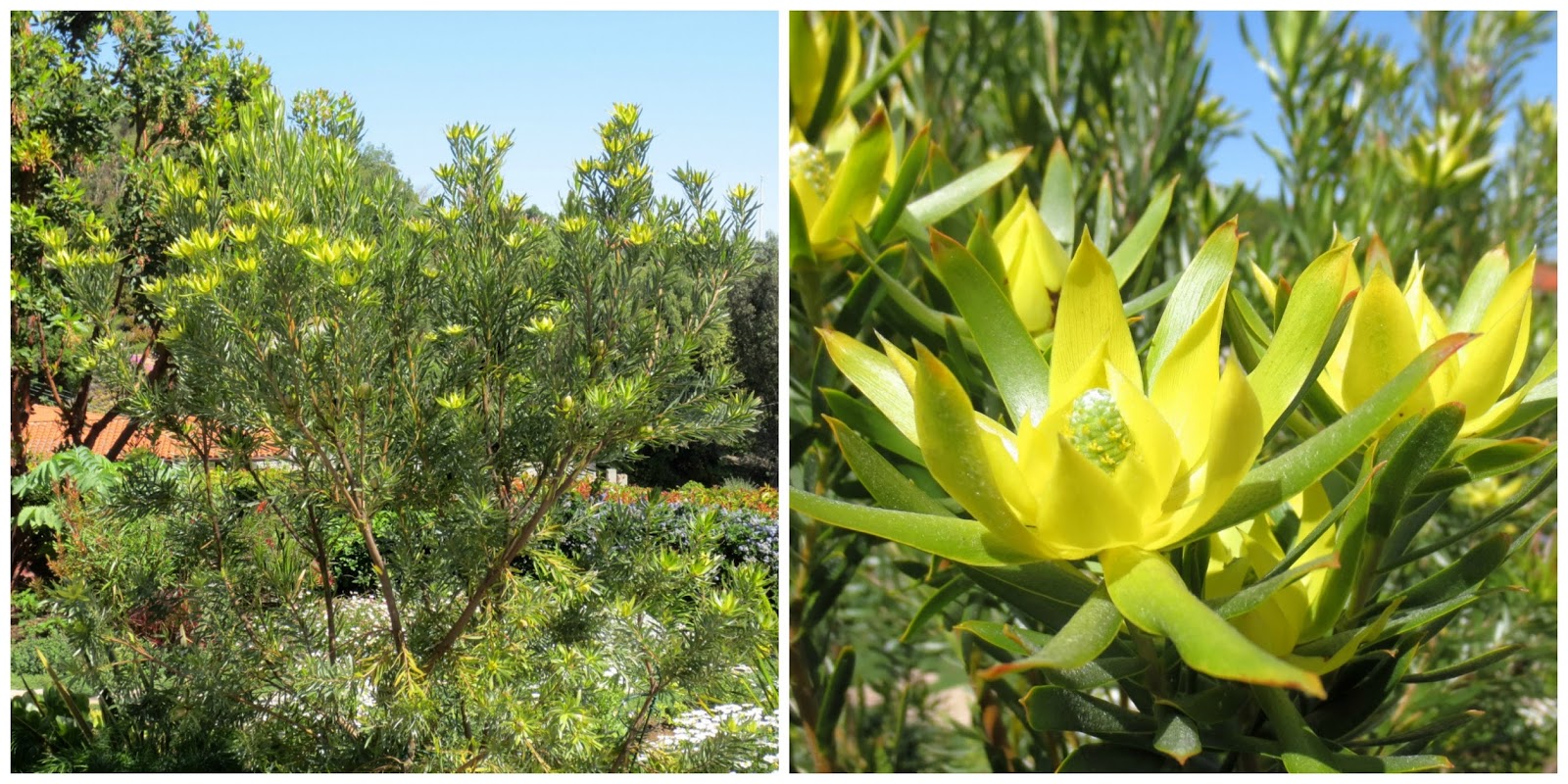
Leucadendron 'Pisa' has produced its cone "flowers" right on schedule this year.  The foliage is a wonderful silver color.  The luminescent yellow "flowers" are actually bracts surrounding a silvery cone.  This plant started out life in my garden in a pot in 2014 and moved into its current location in late winter 2015.  It needs moderate water and can grow to 8x5 feet.  Mine is closer to 6x4 feet.

My last remaining stretch of Ceanothus hedge is in full bloom.  As with the Ceanothus hedge I removed from the front garden when the shrubs began to fail, it's backed by another hedge of Xylosma congestum.  Inherited with the garden, I have no ID for the species or cultivar.  I lost one of the shrubs making up this hedge in 2015 but, so far, the remaining shrubs appear healthy.  Sitting at the edge of the steep back slope, perhaps they have better drainage than the ill-fated specimens that were planted on the front slope.

Cistus x skanbergii responded to warmer temperatures by covering itself in pale pink blooms.  Planted in September 2014, it took our drought in stride.  I think I'm really going to like how it looks with the smoke bush (Cotinus coggygria 'Royal Purple') I planted in the same bed last November.  The latter began leafing out this month.

Hellebores aren't common here so I'm really pleased to have 2 varieties bloom for me.  The variety shown at the top of this collage is Helleborus 'Anna's Red'.  It produced its first burgundy red bloom a month ago but it has several buds now.  I love its foliage too.  H. 'Phoebe' (bottom row) was added to my garden soon after I moved in, probably in 2011.  It didn't bloom in its original location and I moved it a couple of years later.  It sulked for a long time.  It produced one, maybe 2, flowers last year but it has close to a dozen blooms and buds now.  'Anna's Red' died down completely last summer but 'Phoebe' was evergreen.

In contrast to the hellebores, ivy geranium (Pelargonium peltatum) is very common here but I still want to share what a terrific show P. 'Pink Blizzard' is putting on along the raised wall we extended last year.  I suspect it likes the improved soil and drainage and of course the winter rains didn't hurt.  It's winding its way around and through Aeonium arboreum and Rosa chinense 'Mutabilis' here.

Here's another common plant, albeit one in a relatively uncommon color.  Anagallis 'Wildcat Mandarin', planted in 2015, is returning for a third run.  It makes a good low-growing ground cover in this partial shade setting and nicely echoes the orange tones in the Arctotis 'Pink Sugar' next to it.

Lotus bertholdii 'Amazon Sunset' is aggressive to say the least but it has been effective in keeping out the raccoons who regularly tore up this bed on the south side of the house.  It seems to take regular trimming in stride but I've found I have to keep at it to prevent the vine-like stems from covering the flagstone path.  I'd thought that the flowers would be less showy when used as a ground cover rather than hanging from a pot but I was wrong!

After months of flaunting buds, Ageratum corymbosum finally burst into bloom just after Garden Bloggers' Bloom Day.  This plant is an evergreen shrub or, as the grower describes it, an "ever-purple" shrub.  It needs afternoon shade in my climate.  When it's done with its spring bloom period, I cut it back hard and the attractive, velvety-textured foliage refreshes itself within a month or so.

Okay, you've made it to the last plant on my list!  This is Acer palmatum 'Mikawa Yatsubusa', a dwarf Japanese maple.  I unceremoniously moved it to a border in the vegetable/cutting garden in December after I replaced it in its former backyard location with a dwarf Jacaranda I'd coveted.  Frankly, I didn't have high hopes for its survival - Japanese maples can struggle here - but it's come back strong, probably aided by all that rain we got.


I'm lucky that my climate has positively affected my garden.  My only complaint at present is with the persistent high winds, which are drying things up quickly now that our winter rains are over.  I know other gardeners, including our host, have faced far more serious weather challenges.  Visit Loree at danger garden to discover what's stood the test of the tough winter she and others have had to face down.


All material © 2012-2017 by Kris Peterson for Late to the Garden Party

Wednesday, March 16, 2016

Foliage Follow-up: Fresh Spring Growth

In yesterday's Bloom Day post I bemoaned  the fact that, in spring at least, my garden seems out of balance, with flowers dominating the scene.  That doesn't mean I don't have a lot of foliage plants.  I have 29 trees by my current count and the entire property is surrounded by hedges of various kinds.  While I've taken out all of the lawn, I've added ornamental grasses as well as creeping thyme throughout the garden as ground cover.  And do we even need to discuss my Leucadendron collection?!  In summer, when the heat is on and flowers are in retreat, foliage plays a more dominant role, even if the floral elements demand the central focus in spring.

But, even in spring, some foliage plants command attention.  The Callistemon 'Cane's Hybrid' I added in the middle of the backyard border last March is one of those plants.  This shrub, purchased in a 1-gallon container to fill the spot vacated by a tall peppermint willow (removed to address a neighbor's complaint with obstruction of her view of the harbor), was probably one foot tall when I planted it but it's already 4 feet tall.  It does bloom but, at the moment, its the fresh new foliage that caught my eye.

The new silvery orange-toned foliage is especially good-looking when viewed from the dirt path behind the backyard border

But the shrub also looks good when viewed from the flagstone path that bi-sects the backyard


The Callistemon isn't the only foliage plant with orange-tinged spring foliage.

This Acer palmatum 'Sango Kaku' enjoys a good deal of shade in its spot in the vegetable garden alongside the garage 

The Calliandra haematocephala produces these flushes of new foliage periodically throughout the year

While my Itoh peony (Paeonia Itoh hybrid 'Keiko'), has refused to rebloom since I planted it in 2013, it does produce pretty foliage in the spring


Other notable foliage this month includes:

Abelia x grandiflora 'Hopley's', which has formed a handsome clump since I planted it in October 2012

Dwarf Acer palmatum 'Mikawa Yatsubusa', which leafed out seemingly overnight

Melianthus major, which I was forced to cut back severely after some creature (I'm blaming the raccoon) badly damaged its main branches, probably when climbing down the Arbutus above it

What I think is Persimmon 'Hachiya', now producing glossy new leaves

The 'Red Flame' seedless grape


I'll end this month's Foliage Follow-up with a different kind of green plant, a spiny hedgehog cactus.

A friend passed this Echinopsis oxygona on to me in December 2014 with just 4 columnar segments.  It's developed all those rounded segments since then and is showing signs that it may even bloom this year.


For views of more flashy foliage, visit Pam, the host of Foliage Follow-up, at Digging.


All material © 2012-2016 by Kris Peterson for Late to the Garden Party