Showing posts with label Felicia aethopica. Show all posts

Friday, April 12, 2024

African Daisies (A Bloom Day Prelude)

You may have noticed that I generally refer to plants by their botanical names.  Maybe that comes across as pretentious but I do it mainly because those names make the identity of plants clear, whereas common names often confuse matters, even if they're easier to remember and pronounce.   Common names often vary by location and thus may baffle people from different parts of the country or elsewhere in the world.  When I formerly conducted tours of the local botanic garden, the example I used to illustrate this point was Soleirolia soleirolii, a tongue-twister if there ever was one.  I know these plants by the common name of "baby tears" but people in the UK call them "mind-your-own-business."  I asked people on my tours what they would think if they asked someone what that delicate little creeping plant was and the response was "mind your own business."  However, the bigger issue is that many plants bear the same common name, although they may look very different and belong to entirely different genera.

"African daisies" are a prominent case in point.  This common name is used to refer to many plants including those in the genera Arctotis, Dimorphotheca, Gazania, Gerbera, and Osteospermum.  The only things most of them share is that they're native to Africa; they have petals surrounding a central disk; and they belong to the Asteraceae plant family.

Here are examples of those I currently have in my garden:

Arctotis

This is the Arctotis cultivar 'Large Marge'.  It's flowers are particularly big.  They're also even brighter than they appear in my photos - I've joked that they can probably be seen from space.

This is 'Opera Pink', which grows in partial shade in my garden.  All the Arctotis I've seen have grayish green foliage and their flowers have a flat eye at their centers.  I've seen no evidence that they self-seed but they can be propagated via cuttings.

This is 'Pink Sugar', which I've grown for over 10 years.  It and all the Arctotis shown above are hybrid cultivars, none of which are probably found growing as natives in Africa in these forms.  In my experience, all handle sun and heat relatively well.  


Gazania

I expect that most of the Gazanias in my garden are also hybrids.  Many of those I've planted started out as named cultivars but they self-seed freely in my warm climate and they don't always show up looking like their parents.  Those shown above may have originated from a cultivar called 'Golden Flame'.

Some of these may have started out from plants in the 'New Day' series, which is advertised as being particularly drought tolerant.  Like Arctotis, Gazanias can handle intense sun and moderately high temperatures.  Unfortunately, my rabbit visitors seem very fond of them.

This is a cultivar known as 'White Flame' from the Gazania 'Big Kiss' series.  Like Arctotis, Gazanias close their petals in low light, making them less useful as cut flowers; however, those in the 'Sunbathers' series produce ruffled centers that allow the petals to remain open in low light.  My 'Otomi' cultivar isn't blooming at present but you can see others in the 'Sunbathers' series in my 2015 post here.


Osteospermum

I grow more Osteospermums than any other of the so-called African daisies.  I'm especially fond of the varieties with ruffled centers.  Shown above are Osteospermums '4D Silver' and '4D Violet Ice'.

Clockwise from the upper left are Osteospermum '4D Pink', another of my favorites, what I think is 'Serenity Pink', followed by 2 other noID paler pink varieties.  The petals of the plant on the lower left look white in my photo but they're a very pale pink viewed in person.

Osteospermums '4D Sunburst' on the left and 'Double Moonglow' on the right

Osteospermums 'Serenity Bronze' on the left and 'Serenity Coral Magic' on the right, purchased years apart but they look very similar

The 2 Osteospermums on the left are 'Serenity Purple' and the one on the right is 'Purple Spoon'.  I love those with the spoon-shaped blooms but I've found most revert to more conventional petal shapes over time (or when they self-seed).

This self-seeded variety reminds me of Osteospermum 'Berry White'.  I failed to photograph 'Berry White' for comparison purposes but they share similar ruffled centers.  The self-seeded variety has larger blooms and the upper sides of the petals are white rather than pink but the undersides of the petals of both are brushed with bronze color.

The Osteospermum '4D White' on the left appeared in local garden centers just last year.  The simpler white forms shown in 2 different areas on the right are the most common in my garden.  All were self-seeded.

Osteospermums mingle comfortably with one another as shown above.  The plants in general are much more sensitive to heat than either Arctotis or Gazanias.  When temperatures soar, flower production effectively shuts down, only to recover as temperatures decline in late fall.  They're short-lived perennials in my climate but self-seeded plants often replace those that shut down completely.


I don't have any photos of Dimorphotheca or Gerberas to share.  Dimorphotheca flowers look virtually identical to those of Osteospermums to my eyes but the former are annuals whereas Osteospermums are perennials in climates like mine.  Given the frequency with which botanists are reclassifying plants, I'm frankly surprised they haven't been lumped into the same genus.  As to Gerberas, I'm terrible at keeping them alive.  In my experience, they require more water than any of those I'm featured above.

Another thing that annoys me about the frequency with which all these plants are lumped together without distinction under the common name of "African Daisies" is that there's at least one other daisy-flowered African native I can think of that's seemingly never included in that category.


Felicia

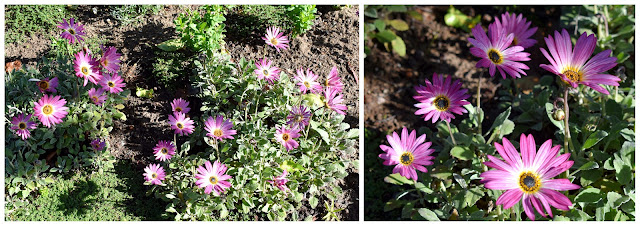
The common names for Felicia aethiopica include "blue daisy" and "wild aster".  The specific epithet "aethiopica" actually means "from Africa."  In my garden it blooms year-round if regularly deadheaded.  Like the daisies described above it's relatively drought tolerant.  It's also in the Asteraceae plant family.


Garden Bloggers' Bloom Day officially falls on Monday, April 15th, but I've already collected a record number of photos from my garden.  The heavier-than-normal rain we've had, recently followed by temperatures in the 70s to low 80sF, has led to a floral explosion.  This post carves the "African Daisies" out of that post and I'm considering other ways to pare down the content of my Bloom Day post, which I don't expect to publish until Wednesday, April 17th.


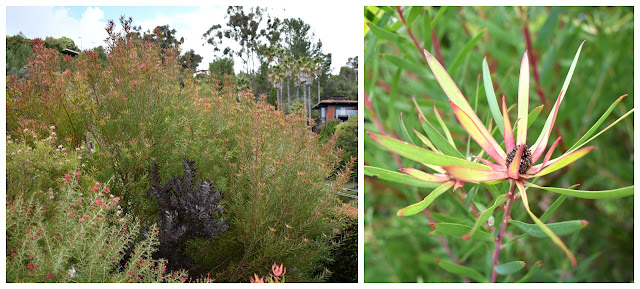
P.S. By coincidence, prior to finalizing this post, I visited a local garden center yesterday and overheard a woman asking a nursery person for a "pincushion succulent."  When the staffer replied that they didn't carry such a plant I interjected that she might mean a Leucospermum, plants that have flowers described as "pincushions" that are drought tolerant although not classified as succulents.  I pulled up "pincushion plants" on my phone, which showed a Scabiosa (commonly known as "pincushion flower"), followed by a Leucospermum (commonly known as a "pincushion shrub").  She identified the Leucospermum as the plant she was referring to.  I pointed her in the direction of those plants in the garden center and identified another local garden center that also usually has a good supply of the plants.  On my way out, I told the nursery person how things had worked out and she told me that she links "pincushion flowers" to Scabiosas, not Leucospermums and therefore didn't make the connection.


All material © 2012-2024 by Kris Peterson for Late to the Garden Party

Friday, February 16, 2024

Bloom Day - February 2024 (Late Edition)

In my coastal Southern California climate, we generally see the early signs of spring by mid-February.  This year is no exception, although colder-than-usual temperatures and a late start to our rainy season has the floral stampede lagging behind last year's display.  Nonetheless, I expect I'm still giving gardeners in much of the Northern Hemisphere a run for their blooms.

I've assigned starring roles to half a dozen plants.  Keep in mind that this award is governed by a jury of one.

My blue Anemone coronaria make me happy whenever I pass them in my cutting garden.  They've been producing flowers continuously for more than a month now.  I've been cutting them for vases every week, even when I don't share them as part of the "In a Vase on Monday" meme.

The 4 Arbutus 'Marina' trees lost all their blooms when they were pruned in late October.  The flowers reappeared en masse with the recent rainstorms. 

I love the foliage of Aeonium arboreum but I'm not entirely fond of the succulent's dunce-cap shaped, florescent yellow flowers; however, they're prolific and the bees love them

The sulfur yellow flowers of Euphorbia rigida stand out beautifully against the bluish succulents in my garden

Similarly, Euryops chrysanthemoides 'Sonnenschein' adds a sunny element to the shady area outside the lath house

Felicia aethiopica is still going strong.  I'd always assumed that these would make poor cut flowers but I learned they do quite well in a vase, which makes me love the small shrubs even more.


New blooms are showing up almost daily.  Here are some of the newest arrivals:

The flowers of Ceanothus arboreus 'Cliff Schmidt' are mostly congregated at the top of the tree-sized plant, which made it awkward to photograph.  The bees don't care.

I'm amazed every year when Daphne odora blooms as I never thought it'd survive in my garden.  My only concern is that something always nibbles at the leaves.
Clockwise from the upper left, other new arrivals include: Arctotis 'Pink Sugar', Calliandra haematocephala (aka red powder puff), the first Freesia, Centranthus ruber, Ipheon uniflorum (aka spring star), Pyrethropsis hosmariense (aka Moroccan daisy), and the second Freesia to bloom


Even I was surprised by a few particularly early arrivals.

The first sweet pea blooms (possibly part of Lathyrus odoratus 'Mermaid's Dream' seed mix), first Leucospermum 'Sunrise' flower, and first Sparaxis tricolor bloom


As usual, the backbones of my garden have shown up.

The flowers of Grevillea sericea are small and pale in color but they're currently abundant

Grevillea 'Scarlet Sprite' produces more flowers every day

Clockwise from the upper left, other Grevilleas currently in bloom include: Grevillea alpina x rosmarinus, G. 'Peaches & Cream', G. 'Superb', G. rosmarinus (dwarf form), and G. lavandulacea 'Penola'

I'm still not quite ready to cut back the massive Leucadendron salignum 'Chief'

Leucadendrons 'Summer' Red' and 'Safari Sunset' also look too good to cut back yet

I've begun to cut back Leucadendron 'Wilson's Wonder' already and will probably finish the job before the month is over

The Osteospermums are still taking their time to flesh out.  I expect some of the small shrubs could use replacing but there isn't a good selection of the double-petaled varieties I like best yet.

Camellia williamsii 'Taylor's Perfection' dropped a lot of flowers during the earlier rainstorms but it hasn't thrown in the towel yet


What's missing from this post by comparison to last February's bloom report are the Hippeastrums.  I've cut half a dozen stems since January. I've got plenty of buds left but only one plant currently has a bloom.  I'll be moving all of those in pots under cover before the next storm arrives on Sunday.

Hippeastrum 'Evergreen', a Cybister type originally hybridized in South America


As always, I've assembled photos of flowers with lower profiles as part of collages organized by color.

Clockwise from the upper left: Aloe striata x maculata, Antirrhinum majus, Cuphea 'Honeybells', noID orange Gazania, Lobelia laxiflora, and Metrosideros collina 'Springfire'

Clockwise from upper left: Argyranthemum 'Angelic Maize', noID Narcissus, Gaillardia 'Spintop Copper Sun', Gazania 'Gold Flame', noID yellow Gazania, and Senna artemisioides (aka feathery cassia)

Antirrhinum majus, Fuchsia 'Windchimes White', and Nemesia 'Nessie Plus White'

Top row: Antirrhinum majus, Arctostaphylos bakeri 'Louis Edmunds', and Arctotis 'Opera Pink'
Middle: Bauhinia x blackeana (aka Hong Kong orchid tree), Boronia crenulata 'Shark Bay', and Coleonema pulchellum 'Sunset Gold'
Bottom: Cuphea 'Starfire Pink', Hebe 'Wiri Blush', and noID Kalanchoe (maybe K. fedtschenkoi)

Clockwise from the upper left: Argyranthemum 'Grandaisy Red', Helleborus 'Anna's Red', magenta Pericallis hybrid, and Ribes viburnifolium (aka Catalina currant)

Top row: Delphinium grandiflorum, Echium handiense, and Geranium 'Tiny Monster'
Middle: Lavandula multifida, Limonium perezii, and Pericallis hybrid
Bottom: Polygala myrtifolia, Salvia rosmarinus (aka rosemary), and Viola cornuta 'Penny Peach'


That's it from me for this month's bloom day coverage.  Two more atmospheric rivers are due to arrive back-to-back this weekend.  Those may leave me with soggy flowers once again, or spur other plants to burst into bloom.  We shall see.  Best wishes for a pleasant weekend and, if you haven't already done so, check in with Carol at May Dreams Gardens for more Garden Bloggers' Bloom Day posts.


All material © 2012-2024 by Kris Peterson for Late to the Garden Party


Friday, December 16, 2022

Bloom Day - December 2022 (Late Edition)

Scanning my garden, my perception is that it's low on flowers but, when I check all its nooks and crannies, there's actually quite a lot out there.  The large splashes of color characteristic of spring and summer are largely missing; however, by comparison to many gardens on the Northern Hemisphere, there are plenty of flowers to be found in my frost-free climate.

I'll start with the flowers that came as the biggest surprise to me.

I planted 3 small bulbs of Lachenalia viridiflora in a pot in October 2021.  They bloomed last December and here they are back for a second year.  The turquoise color of the flowers makes them look like jewels.

The first bloom of Camellia williamsii 'Taylor's Perfection' opened just in time for Bloom Day.  Dry conditions and untimely heatwaves have cost me the majority of these flowers in some years.  I'm hoping the shrub will respond well to our recent rainfall and cooler temperatures and give me many flowers this year.

I stored all but one of my dahlia tubers in late October to wait out their dormant season but Dahlia 'Lavender Ruffles' has continued to throw out a huge bloom (or two) at intervals into December.  The plant's foliage looks terrible but I'll hold off on digging it up as long as buds continue to develop.

I found this Dermatobotrys saundersii (tree jockey) at a Huntington Garden sale in 2017.  It blooms reliably sometime between Halloween and Christmas but always manages to surprise me, producing new leaves, flowers and fruit all at once after dropping its leaves and briefly playing dead.

This Medinilla myriantha (Malaysian orchid) was blooming last month and it's still going strong with a second bud cluster developing this month.  This tropical plant prefers shade, high humidity, and temperatures in the 60s and it's finally got that trifecta.


A couple of plants have made very brief appearances.

Hemerocallis 'Spanish Harlem' (left) is a relatively reliable rebloomer in my climate but it's struggled with the colder temperatures we've had recently.  This is one of its more presentable blooms.  It's been a very poor year for roses in my garden but 'California Dreamin' (right) graced me with a single delicate bloom late last week.


The plants I often describe as my "old dependables" continue to offer blooms.

All 4 of our Arbutus 'Marina' are dripping with flowers but, as the trees are scheduled for pruning next Monday, this will be the end of them for awhile 

Argyranthemum frutescens appreciates cooler temperatures.  'Aramis Bicolor' is on the left and 'White Butterfly' is on the right.

Bauhinia x blakeana (Hong Kong orchid tree) also celebrates cooler temperatures and higher humidity levels with flowers

The raccoons dug up the Calibrachoas I grew in another barrel last summer but none have touched this peach variety

These 2 noID varieties of Camellia sasanqua are putting on a particularly good show right now 

Felicia aethiopica has been blooming continuously for months

My garden wouldn't be the same without Grevilleas.  Clockwise from the upper left are: Grevillea alpina x rosmarinifolia, dwarf G. rosmarinifolia, G. 'Scarlet Sprite', G. 'Peaches & Cream', and G. 'Superb'.

The Leucadendrons continue to mimic flowers.  Left to right are: Leucadendron salignum 'Blush', L. salignum 'Chief', and hybrid L. 'Safari Sunset'

The Osteospermums are returning in greater numbers as the cooler temperatures persist.  Clockwise from the upper left: Osteospermum '4D Pink' (without the blue blue color it showed off last year), O. '4D Silver', O. '4D White', O. '4D Violet Ice', and a mutant variety.

Ivy geraniums (Pelargonium peltatum) in burgundy and lavender 

Pennisetum advena 'Rubrum', not quite as vigorous as in prior years

Tagetes lemmonii (Mexican marigold) in full bloom in partial shade


I've grouped the best of the rest in color-coded collages.

Top: Barleria obtusa, Lavandula multifida, and Teucrium fruticans 'Azureum'
Middle: Lantana montevidensis, Salvia rosmarinus, and Scabiosa columbaria
Bottom: Gomphrena decumbens 'Itsy Bitsy', Viola cornuta 'Penny Peach', and Vitex trifolia

Clockwise from the upper left: Achillea ptarmica, Primula vulgaris, Westringia fruticosa 'Morning Light', Achillea 'Moonshine', noID Calendula, Gaillardia 'Spintop Copper Sun', and Nemesia 'Banana Split'

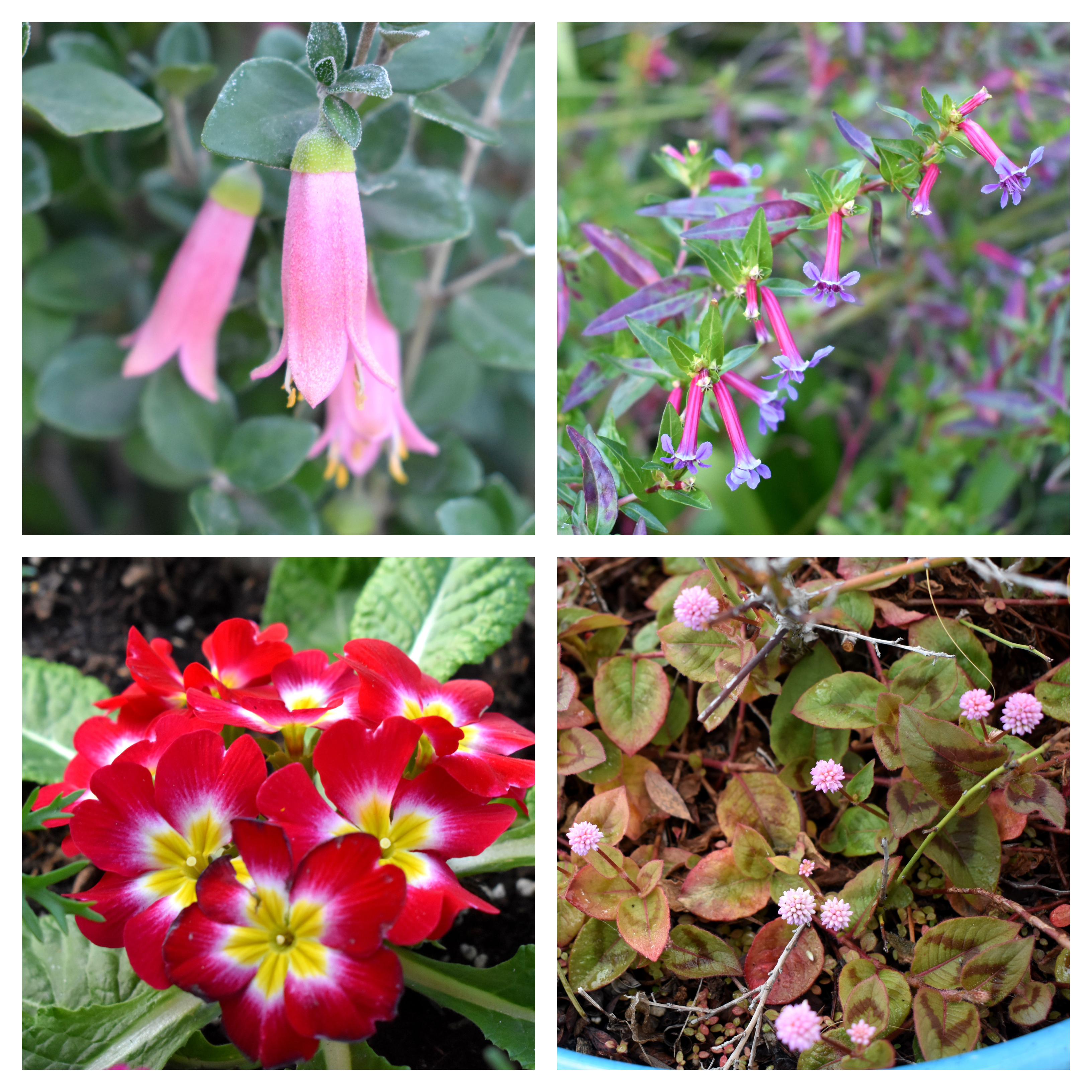
Clockwise from the upper left: Correa 'Dusky Bells', Cuphea 'Starfire Pink', Persicaria capitata, and Primula vulgaris


A check of my December 2021 and 2020 Bloom Day posts indicates that there are fewer flowers in my garden this year.  After three years of seriously low rainfall, that's to be expected.  This December also seems colder than those prior years, which may be slowing the bloom cycles of some plants.  The Aloes and Aeoniums are gearing up to put on show in January and hopefully other tardy bloomers will join in.


Visit Carol at May Dreams Gardens to find other Garden Bloggers' Bloom Day posts.


All material © 2012-2022 by Kris Peterson for Late to the Garden Party