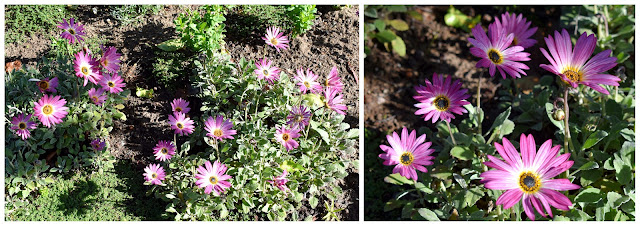
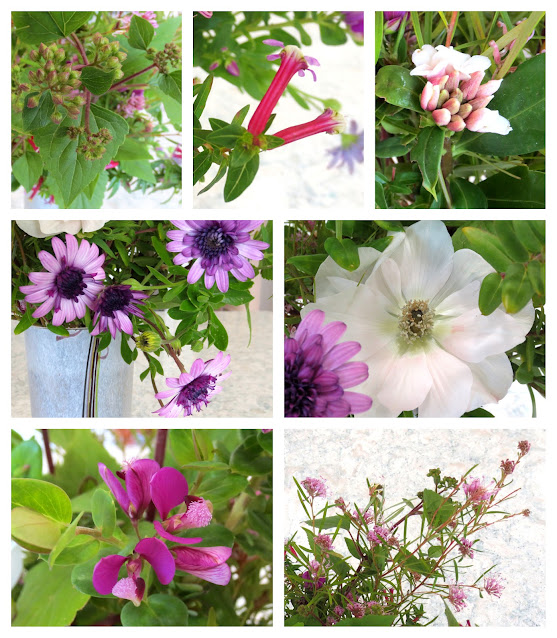
Showing posts with label Osteospermum. Show all posts

Monday, January 26, 2026

In a Vase on Monday: Change is in the air

A stretch of warmer weather earlier this month prompted the development of new blooms.  Even through temperatures dropped lower over the last few days (mid-60sF/18C), they're expected to climb again this week, at least for a time.  Meanwhile, last week's brush with rain delivered just one hundredth of an inch here.  There's currently no chance of rain showing in the ten day forecast but there's a moderately decent opportunity of some as we get closer to mid-February.  I remain hopeful that our brief rainy season, which started with such promise, won't bottom out early. 

The first of my Leucospermums is blooming but I didn't elect to use any of the stems this week.  However, I couldn't ignore Hippeastrum 'Amadeus Candy'.  I potted three bulbs in a single pot and two of the stems are now flowering with the bud of the third looking ready to open any day.

I had a surprisingly difficult time finding flowers to echo the bright pink of the petal tips.  Two Grevilleas with small flowers stepped up to help.  The white jasmine with pink buds was provided courtesy of a neighbor's plant that's currently spilling over my side of our fence.

I used more pink snapdragons this week to fill the back side of the vase

Overhead view

Clockwise from the upper left: Acacia cognata 'Cousin Itt', Antirrhinum majus (aka snapdragon), Grevillea rosmarinifolia, G. 'Scarlet Sprite', Hippeastrum 'Amadeus Candy', and Jasminum polyanthum


The 'Bordeaux' and 'Lord Lieutenant' Anemones continue to produce new blooms and two more varieties are slowly unfurling.  I used one of the newbies and 'Lord Lieutenant' in my second arrangement.

Anemone 'Mistral Azzurro' is one of the new bulb flowers to make an appearance.  It's looking paler than I recall when I previously grew it but perhaps I just cut the first 2 flowers prematurely.  Interestingly, I've learned that these Anemones, like tulips, continue to grow taller after they've been cut.

Back view

Overhead view

Clockwise from the upper left: Anemone coronaria 'Lord Lieutenant', A. c. 'Mistral Azzurro', Limonium perezii, Matthiola incanum (aka stock), Osteospermum 'Violet Ice', and Prostanthera ovalifolia 'Variegata'


For more IAVOM creations, check in with Cathy at Rambling in the Garden.


All material © 2012-2026 by Kris Peterson for Late to the Garden Party

Friday, April 12, 2024

African Daisies (A Bloom Day Prelude)

You may have noticed that I generally refer to plants by their botanical names.  Maybe that comes across as pretentious but I do it mainly because those names make the identity of plants clear, whereas common names often confuse matters, even if they're easier to remember and pronounce.   Common names often vary by location and thus may baffle people from different parts of the country or elsewhere in the world.  When I formerly conducted tours of the local botanic garden, the example I used to illustrate this point was Soleirolia soleirolii, a tongue-twister if there ever was one.  I know these plants by the common name of "baby tears" but people in the UK call them "mind-your-own-business."  I asked people on my tours what they would think if they asked someone what that delicate little creeping plant was and the response was "mind your own business."  However, the bigger issue is that many plants bear the same common name, although they may look very different and belong to entirely different genera.

"African daisies" are a prominent case in point.  This common name is used to refer to many plants including those in the genera Arctotis, Dimorphotheca, Gazania, Gerbera, and Osteospermum.  The only things most of them share is that they're native to Africa; they have petals surrounding a central disk; and they belong to the Asteraceae plant family.

Here are examples of those I currently have in my garden:

Arctotis

This is the Arctotis cultivar 'Large Marge'.  It's flowers are particularly big.  They're also even brighter than they appear in my photos - I've joked that they can probably be seen from space.

This is 'Opera Pink', which grows in partial shade in my garden.  All the Arctotis I've seen have grayish green foliage and their flowers have a flat eye at their centers.  I've seen no evidence that they self-seed but they can be propagated via cuttings.

This is 'Pink Sugar', which I've grown for over 10 years.  It and all the Arctotis shown above are hybrid cultivars, none of which are probably found growing as natives in Africa in these forms.  In my experience, all handle sun and heat relatively well.  


Gazania

I expect that most of the Gazanias in my garden are also hybrids.  Many of those I've planted started out as named cultivars but they self-seed freely in my warm climate and they don't always show up looking like their parents.  Those shown above may have originated from a cultivar called 'Golden Flame'.

Some of these may have started out from plants in the 'New Day' series, which is advertised as being particularly drought tolerant.  Like Arctotis, Gazanias can handle intense sun and moderately high temperatures.  Unfortunately, my rabbit visitors seem very fond of them.

This is a cultivar known as 'White Flame' from the Gazania 'Big Kiss' series.  Like Arctotis, Gazanias close their petals in low light, making them less useful as cut flowers; however, those in the 'Sunbathers' series produce ruffled centers that allow the petals to remain open in low light.  My 'Otomi' cultivar isn't blooming at present but you can see others in the 'Sunbathers' series in my 2015 post here.


Osteospermum

I grow more Osteospermums than any other of the so-called African daisies.  I'm especially fond of the varieties with ruffled centers.  Shown above are Osteospermums '4D Silver' and '4D Violet Ice'.

Clockwise from the upper left are Osteospermum '4D Pink', another of my favorites, what I think is 'Serenity Pink', followed by 2 other noID paler pink varieties.  The petals of the plant on the lower left look white in my photo but they're a very pale pink viewed in person.

Osteospermums '4D Sunburst' on the left and 'Double Moonglow' on the right

Osteospermums 'Serenity Bronze' on the left and 'Serenity Coral Magic' on the right, purchased years apart but they look very similar

The 2 Osteospermums on the left are 'Serenity Purple' and the one on the right is 'Purple Spoon'.  I love those with the spoon-shaped blooms but I've found most revert to more conventional petal shapes over time (or when they self-seed).

This self-seeded variety reminds me of Osteospermum 'Berry White'.  I failed to photograph 'Berry White' for comparison purposes but they share similar ruffled centers.  The self-seeded variety has larger blooms and the upper sides of the petals are white rather than pink but the undersides of the petals of both are brushed with bronze color.

The Osteospermum '4D White' on the left appeared in local garden centers just last year.  The simpler white forms shown in 2 different areas on the right are the most common in my garden.  All were self-seeded.

Osteospermums mingle comfortably with one another as shown above.  The plants in general are much more sensitive to heat than either Arctotis or Gazanias.  When temperatures soar, flower production effectively shuts down, only to recover as temperatures decline in late fall.  They're short-lived perennials in my climate but self-seeded plants often replace those that shut down completely.


I don't have any photos of Dimorphotheca or Gerberas to share.  Dimorphotheca flowers look virtually identical to those of Osteospermums to my eyes but the former are annuals whereas Osteospermums are perennials in climates like mine.  Given the frequency with which botanists are reclassifying plants, I'm frankly surprised they haven't been lumped into the same genus.  As to Gerberas, I'm terrible at keeping them alive.  In my experience, they require more water than any of those I'm featured above.

Another thing that annoys me about the frequency with which all these plants are lumped together without distinction under the common name of "African Daisies" is that there's at least one other daisy-flowered African native I can think of that's seemingly never included in that category.


Felicia

The common names for Felicia aethiopica include "blue daisy" and "wild aster".  The specific epithet "aethiopica" actually means "from Africa."  In my garden it blooms year-round if regularly deadheaded.  Like the daisies described above it's relatively drought tolerant.  It's also in the Asteraceae plant family.


Garden Bloggers' Bloom Day officially falls on Monday, April 15th, but I've already collected a record number of photos from my garden.  The heavier-than-normal rain we've had, recently followed by temperatures in the 70s to low 80sF, has led to a floral explosion.  This post carves the "African Daisies" out of that post and I'm considering other ways to pare down the content of my Bloom Day post, which I don't expect to publish until Wednesday, April 17th.


P.S. By coincidence, prior to finalizing this post, I visited a local garden center yesterday and overheard a woman asking a nursery person for a "pincushion succulent."  When the staffer replied that they didn't carry such a plant I interjected that she might mean a Leucospermum, plants that have flowers described as "pincushions" that are drought tolerant although not classified as succulents.  I pulled up "pincushion plants" on my phone, which showed a Scabiosa (commonly known as "pincushion flower"), followed by a Leucospermum (commonly known as a "pincushion shrub").  She identified the Leucospermum as the plant she was referring to.  I pointed her in the direction of those plants in the garden center and identified another local garden center that also usually has a good supply of the plants.  On my way out, I told the nursery person how things had worked out and she told me that she links "pincushion flowers" to Scabiosas, not Leucospermums and therefore didn't make the connection.


All material © 2012-2024 by Kris Peterson for Late to the Garden Party

Monday, April 8, 2024

In a Vase on Monday: Spring spectacle

I can't help myself.  I've keep cutting flowers for the house.  It doesn't noticeably diminish the flowers in the garden because they keep coming, thanks to the relatively bountiful rainfall we've had.  Our total rain thus far this water year currently stands at 18.53 inches, which is considerably more than the average of 14.25 inches, and there are over five months left before the water year is over.*  Although our rainy season usually comes to an end by mid-April, climate scientists contend that it may continue into May this year.

My first arrangement this week was inspired by the the bearded Irises in bud at the bottom of my back slope.  However, they didn't open on the schedule I'd anticipated so I took another tact.  I cut a few stems of the fragrant Abelia 'Chiapas' growing nearby and sought companions to complement it elsewhere in my garden.

In lieu of the dark purple bearded Irises, I cut the nearly black Dutch Iris known as 'Eye of the Tiger'.  I added two of the last 'Pink Panther' Irises to provide a contrast.

Back view: I used stems of the Abelia 'Chiapas' (syn. Vesalea floribunda, aka Mexican Abelia) and Polygala myrtifolia (aka sweet pea bush) as filler material.  The Abelia, purchased from Annie's Annuals & Perennials years ago, has a delicious scent.

Top view

Clockwise from the upper left: Abelia 'Chiapas', Osteospermum '4D Pink', O. 'Violet Ice', Iris hollandica 'Eye of the Tiger', Phlomis fruticosa, Polygala myrtifolia, and Iris hollandica 'Pink Panther'


I checked the bearded Iris again late Sunday afternoon but the buds still weren't fully open.

I expect they'll be well past their prime by next Monday


It's impossible to ignore the Leucospermum blooms in my garden at the moments so I cut several of those stems for a second arrangement.

I kept flip-flopping between this side and the one shown below to serve as the "front" of the arrangement.  The Erysimum 'Winter Orchid' used as a "spiller" here finally sealed the deal.

The other side of the vase featured 2 varieties of snapdragons

Top view

Clockwise from the upper left: Antirrhinum majus 'Chantilly Peach', noID Antirrhimum, Erysimum 'Winter Orchid, Leucospermum 'Royal Hawaiian Brandi', Narcissus 'Geranium', Xylosma congestum, Zantedeschia aethopica, and Leucospermum 'Sunrise'


I also cut flowers for a small vase during the middle of last week, then refreshed it on Sunday.  In addition, not able to bring myself to dump all the contents of one of last week's arrangements, I rejiggered it using what was still fresh.

The tiny vase on the left contains Anemone coronaria 'Rosa Tigrato', A. c. 'Mount Everest', Alstroemeria 'Inca Lucky', and Cuphea 'Honeybells'.  The Anemones appear to be headed toward their seasonal exit.  The arrangement of leftovers on the right includes last week's Helleborus 'Anna's Red', noID Alstromeria, Argyranthemum 'Grandaisy Dark Pink', and Heuchera maxima.  The revamped arrangement shows off the form of the clasped hands vase nicely.


For more IAVOM creations, visit Cathy at Rambling in the Garden.


*Approaches to recordkeeping with respect to rainfall vary.  The US National Weather Service tabulates rainfall by "water year," measured from October 1st through September 30th of the following calendar year and the current average figure of 14.25 inches is calculated based on water year totals over the 30 year period from 1991-2022.  In contrast "seasonal" rainfall for downtown Los Angeles is calculated from July 1 through June 30 of the following year over a span of years from 1887-2022.  The resulting average in that case is 14.75 inches.


All material © 2012-2024 by Kris Peterson for Late to the Garden Party

Monday, February 19, 2024

In a Vase on Monday: Rhapsody in blue

Ominous rain forecasts followed us all weekend but both Saturday and Sunday were relatively sunny, if not exactly warm.  The onset of rain was pushed back several times but Monday will almost certainly see some and, unless the forecasters are really off their game, Tuesday will see more.  The front page of the Los Angeles Times on Sunday featured a front page article on my area's long-running issue with a slow-ball landslide that started in 1956 and continues to this day.  The affected area is about five miles from us but it's a cautionary tale.  Last July, just ten miles away, a nearby city on our peninsula lost a dozen homes built in the 1970s to a slide that dropped eight of them forty-five feet down into a canyon in only hours.  Although that slide occurred months after the end of our rainy season, the higher rainfall we had was identified as the principal cause.  A geological survey we'd done in 2019 indicates that our seventy-plus year old house is on bedrock so we hope we're okay whatever comes with these atmospheric rivers.

Blue seemed the appropriate color to accompany the rain and, once I looked around a bit, I found more in that color than I'd anticipated.

My blue Anemones took center stage but I also turned up some white flowers, including scented Freesias

Back view: I used stems of a noID Ceanothus as filler material, along with a handful of early sweet pea blooms

Top view

Clockwise from the upper left: Felicia aethiopica, white Freesia, Lathyrus odoratus (maybe from 'Mermaid's Dream' mix), Anemone coronaria, Osteospermum '4D Silver', Teucrium fruticans 'Azureum', and noID Ceanothus


Here's a musical accompaniment, a short version of 'Rhapsody in Blue' from Warner Brothers (circa 1945), should you wish to listen to it as you finish reading this post.


I've been planning to cut stems of Grevillea sericea for some time but was at a loss as to what I could use to complement its small, delicate flowers.  Inspiration was found in the flowers of the sweet pea bush and my second arrangement came together better than I'd hoped, although I suspect the arrangement looks better up close than in photos.

A noID Anemone planted years ago appeared in my cutting garden with a white bloom bearing just a faint hint of pink, its name now lost.  The pinky-purple Osteospermum flowers stole the show from both the Anemone and the Grevillea flowers.

Back view

Top view: I added stems of what I think is an Ageratum of some kind, although I have no record of planting it and it grows far taller than A. houstonianum, the species commonly grown here.  It also acts like a shrub, not an annual.  It produces white floss-like flowers.  The stems I cut have buds but aren't yet in bloom.  I doubt they'll flower in a vase but I thought their buds were attractive enough to use as a filler.

Clockwise from the upper left: noID Ageratum, Cuphea 'Starfire Pink', Daphne odora, noID Anemone coronaria, Grevillea sericea, Polygala myrtifolia, and Osteospermum '4D Pink'


My husband and I celebrated our anniversary over the weekend.  He made one of my favorite meals for dinner and brought me an orchid so the kitchen island has its requisite decoration.

The pot contains 2 Phalaenopsis and a clump of Dracaena marginata


For more IAVOM creations, visit Cathy at Rambling in the Garden who runs the weekly show.


All material © 2012-2024 by Kris Peterson for Late to the Garden Party


Monday, July 3, 2023

In a Vase on Monday: Red, white - and blue

In honor of Independence Day tomorrow, I'd intended to create a red, white and blue arrangement but the reds I have on hand are limited and they didn't mix well with the blues I'd selected so instead I have a red and white arrangement and a separate blue and white arrangement.

Daucus carota 'Dara' was the inspiration for this arrangement but Lilium 'Pretty Woman' assumed center stage

Back view: Unfortunately the small white flowers of Leptospermum 'Copper Glow' were almost lost in the arrangement

Top view

Clockwise from the upper left: Argyranthemum 'Grandaisy Red', Coprosma repens 'Plum Hussey', Leptospermum 'Copper Glow', Daucus carota 'Dara', and Lilium 'Pretty Woman'


I spent a lot of time dithering with the blue arrangement, although Agapanthus remained the primary element from the outset.

Like a lot of flowers in my garden, the Agapanthus were slower to get started this year but they're currently coming on like gangbusters

Back view: I included cuttings of the twisty mystery vine I discovered in my cutting garden to add some interest.  The stems of Salvia 'Winnifred Gilman' I added were largely lost among the Agapanthus but they do add scent.

Top view

Clockwise from the upper left: Digitalis purpurea 'Dalmatian White', Osteospermum 'Violet Ice', Prunus ilicifolia, noID blue Agapanthus, Salvia clevelandii 'Winnifred Gilman', noID vine, and noID white Agapanthus


Our marine layer is still intact but it's been clearing between 10am and 11am each day so our afternoon temperatures have crept up. 

I took this photo Saturday morning but the view was the same on Sunday morning.  Our temperature reached a high of 84F/29C on Saturday but it didn't climb above 80F/26C on Sunday.  However, our humidity levels remained significantly higher than usual both days.


For more IAVOM creations, visit our host, Cathy at Rambling in the Garden.  For those of your celebrating Independence Day, best wishes for a happy and safe holiday!  Avoid the noise, air and water pollution caused by outdated firework displays and the heightened risk of wildfires that accompany them and try out the new drone-driven light shows if you have that option.  It frankly sounds - and smells - like a war zone in my area on the 4th of July.  The Los Angeles Regional Water Control Board recently nixed the professional firework displays along a large stretch of our south coast due to the plastic pollution that ends up in the ocean.  Amateur displays of even the so-called "safe and sane" fireworks are illegal in my high fire-risk area but that hasn't stopped the fireworks we've been hearing regularly for more than two weeks leading up to the holiday, despite the exposure to hefty fines.


All material © 2012-2023 by Kris Peterson for Late to the Garden Party