Showing posts with label Hesperaloe parviflora. Show all posts

Tuesday, July 23, 2019

Tell the Truth Tuesday (Late Edition): Ladybugs needed

I was pleased when two of my Hesperaloe parviflora produced bloom spikes this year.  They weren't nearly as floriferous as those I saw in Austin, Texas last year but I felt my small collection of plants was headed in the right direction.

I took this photo of the Hesperaloe blooms in late June

The flowers still looked fine when I took photos for Garden Bloggers' Bloom Day in mid-July


Then this week I noticed that the smaller bloom spike didn't look right.

I took this photo yesterday.  Notice the bloom spike on the left.


From a distance, the flower spike on this plant seemed to have turned gray

But it was actually covered in tiny green sap-sucking beasties


Within little more than a week, when I wasn't looking, the aphids covered the entire flower spike.  It seems that the warmer weather brought them out.  I dealt with smaller infestations on the Gaura in my front garden in early spring but it was nothing like this.  I cut the entire spike and deposited it in the trash, then doused the Hesperaloes with insecticidal soap.  At present, the flower spikes on the adjacent plant don't appear to have any bugs at all.

After I'd cleaned up the aphid problem (at least for the moment), I noticed a nearby bed was in need of grooming.  It too had looked great in June.

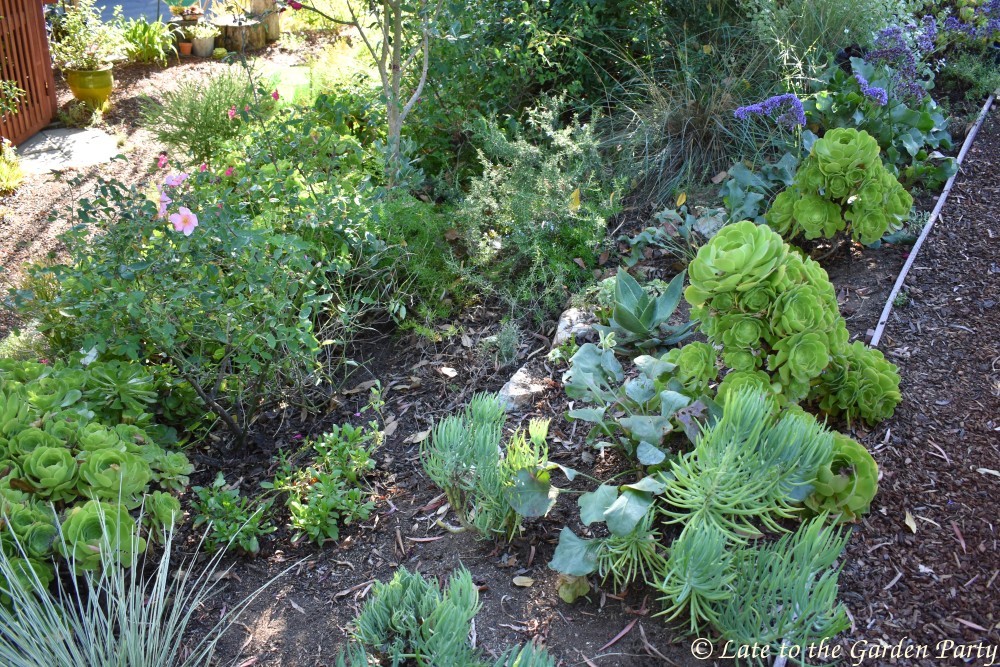
Succulents comfortably mingled with purple-flowered Limonium perezii (aka sea lavender) here


As the Limonium started to fade I cut out the flower stems that no longer looked good.  One thing led to another and, after pulling some of rattier Limoniums, I cut back an overly exuberant trailing Osteospermum, rampant stems of asparagus fern (an inherited weed here), and some sickly pale stems of Senecio vitalis, revealing other plants I'd entirely forgotten about.

My clean-up is by no means complete but my knee can only handle so much time working on even a moderate slope like this one

I planted this Aloe striata x maculata early last year, along with Aeonium cuttings, then lost track of it entirely when it was engulfed by the Limonium.  There's another variegated succulent  just beyond it I haven't even identified yet. 


More clean-up - and perhaps a new planting vision - is needed to whip this area into shape, but that's a project for a cooler day.  The heat seems to have caught up with us at last.

Tell the Truth Tuesday is hosted on a periodic basis by Alison at Bonnie Lassie to keep things real by showing the less-than-Instagram-perfect features of our gardens.   Is your garden harboring any nasty bugs or hiding any lost treasures?  Do tell.


All material © 2012-2019 by Kris Peterson for Late to the Garden Party


Wednesday, June 26, 2019

Succulent Stars

I've been spending a lot of time in my garden, partly to escape the pandemonium associated with our remodel, but also in an effort to manage the garden's explosive growth following the best stretch of rain and moderate temperatures we've had in a long time.  I could probably spend several hours a day for a solid month just cutting back Erigeron karvinskianus and even then might have to start all over again with a fresh round of haircuts as soon as I finished.  I've also spent gobs of time deadheading flowering plants, pulling weeds, and cleaning out ripened bulb foliage.  In the midst of the last exercise, I took time to admire my sleek and always tidy succulents.

This is Aloe labworana, native to Uganda.  I picked it up last August because I loved its wavy shape.  Once I cut back the dead daffodil foliage surrounding it and uncovered the Echium debris that had nearly covered it, I noticed that it'd taken on a pretty red tinge.

This Yucca gloriosa 'Variegata' had been nearly smothered by Erigeron karvinskianus (aka Santa Barbara daisy) and was partially hidden behind a tall mass of Gaura lindheimeri.  I purchased the plant in a 4-inch pot about 18 months ago and it's still relatively small but someday it'll be big enough to hold its own in that spot against all comers.

This Agave is sold under a variety of names but now is commonly known as Agave mitis 'Multicolor'.  This is the largest of the 3 I have, given to me as a birthday gift 3 years ago.  It's beefed up dramatically in the past year, presumably in response to the extra rain we received this past winter. 

There are several nice 'Blue Glow' and 'Blue Flame' Agaves here but what dials this vignette up a notch is the mass of Crassula pubescens ssp radicans in full bloom among the Agaves.  The smaller succulent's red foliage nicely echoes the red edges of the 'Blue Glow' Agaves most of the year but the cream-colored flowers light up the bed in early summer.

The same grouping from another angle.  Please ignore the crabgrass I missed during my clean-up.


Some succulents have joined the floral parade.

My Hesperaloe parviflora aren't as exuberant as the plants I saw at last year's Garden Bloggers' Fling in Austin, Texas but I'm pleased with the statement they make here and I'm hopeful that, in time, my 3 plants will form large clumps.

I fell in love with Oscularia deltoides (aka Lampranthus deltoides) several years ago based on its foliage alone.  Its red stems are covered in icy blue-green leaves.  Like many succulents, it's easily grown here simply by sticking a cutting in soil.  This one is happy trailing down a low stacked stone wall in partial shade.  I have others growing in full sun but in my location they look best with some afternoon shade.

The bloom spikes on the 2 Agave desmettiana growing in my street-side bed formed in October.  The plants were in full bloom in March.  It appears that bulbils are finally forming, although thus far most are well above my head and therefore hard to photograph.  Meanwhile the mother plants' foliage has taken on a pretty reddish color.

The 3 Agave desmettiana 'Variegata' growing on the slope here are also progeny of the 2 plants currently in bloom.  I planted 5 pups in this area (not all visible in this photo) several years ago when I put the original plants in the street-side bed.  They also got a major boost from our winter rains.


Blooms are a mixed bag when the blooming plant is monocarpic, as most Agaves are.  But, if the Agave desmettiana produce a host of baby plants, that'll take the sting out of the loss of the 2 large specimens.  I only hope the bulbils develop fully before those 2 bloom stalks fall into the street.


All material © 2012-2019 by Kris Peterson for Late to the Garden Party

Tuesday, September 23, 2014

Planting Bed Facelift #2

My first planting bed facelift involved the bed formerly occupied by an unused wood-fired spa.  Last week, I tackled my second facelift, the bed once occupied by a 60 foot Eucalyptus tree.  I replanted the area in March 2013 after the tree was removed at the request of a neighbor.  It looked fine for a short while but the combination of dry soil (made worse, not better by the addition of the woody remains of the Eucalyptus tree), high winds, drought, nightly digging operations by the neighborhood raccoons, and poor plant selections left it looking sad.  The wood chips and shavings left after grinding down the tree stump had formed clumps with the consistency of dry cardboard and didn't hold water well.  I cleared as much of the remnants of that debris as I could and added lots of soil amendment before replanting.  My fingers are crossed that the new plants will fare better than the bed's previous occupants did.

View of replanted bed looking west

View of the same bed from the side yard patio


Two of the 3 original Coprosma 'Plum Hussey' remain in place along the bed's outer edge.  The third, which was struggling to survive, was removed and replaced with a smaller plant of the same variety, moved from the side yard border.

The 2 original Coprosma 'Plum Hussey' bordered by Pelargonium tomentosum (peppermint geranium)

The smaller Coprosma, moved from a shadier bed, hasn't developed 'Plum Hussey's' striking red color yet


Grevillea 'Bonfire' replaced the sad Acer palmatum 'Purple Ghost,' which couldn't hold up to the winds that whip through this area most afternoons.  The Japanese maple was moved to the vegetable garden, where I hope it has a chance to survive.

Newly planted Grevillea 'Bonfire'


Four Agave 'Blue Glow' and one Hesperaloe parviflora were installed both for their looks and the possibility that their prickly leaves will deter the raccoons from digging in the area in their relentless search for grubs.

Agave 'Blue Glow,' still relatively small

Hesperaloe parviflora (aka red yucca)


To complement the gray-foliage of the Hesperaloe, I added Festuca 'Elijah Blue,' tiny cuttings of succulent Senecio mandraliscae, and pink-flowering Cistus x scanbergii.

Cistus x skanbergii


We raised the height of the wall that borders one length of the bed to reduce its slope and support the additional soil amendments I added.  I replaced the mass of gray Helichrysum petiolare that previously occupied that space with 5 Pennisetum setaceum 'Fireworks' and 2 varieties of Rhipsalis.  The Helichrysum did well in the location but it wasn't particularly interesting.

Pennisetum setaceum 'Fireworks' is reputed to be smaller than the standard variety

Five plants line the top of the wall

This was labeled 'mistletoe cactus' - my best guess is that it's Rhipsalis baccifera aka spaghetti cactus

This one was labeled Rhipsalis salicornioides, aka dancing bones cactus


I moved 3 Hemerocallis 'Spanish Harlem' here from the front yard borders to pick up the red tones of the Coprosma and the Pennisetum.  There's less late afternoon sun in this bed but I hope it will be sufficient to keep 'Spanish Harlem' blooming as I love this daylily's flowers.

These evergreen daylilies are a little sad at the moment as I cut them back prior to transplanting 

Here's a reminder of what 'Spanish Harlem' looked like in full bloom


Unfortunately, the Agaves are still small and aren't yet up to the challenge of keeping the raccoons at bay.  The little monsters dug up a few of the smaller plants and pawed around the base of the Grevillea.  I've put down more animal repellent and temporarily caged the Grevillea for its own protection until it's well-rooted in its new location.

Grevillea wearing a tomato cage


Work continues on the denuded front lawn area, as well as a small bed dug out of the lawn in the backyard.  My lawn removers left a lot of grass roots behind, as well as much of that nasty plastic netting embedded in the sod laid by the former owners.  My husband and I are in the process of clearing out what we can before hauling in supplemental topsoil and soil amendments.  It may be quite some time before I'm ready to plant the front area but, impatient as I am, those grass roots need to go and the soil, pure clay in one area and nothing more than decomposing rock in another, needs work.


All material © 2012-2014 by Kris Peterson for Late to the Garden Party