Showing posts with label favorite plants. Show all posts

Wednesday, August 22, 2018

Top 10 Blooms in my Mid-Summer Garden

I'm joining Chloris at The Blooming Garden in featuring my top 10 blooms this August.  August isn't a month I usually associate with flowers but, as mentioned in my earlier Garden Bloggers' Bloom Day post, judicious applications of extra water this year have had a major input on the floral output.  We haven't received our August water bill so I'm not yet feeling as terribly guilty as I'm afraid I may feel soon.

Winnowing down the flowers in my garden to 10 selections wasn't easy.  The sheer volume of bloom was a major factor in my choices.  The current condition of the flowers was another, as was their photogenic qualities, but ultimately it's an emotional decision.

Rosa 'Medallion' was an easy choice because it surprised me by making its first appearance of the year by blooming en masse.  Roses here usually bloom best in spring before our temperatures soar, if they bloom at all.  I had very few rose blooms last year and even fewer this spring after the lowest winter rain levels I've ever measured.

I inherited 2 'Medallion' rose shrubs with the garden.  Of the paltry number of rose bushes I have, these had once been the most reliable spring bloomers but they didn't bloom at all this spring and they lost all of their foliage to a combination of rust and the nuclear heat that hit in early July.  They leafed out again after repeated deep watering sessions but I hadn't really expected them to bloom in mid-summer even after I saw a few buds forming.  Then I came home from a trip last weekend to find this!  This may not be a lot of roses for some of you but it's a mass of bloom in my garden.


Heteromeles arbutifolia was another surprise.  If this tree-sized shrub was blooming a week ago, I hadn't noticed it but now the blooms can't be missed.

The common name for this plant is Toyon.  It's been selected as the official native plant for the city of Los Angeles.  This one balances atop a steep slope on our property's boundary line and I estimate it's 15 feet tall.  The flowers will be followed by a plentiful supply of red berries.  The berries, although toxic for humans, are consumed by mockingbirds, robins, and cedar waxwings, as well as coyotes.


My dahlias were another obvious choice as a favorite but which one can be said to rule my cutting garden is another question altogether.  Each and every one deserves recognition.  Could you pick just one?

'Loverboy' (upper left) is flashy semi-cactus variety.  'Otto's Thrill' (upper right), a dinnerplate variety, has been the most prolific bloomer thus far, although it's quickly being overtaken by the smaller, semi-cactus 'Terracotta' (lower left).  Dinnerplate 'Strawberry Ice' (lower right) is new on the scene.

But it's 'Punkin Spice' that keeps drawing my eye.  I don't remember that it impressed me as much last year but this year every bloom is a glowing orb.  It's classified as an informal decorative type but the flowers are as large (or larger) than any in the dinnerplate class.


The zinnias in the cutting garden also came on with a bang this month but there is one, grown from seed rather than plugs from the local garden center, that impresses me every time I see it.

This is Zinnia elegans 'Benary's Giant Giant Salmon Rose'.  Each bloom is perfect.


Have I forgotten my Lisianthus (Eustoma grandiflorum) you might ask?  Of course not but, like choosing a favorite dahlia, the Eustomas that draw my eye shift from one week to another.

A week ago, it was the delicate green-flowered variety (left) that won my heart.  A new variety, 'Mint Cocoa' (right) has been a favorite with commentators and I admit I'm impressed by how well it's performed this year.  My biggest issue with it is that its unusual color doesn't mix well with most of the flowers surrounding it.  I'll need to find a better placement for it next year.

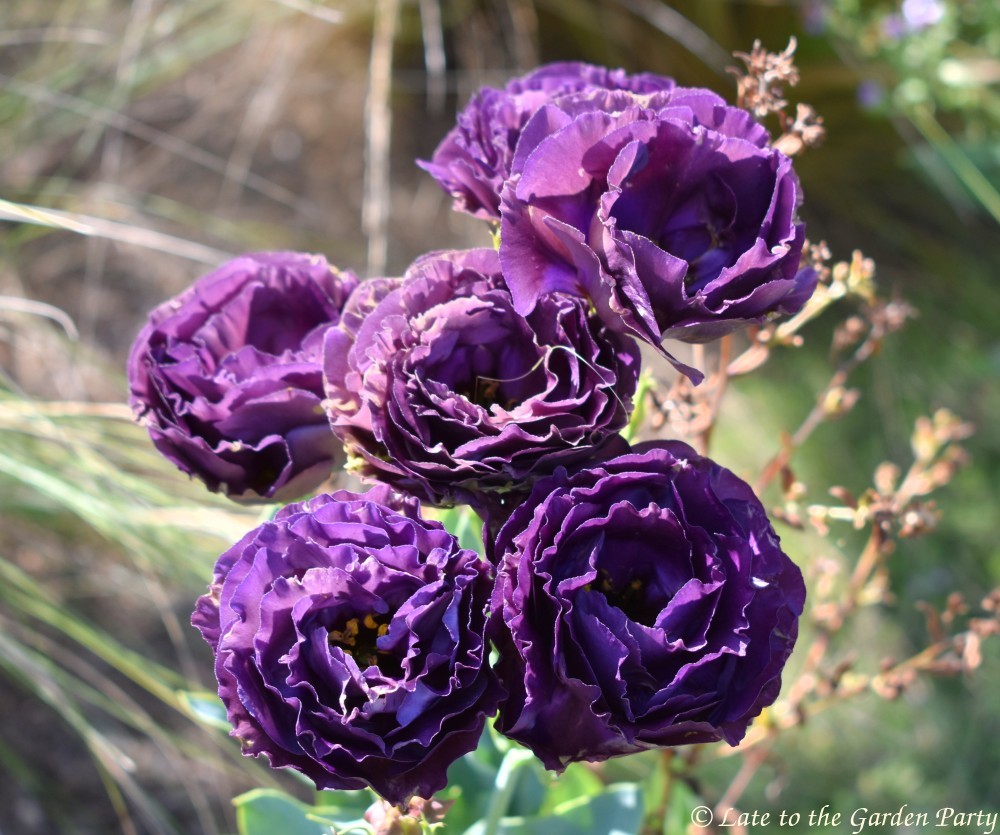
Eustoma grandiflorum 'Black Pearl' wins my thumb's up for late August.  It's blooming on last year's plants.  Last year I found its performance disappointing but it's a happier plant in its second year.  The flowers are tighter and more heavily petaled than most of the other varieties of Eustoma growing in my garden.  Its shape and growth habit closely resemble that of 'Mint Cocoa'.


A number of more common flowering plants make up the rest of my mid-summer bloom list.

This is the native California aster, Symphyotrichum chilense.  I put in 2 plants in 2015 but, if you looked at the bed it's growing in, you might think there were a half dozen or more plants there.  It spreads by rhizomes and is a little more exuberant than I'd expected but it's the only aster I've ever considered a success here.

Plumbago is VERY common here.  From my home office window, I can see a large mass of it in bloom across the canyon.  It's blooming up the street and I see masses of the blue flowers along the road every time I leave my neighborhood.  My plants, Plumbago auriculata 'Imperial Blue', are better behaved in large pots outside my lath (shade) house.  

Lantana 'Samantha' is having a banner year.  I love the cheerful yellow flowers but the variegated foliage is its main attraction.  It makes me think of Ceanothus 'Diamond Heights', a plant I've killed at least 3 times, but in contrast this Lantana is easy to grow and happy here.

Gaillardia 'Fanfare Citronella' in the same bed as the Lantana is another current favorite.  While the flower stems are annoyingly short, the flowers are prolific and of course loved by bees.

I've got as many as a half dozen varieties of Abelia in my garden, all of which I love, but at the moment this older variety, Abelia grandiflora 'Edward Goucher' is what's grabbing my attention.  The 2 large shrubs came with the garden and, unlike the varieties I've introduced, there's no variegation in the foliage of these but they do pump out the blooms!  I cut the 2 shrubs back hard in late winter and I've been rewarded this year with lots of long flowering stems.  When the flowers drop, they leave behind reddish bracts just as pretty as the flowers themselves.


Could you distill the bloomers in your garden down to just 10 plants?  Visit Chloris to find her list.


All material © 2012-2018 by Kris Peterson for Late to the Garden Party

Thursday, June 28, 2018

June's Top 10 Blooms

Chloris at The Blooming Garden hosts a monthly recap of the top 10 blooms selected by gardeners each month.  I'm joining this month with my own list.  While my Bloom Day posts are free-for-alls that cram together virtually everything I find in flower, the top 10 exercise requires more thought and, better perhaps for readers of my blog, much less to digest.  The exercise of distilling my list down to 10 plants was surprisingly difficult, at least at this time of year.  What is the basis for selecting such favorites?  Do I apply that rationale consistently?  Should I rule out plants that bloom all or most of the year to focus only on plants that peak during the month in question?  Am I over-thinking this?  The answer to the last question is "probably."

I often over-analyze things; however, in this case, I found that the blooms that are the most profuse in my garden generally rose to the top of my list, followed by flashy plants that put on a limited show.  Then, once I ruled out plants that I'd previously listed as favorites this year, plants that are new and haven't yet proven their value, and plants that are only just starting their bloom cycle, I was able to settle on my top 10.

Agapanthus was an easy choice.  It's blooming en masse this month.

The plants and their flowers are often dismissed as common here because you see them everywhere but that's because they're tough, attractive in and out of bloom, and fairly drought resistant

These 2 large masses consisting of multiple clumps of Agapanthus are located in my front garden.  There are similar masses in other areas of the front and back gardens.

All my Agapanthus came with the garden, although I've dug up, divided and moved some clumps over the course of our time here.  This group sits under the mimosa tree in the back garden.


Arthropodium cirratum (aka Renga Lily) is also blooming in spots throughout my garden.

This is a plant I introduced in this garden.  I purchased 3 plants by mail order from Annie's Annuals & Perennials our first year here and I've divided them several times already.  I've spread them throughout the garden.  They bloom best when given morning sun and afternoon shade.


Another profuse bloomer is Crassula pubescens ssp radicans.

This Crassula with its tiny yellow flowers is another one I've spread throughout my garden but the flowers show up best against the larger agaves in this area


My choice of Cuphea 'Vermillionaire' surprised me a bit but, after doing little or nothing last year, it's come into its own this summer.

It looks best when backlit.  Between the Cuphea and the Grevillea 'Superb' (right) the hummingbirds are in heaven here.


Gazanias Gaillardias are one of the flowers with an exceptionally long bloom period in my garden, although unlike some of my Grevilleas they don't actually bloom all year.  However, 'Arizona Sun' is at its best this time of year.

I've used 'Arizona Sun' in a number of areas as it nicely echoes the reds, oranges and yellows in many of my beds

This clump is in the front garden.  Even though this photo was taken at dusk, 'Arizona Sun' still shines.


Gaura lindheimeri also has a long bloom period.  In addition, its delicate bloom stalks blow in the wind, adding movement in the garden.

Gaura is admittedly a rampant self-seeder but, if you're watchful, you can pull up the seedlings easily when they're small


Perhaps you noticed the flowers of Hemerocallis 'Spanish Harlem' in the photo of the Gaura above.  That photo was taken in the late afternoon after a day of intense sun and the flowers look more washed out that they appeared earlier in the day.

'Spanish Harlem' was one of the first daylilies I introduced to this garden.  It's flowered well this year despite our pitifully low winter rainfall.  It also hasn't had the rust issues I've noticed in prior years.

No one can claim that this bloom looks washed out!


Leucanthemum x superbum (aka Shasta Daisies) are common in gardens all across the country but I love the ruffled form that grows in my garden.  A friend gifted me with 6 plants in 4-inch pots following my mother's death in 2013.  They come back more strongly every year.

If the plants came with a tag identifying the cultivar, I've no record of it.  This mass of blooms is in my back garden.

And this is one of several in my front garden


My next choice, Polygala, almost didn't make the cut for this list because it doesn't photograph well, or, more accurately, I never managed to capture it well.  Still, I notice it every time I walk through both the front and back gardens so it deserves a place on the list.

This is a smaller variety, Polygala fruticosa 'Petite Butterfly'.  It's self-seeded a bit in my front garden.

This taller variety is Polygala myrtifolia 'Mariposa'.  The flowers are identical to those of 'Petite Butterfly'.  Only the plant's mature size seems to be different.  These in the back garden get more sun and the foliage tends to yellow a bit.


My last selection, Salvia clevelandii 'Winnifred Gilman', also didn't show up especially well in its photos but its flowers are a bright blue so I'll forgive it just about anything.

This Salvia has been in the ground just 2 years and it's still well shy of its projected mature size


That's my top 10 list of blooms.  What's on yours?  To see others, visit Chloris at The Blooming Garden.


All material © 2012-2018 by Kris Peterson for Late to the Garden Party

Wednesday, May 30, 2018

May: Glory Days in the Garden

March, April and May are the very best months in my garden; however, March is usually the month that I experience my twirl-in-the-garden reaction to the wonders of Spring.  I didn't feel that moment in March this year, nor April either.  That may have been a reaction to the pathetically low rainfall we received during our winter rainy season and apprehension about what the summer would bring.   Flowers bloomed but less profusely than last year and prior years in general.  Fruit trees failed to produce buds.  The mimosa tree (Albizia julibrissin) has failed to leaf out at all and shows all the signs of infestation by the shot hole borer killing trees throughout Southern California.  The mimosa tree still looks like a goner but a long, nearly continuous stretch of "May Gray" weather has provided relief.  The drizzle that's accompanied it on some days even racked up a total of 8/100ths of an inch of precipitation in this location, 3/100ths of that this morning alone.  That's admittedly not a lot but, when your annual rain total (for the rain year beginning October 1, 2017) stands at 3.78 inches, it's appreciated nonetheless.  So mid-May finally brought that feeling of utter joy I associate with Spring.  I'm celebrating it by sharing a few wide shots of my garden and belatedly joining Chloris of The Blooming Garden in sharing my top 10 blooms for the month of May.

Since I returned from the Austin Garden Bloggers' Fling in early May, there have been only 2 truly sunny days.  This photo of the back garden taken last Friday morning facing the entrance to the Los Angeles Harbor was one of them.  Most days, we get at least a couple of hours of clearing by late afternoon but we've occasionally been socked in all day.


This is the view of the back garden looking north from the main patio area.

Two of my favorite May bloomers, both members of the Protea family, are visible here

The first is Leucadendron 'Pisa'.  Its "flowers" are actually bracts surrounding cones.  They literally glow against the tree-like shrub's silvery foliage.

The blooms of Leucospermum 'Royal Hawaiian Brandi' are still relatively sparse but as this is the first year the plant has bloomed since I planted it in March 2016, I'm thrilled


The views of the back garden looking south reveal other favorites.

The moderate gloom on the morning I took this photo was generally great for photographs, although the yellow flowers of Achillea 'Moonshine' blend in with the foliage of Coleonema pulchellum 'Sunset Gold' here

The Achillea shows up better in this photo, taken early yesterday evening


Favorite flowering plants in this area include the following:

Achillea 'Moonshine' lights up the back border in late Spring/early Summer and balances the blue of the Agapanthus, which are just now beginning their bloom cycle

A few Alstroemeria are still blooming but 'Indian Summer' is the most vibrant.  I draws my eye even when I'm inside the house.  Its dark foliage gives is extra zing.

I had the devil of a time time reducing my favorite blooming plants to 10 but Ozothamnus diomifolius (aka rice flower) made the cut.  It looked terrible last year and I debated pulling it out entirely before cutting it back dramatically.  It's made a great comeback.


The front garden is also looking lush.

Leptospermum 'Copper Glow' is living up to its name right now, showing off nicely against the chartreuse foliage scattered about


Dorycnium hirsutum (aka Hairy Canary Clover) is doing a nice job as a ground cover along the edge of the driveway.

Hairy Canary Clover is attractive in and out of bloom.  The flowers are drawing bees now.  The plant self-seeds but it isn't a pest and I've used it widely throughout the garden in areas that are particularly dry.

Looking southward at the front garden from a different angle brings another of this month's favorite blooming plants into view.

The flower spires of Echium candicans 'Star of Madeira'  are just visible behind Leptospermum 'Copper Glow' on the right

Variegated 'Star of Madeira' is blooming about one month later this year than it did last year and well behind Echium webbii in the back garden.  Luckily for the bees, as the flowers on the latter shrub fade, they've been able to move to the fresh flowers on 'Star of Madeira'.


From the south end of the front garden looking north back toward the driveway, you can see not only the Echium but also one of my favorite Pelargoniums.

Pelargonium 'Oldbury Duet' is scattered to the left of the path

'Oldbury Duet' is flowering especially well this year.  In contrast, Eustoma grandiflorum (Lisianthus), also shown in this photo, seem reluctant to bloom at all.  Although Lisianthus has over-wintered for me in prior years, most of last year's plants failed this winter, possibly due to our paltry rain.  I've added lots of new plugs this year but, thus far, I've had just a couple blooms.


The wide shots I shared above hid only 2 of the blooming plants on my top 10 list for May.

Planted in the front garden on the far south side outside the cat's screened porch, I love Salvia lanceolata (aka Rocky Mountain Sage), a South African native, for its quirky flowers.  Its gray foliage has a lovely satin texture.

Pelargonium peltatum (aka ivy geranium) is a very common plant here but it's never sold as the climber it's shown itself to be in my garden.  I brought this plant from my former garden and planted it as a ground cover at the base of an existing vine (Pandorea jasminoides 'Alba') in what's now my cutting garden.  I cut it back hard last year but it's climbed right back this year.


Visit Chloris at The Blooming Garden to see her top 10 list for May and to find links to other top 10 choices.


All material © 2012-2018 by Kris Peterson for Late to the Garden Party

Friday, April 27, 2018

The Domino Effect

Last week I published photos showing the removal of a large Grevillea in the dry garden area on the northeast side of our property.  At that time, I commented on the domino theory and how one change can precipitate another.  Well, further changes were made this week.  The sad little non-blooming cherry tree came out and so did one of my two guava trees.  The latter change made the biggest difference in the area.

Here's a before shot showing the guava tree in question, which largely obscured the Leptospermums behind it

and here's the area after the guava tree, which we inherited with the garden, was removed

The flower and leaf-less cherry tree can be seen here, to the right of a persimmon tree that's in the process of leafing out

and here's a shot of the same area after the cherry tree was removed


I made the changes (with my husband's able assistance) despite the fact that I haven't yet decided what will go into the empty spaces.  I don't plan to put anything large into the space formerly occupied by the guava tree.  I want to give the 2 Leptospermums in that area a chance to fill out and I expect I'll just add ground cover plants beneath them, or possibly fill in with more Centranthus ruber, which is a virtual weed here.  Leptospermum scoparium 'Pink Pearl' is one of my favorite plants and it deserves an opportunity to shine.

The 2 shrubs need shaping but I'll handle that after the current bloom cycle.  They have a long bloom period, heaviest in spring with a light repeat bloom during the fall.


While I'm talking about favorite plants, I thought I'd join Chloris at The Blooming Garden and share my top 10 favorite bloomers for the month of April.  As I've got a flower fixation and as April is possibly the most floriferous month here, restricting myself to 9 other favorites wasn't easy but here we go:

Echium webbii is my current favorite in the back garden.  It's a bee magnet.  I don't think I'd be exaggerating to say that there are at least a hundred bees swarming about the plant during the sunniest part of the day.  It's bloom cycle is well ahead of variegated Echium candicans 'Star of Madeira' this year.

Most of my Freesias are done blooming but this batch of blue Freesia in the back garden is still going strong.  In this case, I bought the plants in bud to replace the pink, red and orange Freesia that came up in place of the blue blooms I expected from the bulbs I planted last fall.  I'm much happier with the blue blooms here and, given my luck (or lack of it) with packaged bulbs, I may have to make it a practice to buy such bulbs in bloom in the future to ensure I get what I want.

I've bemoaned the failure of my bearded Iris to bloom over the past few years so I was delighted when this noID Iris germanica on the neglected back slope produced 3 tall bloom stalks this year, despite our truly pathetic winter rains. 

I look out at this Hunnemannia fumariifolia (aka Mexican tulip poppy) from my home office window and smile every time I see it

I featured Leucospermum 'Goldie' (top row) in my Bloom Day post.  Planted late last year, it represents my first real success with the genus; however, 2 other Leucospermums, 'Spider Hybrid' (lower left) and 'Brandi' (lower right, planted in March 2016) are also blooming and still another plant has buds.  I'm thrilled to think I may have finally overcome my problem with this genus.

While all my Alstroemeria are blooming, 'Indian Summer' is the most striking of them all.  In addition to the attractive flowers, its dark foliage is also attractive, especially when backlit.

These are the same photos I used for my Bloom Day post but I cut the Lotus berthelotii 'Amazon Sunset' here back dramatically a week ago so it doesn't look quite this good at the moment.  However, past experience suggests that it'll come roaring back.  It's a very vigorous plant and makes a great ground cover.  Its only fault is that it'll swamp anything in its path if allowed free rein.

Gazania blooms year-round here but it's at its flashiest in the spring.  The 2 top photos feature 'White Flame'.  The photo on the lower left is 'Strawberry Shortcake' and the bloom on the lower right is a noID self-seeded form.

Coleonema album (aka breath of heaven) adds white froth to the garden at this time of year


One plant that didn't make the cut this month is Festuca californica, a native California grass that's currently blooming.

It's hard to capture its beauty unless it's backlit


The grass adds an airy feeling to the garden and, rather than plant a tree in the area formerly occupied by the Grevillea and the cherry tree, I'm considering adding a mass planting of this grass and perhaps another large agave in that area rather than a tree.  My husband has made it clear that he really wants a tree to screen his view of the newly renovated house up the hill from us and I don't want to place two trees in such close proximity.

Enjoy your weekend and do check in with Chloris at The Blooming Garden to see what blooms gained her approval and that of other participating gardeners this month.


All material © 2012-2018 by Kris Peterson for Late to the Garden Party