Showing posts with label neighborhood front yards. Show all posts

Friday, August 22, 2025

Compliant

In late March I published a post addressing an ordinance adopted by the Los Angeles County Board of Supervisors calling for the creation and maintenance of "defensible space clearance" surrounding homes and other buildings in areas within a "high or very high fire severity zone" as designated by the Los Angeles County Fire Department.  Effectively, that designation applies to the entire peninsula on which we live.  In capital letters and red print, the letter we received from the Fire Department was described as a "NOTICE TO DESTROY HAZARDOUS BRUSH, DRY GRASS, WEEDS, COMBUSTIBLE GROWTH OR FLAMMABLE VEGETATION TO INCLUDE NATIVES AND ORNAMENTALS."  The partial list of vegetation "known to be flammable" included: Acacia, Cedar, Cypress, Eucalyptus, Juniper, Pine, and Pampas Grass.  Additional information was provided concerning homeowner responsibilities, annual inspections, a $151 inspection fee to be billed on the 2026 property tax bill, and a description of penalties to be assessed if a property owner cited for non-compliance fails to correct any issues described in the citation within thirty days.  Inspections of properties along the coast were expected in June.  You can find my original post here and associated posts regarding the actions I took here and here.

Even prior to the new ordinance, we'd received annual walk-through inspections (with no associated fees).  I've spoken to those inspectors on a couple of occasions, receiving input I was asked to pass along to a neighbor on one occasion but never any criticism of my own landscape.  I watched for the inspectors in June but never saw anyone, although I spotted a fire department vehicle hustling through the neighborhood on one occasion that month.  I subsequently spoke to a neighbor who told me he'd been cited and he referred generally to other neighbors he thought may have been cited as well.  My husband and I received no citation; however, we finally received a notice in early August (dated July 3, 2025) notifying us that we were found "compliant" with the Los Angeles County Fire Department's Fire Code.  We were also advised that the local fire station may conduct further inspections throughout the fire season and that, if we were to sell our house more than six months following the official notice of our compliance, we'd need to request another inspection.

So I didn't get much in the way of guidance!  I can only make rudimentary assumptions based on the actions taken by selected neighbors.  If anyone in our neighborhood received formal notice of non-compliance with an inspection citation, I haven't heard about it but then how many people would advertise that?

Here's what I noticed with respect to neighbor properties.  As I don't have any recent "before" photos you can only rely on my personal assessments.

This unirrigated area previously included masses of Asphodelus fistulosus (aka onionweed).  The homeowner told me he thought it was attractive, which it is for about a nanosecond in early spring.  He pulled all of it up and cut back the woody Echiums.  When we talked he told me that the inspector focused exclusively on the front garden, never venturing into the back garden.

This neighbor pruned the trees, increasing the space between them, and also pulled the weeds in his front garden

These neighbors had the most extensive work done, although my guess is that much of it may have been unrelated to any citation.  It included the removal of 2 dead and one dying Eucalyptus and pruning all their pine, palm, and California pepper trees (Schinus molle).  The only thing I found odd was that they didn't remove  the 2 large junipers lined up against the house. They have a wide pickle ball court and patio area between the house and the succulent bed running along the street so their home seems generally well-protected in the event of a wildfire.

Their palm trees were beautifully groomed by the tree service crew.  In fact, it appears that virtually everyone with a palm tree in the surrounding area had their dead fronds removed.

This neighbor across the street from the prior property had general pruning done

This neighbor had all her tall pine trees nicely pruned for the first time I can remember

No work was done here other than the owners' own weekly sweeps of debris.  I've always had concerns with the Eucalyptus trees here, one which looks to be no more than a foot from the house and the other which sits right along the street.  None of the trees appear particularly healthy and they're not well pruned.  There's only one way to drive out of our neighborhood and, if one of those trees falls into the street, it could have dire consequences.

By comparison, this Eucalyptus in another neighbor's garden is well-maintained.  These trees are questionable in a high fire risk area to begin with but at least this one is healthy.

This one-plus acre lot has been empty for decades and the owner doesn't maintain it at all to our knowledge.  The city comes in annually and cuts down the weeds and overgrowth, presumably billing the owner.  Whoever did the work this year left ample debris behind and I really hope the Fire Department filed a citation.  Penlities include a $500 administrative fee, an assessment of $1199 added to the owner's tax bill, and another inspection fee of $51.59.

Another California pepper and 2 palms received severe haircuts here

This is an old photo of the house down the street from me with the wide expanses of Mexican feather grass (Nassella tenuissima) and succulents.  (The agaves are much taller now.)  I expected the Fire Department inspector to order removal or at least a hard cutback of the grass nearest to the front of the house but all of it is untouched.  Their Pampas grass is also untouched.


A landscaper took measurements of the front area of this property a year ago and I've been looking forward to seeing a garden emerge ever since.  One large Yucca elephantipes was removed several months ago and bags of rock were dropped off but nothing has happened since.  The large shrubs by the house could use a trim but I'm guessing there may be nearly a 5 foot space between them and the house and thus didn't trigger a citation. 

This neighbor pruned a tree and cleared many of their shrubs of pine tree debris but left a lot of the dry needles in place on the ground.  I saw this in another garden too.  According to some online sources, pine needles can ignite even without direct fire exposure.  (You can see more in this video.)


I'll be having many of my trees and several large shrubs pruned as usual this fall.  I'll have the dead Ceanothus arboreus at the bottom of my back slope removed at the same time.  I also plan to dig up the Cistus ladanifer close to the house as soon as I find a replacement as there seems to be general agreement that it's flammability is greater than other Cistus due to the particularly volatile oil in its foliage.  I still have a fair amount of replanting to do as well in the areas I cleared in early May but the remainder of that work is on hold until cooler temperatures return and the prospect of rain is back on the horizon.

I'd like to point out that, if you look into plant flammability, there are a lot of contradictions to be found in the available literature.  I've pulled a variety of lists for reference in making my own judgments but it's maddening at times.  I can only hope that there'll be more scientific study in this area, especially given the increasing risk of wildfire as our climate continues to warm.   Should you have an interest in the subject, here are links to just a few resources I found:

For those of us in California, the impact of the "zone zero" legislation (Assembly Bill 3074) is still pending.  The State Board of Forestry has been assigned the task of developing guidelines for its implementation, which would restrict the use of combustible materials within five feet of residential structures in high fire risk areas.  When those guidelines are developed and approved, they'll immediately apply to all new structures.  I've heard they'll be applied to existing residences within one to three years (depending upon the source you consult).  There's some controversy over the value of the "zone zero" approach but, if adopted, my guess is that insurance companies presented with decisions about renewing fire insurance policies may require it.  A couple views on the "zone zero" approach can be found here and here.


Fun, huh?!  Best wishes for a pleasant weekend.


All material © 2012-2025 by Kris Peterson for Late to the Garden Party

Friday, May 16, 2025

My neighborhood in May

After a long May Bloom Day post, with my garden calling (or rather screaming) for attention, I've tossed together random photos of what caught my attention during my near-daily walks through the neighborhood.  All the following shots were taken with my phone over the last couple of weeks.

One large lot has been empty longer than we've lived here, probably well over 20 years since the home there burned down.  It's over an acre in size and has a good view of the Port of Los Angeles.  The fact it hasn't been sold is a complete mystery.  It's cleared of weeds and dead plants on an annual basis, presumably at the city's direction.

It's going to be interesting to see if the Fire Department takes a position on the large swaths of Mexican feather grass (Nassella tenuissima) planted here when they conduct their inspection of this home's "defensible space clearance."  The succulents are fire resistant but that grass is considered fire prone.

The owner of this house did a nice job of cutting back this Bougainvillea earlier this year

This Bougainvillea at a nearby house is my favorite but I wonder if having it intertwined with junipers and a palm (both considered flammable) could present any concerns

I thought this Callistemon was nicely trimmed to frame the house and garden in the background

Centranthus ruber has taken over the front slope of this house


This house's front slope was once covered by a wrinkled fake grass carpet before it was entirely replanted with agaves, magnolias, and junipers.  The white Centranthus ruber 'Albus' lightened up the color scheme.

This colorful mass of lavender Delosperma spills down the slope along this driveway every spring

Another neighbor has a nice mass of red Delosperma

This may be the most well-maintained Echium in the neighborhood (although even it took a hit when the heatwave passed through recently)

Lovely bearded Irises in front of one house

Two other homes show off large masses of what I think are Spuria Irises


This display has me thinking of planting bulbs of Ornithogalum arabicum (Star of Bethlehem) this coming fall

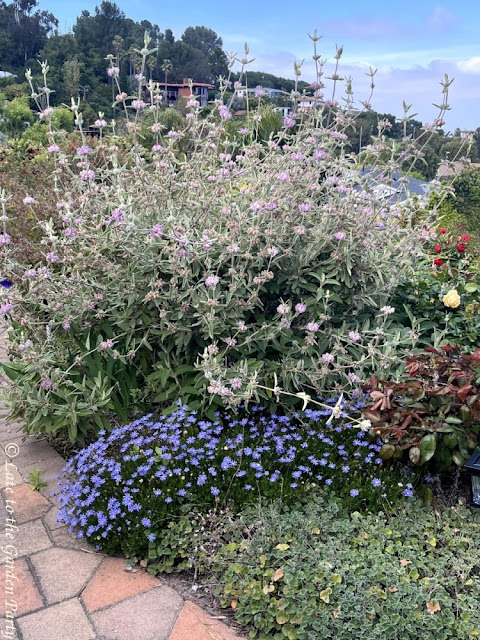
This neighbor's Phlomis purpurea puts mine to shame

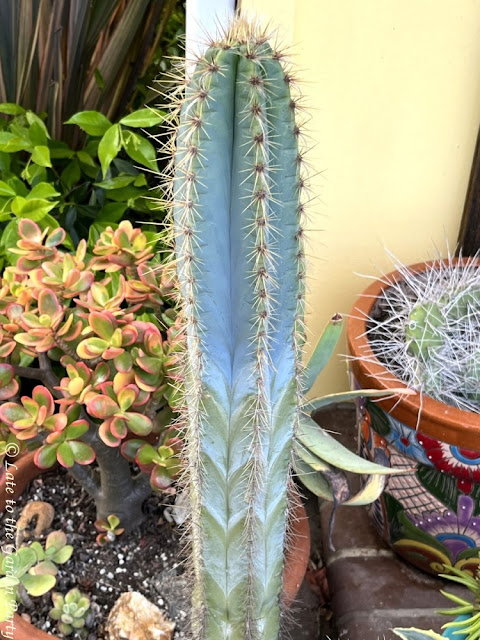
The same neighbor has the best-looking Pilosocereus azureus I've ever seen

As well as the largest rose (Rosa 'Brandy')

She has some 70 roses, including various carpet roses lined up with succulents along her front slope

I don't often see rambling roses here but this noID specimen in another neighbor's garden blooms like this every year

I've been considering adding a bird of paradise (Strelitzia reginae) to one of the newly empty spaces in my garden.  Many are too large to suit the spot I have available but this well-trimmed specimen impressed me - until all its flowers fried during our recent heatwave.


I'm already feeling a seasonal shift in the direction of summer, both in my neighborhood and my own garden.  The early heatwave we experienced last weekend snapped us out of spring mode.  Plants I associate with summer like Achillea, Hemerocallis, and Agapanthus are marching forward.  As I feel summer's heat already breathing down my neck, I need to get moving with my replanting effort.  I hope you're enjoying a more leisurely spring.


All material © 2012-2025 by Kris Peterson for Late to the Garden Party

Friday, November 29, 2024

Fall color comes in various forms

With cooler temperatures, we've finally seen a bit of colorful foliage in my part of coastal Southern California.  My garden is still mostly green but I appreciate the bright touches where I find them and wanted to share them.  I haven't restricted myself to foliage color either.  Some flowers and berries put on a great show at the start of our all too short cool season as well.

I showed Acer palmatum 'Sango Kaku' (aka coral bark Japanese maple) in my foliage post earlier this month but its color is more pronounced now.  It's yet to start dropping leaves en masse but I suspect that's coming soon.

The color of Aloe vanbalenii x ferox isn't provided by its leaves but by the budding flower stalks

The berries of Auranticarpa rhombifolium (aka diamond leaf pittosporum) have been later to develop this year, possibly due to delayed pruning on my part

The color of the smoke bush (Cotinus coggygria 'Royal Purple') is more vivid now than it was weeks ago


Closeup of the Cotinus foliage.  The water droplets were delivered courtesy of another 0.07/inch of precipitation on Wednesday.

Along with the Japanese maple, the 'Fuyu' persimmon (Diospyros kaki) is at the top of the list of the most colorful trees in my garden

In contrast to the 'Fuyu' persimmon, the foliage of my other persimmon, Diospyros kaki 'Hachiya', is muted in color but its fruit is more colorful.  The fruit I wasn't able to reach is gradually being "picked" by critters.  (Like many people I know, the critters appear to like the 'Fuyu' fruit better - they took care of the fruit of that tree much more quickly.) 

My Ginkgo biloba 'Autumn Gold', planted in 2021, is still struggling to live up to its potential

Including Grevillea 'Superb' in the lineup of this post is a bit of a cheat as it blooms year round but I couldn't resist.  All it takes are cooler temperatures and a tiny amount of rain to make the shrub shine.

Nandina domestica (aka heavenly bamboo) contributes both colorful foliage and bright red berries at this time of year.  Regrettably, the poisonous berries of the Nandina are off limits for inclusion in floral arrangements, especially with a young cat now in residence.

This succulent was labeled as a Christmas cactus (Schlumbergera bridgesii) but, based on the leaves, I think it's actually a Thanksgiving cactus (S. truncata)

Tagetes lemmonii (aka Mexican marigold) blooms in spring as well as fall but it deserves a shout out during both seasons

Our ornamental pear tree (Pyrus calleryana) is notably absent from this survey as it's off to a particularly slow start this season.  My blueberries are also unimpressive at this time but then I think they may have been in their pots too long.

Overall, my neighborhood is relatively short on fall color too but there are some notable exceptions.

The sweetgum trees (Liquidamber styraciflua) across the street put on the best show to be found in our neighborhood

There are 3 Ginkgo trees tucked into that neighbor's mix too.  Their success gives me hope for mine.  These trees were already mature when we moved in almost 14 years ago so I'm giving my 3 year old tree a break.

This tree is in another section of that same garden.  My best guess is that it's what's known as the tree of heaven (Ailanthus altissima).  It's considered invasive in California but it is pretty.

I can't identify this shrub growing within a mass of other shrubs in another neighbor's garden either.  My phone app thinks it may be a blueberry but I've never seen any berries on it.

The fall color in this garden is composed of the Aloe arborescens (candelabra also) in the mix.  The Bougainvillea, hard-pruned by this neighbor many months ago, and the spires of Euphorbia tirucalli 'Sticks on Fire' make this a dramatic color mix.  Bougainvillea bracts and the Euphorbia "sticks" are always more colorful at this time of year.

Still another neighbor has a great crop of tangerines ripening up

The colorful element here is another flower, the red "bottle brushes" of a Callistemon.  This neighbor lives 2 doors down from us but I could swear that I've never noticed it in flower before..

Pyracanthas shine this time of year.  I had our self-planted shrub cut down to the ground but I appreciate the large, thorny shrubs in other people's gardens.

Beyond the trees fronting the road directly across street, fall foliage color is in short supply in my neighborhood.  Bougainvillea is the notable exception in providing flashes of color but then those shrubs aren't specifically characteristic of the fall season.  The bright berries of Pyracantha are the most prominent elements this time of year.  I'm surprised that I haven't seen Japanese maples anywhere nearby but then I only have two of them myself.  (The dwarf variety doesn't color up much.)  I've tried introducing additional Japanese maples in my garden but I've discovered that they need protection from the intense summer sun, as well as the powerful bouts of wind we get at times, and I just haven't found any other areas that allow them to thrive.

If you're in the US, I hope you enjoyed a wonderful Thanksgiving and that you have the opportunity to celebrate the holiday throughout the weekend.


All material © 2012-2024 by Kris Peterson for Late to the Garden Party