Showing posts with label butterflies. Show all posts

Wednesday, August 27, 2025

Late summer visit to the local botanic garden

The heat finally backed off a bit yesterday, peaking at 81F (27C), so I elected to move my usual daily walk from my own neighborhood to the local botanic garden.  I booked my second and probably last visit to the SOAR butterfly exhibit for the summer season for 10am but took a quick and fairly haphazard spin around the garden before the exhibit opened.

I'll share just a few highlights.

This Brazilian orchid tree (Bauhinia forficata) has clearly been in the garden for a long time but it's the first time I can recall seeing it in full bloom


The garden's sea squill (Drimia maritima) were putting on a great show, much more impressive than the 5 bulbs that've already bloomed out on my back slope

I had to hunt down the name of this massive tree covered in yellow flowers.  It appears to be a golden raintree (Koelreuteria paniculata).  It's reportedly native to China, Korea, and parts of Mongolia and Russia. 


Before heading into the SOAR exhibit, I checked out the Fuchsia Garden.

I couldn't find a name for this floriferous Fuchsia but a gulf fritillary butterfly (Dione vanillea) was busy showing its appreciation


In prior years, the occupants of the SOAR butterfly exhibit changed over the course of its May through September run but there were fewer noticeable changes this year with a lot of the species present in May still prominent in late August.

I checked the board included in my June post and found that the late August board showed many, albeit not all, of the same butterflies

While many of the plants geared to appeal to butterflies and other pollinators outside the enclosure have largely finished their bloom cycles, a few new arrivals were trying to make up for the shortfall.  The plant on the left may be an Anisacanthus.  The one in the middle is some kind of Senna and the third looks like an aster (Symphyotrichum) of some kind.

There were still a lot of plants to appeal to the tropical butterflies inside the SOAR enclosure too


I'm sure I missed some of the butterflies but I did my best to profile those that I was able to catch with my camera.  There were far fewer humans to skirt around than there were back in May but then the early time slot for my visit may have played a role there.  The IDs are my best guesses based on the garden's list at the entrance to the exhibit and my own research.

Catonephele numilia (aka blue frosted banner)

Dryas julia (aka Julia butterfly)

Heliconius charithonia (aka zebra longwing)

Heliconius doris (aka doris longwing)

Heliconius hecale (aka tiger longwing)

Heliconius ismenius (aka Ismenius tiger)

Heliconius melpomene (aka red postman)

The large Morpho peleides (aka blue Morpho)

The Morphos liked to hang out at the feeders with their wings closed, occsionally including other butterflies

This is the best photo I managed of Parides childrenae (aka green celled cattleheart)

Siproeta epaphus (aka rusty tipped page)

Siproeta stelenes (aka malachite butterfly)


I walked by the plant kiosk area on my way out.

No deals to be found


However, I was glad I didn't miss seeing the orange flame vine as I crossed through the parking lot back to my car.

Combretum farionsum


There's still no obvious action on the Children & Family Garden that had originally been slated to open in 2024, which was disappointing.  As far as I could tell nothing at all has happened for months.  However, the garden is advertising a new animatronic dinosaur exhibit planned to launch in November and another visit from the giant Trolls in March but I haven't heard a word about the status of the new children's garden, much less any plans for a fall plant sale.


All material © 2012-2025 by Kris Peterson for Late to the Garden Party

Wednesday, June 4, 2025

The butterflies are back!

I made an appointment for a friend and I to attend the tropical butterfly exhibit at South Coast Botanic Garden (SCBG) last Saturday when she paid me a visit.  Our morning marine layer along the coast has been fairly persistent but I'd booked a slot for 10:30AM in the hope that it would be lifting by then as the butterflies aren't very active until the temperature rises and the the sun shines.  Things didn't look good on our drive over as the fog was dense but luckily, as we were waiting to enter the exhibit, the sun began breaking through the clouds.

This is the fifth run for the SOAR tropical butterfly exhibit.  I've attended each year.  The SOAR enclosure was built in 2020/2021 by a contractor called Spineless Wonders, which specializes in both permanent and temporary butterfly enclosures.  The area adjacent to the enclosure, formerly dedicated to dahlias, is now planted in flowers and foliage that attract local butterflies (while the tropical butterflies are carefully contained within the enclosure).  Visitors with tickets are permitted to wander the butterfly garden prior to their admission to the butterfly pavilion.

The raised beds of the former dahlia garden remain in place

The planters are arranged in a circular pattern


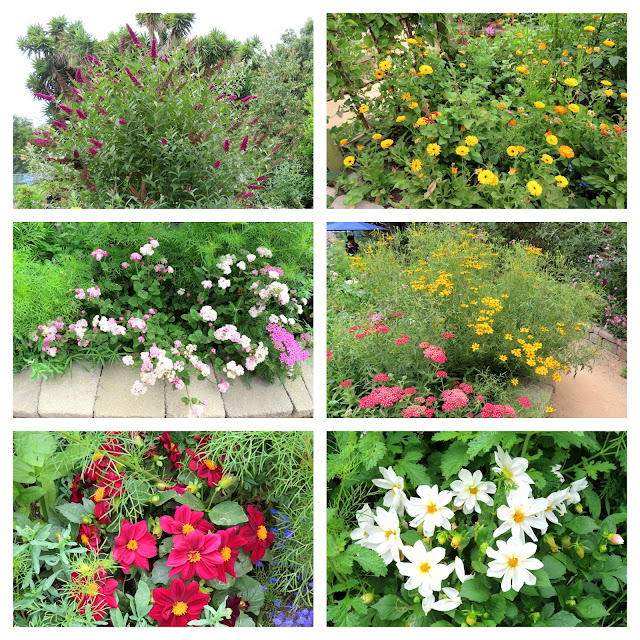
Clockwise from the upper left, the plants I noted included: Buddleias, Calendulas, Achilleas and Tagetes, various single-petaled Dahlias, and a plant that's familiar but I couldn't identify

Aided by a visiting child's attention to details, I caught a photo of a caterpillar 


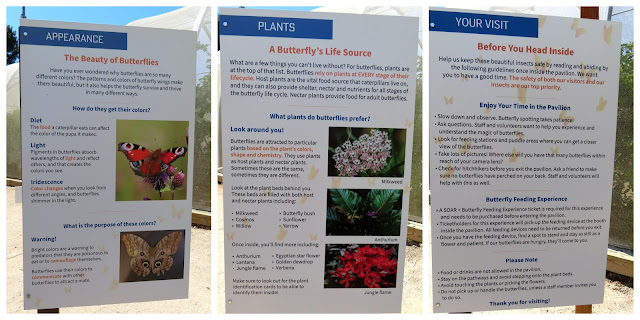
There are lots of signs to help visitors learn more about butterflies, as well as an Emergence Chamber where they can view butterfly pupas (aka chrysalises).

This butterfly had fully emerged from its chrysalis but was still drying out, a process that can take up to 2 hours according to the posted FAQs


Other helpful graphics

This sign with guidelines for visitors upon entering the pavilion stood just outside the pavilion's entrance.  One of the exhibit's guides also took the group through the rules prior to letting them enter in small groups.  The entrance cubicle has 2 doors and a middle buffer to prevent the tropical butterflies from escaping their enclosure.


The pavilion's interior area is filled with plants attractive to the tropical butterflies.

The enclosure is more densely planted than it was in the early days of 2021.  The plants have also changed a lot over the years.

Clockwise from the upper left, plants I noted included: Fuchsia arborescens, Pentas lanceolata, Stachytarpheta jamaicensis (aka blue porter weed), and a noID plant that looks like some kind of Gardenia to me but my cell phone's app doesn't agree


I'd taken a photo of the sign listing the current butterflies in residence at the entrance booth.  Unfortunately, on this occasion, I was only able to photograph four different species, which was less than half the number my camera captured in prior years.  


The lingering marine layer may have limited the number warmed up to fly, or the supply of butterflies may be lower than in prior years.  One of the attendants told me that SCBG had used a butterfly broker in prior years to obtain chrysalises from multiple sources at periodic intervals.  This year I understand they're using only a single source.

The sign listed a Hamadryas laodamia (aka starry cracker) among the pavilion's current flyers but this looks more like Hamadryas februa (aka gray cracker) to me.  Based on my own prior experience, this one is particularly prone to landing on people.

Two different golden longwings (Heleconius hecale)

The large blue morphos (Morpho peleides) were all over but as usual proved difficult to photograph with their bright blue upper wings wide open.  I more commonly saw them with wings closed as in the middle photo.  My friend caught the photo on the right using her cell phone when another visitor leaned in with a flower-shaped nectar vial.

The malachites (Siproeta stelenes) seemed to be the most abundant butterflies moving about during this visit, as well as the most accommodating about opening their wings


I may book another visit to the SOAR pavilion later in the season to see if the mix of butterflies changes.  The exhibit is scheduled to run through the end of September.


This year, a second exhibit called Bamboozled, featuring bird sculptures created from bamboo, is running concurrently with SOAR.  I'll provide photos of those sculptures and some of the plants I noted during our walk through SCBG on Friday.


All material © 2012-2025 by Kris Peterson for Late to the Garden Party

Friday, July 5, 2024

Butterflies love warm temperatures!

I've yet to miss making at least one visit to my local botanic garden's Butterfly Pavilion for its summer SOAR exhibit.  The Pavilion opened for the first time on April 1, 2021.  It opened in May this year but I didn't visit until earlier this week.  Everyone, including members, are required to reserve their half-hour slots for entrance.  The earliest entrance time is 11am, probably because it offers reasonable assurance that the marine layer will have lifted and the butterflies will be active.  I scheduled the early slot to avoid the hottest part of the day.  While we haven't experienced the extreme high temperatures affecting much of California, it's still been on the warm side, with mercury readings in the mid-80sF (29C).

I arrived about a half-hour early and cruised the Fuchsia Garden, which is adjacent to the Butterfly Pavilion.  Volunteers were busy in the area during my last visit in June so I'd skipped it.

I can't identify this one but the flowers were plentiful

I didn't see a label for this one either but I was interested to see that stems had been braided to create something resembling a trunk

The orange color of these flowers appealed to me.  I was able to hunt down a name online.  It's a hybrid called 'Monterey'.

This one appealed to me as well.  It also had no visible label but I liked how it was mounted in a flat-backed pot.


After that brief ramble, I checked in at the SOAR desk and wandered through the Pavilion's exterior area while waiting to enter the Pavilion itself.

The outside area looked wilder than I'd ever seen it but then it was planted much earlier in the year.  I expect that the native butterflies and their progeny appreciated the protection and food sources it provided. 

These were some of the individual plants I spotted, clockwise from the upper left: Achillea millefolium, some kind of aster, Grindelia, 2 varieties of Buddleia, Cosmos bipinnatus, and Heliotropium


There are signs providing general information about butterflies and the exhibit, as well as a view of what's called the "emergence chamber," where visitors can view butterflies still in their chrysalises. 

Description of the 4 stages of a butterfly's life

The emergence chamber and related Q&As


I queued up with others waiting to enter the Pavilion several minutes before 11am.  The volunteers let people enter in groups of three or four using a double door system to prevent butterflies from escaping.  They're very serious about managing the entrance and exit processes as I understand their licensing to run the exhibit requires them to contain the tropical species, presumably to avoid impact on native species.

I don't think I've ever seen the butterflies as active.  They were everywhere.


Like the Pavilion's exterior, the interior was planted with flowers and foliage attractive to butterflies.

The plants included everything from shrubs to bromeliads

As a side note, unlike some of my prior visits, I didn't see a single child freak out about being surrounded by butterflies or having one land on them

These were just a few of the flowering plants, clockwise from the upper left: Duranta erecta, Impatiens, Gloriosa, Pentas, and Salvia.  Other species I noted included: Ageratum, Dichondra, Fuchsia, Iresine, Tillandsia, and Verbena.


Although there were a lot of butterflies, the number of species appeared more limited than I'd seen during prior visits.  However, that may be related to the time of year, or my limited ability to discern individual species.  My phone's camera app helped with butterfly identifications and, although I attempted to verify these with other online sources, they can be only be construed as guesses.

The blue Morpho butterflies congregated in several feeding stations scattered through the exhibit, mainly with their wings closed

Battus polydamas, aka gold rim swallowtail

Hamadryas feronia, aka variable cracker (although it doesn't look like any of the other cracker butterflies I've seen online)

Heliconius charithonia, aka zebra longwing

Heliconius hecale, aka golden longwing.  I think the butterfly visible in the upper section of the photo on the right with its wings closed is a Siproeta stelenes.

The ID on this one came up as Libytheana, aka snout butterfly, but the wing coloration seems off to me and I didn't get a shot that showed its snout

Limenitis arthemis, aka white admiral

Morpho peleides, aka blue Morpho.  The butterfly on the right was so perfect (and immobile) that I initially thought it was a fake attached to the sign - until it flew away.

Myscelia cyananthe, aka blackened bluewing

Siproeta stelenes, aka malachite butterfly.  This species was almost as profuse as the Morpho butterflies.

Among the butterflies that landed on me were a Hamadryas februa (gray cracker) and a Morpho peleides (with wings closed).  It's very difficult to photograph these creatures when they're on your side or your shoulder!


At 11:25am, the volunteers advised visitors that they needed to prepare to exit.  Like the entrance process, that occurred in stages but visitors also had to twirl around so the volunteer could ensure than no butterflies were attempting to hitchhike out of there.


The temperature was already noticeably higher than when I'd arrived so I walked through only a few other areas on my way to the garden's exit.

Brugmansia near the Butterly Pavilion's exit

Tithonia diversifolia, aka Mexican sunflower and tree marigold


I got a half-decent photo of the turtle in the Pollination Garden's pond
Lagerstroemia hybrid, aka crape myrtle


On the way out, I saw signs advertising pending events.

There must be a big appetite for nostalgia in the area


That's it for me this week.  If you're currently getting toasted by high temperatures, I hope you see them come down soon.  Best wishes!


All material © 2012-2024 by Kris Peterson for Late to the Garden Party