Showing posts with label Agave desmettiana. Show all posts

Wednesday, August 12, 2020

Almost there

One of the projects I committed myself to tackle this month was/is to reduce the mass of Centaurea 'Silver Feather' planted in front of my mimosa tree (Albizia julibrissin).  With a heatwave in the near-term forecast, I decided to get started late Monday afternoon.  It was tougher than I'd thought as the base of the plants were hard to uncover under all the shrubs' heavy branches.

After removing a mass of asparagus fern, I planted seven Centaurea here in January 2019 to hide the mimosa's scarred trunk after half the tree was cut down in an effort to rid it of disease caused by shot hole borers.  While I can say I was misled by the plant's tag, seven plants was still overkill and, within a year, they'd formed a mass that blocked the path through this area. 

This photo was taken after I'd removed four of the shrubs

The path is clear but I still wasn't happy with it

I took out a fifth shrub this morning but I'm think the one on the right has to go too.  It blocked view of the Agapanthus in bloom earlier this summer and the Centaurea still feels like it's overwhelming the area.


I've paused the project as my green bins are almost full and I need the gardeners to trim that Xylosma hedge behind the tree, which is completely out of control.

Another small project I had on my plate was to replant the Epiphyllum in my lath house, which had grown too large for that space.  I'd planned to move it into a hanging basket but when I checked the lath house yesterday, I found this:

We put up the shade screens in the lath house a couple of weeks ago as one branch of Epiphyllum 'Monastery Garden' was heading for the roof.  I understand that the plant normally wants its roots crowded before it blooms and it appears the conditions are right now.


So I've paused that project too, at least until the plant blooms.

Viewing the moderate slope outside my lath house, it occurred to me that I need to do something about a very visible bare spot.

I've got a series of Agave desmettiana 'Variegata' planted along the slope, pups of one of the two plants that bloomed in 2019

Adding more Agaves seemed a reasonable solution but, rather than buy a large specimen, I decided to use one or more of the bulbils from the Agaves that bloomed in 2019.  I'd saved only those with the best variegation.  They're still pretty small but I repotted three of them to allow them to beef up a bit further before I plant out all or some this winter.


So that's another project that's almost there...And speaking of that, I noticed that my blogger stats show that I'm just shy of one million views this morning.  As I started the blog at the end of December 2012, I expect a million views isn't all that remarkable but it was/is an informal target I'd set when considering whether or not to continue this blog.  It feels weird to be so close to that target this morning.  I've no immediate plans to shut the blog down but it's probably time to give its future some thought.  I've been posting on Instagram (at krispeterson591) for a couple of years now but I haven't yet entirely embraced that forum as a blog substitute.   Deliberations will continue...


All material © 2012-2020 by Kris Peterson for Late to the Garden Party

Friday, September 6, 2019

An Agave's Legacy

Reactions to a blooming agave can be mixed.

My best guess is that I planted the 2 Agave desmettiana 'Variegata' shown here sometime in 2014 from 1-gallon containers.  The containers (and the plants) were bigger than those I usually buy.  This photo of them forming bloom stalks was taken in mid-October 2018.


On the one hand, agave bloom spikes are usually impressive, soaring many feet above the plant with the flowers drawing bees and even hummingbirds by the droves while they last.

My 2 plants were in full bloom in March


While the blooms are attractive, agaves are monocarpic, which means they signify the beginning of the end for the plant.  Although I have more agaves than I can count off the top of my head, I'd never had any bloom until these 2 Agave desmettiana 'Variegata' did so.  I usually purchase my plants in small containers; however, I inherited a large clump of mature Agave attenuata with the garden but even those plants have never produced blooms.  I've something on the order of a dozen Agave 'Blue Glow' scattered about, all purchased at about the same time in small pots, and I live in apprehension that one day they'll all bloom at once, leaving large holes throughout my garden.

I had no idea that the process from the emergence of a bloom spike to the plants' ultimate death would be quite so lengthy.  The stalks I first noticed in October grew steadily but didn't bloom until March of this year.  The blooms didn't last long, perhaps a few weeks between the 2 plants, but the bulbils or plantlets formed so slowly that, for a time, I didn't think they were going to develop at all.   It wasn't until June that I became confident that I was going to get a crop of baby agaves out of those flower stalks.

As August turned to September, the bloom stalks were visibly leaning toward the street and the bases of the 2 bloomed-out plants had shriveled.  Prompted by a post on an agave harvest published by Hoover Boo of Piece of Eden, I decided that I'd better cut those stalks before they came crashing down on a neighbor's car (or a construction worker's truck).  Of course, I chose what may be the hottest week we've had all summer to tackle the job.  Luckily for me, the bloom spikes of my agaves aren't as tall - or as heavy - as some.

This is what the plants looked like immediately before I went to work

As you can see, there was little left of the agave's foliage by this point

There were lots of bulbils, though!


After cutting down the stalks, I hauled my harvest into the shade and began sorting through the bulbils, pulling out those that were of decent size, well-formed, and showed some sign of variegation.

I tossed the vast majority of the bulbils, saving just 30 for myself (shown in the pot on the left) and putting aside another 100 or so to give away (shown in the pot on the right)


I stuck those I saved for myself in a flat of loose, gritty soil to allow them to develop roots.

Here's my stash.  I stuck the largest bulbil in a small plastic pot.

A few showed marked variegation like this one


I decided to offer the remainder of those I'd saved to neighbors.  Although succulents have become a lot more popular in our dry climate in recent years, I wondered if there would be sufficient interest in caring for these baby plantlets until they developed roots and could more easily survive on their own.

I found 3 empty plastic 6-packs and stuck bulbils in each pocket in the hope people might find them more appealing packaged this way.  I left the rest of the giveaway plantlets in the plastic pot I'd placed them in while sorting them out. 

I placed all the plants slated as giveaways on this low wall at the edge of our driveway, facing the street.  I've previously done the same thing with lemons and succulent cuttings with generally positive results.

I also left flyers with general information on the plants.  The 3 agaves shown in the photo on the flyer are actually pups of the same 2 bloomed-out agaves that produced the crop of bulbils.


Two of the six-packs of bulbils were picked up early Wednesday morning.  Then a truck containing sandblasting equipment arrived for work on our house, hiding my sign and the rest of the plants from view.  With our temperature headed into the mid-90sF, I moved the plants out of view into a shadier location.  I put the plants out again Wednesday evening and someone, or possibly multiple someones, picked up the rest of the giveaway plants before the heat climbed yesterday.  I'm counting that a success.  Agave desmettiana babies: may you live long and prosper.

Enjoy your weekend!


All material © 2012-2019 by Kris Peterson for Late to the Garden Party
Wednesday, June 26, 2019

Succulent Stars

I've been spending a lot of time in my garden, partly to escape the pandemonium associated with our remodel, but also in an effort to manage the garden's explosive growth following the best stretch of rain and moderate temperatures we've had in a long time.  I could probably spend several hours a day for a solid month just cutting back Erigeron karvinskianus and even then might have to start all over again with a fresh round of haircuts as soon as I finished.  I've also spent gobs of time deadheading flowering plants, pulling weeds, and cleaning out ripened bulb foliage.  In the midst of the last exercise, I took time to admire my sleek and always tidy succulents.

This is Aloe labworana, native to Uganda.  I picked it up last August because I loved its wavy shape.  Once I cut back the dead daffodil foliage surrounding it and uncovered the Echium debris that had nearly covered it, I noticed that it'd taken on a pretty red tinge.

This Yucca gloriosa 'Variegata' had been nearly smothered by Erigeron karvinskianus (aka Santa Barbara daisy) and was partially hidden behind a tall mass of Gaura lindheimeri.  I purchased the plant in a 4-inch pot about 18 months ago and it's still relatively small but someday it'll be big enough to hold its own in that spot against all comers.

This Agave is sold under a variety of names but now is commonly known as Agave mitis 'Multicolor'.  This is the largest of the 3 I have, given to me as a birthday gift 3 years ago.  It's beefed up dramatically in the past year, presumably in response to the extra rain we received this past winter. 

There are several nice 'Blue Glow' and 'Blue Flame' Agaves here but what dials this vignette up a notch is the mass of Crassula pubescens ssp radicans in full bloom among the Agaves.  The smaller succulent's red foliage nicely echoes the red edges of the 'Blue Glow' Agaves most of the year but the cream-colored flowers light up the bed in early summer.

The same grouping from another angle.  Please ignore the crabgrass I missed during my clean-up.


Some succulents have joined the floral parade.

My Hesperaloe parviflora aren't as exuberant as the plants I saw at last year's Garden Bloggers' Fling in Austin, Texas but I'm pleased with the statement they make here and I'm hopeful that, in time, my 3 plants will form large clumps.

I fell in love with Oscularia deltoides (aka Lampranthus deltoides) several years ago based on its foliage alone.  Its red stems are covered in icy blue-green leaves.  Like many succulents, it's easily grown here simply by sticking a cutting in soil.  This one is happy trailing down a low stacked stone wall in partial shade.  I have others growing in full sun but in my location they look best with some afternoon shade.

The bloom spikes on the 2 Agave desmettiana growing in my street-side bed formed in October.  The plants were in full bloom in March.  It appears that bulbils are finally forming, although thus far most are well above my head and therefore hard to photograph.  Meanwhile the mother plants' foliage has taken on a pretty reddish color.

The 3 Agave desmettiana 'Variegata' growing on the slope here are also progeny of the 2 plants currently in bloom.  I planted 5 pups in this area (not all visible in this photo) several years ago when I put the original plants in the street-side bed.  They also got a major boost from our winter rains.


Blooms are a mixed bag when the blooming plant is monocarpic, as most Agaves are.  But, if the Agave desmettiana produce a host of baby plants, that'll take the sting out of the loss of the 2 large specimens.  I only hope the bulbils develop fully before those 2 bloom stalks fall into the street.


All material © 2012-2019 by Kris Peterson for Late to the Garden Party

Friday, February 8, 2019

The joy that rain brings

Last year was one of the driest in Southern California since records have been kept but this year we're on target to reach or exceed our "old normal" standards.  The rain has come in several bursts over consecutive days.  Our last storm cleared out Tuesday morning.  There's a chance of another this weekend and still another during the middle of next week.  We've been lucky to have a couple of sunny, albeit cold, days in the intervening period, during which I took time to clean up the garden a bit and take some pictures.  It already looks as though were headed in the direction of a nice spring.

I don't usually get much pleasure out of visiting my back slope but on this occasion it offered a few positive surprises.

The lemon tree that dropped every single piece of fruit in early July when our temperature hit 110F has fully recovered

Ceanothus arboreus 'Cliff Schmidt', planted in 2015, is finally taking on the tree-like form I envisioned for it

With the rain, the calla lilies (Zantedeschia aethiopica) planted decades ago by another gardener at the bottom of the arid slope have magically reappeared

Centranthus ruber has self-seeded generously in the same area and it looks as though the California poppy plugs I planted in December are thriving too


On the main level of the back garden, I couldn't miss the fact that the Xylosma congestum hedge that surrounds it produced fresh new foliage.

The garden service that maintains our hedges cut the new foliage back the day after I took these photos but, with more rain expected I don't think it'll be long before my "ring of fire" is back


The backyard offered other surprises as well.

I'd entirely forgotten these plants with the tiny white flowers.   I think they smartly went underground last summer.   This is Arabis alpina 'Variegata'.

This is the first flower on Isopogon anemonifolius, an Australian plant I picked up on a whim while plant shopping in November.  It's interesting but it doesn't look like much like it did on the plant tag; however, I'll give it more time to develop before making any decision about whether it stays or goes.

Plants showing flower buds include: Ageratum corymbosum (left) and Leucospermum 'Brandi' (right).  It'll be awhile yet before either will be in full bloom but it's nice to see progress in that direction.


My discoveries weren't limited to the back garden.

Euphorbia rigida is blooming in the succulent garden on the south side of the house

Leucadendron 'Safari Goldstrike' produced its luminescent flower-like bracts seemingly overnight in the front garden

After looking near death this summer, Aeonium 'Mardi Gras' is blushing again

Moss has appeared on paths, along the stairs leading down my back slope and between paving stones

The first flowers have opened on the tall bloom stalks produced by the 2 Agave desmettiana 'Variegata' planted in my street-side succulent bed.  The foliage of each plant now has a pretty pink blush too.  I don't know if that's a reaction to the cold or simply part of its slow process of dying.


Along with the calla lilies, the first Freesia bulbs are flowering.  I expect my other early spring bulbs aren't far behind.

The blue Freesias are the first to appear this year.  Ferraria crispa (upper right) has also produced fresh foliage.  Leucojum aestivum, Narcissus and Sparaxis are also on their way.


I know it's been a nasty winter for many of you in the Northern Hemisphere but spring is getting closer.  Take heart!


All material © 2012-2019 by Kris Peterson for Late to the Garden Party

Friday, September 11, 2015

Lynda's Succulent Garden Revisited

In July last year, I posted photos of my friend Lynda's succulent garden.  Being both an artist and a perfectionist, she's continued to futz with both her design and her plant selections, which is good for me as every time she's planning a change usually means we make a trip to our favorite succulent garden center in Orange County.  In advance of one such trip, I took photos of the succulent beds in the front of her townhouse.

Her succulent beds are enclosed within tiered, brick-lined planters along the right and left sides of her sloped driveway.  Here's the first tier on the right side.

The bed is tightly packed but the plants are very happy

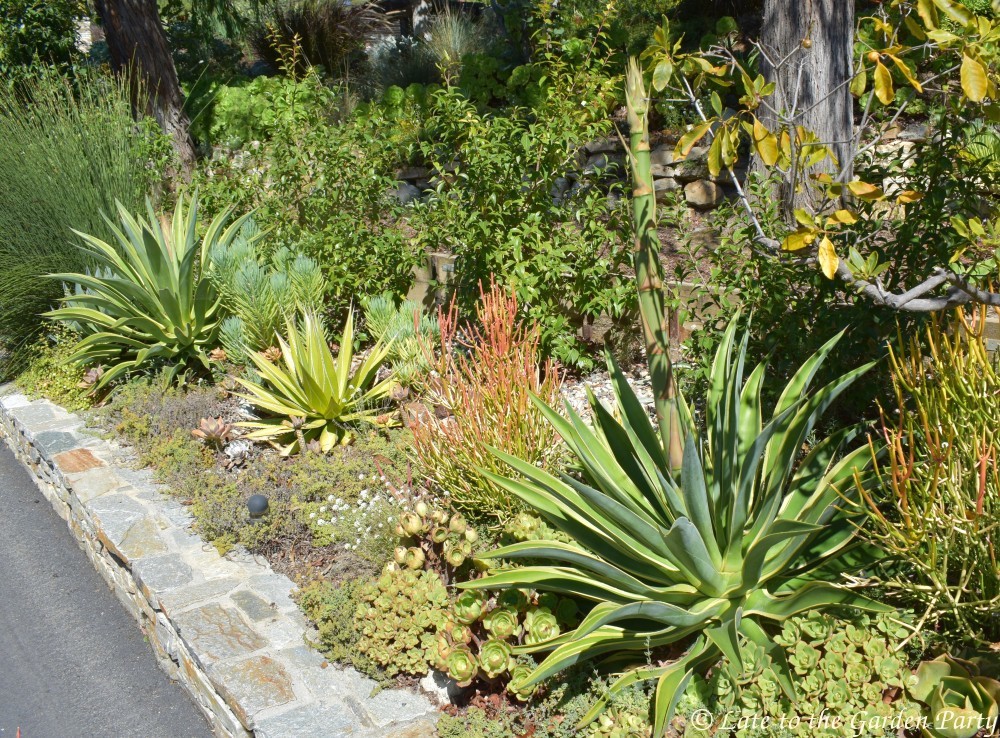
Close-up of Agave desmettiana, Graptoveria 'Fred Ives', Euphorbia tirucalli and Crassula capitella 'Campfire' 

Agave 'Blue Flame', Agave Blue Glow', more Graptoveria and Euphorbia, and Sedum rupestre 'Lemon Ball'

Another view of the plants shown above plus what I think is Agave pgymaea 'Dragon Toes'


The second tier planting bed on the right side featured (past tense) Opuntia santarita.  As it had become impossible to weed around the Opuntia, it was destined for removal when I visited.

Lynda intends to replace the Opuntia with another Agave 'Blue Flame'

Agave desmettiana, Euphorbia tirucalli and Kalanchoe fedtschenkoi 'Variegata' among other smaller succulents (Let me know if you can name the plant in front - I can't identify it Thanks to Jane, the plant in front has been identified as Crassula arborescens 'Blue Waves' aka Crassula ovata undulata)

The condemned Opuntia sandwiched between 2 Euphorbia tirucalli

Manfreda x 'Silver Leopard' backed up by Euphorbia and an unidentified Aloe


The succulent bed on the left side of the driveway is wider and serves as a divider between Lynda's property and that of her neighbor.  

Lynda added beach pebbles to create a pathway she could use when weeding the bed
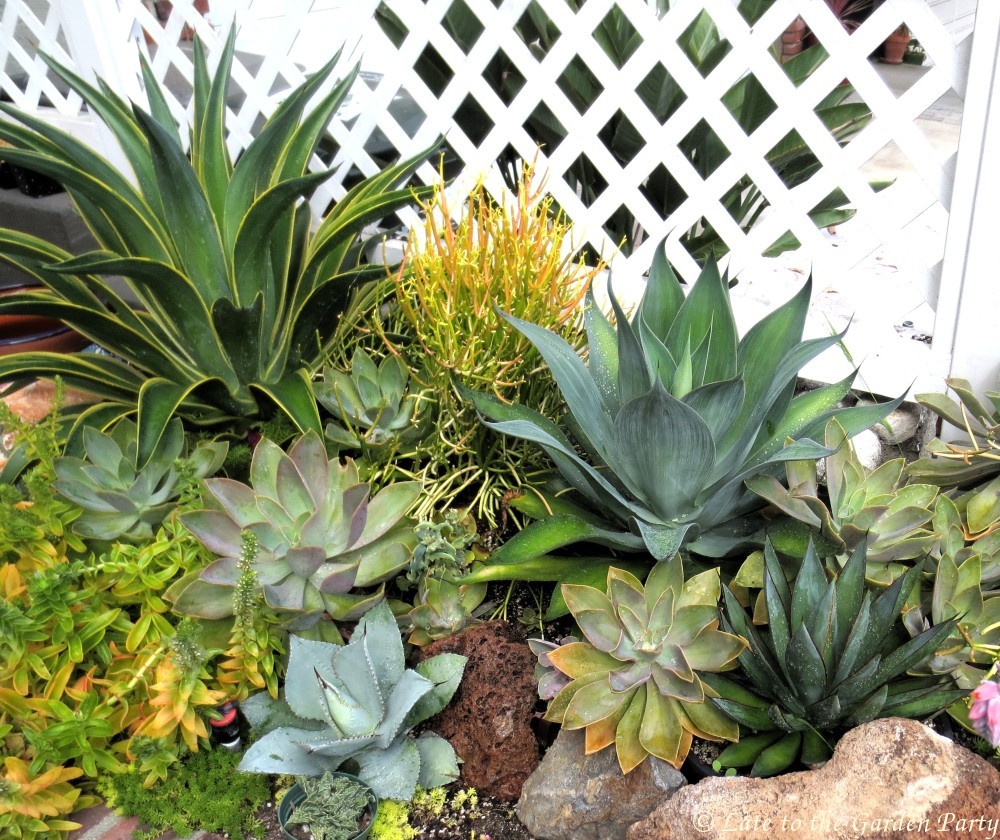
Agave 'Joe Hoak' provides a focal point in this bed

Aloe cameronii (with what may be a crested Euphorbia in front)

Lynda has used plant repetition and contrasting foliage texture and color to great effect.  Since last July, she has removed the Abelia 'Kaleidoscope' that formerly shared the beds, added lots of rock, rearranged plants and added new ones.  It looks great now and I have no doubt that it'll look great next year too - only probably different.


All material © 2012-2015 by Kris Peterson for Late to the Garden Party