Showing posts with label Euphorbia tirucalli. Show all posts

Wednesday, April 6, 2022

The fire is out

Last Wednesday, I published a post focused on the unmanageable growth of a Euphorbia tirucalli 'Sticks on Fire' I'd planted in a strawberry pot back in 2012.  

I'd cut the Euphorbia back many times over the years, briefly shortening its height on each occasion while inevitably causing it to bush out further

After deciding that the plant had overstayed its welcome in my cutting garden, I tackled its removal.  Partway in, I began asking myself if I really wanted it out but I persevered.  As expected it was a messy job.

I wore elbow-length garden gloves and avoided the milky sap released by the plant with every cut as best I could.  This was what it looked like when I finished my first pass at cutting it back.

I created separate piles of small-to-medium cuttings and large cuttings but much of what I cut went into a green bin for recycling

A close look at the pot showed that it was riddled with deep cracks

While I did a grocery run on Saturday, my husband went to work breaking up the pot and pulling out the rest of the plant.  Interestingly, although the pot was broken in many places by the plant's sheer girth, he told me that it hadn't actually rooted itself in the ground below the pot.

This is the area after my husband pulled up the plant and the remnants of the broken pot

I'd initially hoped I could leave the Aeonium haworthii 'Kiwi' plants surrounding the pot in place, although I had to remove those growing out of the side pockets of the strawberry pot (cuttings shown on the left).  However, the remaining plants didn't look great once the pot was out so I took cuttings of those too (shown in the bucket on the right), clearing the rest of the space.

I was surprised to find massive roots in the area.  These weren't roots of the Euphorbia.  My guess is that they're an extension of the Pandorea jasminoides vine situated some 8-10 feet away, another plant I inherited with the garden.

When cleared, I discovered that there was a drip irrigation bubbler in the middle of the area I hadn't remembered was there

I'd briefly considered putting a half-barrel in the empty spot but that would have required removing or capping the drip irrigation pipe that fed that bubbler so I returned to my original plan of moving a large terracotta pot there.  Moving the pot frees up space for another barrel alongside the two I already have on the west side of the cutting garden.

I moved the pot and planted some of the Aeonium cuttings around it.  Last year, I planted Dahlia 'Akita' in this pot and may do so again when one of the 2 tubers I saved produces a sprout in its temporary pot.

I put the Aeonium 'Kiwi' cuttings I had no use for on the street as another neighborhood giveaway.

Two of these pots (each containing a dozen or more cuttings) were already gone when I checked 2 hours later and I won't be surprised if the 2 remaining pots are gone by morning


So one problem dealt with!  However, yesterday, as I headed out to meet my jury service obligation, I noticed another little problem.

This was what was left of a Clianthus puniceus 'Flamingo Pink' I'd planted in March.  I don't know why I thought the rabbits wouldn't bother it.

I'd taken this photo in late March, not for the purpose of showing the Clianthus on the right but rather to show Gomphrena 'Itsy Bitsy' (left) as she recovers from the severed pruning I gave the plant in late winter.  However, this may end up being the one and only photo of the Clianthus with foliage.

I caged the plant in the late afternoon once I'd been released from jury service

Whether the Clianthus has any chance of recovery is anybody's guess.  Win one, lose one - that's often the story of gardening, isn't it?


All material © 2012-2022 by Kris Peterson for Late to the Garden Party

Wednesday, March 30, 2022

Fire and rain

The time has come to deal with the Euphorbia tirucalli 'Sticks on Fire' in my cutting garden.  It's a colorful attention-grabber but it's out of control and my efforts to prune it into submission have only made things worse.

Photo taken yesterday

You can barely tell that it's growing out of a strawberry pot


It started as a small plant in what was originally a vegetable garden.

This photo was taken early in 2012 after I'd planted my first vegetable garden in the raised planters that came with the property we acquired in December 2010

In March 2014, it was still relatively small

By the time I converted the vegetable garden into a floral cutting garden, the plant's size was already beginning to concern me (Photo taken March 29, 2018)


Several months after the photo taken in March 2018, I pruned the Euphorbia back to reduce its size for the first time.

Before and after shots are shown on the left and right respectively.  The cuttings I left at the edge of the driveway for neighbors disappeared quickly.


The pruned plant responded by growing taller and bushier.  I've cut it back at least once a year since then but it's just gotten larger and larger.  This year, it's flowering too.

Photo taken yesterday

The tip of virtually every pencil stem bears a flower.  I believe this is the first time it's flowered.

I've already planted cuttings here and there throughout my garden over the years, some of which are also growing into beasts.  A mature plant can reach 8-10 feet tall, which isn't something I want to see in my cutting garden.  Much as I appreciate the plant's cheerful color, I think it's time for it to go.  Another giveaway is pending.

In other news, we got rain as predicted on Monday, almost three-quarters of an inch in fact.  It brought our seasonal total, calculated from October 1, 2021 (the official start of our "water year"), to 7.7 inches.  That's not a lot, and it's well short of the 15 inches Los Angeles "normally" receives, but on the other hand, it's nearly twice the amount we received during the prior water year.


My 50 and 160 gallon rain tanks are full and my 265-gallon tank is three-quarters full.  As the latter tank is fed by rain sheeting off the smallest roof surface, I collected overflow from the rain gutters and the rain chain in a plastic garbage can and plastic trugs, moving what I collected to the largest tank as those containers filled.  New water use restrictions are pending as our local water supplier moves to "stage 2" of its Water Shortage Contingency Plan in response to an executive order from California's Governor requiring stricter conservation.  The rainwater I've collected provides me a little flexibility in caring for my garden but the truth is that it won't last long.  Our rainy season generally comes to an end in early April and, with the exception of a wayward tropical storm in summer, we won't see any more rain in Southern California until October at earliest.


All material © 2012-2022 by Kris Peterson for Late to the Garden Party


Friday, August 7, 2020

An interim strategy

On Wednesday, I published a post on a few small garden projects, including one that involved the removal of several rosemary shrubs on the south end of my back garden.  I initially planned to leave the area I'd cleared bare until fall arrives but patience isn't one of my strongest traits.  In short order, I decided to go ahead with an interim strategy, which resulted in the purchase of another Abelia 'Kaleidoscope' and fourteen small Zinnias.  These went into the ground late yesterday afternoon.

The Abelia 'Kaleidoscope' in the background on the right mirrors the plants to the right of the remaining rosemary shrub (outside the frame of this photo but shown in my earlier post).  The new Zinnias mirror those behind Leucospermum 'Goldie' on the left (some of which are just visible on the far left).

The Abelia will stay as it'll eventually cover the bare legs of the rosemary and will complement the Leucopermmum 'Sunrise' in the center.  With supplemental water, the Zinnias should survive the summer, after which I'll replace them with something yet to be determined.


In the same post, I floated the possibility to getting rid of the over-stuffed strawberry pot containing a large Euphorbia tirucalli 'Sticks on Fire', which caused some commentators to express concern.  I admit that it's an attractive plant.  I considered moving it but I've already got cuttings of that same plant spread throughout my garden.  (In fact, if you look at the last photo above, you can see two of these in the succulent area in the distance on the left.)  So, I elected an interim strategy to deal with the strawberry pot as well.

I cut the Euphorbia back (again).  The before photo is on the left and the after photo is on the right.  In addition to diminishing its height and girth, this gives Dahlia 'Rip City' in the raised planter next to it more sun.

These are the cuttings I'll put out on the curb for "adoption" once they stop seeping sap.  I cut them down to a manageable size for transplant in other gardens or pots.  I plan to include a warning about exposure to the sap, which can cause skin irritation and eye damage if not properly handled.


I haven't dealt with the mass of Centaurea 'Silver Feather' yet but, while we're addressing the cutting garden, here are photos of the first two dahlia blooms to open there.  I planted most of my dahlia tubers a good six weeks later this year than last year but they're on their way at last!

This is Dahlia 'Sellwood Glory', the first to open

This is 'Mr Optimist', which opened on the heels of 'Sellwood Glory'


That's it from me this week.  Thanks to everyone who weighed in on my projects!  Your input helped me sort through my options.

Best wishes for a safe and enjoyable weekend.


All material © 2012-2020 by Kris Peterson for Late to the Garden Party

Friday, November 2, 2018

Fire Management

For a few weeks now, I've been wondering what the heck I should do with the bountiful Euphorbia tirucalli 'Sticks on Fire' I have growing in a strawberry pot in my cutting garden.  Yesterday, I woke up with a plan: haul a pile of cuttings up to the succulent garden that sits at the entry to our neighborhood.

This large succulent bed on a slope sits at the entrance to our neighborhood just off the main road.  That big white structure on the other side of the main road may look like a government building of some kind but it's just someone's (very big) home.

I've no idea how that succulent garden came into being.  It was in place well before we moved in almost 8 years ago.  If I were to venture a guess, I'd say that no one designed it and that it came together as a collection of cast-off plants donated by neighbors.  No one takes any overall responsibility for it, although the homeowner's association now employs a garden service to tend it and my husband and a neighbor have repaired the irrigation system (several times).  Contributing cuttings from my garden struck me as a perfect use for my excess 'Sticks on Fire'.

After taking cuttings of the Euphorbia, I decided to throw in cuttings of Senecio vitalis and Aeonium arboreum from my garden as well


I enlisted my husband's assistance in getting the job done.

We planted half a dozen large cuttings of the Euphorbia and all the Senecio and Aeonium I'd cut but these contributions were swallowed up by the space, having relatively little impact

As you can see from this view atop the slope, the new additions aren't readily identifiable but hopefully they'll have more impact as they bulk up.  I can easily donate more cuttings later.


I didn't use all the 'Sticks in Fire' cuttings I'd taken from my plant as that seemed like overkill.  The excess is currently sitting along the street for anyone to take what they wish.


My 'Sticks on Fire' mother plant is a little shorter and not quite as wide but it seems only moderately diminished despite my removal of about 2 dozen large stems.

This plant appears to thrive in response to pruning.  I've used plenty of it throughout my own garden already.


After we finished planting, my husband took our tools back to the house while, camera in hand, I took a spin around the neighborhood.  I don't walk it as regularly as I used to but it doesn't change much from month to month or even season to season; however, a few things drew my notice.

One neighbor has replanted her driveway with Pittosporum tenuifolium, all of which is doing well (in marked contrast to the shrubs planted by a neighbor on our south side).  There's also a huge new house going up on the main road right behind this home.

The Bougainvillea along this slope lost all their colorful bracts following July's horrific heatwave when our temperature reached 110F but the plants have recovered and the whole slope, replanted last year, looks great despite our dry year

I'm in love with the colorful Cordyline planted along this slope

The ground cover in front of this property has been replaced with synthetic lawn.  It looks like getting fake grass to lie flat on a slope is difficult.

This home has recently gone on the market after a large-scale refurbishment.  A hedge of oleander and other plants formerly hid it from view but now the bones of the Spanish-style structure can be seen.  It's a large house on more than an acre.

The price made my eyes pop.  It'll be interesting to see if it sells for what the owners are asking.

My favorite neighborhood garden is looking well manicured but less colorful than usual.  That flat-topped tree in the upper center position in the photo caught my eye too as I don't remember a tree with that shape.

But then I noticed that all 3 of the Arbutus 'Marina' on the other side of the street also had flat-tops.  So maybe that's now a thing.


The most colorful front garden in the neighborhood right now is one I pass every time I leave the house.

The Bougainvillea framing this street-side succulent bed looks great

but so does the mass of Tagetes lemmonii and the noID ornamental grasses 


Unlike many areas of the country that have already received a visit from Jack Frost, it still feels much like summer here.  The nights are reliably cooler but the Santa Ana winds have kept our daytime temperatures on the high side.  And it remains very dry.  There's been no rain since the half inch we got in early October and there's nothing in the current forecast until late November.  The long-term forecasts for December and January aren't promising either, yet I remain hopeful that the weak El Niño predicted by NOAA will come through eventually.  Another year with rainfall less than 4 inches in total is just too awful to contemplate.

Best wishes for a wonderful weekend!


All material © 2012-2018 by Kris Peterson for Late to the Garden Party

Friday, September 11, 2015

Lynda's Succulent Garden Revisited

In July last year, I posted photos of my friend Lynda's succulent garden.  Being both an artist and a perfectionist, she's continued to futz with both her design and her plant selections, which is good for me as every time she's planning a change usually means we make a trip to our favorite succulent garden center in Orange County.  In advance of one such trip, I took photos of the succulent beds in the front of her townhouse.

Her succulent beds are enclosed within tiered, brick-lined planters along the right and left sides of her sloped driveway.  Here's the first tier on the right side.

The bed is tightly packed but the plants are very happy

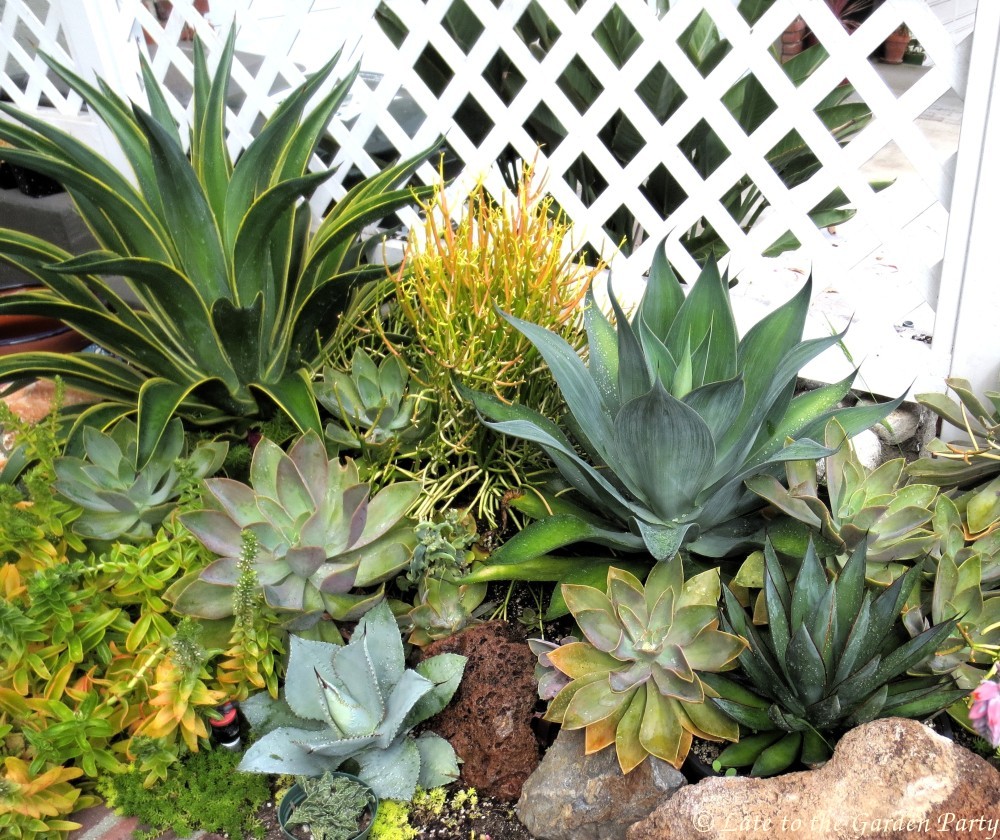
Close-up of Agave desmettiana, Graptoveria 'Fred Ives', Euphorbia tirucalli and Crassula capitella 'Campfire' 

Agave 'Blue Flame', Agave Blue Glow', more Graptoveria and Euphorbia, and Sedum rupestre 'Lemon Ball'

Another view of the plants shown above plus what I think is Agave pgymaea 'Dragon Toes'


The second tier planting bed on the right side featured (past tense) Opuntia santarita.  As it had become impossible to weed around the Opuntia, it was destined for removal when I visited.

Lynda intends to replace the Opuntia with another Agave 'Blue Flame'

Agave desmettiana, Euphorbia tirucalli and Kalanchoe fedtschenkoi 'Variegata' among other smaller succulents (Let me know if you can name the plant in front - I can't identify it Thanks to Jane, the plant in front has been identified as Crassula arborescens 'Blue Waves' aka Crassula ovata undulata)

The condemned Opuntia sandwiched between 2 Euphorbia tirucalli

Manfreda x 'Silver Leopard' backed up by Euphorbia and an unidentified Aloe


The succulent bed on the left side of the driveway is wider and serves as a divider between Lynda's property and that of her neighbor.  

Lynda added beach pebbles to create a pathway she could use when weeding the bed

Agave 'Joe Hoak' provides a focal point in this bed

Aloe cameronii (with what may be a crested Euphorbia in front)

Lynda has used plant repetition and contrasting foliage texture and color to great effect.  Since last July, she has removed the Abelia 'Kaleidoscope' that formerly shared the beds, added lots of rock, rearranged plants and added new ones.  It looks great now and I have no doubt that it'll look great next year too - only probably different.


All material © 2012-2015 by Kris Peterson for Late to the Garden Party