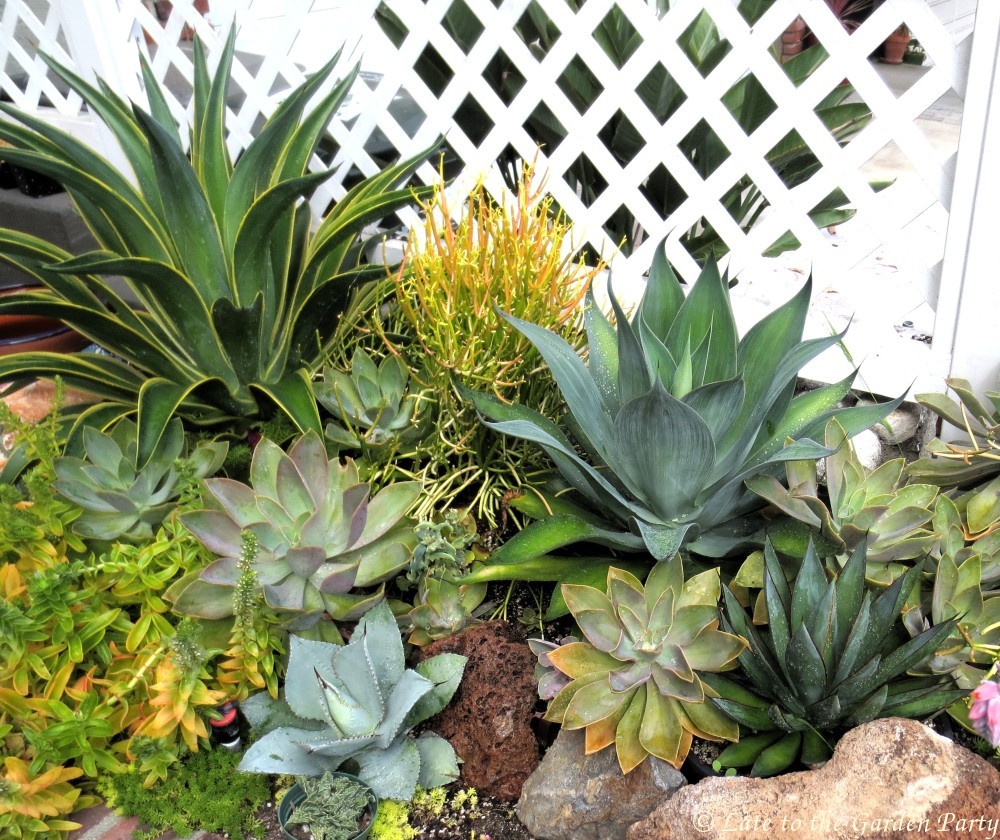
Showing posts with label xGraptoveria 'Fred Ives'. Show all posts

Friday, March 29, 2019

Foliage: Lost among the flowers?

In early Spring even the most foliage-focused gardeners I know can be distracted by the colorful blooms that take the stage by storm.  For someone like me who's a bit flower-obsessed to begin with, it can be difficult to even see the foliage for the flowers.  I recently took time to survey the foliage in my garden in a effort to balance my outlook.  I won't share every one of my foliage stand-outs (I covered many of these back in late December), just those that grabbed my attention for one reason or another this month.

The first one is a new introduction to my garden.

This is Acer shirasawanum 'Aureum' (aka Golden Full Moon Maple), a dwarf Japanese maple I picked up at my local garden center in late February.  It reportedly has requirements similar to other Japanese maples; however, I belatedly discovered that my Sunset Western Garden Book doesn't recommend this species for my area.  So far, it's doing alright in a protected area with morning sun exposure.  I'm crossing my fingers that it'll survive our summer.


As usual, many of my top foliage picks are succulents.

I thought all the Crassula I planted here next to the Aeonium arboreum was C. pubescens radicans but only some of it's developed that variety's characteristic deep red color.  I like the mix of colors in any case.

I grow a lot of Aeonium haworthii 'Kiwi'.  Last year, I added a variety called 'Kiwi Verde'.  I initially considered it 'Kiwi's' duller cousin but I've grown fond of it.  While it doesn't have the pronounced variegation 'Kiwi' is known for, the rosettes still develop attractive red edges and it's an even more robust grower.

Agave 'Blue Flame'  is making quite a statement in my south-side succulent bed this year

A couple of months ago, I added Aeonium 'Zwartkop' to embellish these 'Blue Glow' Agaves but  Lotus bethelotii 'Amazon Sunset' provides a nice accent too

Albuca spiralis 'Frizzle Sizzle' has emerged from its long underground nap


A variety of shrubs also caught my eye.

This is Artemisia californica, a California native as the name suggests.  It looked sad after summer's intense heat and I cut my 2 shrubs back hard.  They're looking great now.

Corokia x virgata 'Sunsplash' adds a subtle note of variegation to this bed in my front garden

Melianthus major has sprung back after I cut it nearly to the ground.  It provides a handsome contrast to Leucadendron 'Jester' and Phormium 'Amazing Red' here.

This is a plant I'd all but forgotten about until I cut back the ornamental grass that had threatened to envelop it.  It's Ochna serrulata, aka Mickey Mouse Bush.  I planted it in November 2014 and, even now, it's only a foot tall at best.  It's supposed to reach 8 feet in height at maturity but it certainly seems to be making a slow start.  It's an interesting plant, though, so I'll give it more time.

This is Pelargonium cucullatum 'Flore Plenum', possibly the most vigorous Pelargonium I've ever grown.  It produces pretty flowers but it's the foliage that originally attracted me.  Despite it's crinkly leaves, it's almost silky to the touch and it looks great when backlit.


I'll close with a succulent combination I'm particularly pleased with at the moment.

Graptoveria 'Fred Ives' and Hesperaloe parviflora make a happy combination


That's it for me this week.  Wherever you are, I hope you're treated to a warm, pleasant, sunny weekend.


All material © 2012-2019 by Kris Peterson for Late to the Garden Party

Friday, November 16, 2018

Touches of Fall Color

Although Pam at Digging no longer hosts her foliage follow-up meme, I'm still conditioned to think about foliage after collecting a glut of photos in preparation for Garden Bloggers' Bloom Day.  There isn't much in the way of fall color in my region of the country, especially as temperatures seem to be growing higher with each passing year, but our nighttime temperatures have markedly declined* recently so I took my camera outside and mounted a search.

The deciduous trees still aren't showing much color but I found two exceptions.

The coral bark Japanese maple (Acer palmatum 'Sango Kaku'), grown in a protected spot alongside our garage, is the only reliable provider of fall color I have

The noID persimmon at the edge of my cutting garden didn't produce any fruit this year but it has a touch of fall color, which isn't always the case.  A second persimmon tree on the other side of the fence has a little fruit but ugly brown leaves.

This year Leptospermum 'Pink Pearl' is obscuring the persimmon's best side

The persimmon doesn't look as impressive from this side, at least not yet


In the absence of real fall color, we look to plants that can mimic it.  Here's an example:

Graptoveria 'Fred Ives' has colored up nicely in the succulent garden on the south side of the house


My neighbor's maples are just showing the first signs of changing color but I expect it could be Christmas before they're flashy enough to show off.  I hope those of you in colder climates had a chance to enjoy the colors of fall before freezes hit or snow arrived.  Best wishes to all of you in the US in the sights of the Nor-easter.

*A "marked decline" here means temperatures occasionally dipped into the 40s.


All material © 2012-2018 by Kris Peterson for Late to the Garden Party

Monday, October 30, 2017

In a Vase on Monday: Nothing to be scared of

Tomorrow is Halloween but I couldn't get myself to do much in the way of decorating this year.  Turning on the morning news is enough to send chills down my spine so I don't need to add anything else to set nerves on edge, be it mine or anyone else's.  Our neighborhood doesn't attract many trick-or-treaters anyway.  It's off the main road; houses are a distance apart; and some have long driveways or locked gates.  Last year no one rang our bell.  In the years before, we've never had more than five costumed visitors here.  The candy I bought last year is still in the cabinet but as its "best by" date has come and gone, I'll give away single serving bags of popcorn if any kids show up.

I bought a few pumpkins and thought about decorating one with succulents as I did last year but I foolishly left the big one outside, where the squirrels took responsibility for carving it.  I was unable to find inspiration in the dead foliage left by last week's heatwave either so I kept things simple and created a vase using warm, autumn-hued flowers and berries.

To give the vase a little something different, I added a large succulent rosette front and center, anchoring the heavy cutting above water level using a wire "stem"

Rear view

Top view

I used just 4 elements: (top row) Grevillea 'Superb' and (bottom row, left to right) Correa 'Wyn's Wonder', Graptoveria 'Fred Ives', and Nandina domestica


I made up a second arrangement for the front entryway using Camellia sasanqua flowers.  Even though these plants are cozied up against the house on the north side, they surprised me by producing flowers during a week that delivered temperatures of 100F with humidity below 10%.

All the Camellia blooms had ants, which I don't remember being an issue in prior years.  I had the devil of a time getting rid of them before I put together my vase.

Clockwise from the upper left, the vase contains: noID Camellia sasanqua, Abelia 'Edward Goucher', Lotus jacobaeus, Alternanthera 'Little Ruby', and weed-like Helichrysum petiolare 'Silver Mist'

Even with the addition of dark elements in the form of the Lotus and Alternanthera stems, I can't claim the vase says "Halloween"


The autumn-toned arrangement landed on the dining table with the still intact mini-pumpkins.


I didn't entirely give up on Halloween decorations, though.

A skeleton hovers above the dining table arrangement from our chandelier.  My cat and rat skeletons sit outside the front door.  They had no impact whatsoever in scaring off the squirrels who destroyed my large pumpkin within 3 days.  I tossed what was left of it into the green bin for pick-up last week.


I hope your Halloween is a pleasant one, whether you're observing the event or not.  For more vases, visit Cathy at Rambling in the Garden.


All material © 2012-2017 by Kris Peterson for Late to the Garden Party

Friday, September 11, 2015

Lynda's Succulent Garden Revisited

In July last year, I posted photos of my friend Lynda's succulent garden.  Being both an artist and a perfectionist, she's continued to futz with both her design and her plant selections, which is good for me as every time she's planning a change usually means we make a trip to our favorite succulent garden center in Orange County.  In advance of one such trip, I took photos of the succulent beds in the front of her townhouse.

Her succulent beds are enclosed within tiered, brick-lined planters along the right and left sides of her sloped driveway.  Here's the first tier on the right side.

The bed is tightly packed but the plants are very happy

Close-up of Agave desmettiana, Graptoveria 'Fred Ives', Euphorbia tirucalli and Crassula capitella 'Campfire' 

Agave 'Blue Flame', Agave Blue Glow', more Graptoveria and Euphorbia, and Sedum rupestre 'Lemon Ball'

Another view of the plants shown above plus what I think is Agave pgymaea 'Dragon Toes'


The second tier planting bed on the right side featured (past tense) Opuntia santarita.  As it had become impossible to weed around the Opuntia, it was destined for removal when I visited.

Lynda intends to replace the Opuntia with another Agave 'Blue Flame'

Agave desmettiana, Euphorbia tirucalli and Kalanchoe fedtschenkoi 'Variegata' among other smaller succulents (Let me know if you can name the plant in front - I can't identify it Thanks to Jane, the plant in front has been identified as Crassula arborescens 'Blue Waves' aka Crassula ovata undulata)

The condemned Opuntia sandwiched between 2 Euphorbia tirucalli

Manfreda x 'Silver Leopard' backed up by Euphorbia and an unidentified Aloe


The succulent bed on the left side of the driveway is wider and serves as a divider between Lynda's property and that of her neighbor.  

Lynda added beach pebbles to create a pathway she could use when weeding the bed

Agave 'Joe Hoak' provides a focal point in this bed

Aloe cameronii (with what may be a crested Euphorbia in front)

Lynda has used plant repetition and contrasting foliage texture and color to great effect.  Since last July, she has removed the Abelia 'Kaleidoscope' that formerly shared the beds, added lots of rock, rearranged plants and added new ones.  It looks great now and I have no doubt that it'll look great next year too - only probably different.


All material © 2012-2015 by Kris Peterson for Late to the Garden Party

Thursday, October 16, 2014

Foliage Follow-up - Celebrating Succulents

Summer here in Southern California takes its toll.  At this time of year, most of my plants are looking a little worse for the wear.  That's especially true this year as we're in a severe drought and, like many people, I've reduced my supplemental irrigation in response to pleas to conserve water.  2013 was our driest year on record and 2014 isn't shaping up to be much better.   Under these conditions, it's the perfect time to celebrate succulents, which generally get by with very little water or attention.  So, for this month's foliage follow-up, an event posted by Pam at Digging, I'm focusing on a few of my ever-expanding succulent collections.

I had very few succulents at my former house - all I can recall is a scattered planting of Aeonium 'Kiwi' and Calandrinia grandiflora (aka Cistanthe grandiflora) along the driveway.  Now I have succulents in pots large and small, as well as borders.

I put this first planter together 2 years ago this month, using a container that formerly functioned as a friend's fountain, and it remains one of my favorites to this day:

This planter contains Aeonium haworthii 'Kiwi,' Aloe 'Delta Delight,' Crassula 'Ivory Pagoda,' Dyckia 'Burgundy Ice,' Echeveria 'Violet Queen,' Graptoveria 'Fred Ives,' and Senecio radicans glauca


This next pot, which sits on the same patio, was planted in March of this year:

It contains Aloe deltoidonta, Cotyledon orbiculata (aka Pig's Ear), Senecio vitalis and 2 other succulents for which I have no record


Another, assembled that same month, sits along a path on the other side of the house:

This pot, and its twin on the other side of the path, contains Euphorbia 'Dean's Hybrid' (not a succulent), Graptoveria 'Fred Ives,' Portulacaria afra, and Rhipsalis ewaldiana


My biggest succulent planting effort yet is a long street-side border.  It's still a work in progress - there's a lot of blank space yet to fill.  I'll provide an update soon but I thought I'd highlight one recent addition, an Agave desmettiana 'Variegata,' acquired at a very reasonable price of $20 complete with 11 usable pups!  In these parts, that's what we call a bargain.

The mother plant is surrounded on the left and right sides by 2 of her pups


My thanks to Pam for hosting this celebration of foliage plants.  Visit her blog page to see what foliage is grabbing her attention right now and to find links to other gardeners' foliage picks.


All material © 2012-2014 by Kris Peterson for Late to the Garden Party


Thursday, July 31, 2014

My favorite plant this week: x Graptoveria 'Fred Ives'

As I seem to be fixated on succulents this week, it's only appropriate that I feature a succulent as my favorite plant of the week.  Since planting a new succulent bed last weekend, I've had my eyes open for succulents elsewhere in my garden that I might use to provide cuttings to fill in some of the bed's empty spaces.  I quickly fixated on x Graptoveria 'Fred Ives,' a hybrid mix of Graptopetalum paraguayense and Echeveria gibbiflora.  I've got 'Fred Ives' in at least 4 pots, as well as my backyard border.

A single rosette in the decorative pot I picked up at the Spring Garden Show at South Coast Plaza 

2 rosettes in a pot marking the transition from the side yard to the backyard

A clump of 'Fred Ives' in the backyard border


After looking into 'Fred Ives' parentage, I realized that I also have the parent plants in my garden.

This Graptopetalum paraguayense was part of a 6-pack I planted in my new succulent border

I believe this is an Echeveria gibbiflora, although it didn't have a label when I purchased it


I love the various hues 'Fred Ives' takes on based under different growing conditions.  It can handle anything from full sun to partial shade.  In semi-shady spots, like the one occupied by the pot in the picture at the top of the post, grayish-green and turquoise tones dominate but, in sunnier settings, like those shown in the second and third photos, pinkish-bronze tones appear.

Most of my plants are between 6 and 8 inches (15-20 cm) tall but one, in a large pot receiving morning shade and afternoon sun, is more than a foot (30.5 cm) tall and wide.


I discovered that this plant had produced an elongated stem that reached down behind the pot.  It detached easily when I tugged it upward.  Even by succulent standards, the plant has a reputation for easy reproduction.  The piece I removed already had lots of hairy pink roots.


I was more surprised to find a tiny plant developing on a shriveled leaf that had fallen off the plant in the backyard border.


The succulent flowers too.  My largest plant produced sprays of small yellow flowers on long stems earlier this year.

The flowers are shown in this picture taken in late April


Like most succulents, it's drought-tolerant, although some on-line sources claim that it grows faster with extra water.  It's said to handle over-watering well, which allows it to be combined with plants with greater water needs, as in the case of the plant in my backyard border.  According to San Marcos Growers, it tolerates low temperatures in the 25-30F (-3.9 to -1C) range.

x Graptoveria 'Fred Ives,' a native of Mexico, is my contribution to the favorite plants meme hosted by Loree of danger garden.


All material © 2012-2014 by Kris Peterson for Late to the Garden Party