Ominous rain forecasts followed us all weekend but both Saturday and Sunday were relatively sunny, if not exactly warm. The onset of rain was pushed back several times but Monday will almost certainly see some and, unless the forecasters are really off their game, Tuesday will see more. The front page of the Los Angeles Times on Sunday featured a front page article on my area's long-running issue with a slow-ball landslide that started in 1956 and continues to this day. The affected area is about five miles from us but it's a cautionary tale. Last July, just ten miles away, a nearby city on our peninsula lost a dozen homes built in the 1970s to a slide that dropped eight of them forty-five feet down into a canyon in only hours. Although that slide occurred months after the end of our rainy season, the higher rainfall we had was identified as the principal cause. A geological survey we'd done in 2019 indicates that our seventy-plus year old house is on bedrock so we hope we're okay whatever comes with these atmospheric rivers.
Blue seemed the appropriate color to accompany the rain and, once I looked around a bit, I found more in that color than I'd anticipated.
My blue Anemones took center stage but I also turned up some white flowers, including scented Freesias
Back view: I used stems of a noID Ceanothus as filler material, along with a handful of early sweet pea blooms
Top view
Clockwise from the upper left: Felicia aethiopica, white Freesia, Lathyrus odoratus (maybe from 'Mermaid's Dream' mix), Anemone coronaria, Osteospermum '4D Silver', Teucrium fruticans 'Azureum', and noID Ceanothus
Here's a musical accompaniment, a short version of 'Rhapsody in Blue' from Warner Brothers (circa 1945), should you wish to listen to it as you finish reading this post.
I've been planning to cut stems of Grevillea sericea for some time but was at a loss as to what I could use to complement its small, delicate flowers. Inspiration was found in the flowers of the sweet pea bush and my second arrangement came together better than I'd hoped, although I suspect the arrangement looks better up close than in photos.
A noID Anemone planted years ago appeared in my cutting garden with a white bloom bearing just a faint hint of pink, its name now lost. The pinky-purple Osteospermum flowers stole the show from both the Anemone and the Grevillea flowers.
Back view
Top view: I added stems of what I think is an Ageratum of some kind, although I have no record of planting it and it grows far taller than A. houstonianum, the species commonly grown here. It also acts like a shrub, not an annual. It produces white floss-like flowers. The stems I cut have buds but aren't yet in bloom. I doubt they'll flower in a vase but I thought their buds were attractive enough to use as a filler.
Clockwise from the upper left: noID Ageratum, Cuphea 'Starfire Pink', Daphne odora, noID Anemone coronaria, Grevillea sericea, Polygala myrtifolia, and Osteospermum '4D Pink'
My husband and I celebrated our anniversary over the weekend. He made one of my favorite meals for dinner and brought me an orchid so the kitchen island has its requisite decoration.
The pot contains 2 Phalaenopsis and a clump of Dracaena marginata
In my coastal Southern California climate, we generally see the early signs of spring by mid-February. This year is no exception, although colder-than-usual temperatures and a late start to our rainy season has the floral stampede lagging behind last year's display. Nonetheless, I expect I'm still giving gardeners in much of the Northern Hemisphere a run for their blooms.
I've assigned starring roles to half a dozen plants. Keep in mind that this award is governed by a jury of one.
My blue Anemone coronaria make me happy whenever I pass them in my cutting garden. They've been producing flowers continuously for more than a month now. I've been cutting them for vases every week, even when I don't share them as part of the "In a Vase on Monday" meme.
The 4 Arbutus 'Marina' trees lost all their blooms when they were pruned in late October. The flowers reappeared en masse with the recent rainstorms.
I love the foliage of Aeonium arboreum but I'm not entirely fond of the succulent's dunce-cap shaped, florescent yellow flowers; however, they're prolific and the bees love them
The sulfur yellow flowers of Euphorbia rigida stand out beautifully against the bluish succulents in my garden
Similarly, Euryops chrysanthemoides 'Sonnenschein' adds a sunny element to the shady area outside the lath house
Felicia aethiopica is still going strong. I'd always assumed that these would make poor cut flowers but I learned they do quite well in a vase, which makes me love the small shrubs even more.
New blooms are showing up almost daily. Here are some of the newest arrivals:
The flowers of Ceanothus arboreus 'Cliff Schmidt' are mostly congregated at the top of the tree-sized plant, which made it awkward to photograph. The bees don't care.
I'm amazed every year when Daphne odora blooms as I never thought it'd survive in my garden. My only concern is that something always nibbles at the leaves.
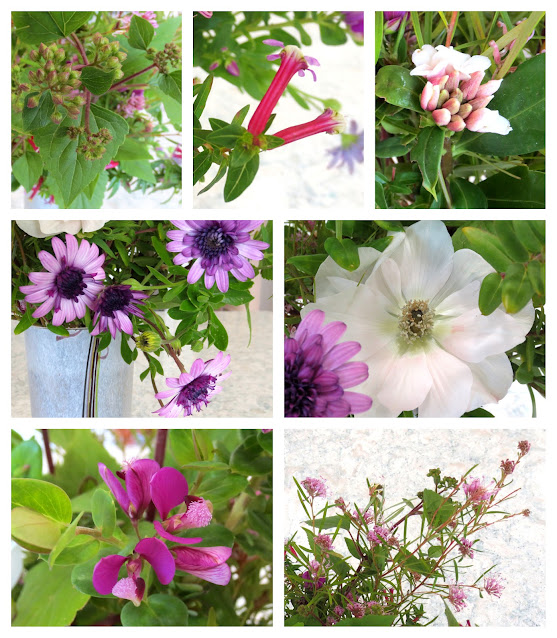
Clockwise from the upper left, other new arrivals include: Arctotis 'Pink Sugar', Calliandra haematocephala (aka red powder puff), the first Freesia, Centranthus ruber, Ipheon uniflorum (aka spring star), Pyrethropsis hosmariense (aka Moroccan daisy), and the second Freesia to bloom
Even I was surprised by a few particularly early arrivals.
The first sweet pea blooms (possibly part of Lathyrus odoratus 'Mermaid's Dream' seed mix), first Leucospermum 'Sunrise' flower, and first Sparaxis tricolor bloom
As usual, the backbones of my garden have shown up.
The flowers of Grevillea sericea are small and pale in color but they're currently abundant
Grevillea 'Scarlet Sprite' produces more flowers every day
Clockwise from the upper left, other Grevilleas currently in bloom include: Grevillea alpina x rosmarinus, G. 'Peaches & Cream', G. 'Superb', G. rosmarinus (dwarf form), and G. lavandulacea 'Penola'
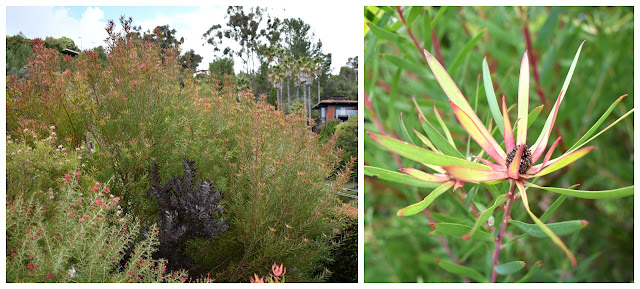
I'm still not quite ready to cut back the massive Leucadendron salignum 'Chief'
Leucadendrons 'Summer' Red' and 'Safari Sunset' also look too good to cut back yet
I've begun to cut back Leucadendron 'Wilson's Wonder' already and will probably finish the job before the month is over
The Osteospermums are still taking their time to flesh out. I expect some of the small shrubs could use replacing but there isn't a good selection of the double-petaled varieties I like best yet.
Camellia williamsii 'Taylor's Perfection' dropped a lot of flowers during the earlier rainstorms but it hasn't thrown in the towel yet
What's missing from this post by comparison to last February's bloom report are the Hippeastrums. I've cut half a dozen stems since January. I've got plenty of buds left but only one plant currently has a bloom. I'll be moving all of those in pots under cover before the next storm arrives on Sunday.
Hippeastrum 'Evergreen', a Cybister type originally hybridized in South America
As always, I've assembled photos of flowers with lower profiles as part of collages organized by color.
Clockwise from the upper left: Aloe striata x maculata, Antirrhinum majus, Cuphea 'Honeybells', noID orange Gazania, Lobelia laxiflora, and Metrosideros collina 'Springfire'
Antirrhinum majus, Fuchsia 'Windchimes White', and Nemesia 'Nessie Plus White'
Top row: Antirrhinum majus, Arctostaphylos bakeri 'Louis Edmunds', and Arctotis 'Opera Pink' Middle: Bauhinia x blackeana (aka Hong Kong orchid tree), Boronia crenulata 'Shark Bay', and Coleonema pulchellum 'Sunset Gold' Bottom: Cuphea 'Starfire Pink', Hebe 'Wiri Blush', and noID Kalanchoe (maybe K. fedtschenkoi)
Clockwise from the upper left: Argyranthemum 'Grandaisy Red', Helleborus 'Anna's Red', magenta Pericallis hybrid, and Ribes viburnifolium (aka Catalina currant)
Top row: Delphinium grandiflorum, Echium handiense, and Geranium 'Tiny Monster' Middle: Lavandula multifida, Limonium perezii, and Pericallis hybrid Bottom: Polygala myrtifolia, Salvia rosmarinus (aka rosemary), and Viola cornuta 'Penny Peach'
That's it from me for this month's bloom day coverage. Two more atmospheric rivers are due to arrive back-to-back this weekend. Those may leave me with soggy flowers once again, or spur other plants to burst into bloom. We shall see. Best wishes for a pleasant weekend and, if you haven't already done so, check in with Carol at May Dreams Gardens for more Garden Bloggers' Bloom Day posts.
I took advantage of a week of dry weather and sunny skies to tackle a few garden chores. The first involved finishing up the job that resulted from removal of a battered and over-sized 'Blue Flame' Agave in my south-side garden. When I published my post on the project, I'd already cleaned up the area, added soil suitable for succulents, and planted cuttings of blue chalksticks (Senecio serpens). I finished replanting the area this week.
I added a few more Senecio cuttings, a mix of Aeoniums, and an Agave ovatifolia that I'd purchased in a 4-inch pot several months ago and potted up in a 1-gallon container. As you can see, the agave's still very small. I've left a relatively wide path, partly to accommodate the agave's eventual size but also to facilitate maintenance.
All 4 Aeonium varieties in one shot. They're growing alongside an Acanthus mollis (left) that appears during our rainy season, then disappears during the hot summer months. As the Aeoniums fill out, I hope they'll hide the empty space during the summer season.
Top left: Aeonium 'Dark Star', branching variety that grows 2 feet tall and wide
Top right: Aeonium 'Jack Catlin', develops low-growing clumps with green centers and burgundy edges
Bottom right: green Aeonium 'Jack Catlin', needs sun to develop those red edges
Bottom middle: Aeonium 'Octo Ink', which sports a singular tall black rosette 1-2 feet in size
Bottom left: Aeonium 'Velour', branching variety with green centers and purple edges on lower leaves
*'Dark Star' and 'Octo Ink' are Steve Super hybrids. The others are cuttings from my garden.
I received delivery of eight plants I'd ordered by mail prior to the rainstorms and got all of those into the ground.
Clockwise from the left, all 8 plants have landed space in my garden: 2 more Arctotis 'Large Marge' have joined 3 mature plants in my back garden; groundcover Centradenia floribunda (aka Spanish Shawl) sits in a bare area of my front garden behind my new Protea "Claire'; Graptopetalum paraguayense 'Pinky' sits in a mixed bed near the driveway; Helleborus orientalis 'True Love' is a splurge that joins other hellebores in a shady area of the front garden; and 3 Papaver hybridum 'Lauren's Grape' found spots in the cutting garden
And yesterday I tackled pruning of a large shrub, one that wasn't on my original project list.
The shrub in question, Grevillea lavandulacea 'Penola' is barely visible in this shot taken from inside the house during a rainstorm last week
This long shot, which I think was also taken from inside the house during that rainstorm, provides only a nominally better view. I circled part of it just to make it more obvious. With its gray foliage and tiny red and white flowers, it's hard to make out at a distance, especially against a gray fence.
But, close up, its lovely flowers are densely packed along most of its branches
Sadly, I positioned it poorly, thinking I could espalier it along the fence. I've regularly tied it to supports attached to the fence, only to have it break away. The long branches were stretching into the path that leads down the back slope. I didn't take a before photo but I cut back or removed many of the branches that blocked the ease of movement down that concrete block stairway. I reduced the size of the plant by more than 25% and tied the largest remaining branches into the supports using plastic-covered wire. Whether this latest effort to manage the shrub this way will be successful is yet to be determined.
More rain is on the horizon. There are two more back-to-back atmospheric rivers currently forecast to show up Saturday and continue into Tuesday. We got off easy with the earlier storms, ending up with only a chimney leak and relatively minor damage to my lath (shade) house; however, others in California didn't fare nearly as well. Over four hundred mudslides were reported, as well as nine deaths. As the ground hasn't had much time to dry out we can only hope that those in the most vulnerable areas will be better prepared this time.
Note: I hope to publish my Garden Bloggers' Bloom Day post on Friday, February 16th.
We got more rain than expected last week, albeit the only snow nearby was in the mountains to the east of us.
Photo from our back garden looking east. The Port of Los Angeles is in the foreground and the City of Long Beach is visible in the mid-range area. The mountains beyond are usually obscured but they showed off their snowy caps clearly after storms scrubbed away the smog.
Many of my flowers were left in a soggy state and finding enough to fill a couple of vases was harder than I'd anticipated on Sunday. The Hippeastrum 'Exception' I used last week was in passable condition so I put together another arrangement recycling it as the centerpiece.
I reduced 'Exception's' stalk by almost half and cut off 2 of the blooms that were browning around the edges
Back view: I used more feathery foliage than I assembled last week and added stronger punches of color
Top view
Clockwise from the upper left: Alstroemeria 'Inca Vienna', a noID Alstroemeria, Antirrhinum majus, Boronia crenulata 'Shark Bay', Chlorophytum comosum (aka spider plant), Coleonema pulchellum 'Sunset Gold', and Hippeastrum 'Exception'
I created a second arrangement using Hippeastrum 'Elvas'. It wasn't in perfect condition but I patched together a vase with a nod to Valentine's Day.
I hunted down red flowers to play off the red edges of 'Elvas'. I can usually count on the feathery flowers of Calliandra haematocephala (aka red powder puff) at this time of year but they're only just getting started.
Back view
Top view
Clockwise from the upper left: Alternanthera 'Little Ruby', Calliandra haematocephala, Leptospermum 'Copper Glow', Grevillea lavandulacea 'Penola', and Hippeastrum 'Elvas'
Best wishes for a happy Valentine's Day! We expect sun today but mostly cloudy skies through the rest of the week, probably culminating with the arrival of another atmospheric river on Saturday.