We received a great deal of rain between November 13th and November 21st, at least by our standards. According to my rooftop rain meter, it was nearly three inches and it could've been more as the meter was clogged for almost a day during the height of the first storm. Unfortunately, my flowers took something of a beating so I was left to collect a lot of bits and pieces to fill my first vase, which was inspired by the last of dahlias that'd surprised me by blooming earlier this month, long after I'd given up on it flowering at all.
Not only was the dahlia late to flower, it also wasn't anything close to what what the tuber's seller advertised. My best guess is that it's Dahlia 'Ferncliff Illusion'. I cut the last fully opened flower and one partially opened bud and then disposed of the tuber.
Back view: I used 2 stems of Polygala (aka sweet pea shrub) to create a base to support the dahlia and squeezed in lots of other small stems, including the 2 stems of the Chrysanthemum 'Fairbank Purple Spoon' shown in this view.
Overhead view
Clockwise from the upper left: Abelia grandiflora 'Hopley's Variegated', Argyranthemum 'Everest', Gomphrena decumbens 'Itsy Bitsy', mystery Dahlia (possibly 'Ferncliff Illusion'), Chrysanthemum 'Fairbank Purple Spoon', Matthiola incana in ivory and magenta, and Polygala myrtifolia
Protea 'Claire' produced two especially nice flowers this week and I couldn't resist cutting them for a simple arrangement.
These 2 Protea flowers opened more fully than those I've previously cut. I used the dark Leucadendron 'Ebony' to play off the dark center of the Protea's flower. 'Ebony' is a sport of L. 'Safari Sunset', which I purchased for a song years ago before it'd been clearly differentiated from 'Safari' by sellers.
Back view
Overhead view
From left to right: Leucadendron salignum 'Blush', L. 'Ebony', and hybrid Protea 'Claire'
Our Thanksgiving holiday is later this year than usual but the holidays still feel as if they've arrived all too soon. But then it's hard to feel excited this year with the continual horrors pouring out of our federal government. My husband and I'll have a quiet Thanksgiving but I'm scheduled to meet up with a group of girlfriends the following Sunday, which I'm looking forward to. Since we've all retired and some of us have scattered, this group meets all too infrequently.
I've been happy to see that the lisianthus plants I happened upon at my local garden center six-plus weeks ago have started to bloom, even if I've yet to see blooms on any of the plants that were supposed to have blue flowers. I cut two stems of the lavender-blushed variety again this week but used different flowers and foliage to complement them.
The lavender blooms of Polygala myrtifolia and Pelargonium peltatum look better with the lisianthus (Eustoma grandiflorum) than the flowers I selected last week
The shiny dark green Ceanothus foliage I used is nice but, in retrospect, this back view could've benefited from some lighter elements
Top view
Clockwise from the upper left: Ceanothus griseus horizontalis 'Carmel Creeper', Leucadendron 'Jubilee Crown', Pelargonium peltatum 'Lavender Blizzard', Eustoma grandiflorum, and Polygala myrtifolia (aka sweet pea shrub)
I've been planning to cut the flowers of Tagetes lemmonii (aka Mexican marigold) for a few weeks now but, as my husband dislikes their scent, I knew I couldn't use too many stems without annoying him. I clipped flowers from two other shrubs, Senna bicapsularis and Grevillea 'Superb' to fill out the arrangement. The Senna flowers are on their way out but the ever-blooming Grevillea is always available to fill out a vase.
The color mix is very autumnal but I wasn't entirely happy with it, at least in this view
Back view
Top view: I did like this particular view
Clockwise from the upper left: Agonis flexuosa 'Nana', berries of Auranticarpa rhombifolium, Cotinus coggygria 'Royal Purple', Grevillea 'Superb' (shown with a seed head of Echinacea purpurea), Senna bicapsularis, and Tagetes lemmonii
Our temperatures have been vacillating but we've had several days of warm afternoon readings in the low to low-to-mid 70sF (21-24C), which have been prompting the Ranunculus and Anemone bulbs to sprout. Temperatures could go higher still beginning next weekend. Meanwhile, our "water year" total (counted from October 1st) stands at 0.19/inch with little to no rain in sight. If Santa could deliver rain, I'd send him a letter...
With the extra rain we've had for two years in a row, my garden exploded this spring. I spent a good part of last week just pulling weeds and clearing paths covered by excessively exuberant plants - and I've barely made a dent in many areas. When it came time to cut flowers for "In a Vase on Monday," I decided to see if I could find any vase-worthy Matilija poppies at the bottom of our back slope. As I headed down there, I realized that, despite my efforts to tidy-up the area two weeks ago, it's more chaotic than ever now.
I took this photo after my first pass at cleaning things up earlier this month. It was relatively neat even if the pathways were narrow; however, while I moved on to other areas of the garden, blissfully believing everything was tidy enough on the slope for awhile, the plants didn't stop growing taller and wider at lightning speed.
I had to cut tall, flopping stems of Centranthus and succulent flowers and artichoke plant foliage just to make it down the concrete-block stairway. And a machete would've been useful to reach the poppies! I spent more time cutting back and pulling spent plants and weeds than cutting flowers.
I managed to get 4 intact poppies (Romneya coulteri) and one promising bud, while shattering the petals of a few more in the process. Some readers may remember that I've tried to rid my garden of this plant, which spreads by adventitious rhizomes, and repeatedly failed. Another attempt will be made this fall.
Back view: The Japanese honeysuckle, which came with the garden and is firmly entrenched within the rampant ivy that blankets the upper level of the slope, is also impossible to get rid of without resorting to poisons. At least it has a nice scent!
Top view
Clockwise from the upper left: Leucospermum 'High Gold', Lonicera japonica, Romneya coulteri, and Tagetes lemmonii (aka Mexican marigold)
While I was down there, I was astounded to see that the bearded Irises were more floriferous than ever before. I cut two tall stems with multiple blooms as the starting point for a second arrangement.
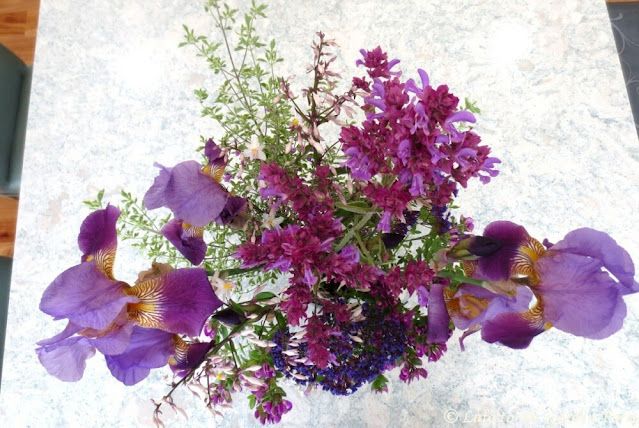
This is another arrangement that looked better to me when stuffed in the bottle I used to collect my materials than after I formally arranged them in a proper vase. I probably should've picked a different vase and left out the Limonium, both of which come across as too blue by comparison to the Iris, although the differences are less jarring in person than in these photos.
Back view: In addition, the delicate Renga lilies (Arthropdium cirratum) got lost among the other elements
Top view
Clockwise from the upper left: Arthropodium cirratum (aka Renga lily), Limonium perezii (aka sea lavender), Nemesia, 'Nessie Plus White', noID Iris germanica, Polygala myrtifolia, Prostanthera ovalifolia 'Variegata', and Salvia canariensis var candidissima
I still need to haul two piles of debris up the slope and I plan to spend at least a couple more hours there this week in an effort to rein in the mess. Meanwhile, the march toward summer continues and the cutting garden needs to be cleared out soon to make way for dahlias and other summer bloomers.
Ominous rain forecasts followed us all weekend but both Saturday and Sunday were relatively sunny, if not exactly warm. The onset of rain was pushed back several times but Monday will almost certainly see some and, unless the forecasters are really off their game, Tuesday will see more. The front page of the Los Angeles Times on Sunday featured a front page article on my area's long-running issue with a slow-ball landslide that started in 1956 and continues to this day. The affected area is about five miles from us but it's a cautionary tale. Last July, just ten miles away, a nearby city on our peninsula lost a dozen homes built in the 1970s to a slide that dropped eight of them forty-five feet down into a canyon in only hours. Although that slide occurred months after the end of our rainy season, the higher rainfall we had was identified as the principal cause. A geological survey we'd done in 2019 indicates that our seventy-plus year old house is on bedrock so we hope we're okay whatever comes with these atmospheric rivers.
Blue seemed the appropriate color to accompany the rain and, once I looked around a bit, I found more in that color than I'd anticipated.
My blue Anemones took center stage but I also turned up some white flowers, including scented Freesias
Back view: I used stems of a noID Ceanothus as filler material, along with a handful of early sweet pea blooms
Top view
Clockwise from the upper left: Felicia aethiopica, white Freesia, Lathyrus odoratus (maybe from 'Mermaid's Dream' mix), Anemone coronaria, Osteospermum '4D Silver', Teucrium fruticans 'Azureum', and noID Ceanothus
Here's a musical accompaniment, a short version of 'Rhapsody in Blue' from Warner Brothers (circa 1945), should you wish to listen to it as you finish reading this post.
I've been planning to cut stems of Grevillea sericea for some time but was at a loss as to what I could use to complement its small, delicate flowers. Inspiration was found in the flowers of the sweet pea bush and my second arrangement came together better than I'd hoped, although I suspect the arrangement looks better up close than in photos.
A noID Anemone planted years ago appeared in my cutting garden with a white bloom bearing just a faint hint of pink, its name now lost. The pinky-purple Osteospermum flowers stole the show from both the Anemone and the Grevillea flowers.
Back view
Top view: I added stems of what I think is an Ageratum of some kind, although I have no record of planting it and it grows far taller than A. houstonianum, the species commonly grown here. It also acts like a shrub, not an annual. It produces white floss-like flowers. The stems I cut have buds but aren't yet in bloom. I doubt they'll flower in a vase but I thought their buds were attractive enough to use as a filler.
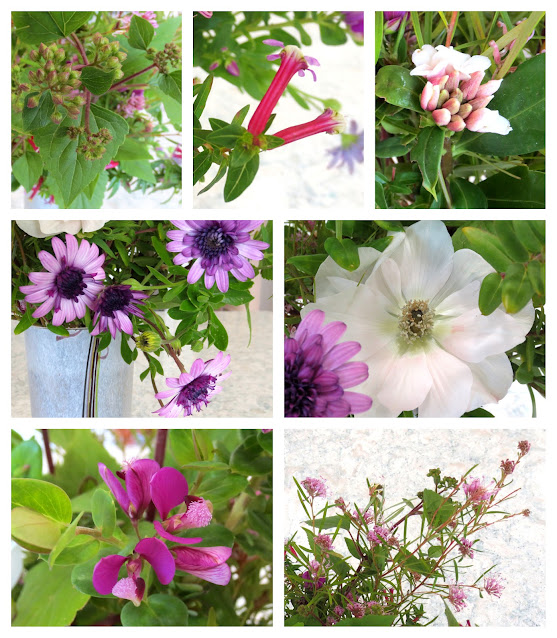
Clockwise from the upper left: noID Ageratum, Cuphea 'Starfire Pink', Daphne odora, noID Anemone coronaria, Grevillea sericea, Polygala myrtifolia, and Osteospermum '4D Pink'
My husband and I celebrated our anniversary over the weekend. He made one of my favorite meals for dinner and brought me an orchid so the kitchen island has its requisite decoration.
The pot contains 2 Phalaenopsis and a clump of Dracaena marginata
Yesterday was cold (from our viewpoint) and damp. We got almost half an inch of rain on Saturday but we had some sun that afternoon. In contrast, Sunday was cloudy and damp most of the day so collecting material to put together a vase wasn't nearly the pleasure it usually is. New Year's Day is expected to be much sunnier, at least by late morning, so hopefully the Tournament of Rose Parade won't disappoint the tourists!
My garden is still relatively low on flowers but I managed two arrangements anyway.
One of the 'La Paz' Hippeastrums I planted out in the garden last year surprised me with a bloom stalk. When planted in the ground they don't usually bloom until spring at earliest, if they bloom at all. The other 2 planted in the same area have yet to make an appearance but then a gopher tunneled through the area earlier.
Back view: As the Hippeastrum 'Apricot Parfait' I used past week was still in good shape, I added it to this arrangement to fill it out
Top view
Clockwise from the upper left: Alstroemeria 'Inca Lucky', Coprosma repens 'Plum Hussey', Leptospermum 'Copper Glow', Hippeastrum 'Apricot Parfait', Leucadendron 'Jester', L. 'Summer Red', L. 'Safari Sunset', and Hippeastrum 'La Paz'
With all my Christmas decorations tucked away, I needed another flower arrangement for the front entry.
This arrangement turned out a little lopsided but I gave up fiddling with it
Back view, showing off Hebe 'Purple Shamrock'
Top view
Clockwise from the upper left: Hebe 'Purple Shamrock' Pelargonium 'Lady Plymouth', Pericallis x hybrida (aka Cineraria, syn. Senecio cruentus), Pelargonium peltatum 'Lavender Blizzard', and Polygala myrtifolia
I hope your New Year's Day is a good one, sunny or not!
It's getting harder to pull together arrangements using what's blooming in the garden but I managed to do so again this week. My first arrangement was created around the last of the Amarines to flower.
I think the pale pink Amarine was upstaged once again, this time by a coleus rather than a dahlia. Amarines are hybrids of Amaryllis belladonna and Nerines.
Back view: I used a second stem of Plectranthus scutellarioides'Florida Sun Rose' (aka coleus) to dress up the back. The coleus stem in the front view is the one I used 3 weeks ago. It's developed roots and I hope to overwinter the cutting in my shade house.
Top view
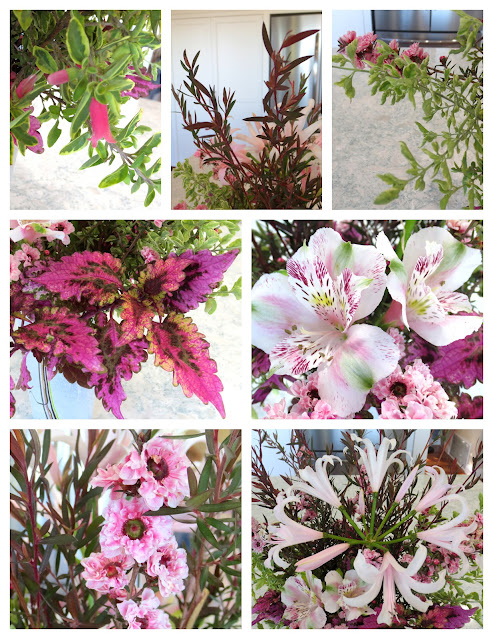
Clockwise from the upper left: Correa 'Wyn's Wonder', Leptospermum 'Copper Glow', Prostanthera ovatifolia 'Variegata', Alstroemeria 'Inca Vienna', Amarine belladiva 'Emanuelle', Leptospermum scoparium 'Pink Pearl', and Plectranthus scutellarioides 'Florida Sun Rose'
The second arrangement features some flowering plants emerging from their summer dormancy. Gomphrena 'Itsy Bitsy' has also returned with a mass of tiny blooms. I cut the shrub down to the ground months ago. The foliage bounced back quickly but the flowers took their time.
Stems of Polygala myrifolia (aka sweet pea bush) provided the base of this arrangement but it's really an ensemble cast
Back view
Top view
Clockwise from the upper left: Antirrhinum majus, Pelargonium peltatum 'Lavender Blizzard', self-seeded Osteospemum, Digitalis purpurea, Gomphrena decumbens 'Isty Bitsy', Polygala myrtifolia, and Vitex trifolia