Showing posts with label Acer palmatum 'Sango Kaku'. Show all posts

Wednesday, November 18, 2020

Wednesday Vignette: A touch of fall color

Coastal Southern California isn't known for fall color, and what little we get usually comes closer to winter than fall.  We had a good stretch of cold weather this month until Monday, when summer paid us a return visit.  Despite that blast of heat, yesterday I noticed that my coral bark maple (Acer palmatum 'Sango Kaku) had colored up nicely.

I have two other Japanese maples but this is the only one that's thrived probably because, planted against the garage, it's protected from the afternoon sun and the wind

On the other side of the cutting garden, Persimmon 'Fuyu' had also suddenly turned orange when I wasn't paying attention.

I could swear this color change happened in the matter of a day or two.  The leaves on my other persimmon ('Hachiya') never color up like this and most have already fallen.

The ornamental pear in our front garden and a neighbor's noID maple and Gingko trees usually lead with their color displays but for some reason these two trees in my cutting garden are off to an early start this year.

Luckily, Monday's heat was short-lived.  On Tuesday, I woke to the sound of fog horns in the Los Angeles harbor and knew it would be cooler even before weather forecasters confirmed that.

A thick blanket wrapped the harbor, leaving the shipping cranes jutting up above it like prehistoric creatures rising from the sea

Yesterday was a good day for gardening and I hope that will remain true for the balance of the week. Whatever your weather, I hope you're able to get out and enjoy what nature has to offer.

For more Wednesday vignettes, visit Anna at Flutter & Hum.


All material © 2012-2020 by Kris Peterson for Late to the Garden Party


Friday, November 16, 2018

Touches of Fall Color

Although Pam at Digging no longer hosts her foliage follow-up meme, I'm still conditioned to think about foliage after collecting a glut of photos in preparation for Garden Bloggers' Bloom Day.  There isn't much in the way of fall color in my region of the country, especially as temperatures seem to be growing higher with each passing year, but our nighttime temperatures have markedly declined* recently so I took my camera outside and mounted a search.

The deciduous trees still aren't showing much color but I found two exceptions.

The coral bark Japanese maple (Acer palmatum 'Sango Kaku'), grown in a protected spot alongside our garage, is the only reliable provider of fall color I have

The noID persimmon at the edge of my cutting garden didn't produce any fruit this year but it has a touch of fall color, which isn't always the case.  A second persimmon tree on the other side of the fence has a little fruit but ugly brown leaves.

This year Leptospermum 'Pink Pearl' is obscuring the persimmon's best side

The persimmon doesn't look as impressive from this side, at least not yet


In the absence of real fall color, we look to plants that can mimic it.  Here's an example:

Graptoveria 'Fred Ives' has colored up nicely in the succulent garden on the south side of the house


My neighbor's maples are just showing the first signs of changing color but I expect it could be Christmas before they're flashy enough to show off.  I hope those of you in colder climates had a chance to enjoy the colors of fall before freezes hit or snow arrived.  Best wishes to all of you in the US in the sights of the Nor-easter.

*A "marked decline" here means temperatures occasionally dipped into the 40s.


All material © 2012-2018 by Kris Peterson for Late to the Garden Party

Sunday, April 16, 2017

Foliage Follow-up - April 2017

I usually try to link my Foliage Follow-up selections together with some kind of theme but, after the intensity of my Bloom Day post, I'm just too dazzled by the glory of spring at the moment to bother with anything more than a hodge-podge series of photos of what caught my fancy on recent spins through the garden.

Acer palmatum 'Sango Kaku', one of only 2 Japanese maples in my garden, was late to leaf out this year so I was very pleased when it suddenly sprang to life

I'm also happy to see that at least 3 of my Artemisia versicolor 'Seafoam' are doing well (A few others, purchased as plugs, are struggling)

I continue to be tickled by the artichoke growing below a fig tree on the steep back slope.  It disappears during the height of summer but comes back with the winter rains and this year it's huge.  And now it has 2 chokes!

I'm also pleased with this Origanum 'Norton Gold', which I prefer out of rather than in bloom

Fuzzy gray seedlings grew up through the gravel and in other obscure places in the garden and, once I determined that they probably weren't weeds, I moved them to the cutting garden.  I'm fairly certain these are Stachys byzantina, although the leaves are thinner than those I've previously grown.  I'm not sure where the seedlings came from as the only place I've had Lamb's Ear for years is at the bottom of the back slope.

This is a mix of succulents growing in the sandiest soil in the garden, located next to the back patio.  Although the Agave colorata (right foreground) is still very small, I like how the rest of the plants, grown from cuttings and plugs, have filled in. The mix includes Aeonium haworthii 'Kiwi Verde', Crassula mesembryanthemodies, Graptosedum 'California Sunset', Kalanchoe orgyalis and Senecio scaposus.  The Kalanchoe was intended to complement Cordyline 'Electric Flash' but it perished.  They'll eventually be too big for this area but I'm enjoying them now.


For more foliage photos, visit our Foliage Follow-up host, Pam at Digging.  Best wishes for a happy spring!


All material © 2012-2017 by Kris Peterson for Late to the Garden Party

Thursday, April 16, 2015

Foliage Follow-up: Touches of Red

It's Foliage Follow-up Day and I'm joining Pam at Digging to recognize the significant role foliage plays in creating a beautiful garden.  For this month's post, I'm focusing on some of the foliage plants that add touches of red to my garden.

Agonis flexuosa 'Nana' is sporting lots of new growth in an orange-red color.  I have 3 of these peppermint-scented plants in the south-side garden bed adjacent to the patio.

The color of the Agonis' new growth is echoed in the foliage of Phormium 'Amazing Red,' Coprosma repens 'Plum Hussey' and various succulents

The same Agonis, photographed from the other direction

Close-up of the wavy stems and curly leaves of Agonis flexuosa 'Nana'


I love the Leptospermum polygalifolium 'Copper Glow' I planted in my front garden in November but it always seems to be either too dark or too sunny to get a good photograph.  The best I could do today was this:

A graceful stem of Leptospermum 'Copper Glow' hangs above Phormium 'Maori Queen'


Another relatively new plant with red touches is Dianella tasmanica 'Tasred,' which I picked up from the Australian Native Plants Nursery in March.

The base of these Dianellas is red 


During that same shopping trip, at Sperling Nursery, I picked up Helleborus 'Anna's Red.'

I presume that Helleborus 'Anna's Red' gets it's name from the color of its flowers but there's also a touch of red in the stems and the base of the leaf cluster


The biggest splash of red color I'll share today comes from an Aeonium I picked up early last year.  It didn't come with a label but my best guess is that it's Aeonium 'Garnet,' reported to be a hybrid of A. arboreum 'Zwartkop' and A. tabuliforme.

Unlike A. 'Zwartkop,' this Aeonium hasn't developed tall stalks


My last foliage pick this month is Acer palmatum 'Sango Kaku' (aka coral bark maple).  Planted early in 2011, not long after we moved in, it's the most successful Japanese maple in my garden, possibly because it had a chance to get established before I began ratcheting down the irrigation in my garden.  Its placement beside the garage, where it's protected from the wind and receives only morning sun, probably also helps.

Acer Sango Kaku' has almost fully leafed out


Visit Pam at Digging to see her foliage picks this month and find links to other gardeners' foliage picks.


All material © 2012-2015 by Kris Peterson for Late to the Garden Party

Friday, September 12, 2014

My favorite plant this week: Acer palmatum 'Sango Kaku'

I've always loved Japanese maples.  Even in my former, tiny garden, I had two of them.  So, although the climate of my current garden is hotter, drier, and far less shady, I had to have some here as well.  I currently have 3, of which Acer palmatum 'Sango Kaku,' also known as the coral bark maple, is my favorite.  I brought it home in 2011 with only the vaguest idea where to put it.  It ended up planted in a bed alongside our garage, facing the vegetable garden, where it has done surprisingly well thus far.


As you can see, 'Sango Kaku' is already sporting its autumn colors, and has been for perhaps a month already.  In May, it was mostly green but still flaunting its trademark coral trunk and stems.


In its current spot, it gets morning sun and afternoon shade, which may account for its healthy appearance.  In my experience, Japanese maples here do best with some shade.  This one had shown little in the way of tip and leaf burn, although I've read that those problems may become less prevalent as the tree matures.


In contrast, my poor A. 'Purple Ghost' is a stick, with only a tenuous hold on life.  I placed it on the southeast side of our property, where it was blasted by sun during the hottest time of the day; buffeted by Santa Ana winds when they blew; and pestered by raccoons burrowing at its base in search of grubs.  I've moved 'Purple Ghost' to a spot alongside 'Sango Kaku' in the hope that it will soon achieve the same level of health.

Acer palmatum 'Sango Kaku' is my favorite plant this week.  It provides a bright spot in my vegetable garden even when most everything else looks dreadful and it provides me a touch of autumn color, which is hard to come by in Southern California.

Please visit Loree at danger garden to find her favorite plant selection and those of other gardeners.


All material © 2012-2014 by Kris Peterson for Late to the Garden Party

Sunday, March 16, 2014

Foliage Follow-up: New Spring Growth

What's impressing me most in terms of foliage right now is the fresh spring growth on some of my deciduous plants.  The Japanese maples, in particular, can't be ignored.  I acquired 2 new Acer palmatum in February.  At the time of purchase, they both looked like sticks.  One month later, they're fleshing out nicely.

Acer palmatum 'Mikawa Yatsubusa' in mid-February

"Mikawa Yatsubusa,' planted in my new backyard bed, photographed yesterday

Close-up of leaves on 'Mikawa Yatsubusa'

Acer palmatum 'Purple Ghost' at time of purchase

'Purple Ghost' one month later, planted in my side yard


The coral bark maple I planted in March 2011 is running a little behind the 2 new trees but its first new leaves began appearing last week.  The light green leaves stand out against the coral bark.

New foliage on Acer palmatum 'Sango Kaku'


However, the most exciting discovery was that the Itoh peony I planted last May has produced new foliage.  More Itoh peonies have recently appeared in the local nurseries, tempting me with their fat buds despite their hefty price tags.  So far, I'm resolved to ignore their charms until I see whether the peony I've already got blooms for me this year.

Fresh foliage on Paeonia 'Keiko'


I'm afraid that the tree peony I planted in 2011 is still a stick, albeit a stick with tiny pink buds.

Honestly, the plant is almost invisible in my front border


I'm not holding my breath over the prospects of the tree peony but, just this past week, I added another peony to my limited collection.  This one hails from the Mediterranean region and isn't supposed to need the winter chill peonies generally prefer.  It arrived from Annie's Annuals & Perennials in a 4-inch pot so it may be a year or more before its charms can be assessed.  (You can find a photo of it in bloom here.)

Newly planted Paeonia cambessedesii (aka Majorcan Peony)


In response to our recent rain, my grape vine has also produced pretty green leaves.  At this stage it seems possible to believe that maybe, just maybe, I'll get some grapes before those dastardly birds and squirrels strip the vine clean.

Grape vine climbing the arbor my husband built to support it


These are my contributions to the monthly foliage follow-up hosted by Pam at Digging.  Please visit her blog to see her foliage picks this month and find links to other gardeners' selections.


Wednesday, November 6, 2013

Fall Foliage Envy

I've been enviously admiring all the wonderful fall foliage photos posted by other bloggers over the past month.  The color changes that accompany colder weather and shorter daylight hours in northern areas aren't as prevalent in southern California.  However, as I sat on a stationary bike running through my morning exercise routine earlier this week, a mirror in the room caught the reflection of colored leaves outside.  I'd almost forgotten that, in addition to colorful fruit, the persimmon trees on the northwest side of the house produced rather pretty fall foliage.

This is Persimmon 'Fuyu':


The leaves on Persimmon 'Hachiya' are running a little behind 'Fuyu' but the color changes are just as pretty.


The foliage on our Japanese maple (Acer palmatum 'Sango Kaku') is rapidly turning from yellow to brown.


The ornamental pear (Pyrus calleryana) is just beginning to take on some color but there's little in the way of leaf drop yet.


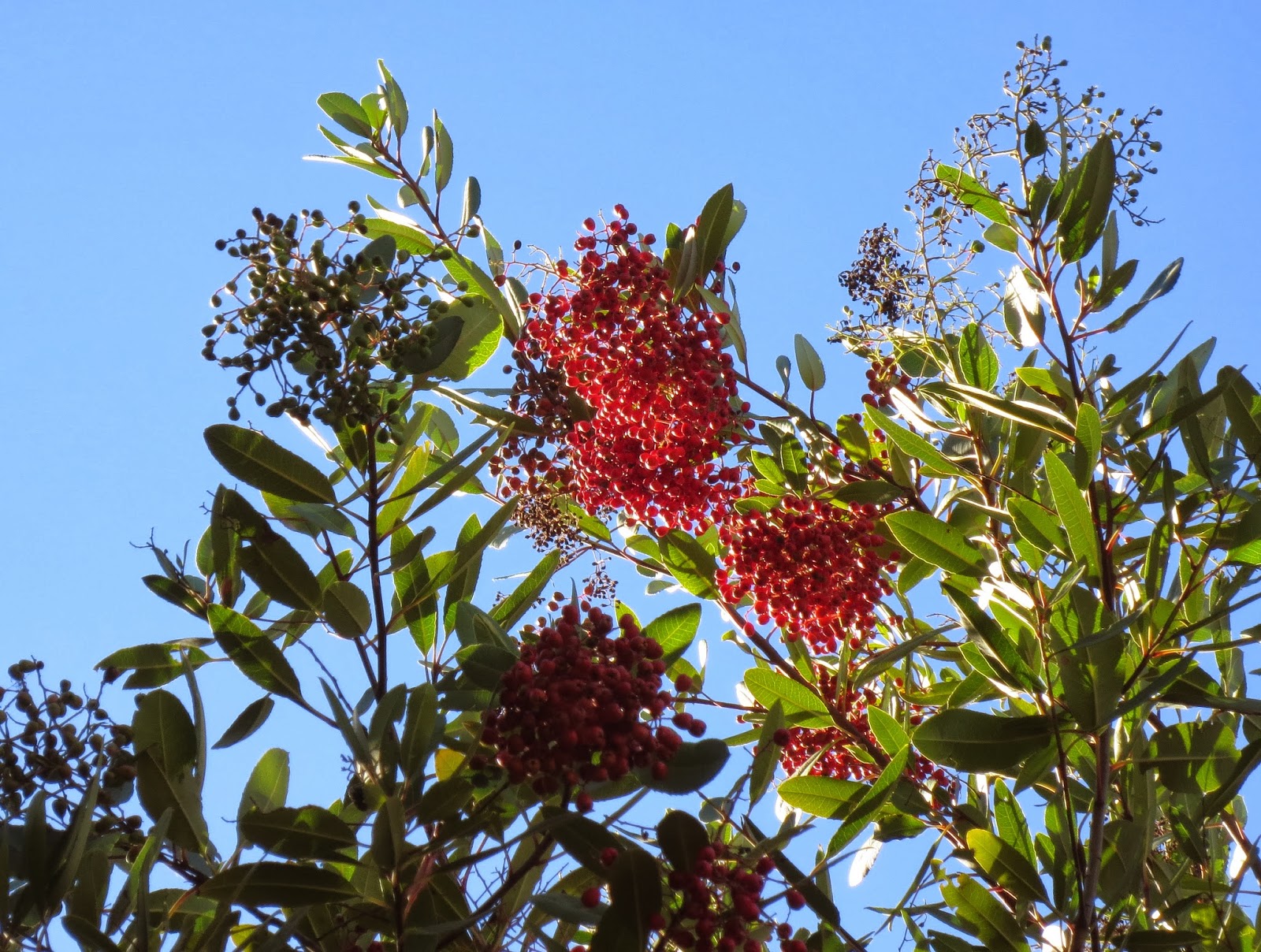
The toyon (Heteromeles arbutifolia) is also producing masses of bright red berries, another hallmark of fall here.  This tall evergreen shrub, also known as California holly, was designated as the official plant of Los Angeles last year.  Yes, Los Angeles has its own official plant (as you can read about here).  We lost one toyon as collateral damage when the Eucalyptus tree was removed from the side yard earlier this year but there's another very tall specimen at the border of our property.


I also found some small-scale color changes:

'Bountiful Blue' blueberry

The color change on this Euphorbia 'Dean's Hybrid' may be due to transplant shock rather than a seasonal change but it's pretty nonetheless

Trachelospermum jasminoides


This is fall, southern California style.