Showing posts with label ugly truths. Show all posts

Tuesday, June 2, 2020

Tell the Truth Tuesday (Late Edition): An Aster Takes Over

"Tell the Truth Tuesday" was promoted by Alison of Bonney Lassie as an opportunity for garden bloggers to come clean about the less-than-perfect aspects of their gardens.  Like proud parents, we want to show our gardens in the best possible light, hesitating to point out their deficiencies.  Maybe, as in my case, we even manage to ignore these until that's just impossible.

Last year, I noticed that my Pacific Aster (Symphyotrichum chilense 'Purple Haze') had spread beyond my expectations but I wasn't overly concerned.  When I planted it in 2016, I knew it spread by rhizomes but I understood that in low water gardens like mine it should be manageable, and it was, at least during our drought.  Then during our October 2018-September 2019 rain year, we got almost double our average precipitation.  And, while rain was lighter during our recent rainy season, even that was better than average.  Following the last rainstorm we had in early May, I finally confronted the fact that the aster is completely out of control.

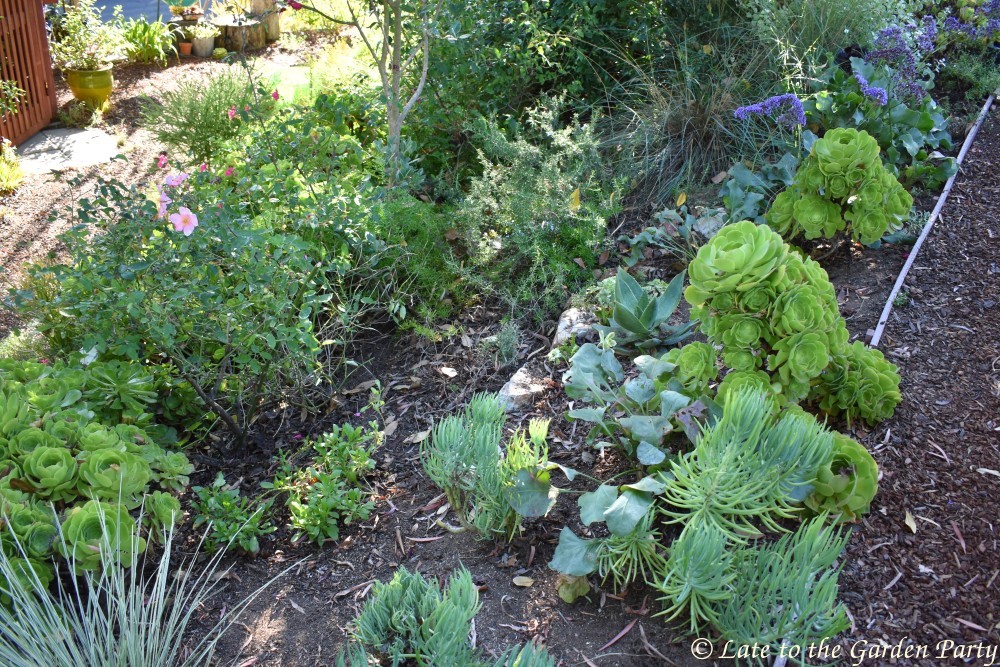
This is the bed's eastern flank and, even here, the aster is pushing into the flagstone path

It now stretches from one side of the bed to the other.  I only have record of putting in one plant but I vaguely recall that I added a second sometime shortly after planting the first one because it seemed to do so well...


It's a pretty enough plant but it's begun choking out plants all around it.

It's supposed to flower from August through October but it's off to an early start this year

Along its western flank it's now choking out the Liriope spicata I foolishly planted on that edge years ago.  I've been planning to take out the Liriope for some time.  Now, I guess I can tackle it and the aster at the same time.


The aster is deciduous but I'm not sure I should wait until late fall to start pulling it out.  It's already trying to march across the flagstone path into the bed on the other side.  I'll probably start by pushing back its eastern offensive before tackling its western flank.

Meanwhile, other plants in the same general area have also become overly "exuberant."  The bush violets (Barleria obtusa) are also trying to squeeze out their neighbors.

The plant to the left of the Echium webii in the center of this shot is a bush violet.  A second bush violet, nearly as large, had swallowed up the space between the Echium and the Lisianthus in the foreground.  I dug it up it last Saturday to give the Echium more space, uncovering a Gazania seedling in the process.


In addition, my "dwarf" Echium handiense doubled in size this year.

It looked great in February, when these photos were taken, although it was already large for the spot

When the first flower spires died back, I pruned it and it flowered again, albeit in a bushier fashion.  In mid-May when this photo was taken, it was covering a good portion of the flagstone path. 


Echiums tolerate tip pruning well but I took things much further than that this past weekend when I cut this one back to clear the pathway and give the surrounding plants breathing space.  I'm afraid it may not recover.

It looks pretty awful at the moment.  I'm half-tempted to pull it out but I may give it a little time to see if it'll recovers from my butcher job.  I wish I'd collected seed while I had the chance.  


Are you dealing with any out-of-control plants?  Do you have any problem areas you try not to see in your garden?  Come on, fess up!  Confession is good for the soul.


All material © 2012-2020 by Kris Peterson for Late to the Garden Party


Tuesday, August 6, 2019

Tell the Truth Tuesday (Late Edition): Summer Stress

Even during a relatively mild summer, as this one's been thus far, our Mediterranean climate puts a good deal of stress on garden plants.  We had a touch of rain in May, late in the season by our standards, but we've been dry since.  While the monsoonal rains in the desert areas to the east occasionally drift into our area, all we've had is Mother Nature's spit this year, providing enough dampness to dirty a car sitting in the driveway but not enough to register as rain.  In all likelihood, dry conditions will continue unabated until at least November.  Dryness, combined with temperatures in the upper 80s to low 90sF can suck the life out of plants that appreciate more hospitable environments, even with regular irrigation.

One area in particular screams "help!" every time I walk through my back garden.

This photo shows the area in question in mid-June (on the right side of flagstone path)

And this is the area as it appears now

Even though last year's rainfall was abysmal, the area didn't look half this bad in July 2018.  In fact, my mid-July 2018 Garden Bloggers' Bloom Day shots show that Achillea 'Moonshine' was still blooming well at that time.  In contrast, by mid-July this year everything in this area looked like it'd been run over by a bulldozer.  The area's collapse seemed relatively sudden, although admittedly my attention was focused less on the garden and more on remodel-related chaos at that time.  My first guess was that critters of some sort staged a mighty battle in this bed.  Our security cameras provided no clues to either support or refute that theory.  I also wondered if I relied more on hand irrigation last year than I did this year, or if gophers or other tunneling creatures damaged plants from under the ground.  I've no record tracking my hand-watering efforts, although I know I undertook emergency watering in early July 2018 when our temperature hit 110F.  As to gophers, I couldn't find any evidence of their presence on the surface.


This area, like the rest of the border is covered by an automated irrigation system.  I deep-watered it manually about 10 days ago, which gave it something of a boost, rewarding me with a few Amaryllis belladonna blooms.


In any case, I'm thinking this area needs an overhaul once cooler weather returns.*  At present, it's occupied by the following plants:

  • Achillea 'Moonshine'
  • Erigeron glaucus
  • Gazanias (self-sown)
  • Geranium 'Tiny Monster'
  • Narcissus 'White Lion' (currently dormant)
  • Scilla peruviana (currently dormant)


I'm considering introducing one or another shrub here that might be tough enough to handle summer conditions - and critters - in stride.

Another Echium webbii is one possibility but this one next to the fountain got bigger than its projected 3x3 foot profile, which I think would be a problem in the bed on the other side of the path 

Lupinus propinquus (syn. Lupinus arboreus) is another prospect.  This is one I had in my garden in 2016.  (The baby Echium webbii that replaced it can be seen nearby on its left, showing that I didn't have any understanding of how big the latter plant would eventually get.)  The Lupinus spread out more than up so it might be fine across the way next to the Achillea.  I loved it but it succumbed rather quickly to webworms in the fall of 2016 so I'd have to watch out for those.


In the short-term, I may plant up 2-3 pots and stick them in the afflicted area.  Or plant heat-tolerant annuals.  Or simply clean out the dead plant material, lay down compost, and wait out the summer.  I'm open to any and all suggestions for short- or long-term solutions to make this area less ugly.

Tell the Truth Tuesday is hosted on a periodic basis by Alison at Bonney Lassie to keep things real by sharing the less-than-perfect aspects of our gardens.


*Recent weather forecasts suggest that the North Pacific "Blob" has returned, which could lead to higher than average temperatures this fall.  Other reports suggest the possibility of a delayed rainy season.


All material © 2012-2019 by Kris Peterson for Late to the Garden Party

Tuesday, July 23, 2019

Tell the Truth Tuesday (Late Edition): Ladybugs needed

I was pleased when two of my Hesperaloe parviflora produced bloom spikes this year.  They weren't nearly as floriferous as those I saw in Austin, Texas last year but I felt my small collection of plants was headed in the right direction.

I took this photo of the Hesperaloe blooms in late June

The flowers still looked fine when I took photos for Garden Bloggers' Bloom Day in mid-July


Then this week I noticed that the smaller bloom spike didn't look right.

I took this photo yesterday.  Notice the bloom spike on the left.


From a distance, the flower spike on this plant seemed to have turned gray

But it was actually covered in tiny green sap-sucking beasties


Within little more than a week, when I wasn't looking, the aphids covered the entire flower spike.  It seems that the warmer weather brought them out.  I dealt with smaller infestations on the Gaura in my front garden in early spring but it was nothing like this.  I cut the entire spike and deposited it in the trash, then doused the Hesperaloes with insecticidal soap.  At present, the flower spikes on the adjacent plant don't appear to have any bugs at all.

After I'd cleaned up the aphid problem (at least for the moment), I noticed a nearby bed was in need of grooming.  It too had looked great in June.

Succulents comfortably mingled with purple-flowered Limonium perezii (aka sea lavender) here


As the Limonium started to fade I cut out the flower stems that no longer looked good.  One thing led to another and, after pulling some of rattier Limoniums, I cut back an overly exuberant trailing Osteospermum, rampant stems of asparagus fern (an inherited weed here), and some sickly pale stems of Senecio vitalis, revealing other plants I'd entirely forgotten about.

My clean-up is by no means complete but my knee can only handle so much time working on even a moderate slope like this one

I planted this Aloe striata x maculata early last year, along with Aeonium cuttings, then lost track of it entirely when it was engulfed by the Limonium.  There's another variegated succulent  just beyond it I haven't even identified yet. 


More clean-up - and perhaps a new planting vision - is needed to whip this area into shape, but that's a project for a cooler day.  The heat seems to have caught up with us at last.

Tell the Truth Tuesday is hosted on a periodic basis by Alison at Bonnie Lassie to keep things real by showing the less-than-Instagram-perfect features of our gardens.   Is your garden harboring any nasty bugs or hiding any lost treasures?  Do tell.


All material © 2012-2019 by Kris Peterson for Late to the Garden Party


Tuesday, July 9, 2019

Tell-the-Truth-Tuesday: Lost in a cloud

With my house in a state of chaos, I find myself needing to assert some control over my garden.  That impulse has been manifested mainly in clean-up activities thus far (but don't be surprised if I'm tearing up a bed or two in the near future).  Late last week, I noticed that the Wahlenbergia 'Blue Cloud' I'm so fond of for softening the sharp edges of the succulent bed on the south end of my garden had gotten rather out of control.

There are 3 Agave americana mediopicta 'Alba' in the mix here.  Can you see them?  Planted nearly 3 years ago as pups given to me by Hoover Boo of Piece of Eden, the Agaves had bulked up nicely following our winter rains but, wrapped up in a filmy cloud of blue flowers, you can barely see them here.


I started cutting the bellflower back but ended up pulling large sections of it out where it had woven itself in the narrow spaces between succulents.  It remains to be seen whether I went too far.  My guess is it'll come back.

As it is, the Lessingia 'Silver Carpet' is also doing its best to engulf the variegated Agave in the foreground


In any case, it looks a bit neater, doesn't it?

Tell-the-Truth-Tuesday is the brainchild of Alison at Bonnie Lassie.  Do you have any garden woes or faux-pas you'd like to share?


All material © 2012-2019 by Kris Peterson for Late to the Garden Party

Wednesday, June 12, 2019

Wednesday Vignette: The Price of Inattention

Back in April, in a Tell the Truth post, I included photos of the clover (Trifolium repens) overtaking the flagstone pathway in my front garden.  I justified leaving it alone based on the arguments that clover fixes nitrogen in the soil; its dense foliage prevents the raccoons from digging; the bees like it; and the flowers are pretty.


I also said that, when our long-awaited remodel started, the clover would get trampled down anyway.  What I failed to consider was how far it could spread, especially as we continued to get rain into May and as the date for our remodel got pushed out time and again.  It spread last year too but not to the extent it has this year.

Not only can you not see much of the path here, you can barely make out the Artemisia versicolor 'Seafoam' (the silver gray foliage), Cordyline 'Renegade' (burgundy foliage), or Phormium 'Tom Thumb'.  The clover is also encroaching on the surrounding Leucadendrons, hellebores and other plants on the left.


Yesterday morning, before the temperature climbed into the 90s on the second day of our first heatwave of the summer season, I spent a good hour cutting back the area immediately surrounding the flagstone path.  (I need to buy a string trimmer.)

You can see most of the flagstones again and I cleared much of the clover choking out the Artemisia

but the clover's steady march into the beds on either side of the flagstone path still needs to be curtailed


Lesson learned.  In addition to cutting back "weeds" like Erigeron karvinskianus (aka Santa Barbara daisy) and Centranthus ruber (aka Jupiter's beard), I should be cutting back the clover in late spring.  Hopefully, next year I won't allow myself to get distracted.

This post owes credit to both Alison of Bonnie Lassie, who spearheaded the idea of "Tell the Truth Tuesday," and Anna of Flutter & Hum, who hosts Wednesday Vignette.


All material © 2012-2019 by Kris Peterson for Late to the Garden Party

Wednesday, May 22, 2019

Succulent Surprise

If you read my blog posts even occasionally, you probably know I have a LOT of succulents.  They do very well here in general and, as our summers grow hotter and our problems with drought persist, I've added more and more of them.  In June 2016, I planted Aeonium haworthii 'Kiwi Verde' from 6-packs all over the garden.  'Kiwi Verde' is a more understated sibling of variegated 'Kiwi', which I've previously described as my "gateway succulent."  The latter was the first succulent I introduced in my former garden.  I brought cuttings with me to my current garden in December 2010 and planted them here too.  They're attractive, well-behaved plants and they've filled in nicely as edging material in several areas of my garden.

I used Aeonium 'Kiwi' here to edge one side of the back patio

and here to edge a portion of the gravel path in the area on the north side of the house


I expected 'Kiwi Verde' would behave the same way.  I found it grew a bit faster and taller but it also appeared well-behaved - until it didn't.

Here's what the plants I added to the sandy bed along the back patio looked like back in March

And this is what the plants look like now.  Unlike 'Kiwi', which produced only a couple of flowers here and there this year as in prior years, 'Kiwi Verde' has bloomed heavily everywhere it was planted.


Back in late March, when I was pondering what I should do with the sandy bed along the patio, 'Kiwi Verde' was still all foliage and no flowers,  I went ahead and filled in the empty center of the bed with a second Yucca 'Blue Boy' and low-growing Festuca glauca.  Since 'Kiwi Verde' began blooming like crazy, I'm once more considering a wholesale renovation of this bed.  The Aeonium rosettes that flowered will die back, leaving holes in that bed, as well as the bed next to it.

One of the principal reasons I didn't remove the Aeoniums in the other bed in the first place was that I had a matching set on the this side of the flagstone path too

This is what the bed in question looks like at present.  The Yucca cutting, while still small, will gain size in time.


I'm going to let 'Kiwi Verde' finish out its bloom cycle but I think I'll pull the Aeoniums out of this bed and the adjacent one when they finish up.  The plants will fit more nicely in other areas of the garden than in they do along the patio.

They look as good in flower as they did beforehand in this spot on the south side of the house

and the flowers do look rather pretty in a vase


I'm not entirely back to square one on the patio bed area.  Yucca 'Blue Boy' #2 is really happy there so I may add a third plant and simply fill in with more blue fescue.

'Blue Boy' has colored up nicely since I planted it here.  (Thanks again for the cutting, Denise!)


As the saying goes, "If at first you don't succeed...".


All material © 2012-2019 by Kris Peterson for Late to the Garden Party

Tuesday, April 30, 2019

Tell the Truth Thursday (Late Edition): Lipstick on a pig

This post poses the question: Can an ugly truth hide behind a pretty exterior?  My garden contains plenty of support for the contention that it certainly can.  My north side garden is looking pretty in pink at the moment.

Leptospermum 'Pink Pearl' is literally covered in flowers, supported by a host of other pink-flowering plants

There's a touch of white to prevent the pink from becoming too sickeningly sweet


The area on the left lining the path that leads down the back slope is dominated by four pink-flowered plants at the moment.

Clockwise from the left: Leptospermum scoparium 'Pink Pearl', Centranthus ruber (aka Jupiter's beard), Oenothera speciosa (aka pink evening primrose), and Dorycnium hirsutum (aka hairy Canary clover)


I've allowed the Jupiter's beard, pink evening primrose, and hairy Canary clover to spread indiscriminately.  The first two plants have already crept down the back slope, laying claim to a significant area.

The back slope gets pinker with each passing day


Both the plants are completely out of control, although I suppose the same could be said for the Pelargonium 'White Lady' and the chartreuse Euphorbia's 'Dean's Hybrid'.  

It's become impossible to walk down the slope's concrete stairs without stepping on plants.  Our heavier-than-usual winter rain promoted rampant growth, which I utterly failed to curtail by properly thinning the seedlings.


For a couple of months, the back slope looks pretty.   The camera sees the frothy flowers and almost entirely misses the mass of weeds blanketing the portions of the upper slope that aren't covered in the dead ivy and honeysuckle vines left behind by last summer's horrific heatwave.

The weeds are between one and 3 feet tall but you probably didn't even notice them in the first two views of the slope did you?


I've pulled the weeds I can reach from where I stand on the concrete stairs but I can't reach the large majority of them.  I'm seriously considering investing in knee-pads to see if I can crawl a bit higher to reach at least some of these but I've no illusions I can clear all of them without hiring sherpas.

Meanwhile, in the front garden, I've let a prettier weed take over an area that I could clean up without fear of breaking my neck.

There's a 2-foot wide flagstone pathway in there but you can't see much of it anymore!

I cut back the Acacia 'Cousin Itt' on the left in an earlier effort to clear the path but the clover just moved in the take over the space


I thought I could control the clover but it's advance is relentless.  Thus far, I've rationalized my inaction based on the argument that clover fixes nitrogen in the soil; it prevents the raccoons from digging in areas it occupies; the bees like it; and it has pretty flowers.  In light of those considerations is it so bad that it makes it difficult for me or anyone else to walk through the front garden?  When our remodel starts, I expect it'll get trampled anyway...

Tell the Truth Tuesday is the brainchild of Alison at Bonny Lassie.  Visit her here to discover the ugly truths other gardeners are hiding.


All material © 2012-2019 by Kris Peterson for Late to the Garden Party

Wednesday, April 10, 2019

Failure to Focus

I've got a number of projects to tackle in the garden but focusing my attention has been a problem of late.

This is the area I featured in an earlier Tell-the-Truth-Tuesday post.  Since then, I've pulled out some of the succulents, moved the smaller Yucca 'Blue Boy', and added low-growing Festuca glauca.  I was going to reorient the half-buried blue pot and plant some new succulents - but meh.  I'm tempted to remove all the succulents except the Agave colorata but the green Aeonium haworthii matches plants growing in another bed a foot away...Deliberations continue.

I need more space for dahlias in my cutting garden so I decided to pull all the herbs that dominated this raised planter.  Easier said than done.  I dug out the African Blue Basil with relative ease but the oregano and garlic chives aren't going without a fight.


I won't even discuss the work in process to cut back the dead ivy and honeysuckle on the back slope.  So why am I having such trouble getting anything done?  Blustery winds made it difficult to do anything outside for a couple of days now but that's a temporary impediment.  The same is true of a new plant delivery.

A mail order delivery I'd largely forgotten about arrived last night


The newly delivered plants need to go into the ground.  I haven't planted those I picked up at a local Spring plant sale yet either.  So what's really diverting my attention?  Here are some clues:

One of my rain barrels has been moved and tucked "out of the way" into a corner of the garden

"Unobtrusive" conduit has been installed to provide power to the area on the other side of the fence

And this messy area is the future site of a "temporary" kitchen


Our remodel, which will involve gutting our kitchen, pushing out a wall, installing a new HVAC system, new flooring, and an earthquake retrofit, among other things, is expected to kick off late next month.  Maybe.  We've had a long series of delays of one kind and another already.  Today we learned that we need to bring in an environmental remediation team to remove asbestos.  Fun.


All material © 2012-2019 by Kris Peterson for Late to the Garden Party