Showing posts with label Duranta erecta 'Gold Mound'. Show all posts

Sunday, November 16, 2014

Foliage Follow-up: More Please!

As we get closer to being ready to plant the area formerly occupied by lawn in the front yard, I've spent more time deliberating on my plant choices.  What's clear is that I need more foliage plants.  In compiling my wish list, I started by looking at what I already have.  In the sunnier area of the new space, I want to add more of these:

Abelia x grandiflora 'Kaleidoscope'

Alternanthera tenella

Duranta 'Gold Mound'

Pelargonium hortorum 'Mrs. Pollock'


In the shadier areas, I'm thinking of more:

Ageratum corymbosum, grown more for the foliage than the flowers

Asparagus densiflorus 'Sprengeri,' which is likely to spread on its own

Prostanthera ovalifolia 'Variegata' (even if it does tend to get leggy over time)


Although I'm not really ready to do any planting yet, that hasn't stopped me from buying plants.  Those selected specifically for their foliage include:

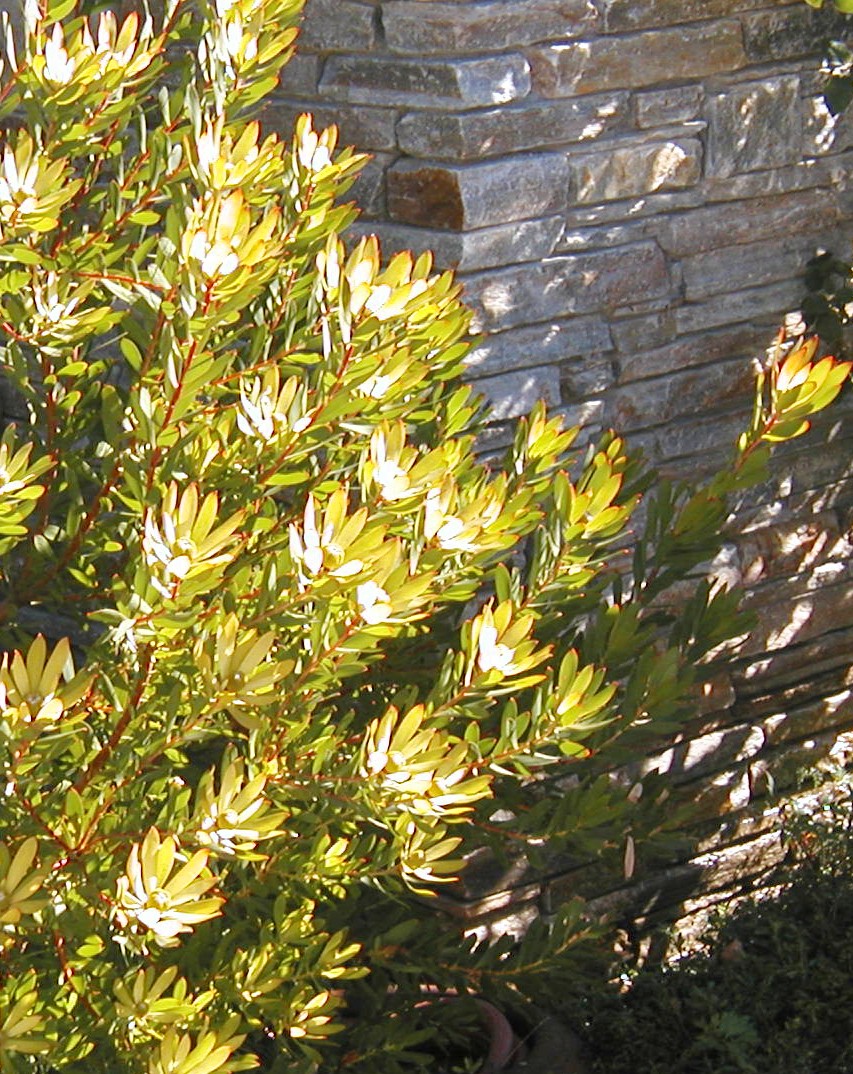
Leptospermum 'Copper Glow,' which is new to me

A wider view of Leptospermum 'Copper Glow,' which doesn't do it justice

Another Leucadendron 'Wilson's Wonder'

For comparison purposes, this is my existing Leucadendron 'Wilson's Wonder,' which is just starting to develop its winter color

More Lomandra longifolia 'Breeze'


I'm itching to start planting but that event is still probably 2 or more weeks away as we're still digging.

The neighbors have been speculating about what has been variously referred to as an archaeological dig and a burial ground


This foliage overview is my contribution to the monthly foliage follow-up sponsored by Pam at Digging to recognize the importance of foliage in our gardens.  Click here to see her post this month and to find links to other foliage-focused posts.


All material © 2012-2014 by Kris Peterson for Late to the Garden Party

Thursday, August 28, 2014

When things come together just right

By mid-summer, most gardeners I know - at least those who garden in hot, dry climates like mine - become discouraged.  I'm no exception.  Most of my grass is dead.  Numerous plants have dropped dead, some seemingly overnight.  An army of disgusting worms attacked my Bush Lupine and ate half the plant before I sent them packing.  The raccoons returned and, in addition to stealing the filter out of our fountain and running off with it, they declared an end to our detente and tore apart the beds in the side yard looking for grubs.  And it's still too warm to begin fall planting - even if that didn't prevent me from indulging in the purchase of a dozen Rudbeckia last week - so I have itchy fingers

I deal with the situation by putting on blinders to avoid seeing the garden as a whole, while focusing on practical problems: modifications to the irrigation system, mulching, hand-watering, pruning, and researching drought-tolerant plants and new ways to thwart raccoons.  However, while planting 3 of the Rudbeckia I couldn't stop myself from buying, I realized just how good at least one of my beds looks right now.

Wide view of the bed

Side view of the same space


This bed seldom shows up in my photos.   On the southwest side of the house, it's partially hidden behind our Magnolia tree.  I've added and subtracted plants from this bed at intervals in the 3 years I've tended this garden.  While some of these are still immature, the bed nonetheless finally feels as though it's coming together.  I love the mix of mid-tone and chartreuse greens, accented by yellow, orange and red touches.  The yellow color is provided by Abelia 'Kaleidoscope' and Coprosma 'Evening Glow' as well as the flowers of Rudbeckia 'Prairie Sun' and Gaillardia 'Mesa Peach.'  Orange and red tones are provided at various times of the year by the berries on the Nandina, 2 varieties of Hemerocallis, and Gaillardia 'Goblin,' which self-seeds freely.

The Calliandra, Coleonema, Nandina and Agapanthus in the background came with the house but I've added most of the rest of the plants.

The Grevillea 'Superb' planted last November is developing lots of new buds

Gaillardia 'Goblin' is flowering less profusely than last year but still provides a lot of color

The new Rudbeckia 'Prairie Sun' mixes well with Abelia 'Kaleidoscope' and Coprosma 'Evening Glow'

Coprosma 'Evening Glow' is a relatively slow grower

One of 5 Lomandra longifolia 'Breeze' in this bed, this plant adds an airy quality

Duranta erecta 'Gold Mound' if the label that came with it can be believed

Salvia 'Mesa Azure'

And a closer look at the Rudbeckia that pulled everything together


Now, my only wish is that the lawn surrounding the bed wasn't so hideous.  I think the answer is to pull the front lawn out.  Plans are underway...


All material © 2012-2014 by Kris Peterson for Late to the Garden Party

Tuesday, January 29, 2013

With Cold, Everything's Relative

The local weather reports have been full of hyperbole about how cold its been in the greater Los Angeles area.  Were you to ignore the actual temperature readings, you might think that Southern California was in the midst of a serious deep freeze.  In reality, the night-time temperatures, although dipping below freezing on a few occasions in the local valleys, have been in the 40s.  Daytime temperatures, at their lowest points, have dipped into the 50s.  But, hey, that IS cold for us!  We're just not used to it.  I remember a movie in which Steve Martin played a LA weatherman who, day after day after day, reported that it would be sunny with a temperature of 72 degrees - with the exception of summer, that's not too far from reality.

However, because our temperatures are generally so moderate, most of us don't take the kinds of precautions with our tender plants that those in harsher climates do.  I've never dug up a plant and brought it inside for the winter, for example.  I've never even covered a plant to protect it.  Nonetheless, for the most part, my plants have survived our winters relatively unscathed.  The only sudden deaths I recall involved the loss of impatiens, which turn to mush in response to a freak dusting of frost.

All this is not to say that some plants don't suffer.  The Clerodendrum ugandense I put in our first year at this house lost all its leaves and, when it failed to recover, I yanked it out.  In 2012, I bought another one and placed it in sunnier spot, where I thought it might also be less troubled by the strong winds that blow through at intervals.  I'm sorry to say it's not looking at all good.
Clerodendron ugandense (under stress)

This plant, which produces blue and violet butterfly-shaped flowers, is native to tropical Africa and, although it's supposed to be adapted to Sunset Zones 23/24, my experience so far doesn't support that.  I'm going to hang onto it for now, hoping that it'll recover.  I grew it successfully at a rental apartment in Santa Monica many years ago but that plant was more protected from wind and close to the house, which probably kept it warmer.

I think the cold accounts for the color changes affecting my Duranta erecta 'Gold Mound' too.  In a replay of last year, the foliage is again turning purplish.  This is more pronounced in some plants than others.
Duranta erecta 'Gold Mound' (close to house)
Duranta erecta 'Gold Mound' (away from house but partially protected)
Duranta erecta 'Gold Mound' (in exposed area)


Although all these plants were presented as 'Gold Mound' and had the gold foliage characteristic of that variety, the labels referred only to a generic Duranta so it's possible that the differences are, at least in part, attributable to different genealogy.  Placement, soil composition, and size may also be factors.  The most purple of the 3 plants shown above is the smallest and was moved twice last year, perhaps contributing to the stress on it when the colder temperatures hit.  I'm hoping that, in spring when the temperatures rise, the gold color will gradually return as it did last year.

My Pseuderanthemum 'Texas Tri-Star' is also showing signs of cold-weather stress.   This plant isn't listed in my Sunset Western Garden Book or any other reference text I have on hand and I've found very little useful information on-line.  It's supposed to be cold hardy to 32 degrees but the lower temperatures have both deepened its pink/reddish tones and caused significant leaf drop in some cases.
Psuederanthemum 'Texas Tri-Star' (in November)
Pseuderanthemum 'Texas Tri-Star' (in exposed location in late January)
Still, although some of my plants may be languishing a bit, a few are clearly enjoying the colder temperatures.  Some succulents are producing blooms.


 And tubers and corms are beginning to bloom.


Meanwhile, in the house, Pipig the cat, as well as my husband and me, appreciate some extra warmth.


Wednesday, January 16, 2013

Foliage Follow-up

This is my first Foliage Follow-up post.  For my non-garden obsessed friends, Foliage Follow-up is a monthly event hosted on the 16th of each month by Pam of Digging garden blog fame.  It provides an opportunity to highlight the foliage that adds so much to gardens but usually takes a back-seat to showier flowering plants.

Since moving to our current 1/2 acre lot, I've gained a much greater appreciation for foliage.  After initial plantings of flash-in-the-pan flowers, I'm now concentrating more on plants with a sustained presence in the garden.  As I like to buy my plants in the smallest sizes available to conserve on expenses and to allow roots to establish a firm footing, many of my new additions are still quite puny.  I'm not the most patient person so giving these plants the time they need to fill out naturally without crowding them with other plants is hard for me but I'm trying...

Without further preamble, here are the foliage plants I'd like to highlight:

Acacia cognata 'Cousin Itt"
I fell in love with this Acacia the first time I touched it but I was only able to find it in large pots at $40 a pop.  Then I tripped over it (almost literally) in a 1-gallon container for $12 at Sperlings Nursery in Calabasas, which I visit occasionally after trips to see my elderly mother.  I bought 2 and wish I'd purchased at least 1 more.  In addition to its beautiful foliage, it's drought tolerant and takes partial shade!  It's also supposed to produce pale yellow flowers but I'll be happy with it even if it never flowers.

Acanthus spinosus

This Acanthus, along with 2 others, was sold to me as mollis but it and 1 other are almost certainly spinosus.  It appears to have a less upright posture than mollis and it bloomed much later, in summer rather than spring, than mollis did in my old garden.  I thought about pulling it out to replace it with mollis but I've decided  that I rather like the more serrated leaves.

Coprosma repens 'Plum Hussey'
Okay, I bought 'Plum Hussey' in part because of its name but also because of its wonderful leave variation.  As temperatures dropped the foliage has become a deeper plum with less variation but I suspect the leaf variation will return with new growth when the temperatures warm up a bit.

Duranta erecta 'Gold Mound'
I bought a number of these lower-growing Duranta to complement the Agapanthus in place all over this property.  As usual, most of the plants I purchased were small - 6-inch pots when I could find them.  As the weather cooled, the first season they were in the ground, the foliage unexpectedly turned from gold to a dark, purplish green.  I checked on-line sources and local nursery experts on this but no one commented on a weather-related change in this plant.  In any case, as the weather warmed, the gold color returned.  'Gold Mound' produces small blue flowers in summer but it's the foliage that makes the statement.

Erysium linifolium 'Variegatum'
I put these Erysium in my back border to echo the foliage color of the Hebe speciosa 'Variegata' I planted soon after moving in.  It's a good, no fuss plant (and, as shown in the picture above, it's already beginning to bud).

Eupatorium corymbosa
None of the pictures I take do service to the beauty of this plant, which I purchased by mail order from Annie's Annuals.  In bloom, it immediately attracts everyone's attention in my yard but I think its purple-tinged foliage is also wonderful.

Pseuderanthemum 'Texas Tri-Star'
I bought 'Texas Tri-Star' for its leaf variation.  In warmer weather, there's much more green and cream color to the leaves than shown above.  I have a dozen of these plants (all still small!) in 3 different areas of the garden.  This one, set with 2 others close to the house, was the last to take on the reddish tones it shows above.

My final foliage all-stars for this first Foliage Follow-up post are pictured without commentary below.  See Pam's Digging blog to find links to foliage selections in other gardens.

Hibiscus acetosella 'Haight Ashbury'

Leucadendron discolor

Loropetalum chinense 'Shang-hi'

Pelargonium tomentusum
Trachelospermum jasminoides