Showing posts with label Hibiscus acetosella 'Haight Ashbury'. Show all posts

Monday, November 20, 2023

In a Vase on Monday: Fleeting beauty

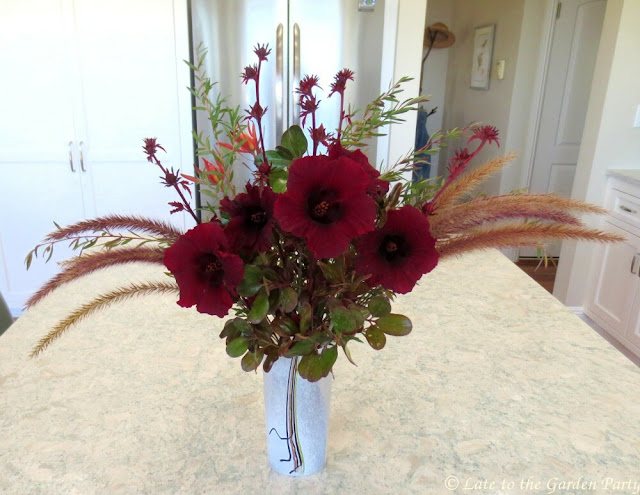
I suspect I've used this post title before but it describes both of my arrangements this week.  As at least one reader anticipated, I decided to feature the Hibiscus flowers that surprised me last week for my first vase.  The velvety red blooms were just too pretty to ignore, even if the flowers close in low light and don't usually last more than two days at most. 


My house is quite bright inside but, regardless, the Hibiscus flowers were already closing by mid-afternoon.  It remains to be seen if they'll open again in the morning light, or if any of the buds clustered along the stems will open.
 
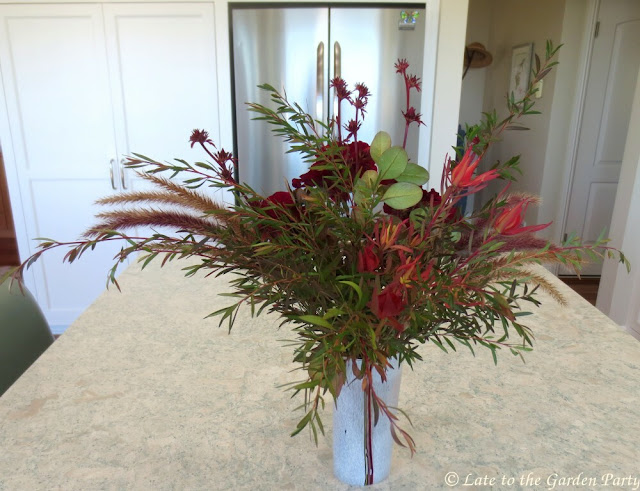
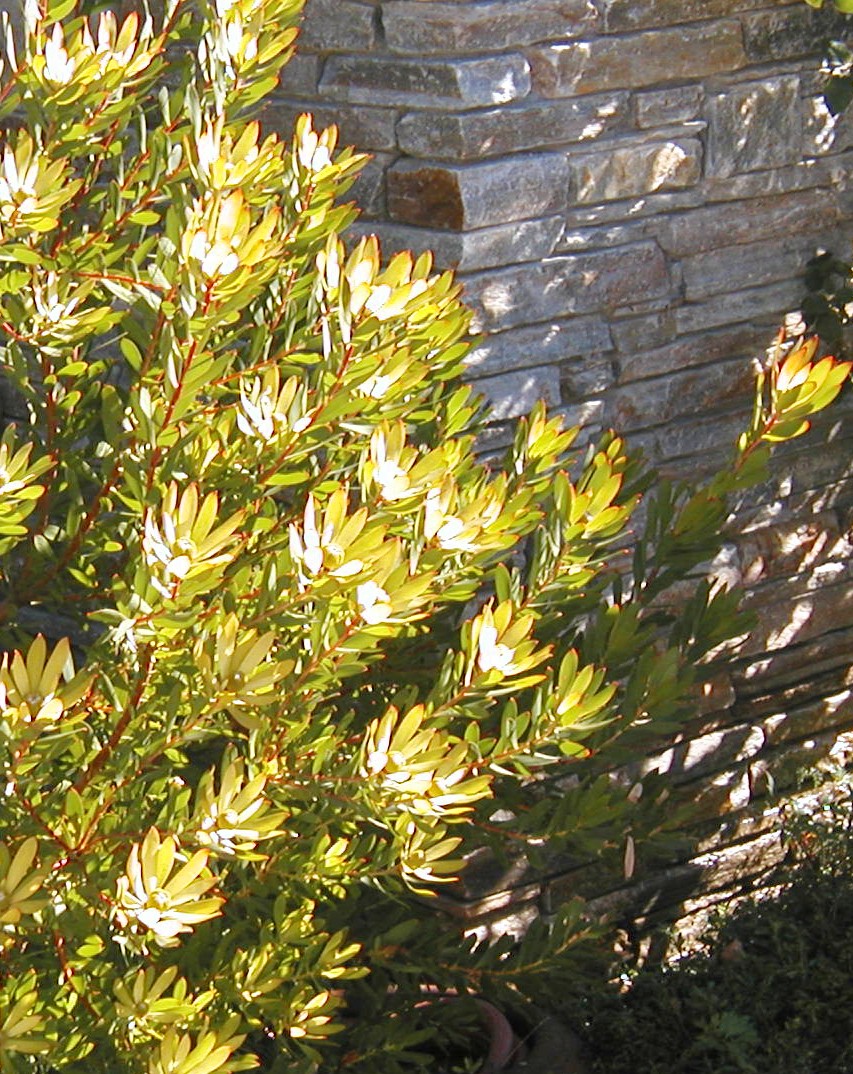
I dressed up the back view with a handful of the flower-like bracts of Leucadendron 'Blush'


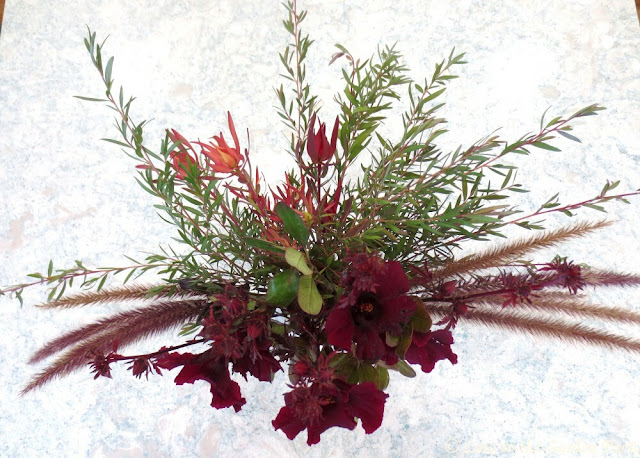
Top view

Clockwise from the upper left: Coprosma repens 'Plum Hussey', Leptospermum 'Copper Glow', Leucadendron salignum 'Blush', Hibiscus acetosella 'Haight Ashbury', and Pennisetum 'Sky Rocket'


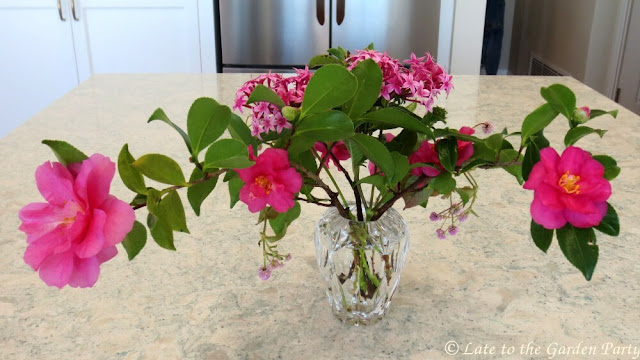
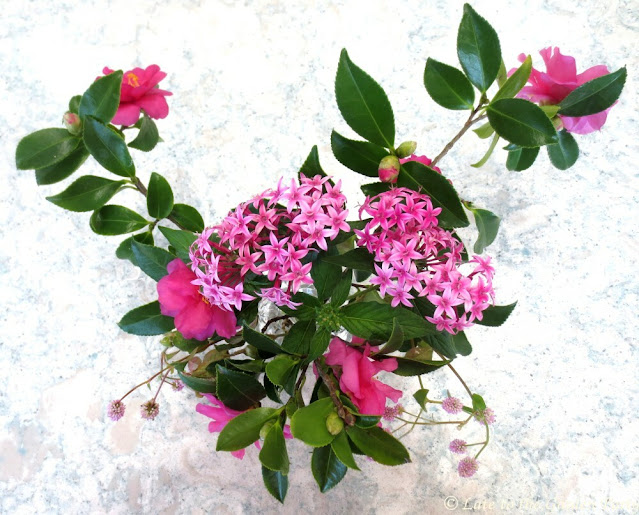
My second arrangement consists of only three elements, with the primary component being the fragile flowers of Camellia sasanqua.  Although we received less than a half inch of rain spread lightly over the course of four days, that was enough to leave many of those flowers shattered.  With wind predicted, I cut three stems from the largest of my shrubs.

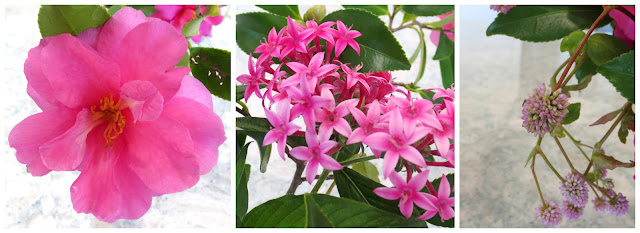
Both varieties of Camellia sasanqua were inherited with the garden.  They differ in form but are very similar in color.

Back view: I could've used more filler plants but c'est la vie

Top view

From left to right: Camellia sasanqua, Pentas lanceolata, and Persicaria capitata


For more IAVOM creations, visit Cathy at Rambling in the Garden.


All material © 2012-2023 by Kris Peterson for Late to the Garden Party

Monday, October 9, 2023

In a Vase on Monday: Can you have too many dahlias?

The dahlias in my cutting garden have gone bonkers.  'Iceberg' is finally in the process of opening its first bloom so now all those I planted this year have made a showing.  Even though the combination of last week's heatwave and our dreaded Santa Ana winds took a toll on some of them, causing tall stems to fall over and break and other blooms to wither in place, there were still many more dahlias than I had time to cram into vases on Sunday.

I built my first arrangement around one of the recent arrivals, Dahlia 'Lady Darlene'.

'Lady Darlene's' yellow and red petals curve downward, giving the flower a ball-like shape

Back view:  As I only had 3 'Lady Darlene' flowers in good shape, I had to make do with yellow dahlias, grass plumes, and foliage to fill out the vase

Top view

Clockwise from the upper left: Dahlia 'Lady Darlene', D. 'Summer's End', noID yellow dahlia, Leucadendron salignum 'Safari Sunset', L. 'Wilson's Wonder', and Pennisetum advena 'Rubrum'


I hadn't planned to use Dahlia 'Fairway Spur' this week but all of a sudden it's producing gobs of flowers, most of which aren't mutants for a change.  I went bigger than usual in creating an arrangement around them.

I used burgundy foliage and a dark-toned vase to contrast with the orange and yellow dahlias

Back view

Top view

Clockwise from the upper left: Dahlia 'Fairway Spur', D. 'Summer's End', Hibiscus acetosella 'Haight Ashbury', Plectranthus scutellarioides 'Pineapple' (aka coleus), and Zinnia elegans 'Queen Lime Orange'


My last arrangement is a simplified version of the one I created last week using lavender-colored flowers and purple foliage.  I wanted to experiment further with the Vitex foliage and, like Dahlia 'Fairway Spur', 'Mikayla Miranda' had pumped out a lot of new blooms.  I skipped the process of dunking the Vitex stems in hot water this week  - the stems straightened up nicely overnight in water after I split the bottom inch of each stem. 

Top row: the arrangement from 3 angles
Middle: pink and white Cosmos bipinnatus and Vitex trifolia
Bottom: Dahlias 'Lavender Ruffles' and 'Mikayla Miranda'


Our temperatures started to come down yesterday.  Instead of the temperatures in the low-to-mid 90sF we had last week, we're expecting them to settle into the low-to-mid 70s (23-25C) this week.  I'm looking forward to getting back to work in the garden, although this week I have some help coming to trim about half my trees (fourteen this year), which means I'll be busy moving potted plants and other breakables out of the way and then restoring them to their spots afterwards so I'm not likely to get any big projects done.


For more IAVOM creations, visit Cathy at Rambling in the Garden.


All material © 2012-2023 by Kris Peterson for Late to the Garden Party

Monday, September 25, 2023

In a Vase on Monday: Magnificent Mutants

Last week I complained that I thought I was in a rut with my dahlia-based flower arrangements.  In response, my friend HB of Piece of Eden suggested that maybe I could try a minimalist or Ikebana-style arrangement if I felt stuck.  I'm not good at minimalism when it comes to flowers, seemingly compelled to stuff everything I can find into most of my vases.  The last of my dahlias have yet to bloom, although 'Breakout' is close; however, it occurred to me that maybe I could do something with my mutant 'Fairway Spur' Dahlias.  I have two clumps of 'Fairway Spur' in my cutting garden, one of which is producing a large number of deformed - but interesting - blooms.  So I used them for my first arrangement, which was also created as a nod to the early days of autumn.

The form of the mutant dahlias vary somewhat but, in all cases, the inner petals fail to fully develop, and sometimes fail to develop at all.  However, the bees seem to like them as the mutated form allows them to reach the nectar at the flower's central disk more easily.  Thrip damage seems the most likely explanation for the deformities.

Back view: Hibiscus 'Haight Ashbury' provided the autumn flair 

Top view: As I was arranging the flowers a tiny green grasshopper, perhaps 1/2 inch in size, hopped out of a flower.  I tried to catch it but it got away and I couldn't find it.  My husband wasn't amused.

Clockwise from the upper left: Abelia 'Kaleidoscope', Sutera cordata (aka Bacopa), malformed Dahlia 'Fairway Spur', D. 'Summer's End'. Hibiscus acetosella 'Haight Ashbury', and Zinnia elegans 'Queen Lime Orange' and 'Benary's Giant Salmon Rose'


Last week I also swore I'd finally put together an arrangement centered around Dahlia 'Enchantress', which has been blooming for well over a month now without being included in an IAVOM lineup.  Here it is:

Dahlia 'Enchantress' usually grows taller than it has this year but I think it's stems have been held down (literally) by its neighbors 

Back view

Top view

Clockwise from the upper left: bi-color and white Cosmos bipinnatus, an oddly formed Cosmos specimen that has formed on only one plant (look carefully at its center), Dahlia 'Enchantress', Leptospermum 'Copper Glow', and Zinnia elegans 'Benary's Giant Purple'


It's feeling very fall-like here at the moment, or at least our version of fall with daytime temperatures in the upper 60s to low 70sF (20-23C).  Working in the garden is downright comfortable, although I've earned some aches and pains in the process.  We filled three jumbo-sized green bins last week (and I topped off two of a neighbor's bins as well).  We've already stuffed two of the bins again this week and I fully expect the third to be full by the next waste recycling pickup date on Thursday as well.  In addition, current predictions suggest that the El NiƱo climate pattern is likely to bring us significant rain again in the 2024 "water year" starting October 1st, perhaps not this fall, but in late winter and spring as was the case in the 2023 water year.  The latest Weather West summary makes interesting reading about changes in the weather in California and the Pacific Northwest.


For more IAVOM creations, visit Cathy at Rambling in the Garden.


All material © 2012-2023 by Kris Peterson for Late to the Garden Party


Wednesday, January 16, 2013

Foliage Follow-up

This is my first Foliage Follow-up post.  For my non-garden obsessed friends, Foliage Follow-up is a monthly event hosted on the 16th of each month by Pam of Digging garden blog fame.  It provides an opportunity to highlight the foliage that adds so much to gardens but usually takes a back-seat to showier flowering plants.

Since moving to our current 1/2 acre lot, I've gained a much greater appreciation for foliage.  After initial plantings of flash-in-the-pan flowers, I'm now concentrating more on plants with a sustained presence in the garden.  As I like to buy my plants in the smallest sizes available to conserve on expenses and to allow roots to establish a firm footing, many of my new additions are still quite puny.  I'm not the most patient person so giving these plants the time they need to fill out naturally without crowding them with other plants is hard for me but I'm trying...

Without further preamble, here are the foliage plants I'd like to highlight:

Acacia cognata 'Cousin Itt"
I fell in love with this Acacia the first time I touched it but I was only able to find it in large pots at $40 a pop.  Then I tripped over it (almost literally) in a 1-gallon container for $12 at Sperlings Nursery in Calabasas, which I visit occasionally after trips to see my elderly mother.  I bought 2 and wish I'd purchased at least 1 more.  In addition to its beautiful foliage, it's drought tolerant and takes partial shade!  It's also supposed to produce pale yellow flowers but I'll be happy with it even if it never flowers.

Acanthus spinosus

This Acanthus, along with 2 others, was sold to me as mollis but it and 1 other are almost certainly spinosus.  It appears to have a less upright posture than mollis and it bloomed much later, in summer rather than spring, than mollis did in my old garden.  I thought about pulling it out to replace it with mollis but I've decided  that I rather like the more serrated leaves.

Coprosma repens 'Plum Hussey'
Okay, I bought 'Plum Hussey' in part because of its name but also because of its wonderful leave variation.  As temperatures dropped the foliage has become a deeper plum with less variation but I suspect the leaf variation will return with new growth when the temperatures warm up a bit.

Duranta erecta 'Gold Mound'
I bought a number of these lower-growing Duranta to complement the Agapanthus in place all over this property.  As usual, most of the plants I purchased were small - 6-inch pots when I could find them.  As the weather cooled, the first season they were in the ground, the foliage unexpectedly turned from gold to a dark, purplish green.  I checked on-line sources and local nursery experts on this but no one commented on a weather-related change in this plant.  In any case, as the weather warmed, the gold color returned.  'Gold Mound' produces small blue flowers in summer but it's the foliage that makes the statement.

Erysium linifolium 'Variegatum'
I put these Erysium in my back border to echo the foliage color of the Hebe speciosa 'Variegata' I planted soon after moving in.  It's a good, no fuss plant (and, as shown in the picture above, it's already beginning to bud).

Eupatorium corymbosa
None of the pictures I take do service to the beauty of this plant, which I purchased by mail order from Annie's Annuals.  In bloom, it immediately attracts everyone's attention in my yard but I think its purple-tinged foliage is also wonderful.

Pseuderanthemum 'Texas Tri-Star'
I bought 'Texas Tri-Star' for its leaf variation.  In warmer weather, there's much more green and cream color to the leaves than shown above.  I have a dozen of these plants (all still small!) in 3 different areas of the garden.  This one, set with 2 others close to the house, was the last to take on the reddish tones it shows above.

My final foliage all-stars for this first Foliage Follow-up post are pictured without commentary below.  See Pam's Digging blog to find links to foliage selections in other gardens.

Hibiscus acetosella 'Haight Ashbury'

Leucadendron discolor

Loropetalum chinense 'Shang-hi'

Pelargonium tomentusum
Trachelospermum jasminoides