Showing posts with label Liriope. Show all posts

Friday, October 1, 2021

This week's projects

This week, while temperatures were still on the cooler side, I tackled a project I've been dreading for a long time.  I dug up two plants in one of my back garden borders, the native California asters (Symphyotrichum chilense) I'd planted in 2016 and the Liriope spicata I'd planted in 2014.  Both were rampant spreaders.  I can't claim I wasn't warned in either case.  However, particularly in the case of the aster, I thought low-water conditions would keep the plants in the manageable range.  What I didn't factor into the mix was the extent to which even one year with significant rainfall could cause the plants to take off - or how awful the aster might look when our drought conditions returned with a vengeance.

The problem wasn't evident in this wide shot taken in late June

This closeup photo, taken in early June, does a better job at illustrating the problem.  The mass of aster stems can be seen swallowing up plants, including a white-flowered Alstroemeria, my dwarf Jacaranda, and even the troublesome Liriope growing along the edge of the pathway. 

This photo, also taken in early June, shows the aster's march across the breadth of the border.  The aster's stems had already started to move across the flagstone path in search of new territory in the border on the east side of the garden.  However, as everything was still green, it was easier to tolerate.

The asters start flowering in July and reach their peak in August.  They looked better in 2019 (as shown here) than they've looked in subsequent years.

This is what the area looked like in early September.  The aster stems on this side of the border looked as though they'd been torched.

The problem is that the aster's rhizomatous underground stems spread everywhere, including under other plants.  Removing those stems meant digging up a lot of other plants in the process. 

I ended up taking out far more plants then I'd hoped to in the process of getting out the aster and Liriope roots.  The Lirope wasn't ugly like the burned out aster stems but it's intrusion on other plants has been a problem for a long time and, as the aster and Liriope were intertwined, it made sense to deal with both at the same time.

Both plants had engulfed the dwarf Jacaranda 'Blue Bonsai' so I had to work very carefully in the area surrounding it to avoid damaging the tree's roots.  I had a similar problem in the area around the fountain, where a lot of Dutch Iris bulbs are planted.  Did I get all the aster and Liriope stems?  That's unlikely but I hope I've at least halted their advance and that careful monitoring will allow me to manage future appearances as they arise.

In addition to losing other plants in the process, I turned up a lot of bulbs that I hope to replant soon.

I couldn't avoid upturning the small Freesia bulbs (left) but I managed to avoid unearthing all but a few of the more deeply planted Iris bulbs (right)

I've already bought a few plants to fill the empty spots in that bed, and I have a trip to a couple of my favorite garden centers to the north planned for early this month.  Next week, I have a truckload of mulch scheduled for delivery too.

My recent purchases include Lomandra 'Platinum Beauty' and Phylica pubescens (aka featherhead).  I couldn't pass them up as they were more reasonably priced than I've seen in the past.


My other project this week was much simpler and more pleasant.  It involved potting up some new - and not so new - plants.

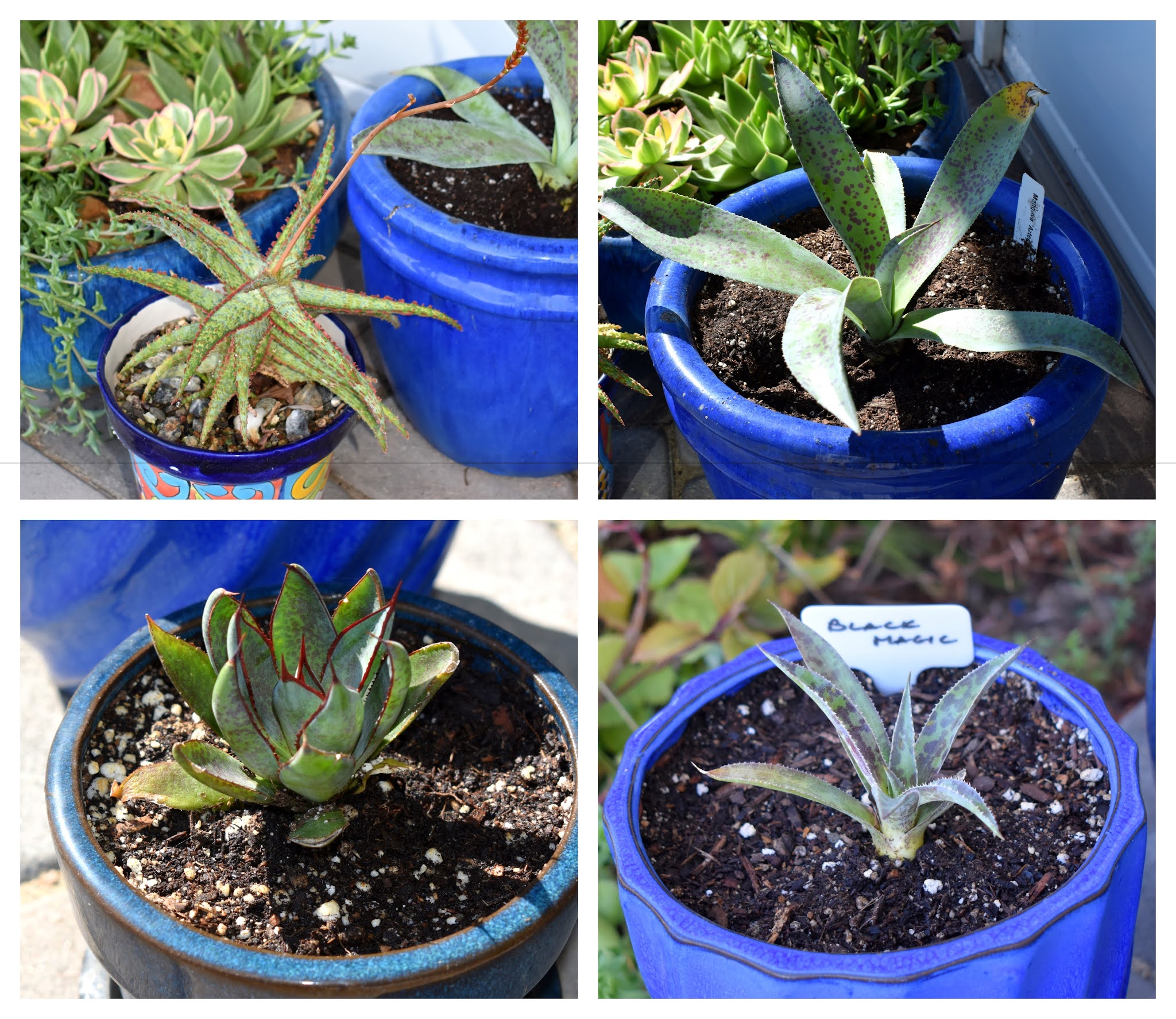
I received four new Mangaves I'd ordered by mail this week.  Two of them are included here, both in blue pots to coordinate with the large succulent bowl I put together three weeks ago.  An Aloe and another Mangave I purchased earlier as a pup joined this collection outside the back door.

Clockwise from the upper left: Aloe 'Marsha Leyhew',  and xMangave 'Aztec King', 'Black Magic' (pup), and tiny 'Praying Hands''Praying Hands' is a hot ticket right now and hard to find in anything but a small size.  You can see a mature specimen here.

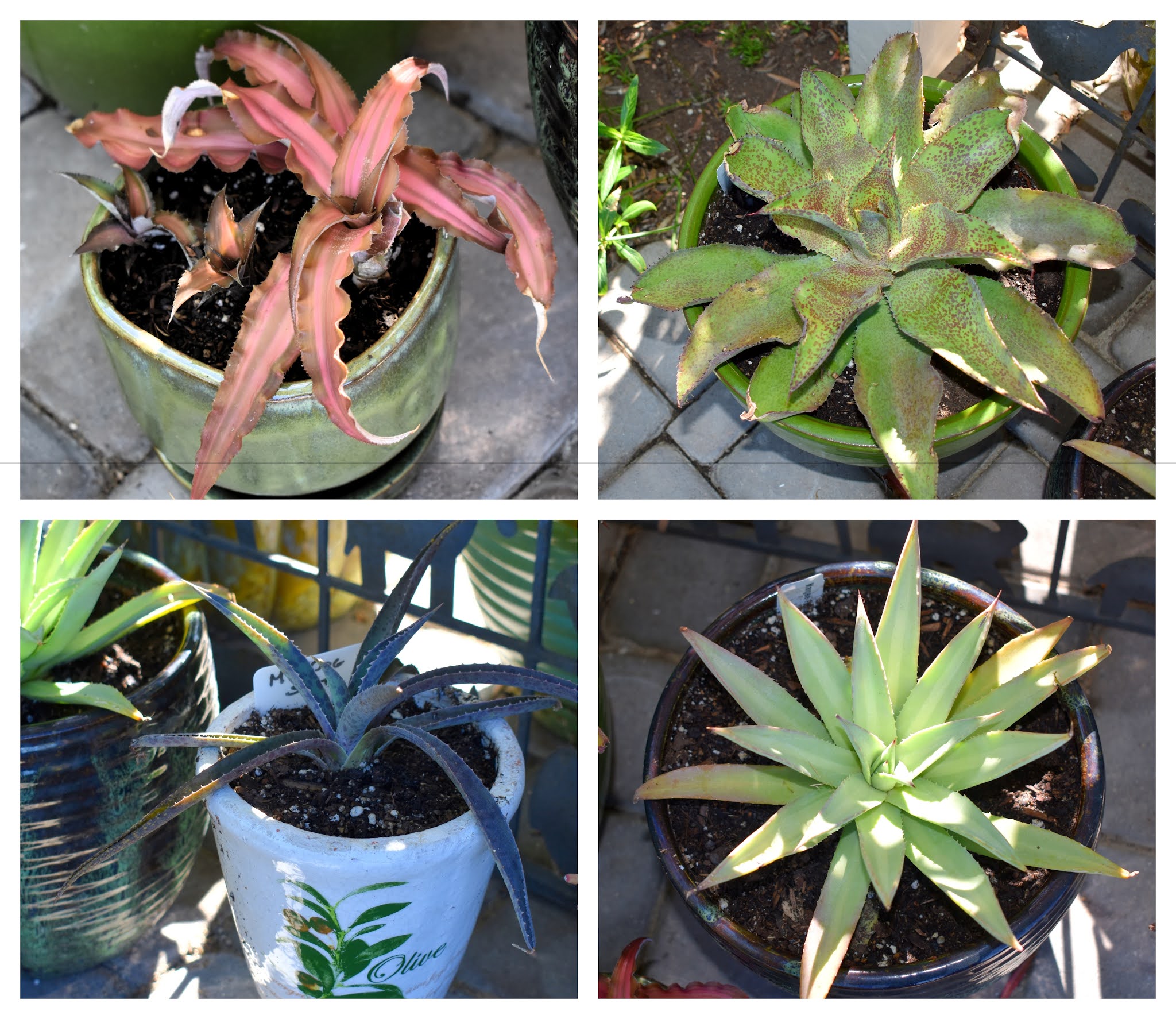
I put together another collection of pots on the small south side patio.  Two more of the mail order Mangaves were included here, as well as one I recently received from a friend.  I also cleaned up and repotted a Cryptanthus.

Clockwise from the upper left: Cryptanthus bivittatus (aka earthstar) and xMangave 'Crazy Cowlick', 'Frosted Elegance', and 'My Dog Spot'.  I'm a little in love with 'Frosted Elegance' at the moment because it glows.

It's turned hot again here.  I sweated (literally) through the process of carefully extricating the underground aster stems in the area surrounding the fountain yesterday morning when our temperature jumped more than 10 degrees Fahrenheit over the previous day's temperature.  It's expected to remain on the excessively warm side for at the next several days at least.   When the truck arrives with my mulch delivery next Wednesday, I'm hoping it'll be cool enough to work in the garden but that remains to be seen.  In the meantime, I'll be focusing on indoor activities.

Enjoy your weekend!


All material © 2012-2021 by Kris Peterson for Late to the Garden Party

Wednesday, April 16, 2014

Foliage Follow-up - A Little of This and a Little of That

In spring, it's easy to get overwhelmed by flowers.  They're everywhere.  While some flowers complement one another, others clash.  I looked around my garden while taking pictures for yesterday's Bloom Day post and thought, I need more foliage to pull this garden together.  Foliage Follow-up, sponsored by Pam at Digging, is a celebration of foliage and a regular reminder of its importance in the garden.

Some of my foliage is so brightly colored, it can almost be mistaken for floral material.  Yucca 'Bright Star' falls into that category.  I added 3 of these to my main backyard border in January.  The plants are still relatively small and the surrounding plants currently distract attention away from them to a degree, but I think that'll change as the Yucca grow taller.  If the neighboring Nicotiana alata 'Lime Green' encroach upon them, the Nicotiana may have to go.

One of 3 Yucca 'Bright Star' in the mid portion of the main backyard border

Another of the 3 plants photographed from above to show off the color variation

The Yucca are currently surrounded by Nicotiana alata, Euphorbia 'Dean's Hybrid,' a Prostanthera ovalifolia and Adenophora seedlings


Abelia grandiflora 'Kaleidoscope' could also be considered a flower-like foliage plant.  It's hard to ignore in any setting.  I've used it in groups in 3 different parts of the garden.

This one, introduced in the in the backyard border 2 years ago with 2 others, is putting on new growth


I'm continuing to add plants for foliage interest.  One of my most recent purchases is Melianthus major, purchased at s spring plant sale conducted by the local botanic garden.  Although it can grow up to 12 feet (3.7 meters) tall and wide, I've been told that it can easily be kept to a smaller size.  I've added mine to what I'm calling my "red bed," an area previously occupied by a seldom-used snorkel spa that was dismantled in January, freeing up more garden space.  (One has to establish priorities, even in the garden.)

Newly-planted Melianthus major


I've added a variety of foliage elements to the other new backyard bed, an extension of our fountain bed.  Among these are 6 Liriope spicata, clumped in 2 groups of 3 plants each.  I understand that this species of Liriope can spread with abandon so I hope I don't regret the choice.  At present, I like how it adds a spiky vertical element along the pathway.

Liriope spicata


On the other side of the path, along the house, Plectranthus ciliatus 'Zulu Warrior' is once again showing why it's one of my favorite plants.  It's attractive even when it isn't in bloom.  The foliage also has a nice spicy scent.  I cut it back hard this winter but it has once again put on a healthy flush of new growth.  I established this mass from cuttings brought from our old house and I recently planted cuttings from this stock in the new bed on the other side of the path (as well as other locations in the side and front yards).

Plectranthus ciliatus 'Zulu Warrior' gets just morning sun


On a recent trip, I picked up a new Aeonium, A. canariense (aka the Velvet Rose), which ended up in a large pot on the small south-side patio.  I'm hoping that it'll prove as easy to grow as the other Aeonium I have growing all around the property.  When we moved in, a friend gifted me with a few cuttings of what I believe is some variety of Aeonium arboreum.  Unsure where to put it, I planted a few pieces below the citrus trees in the vegetable garden.  The few quickly grew into many and now, whenever I have an empty area in dry soil I'm not sure what to do with, I stick an Aeonium cutting directly in the soil, walk away and see what happens.  So far, there's no place these plants haven't thrived.  (Frankly, it's almost scary.)

Aeonium canariense

The original clump of Aeonium arboreum planted below the Mandarin orange tree has grown dramatically in size despite regular harvesting of cuttings

Another clump, developed from cuttings stuck into the soil about a year ago

A few plants recently added in a very dry, largely untended area near the driveway where nothing much other than weeds (aka as Santa Barbara daisies) grow


I haven't added any of these Aeonium to the dry garden (yet).  I'm not sure why.  However, when I was walking about snapping pictures for this post, I noticed that Leucadendron 'Ebony' (acquired last September at far below the usual going rate, possibly due to mis-labeling as 'Safari Sunset'), is putting on new growth at last.

Leucadendron 'Ebony'


Finally, while searching for foliage high-notes, I looked down and realized how nicely my thyme groundcover is filling in among the stepping stones in the side yard.

The thyme shown here, labeled as Thymus serpyllum, hugs the soil

This thyme, also sold as Thymus serpyllum, is somewhat taller (grown here with Ajuga 'Mint Chips')


These are my foliage highlights for April 2014.  Please visit Pam, our foliage follow-up hostess, here to see her foliage highlights and to find links to other gardeners' contributions to this useful meme.


Friday, January 24, 2014

January Projects

As we're lucky enough to be unaffected by the infamous "polar vortex" plaguing much of the US and blessed with unseasonably warm weather (if not, sadly, with rain), we've launched some new garden projects.  Okay, most of the "launching" was done by me but my husband has kindly cooperated.

I began tackling the misshapen hedge that runs along the street on the south side of our property a few weeks ago.  Oddly, half the hedge to the right side of our driveway is constructed of Xylosma congestum while the other half is comprised of what I think is Pittosporum eugeniodes.  It's the latter portion of the hedge that's in poor condition.  Clearly, for many years, gardeners have shorn both sections of hedge on the top and sides.  While that seems to do a fine job maintaining the appearance of the Xylosma, it has left the Pittosporum a twiggy mess with most of the new growth at the top.  I tried cutting a couple of the 9 Pittosporum back hard last year and the regrowth looked much better to my eye so, this year, I cut back all 9 shrubs.

Hedge before pruning, photographed from the back side

Hedge after pruning, photographed from the lawn above

Hedge after pruning, photographed from the street side


Hopefully, I haven't just made matters worse.  It looks very naked now and the area beyond the hedge is all too visible from the street but, if last year's experience is a guide, it should fill in within a few months.  In the meantime, I'm looking for plants to place in front of the hedge.  Behind it, along the top of the interior stack stone wall below the Ceanothus, I've already planted Liriope spicata, Liriope muscari 'Variegata' and Aeonium.

Newly planted Liriope, along with some self-seeded Santa Barbara daisy

New cuttings of Aeonium (A. arboreum, I think)


The Aeonium arboreum rosettes shown in the picture above were cut from existing plants and simply stuck into the ground.  I've produced many large, branched clumps of these Aeoniums from a few cuttings given to me by a good friend shortly after we moved into the house 3 years ago.

Clump of Aeonium arboreum grown from earlier cuttings


The second project of the year kicked off when my husband finally got around to dismantling the "snorkel spa" in the backyard (previously discussed here).

Photo of "snorkel spa" taken last January

Space after the main portion of the spa was removed last week

The stone gravel left behind after the spa's removal


You can't tell it from the picture above but the base of gravel underneath the spa we had to remove was about 6 inches (15 centimeters) deep.  I used some of it to fill shallow spots in the vegetable garden, previously lined using only gravel I'd dug up out of garden beds throughout the property.  (As our site was once part of a rock quarry, I uncover rocks whenever and wherever I dig.)

Gravel-filled pathways between the raised vegetable beds


My husband, with some help from me, used the rest of the gravel to cover the pathway behind the garage.

No more mud behind the garage!


As there's now a good-sized empty space in the backyard, my husband assumed that I'd immediately get started on planting; however, I need to get a load of topsoil in first and, before we do that, I announced that it would be prudent to take out the section of lawn I'd already identified for removal in the backyard.  I drew the lines of the new border earlier this week and my husband installed new bender board to delineate it.

I intend to treat the 8 foot wide grass area between the border on the right and the new border on the left as a pathway

The bender board around the fountain will be removed once the sod between it and the new bender board has been dug out


My husband wants to handle digging up the sod himself rather than call in reinforcements.  We're using some of the sod he removes to fill in holes in the remaining lawn.

The grass removed from alongside the backyard patio was used to fill in the space formerly occupied by stepping stones to the spa


It'll be awhile before the new areas can be planted but that gives me time to figure out how I'll knit these areas together with the existing borders.  In the meantime, there's always the empty space in front of the hedge to plant.


Sunday, August 25, 2013

Good looking inside and out

I've been whining off and on for the last few weeks about the state of my garden.  Even my old garden, situated in an area with a strong marine influence, suffered during the mid-to-late summer months and the heat is 10 degrees higher on average at our current location.  Although we had a few weeks of cooler than normal summer temperatures this year, it still gets hot.  Many of the roses produced new blooms only to wither within a day.

Still, there's an area of my garden that's looking especially good right now, at least by comparison to the rest.  It's the area along our living room window, which looks out onto the backyard and, in the distance, the Los Angeles harbor.  That bed is long and skinny, about 3 feet wide and 23 feet long, which makes it difficult to photograph.

Here are photos taken from the backyard facing the bed, by segment, starting on the right side.

From the far right, the major plants here are Plectranthus ciliatus, Arthropodium cirratum, and Eupatorium sordidum with some ferns, Pseuderanthemum 'Texas Tri-star' and Alyssum thrown in

The middle of the bed is dominated by a tall Calliandra haematocephala with Persicaria microcephala and Eupatorium sordidum on the right and Arthropodium cirratum on the left

The left side of the bed contains the 2nd Arthropodium cirratum, Liriope muscari, and Plectranthus zuluensis with Campanula and Alyssum thrown in


My side view photos may show it better.


I took a couple of photos from inside the house too but their clarity is somewhat obscured due to the fact that I haven't tackled window washing in a few months.


This bed relies heavily on foliage; however, several of the plants do flower.  The Plectranthus ciliatus (variety unknown) came here as a cutting.  It has grown very large in 2 years.  The leaves are textured and purplish burgundy underneath.  The plant produces delicate lavender flower sprays in the fall.

Plectranthus ciliatus


There are 2 Arthropodium cirratum in the bed, placed on opposite ends.  This plant, commonly known as Renga Lily, also blooms, although I grow it mainly for its foliage.

Arthropodium cirratum (aka Renga Lily)

Renga Lily in bloom in May


Next to the Renga Lily on the right side are 3 Eupatorium sordidum (formerly known as Ageratum corymbosa), which have knitted together.  This plant has velvety green leaves with purplish edges and veins.  It flowers heavily in spring but it's producing a lighter crop of ageratum-like flowers now.

Eupatorium sordidum in bloom in August


Persicaria microcephala 'Red Dragon', also grown from a cutting, sits behind the Eupatorium.

Persicaria microcephala 'Red Dragon'


The middle of the bed is dominated by a 4+ foot tall Calliandra haematocephala (aka Pink Powder Puff).  This is the only plant left of those originally in this bed.  It's an unusual choice in the middle of a span of windows but the prior owners positioned their TV in front of the space and we have followed suit as it's the most logical placement to ensure that the main seating is positioned to face the view.  If money weren't an issue, I'd love to have a TV that raised up out of a hidden cabinet but that's not going to happen so we rely on shrubbery to make the TV's placement more presentable from the exterior.

Calliandra haematocephala (aka Pink Powder Puff)


This Calliandra doesn't get enough sun to bloom but the reddish color of the new foliage provides sufficient interest.


On the left side of the Calliandra, there's another Renga Lily, 3 Liriope muscari, and a Plectranthus zuluensis.  This spring-flowering Plectranthus hasn't done as well here as it did in my old garden, where it grew to more than 3 feet tall and wide.  It may simply need more time to mature but I think the drip irrigation system in this area also needs work as the space has been the hardest to keep full.

All in all, it's a nice bed.  I add pansies and other seasonal bedding plants that can manage with only morning sun to fill in but the plants featured above carry the show.  And, it looks good both from the garden and from inside the house.