Showing posts with label hedges. Show all posts

Wednesday, September 13, 2023

A predictable casualty?

As summers go, this hasn't been a bad one.  Yes, we've had heatwaves but my area hasn't experienced any temperatures of 100F or higher this year.  And Tropical Storm Hilary filled my empty rain collection tanks in August, which was a major boon!  So when I noticed yellow and brown leaves on a tree-sized shrub in my street-side border I was surprised.  When I took a closer look at it I was appalled.

The 2 tree-sized shrubs on the far right are Auranticarpa rhombifolia (formerly classified as Pittosporum rhombifolium, commonly known as diamond leaf pittosporum)


Just weeks ago, I'd looked at the now-sad shrub and thought I should prune the lower limbs to allow the succulents planted below to get more sun.  I hadn't noticed any signs that it was at death's door.

This is the wide shot I took of the area in early July.  The foliage may be slightly yellower than the shrub next to it but, if I noticed that at all, it didn't strike me as a dramatic difference.


The Auranticarpa planted directly to the right of the dead one still looks healthy.

These photos provide a direct comparison of the 2 shrubs

A closeup of their foliage tells the story more clearly.  The plant on the right is also producing a generous crop of berries, while there are virtually no berries on the plant on the left.


I don't know what caused this particular Auranticarpa to die off but there's a long pattern involving the plant so, while I'm disappointed, I shouldn't have been all that surprised.  I inherited numerous Auranticarpa shrubs with the garden.  According to online sources, the plants are native to the rainforests of Eastern Australia.  I couldn't find anything describing their drought tolerance but, given the plant's ancestry, it may not be the best one for a drought-persistent landscape.


When we moved in, close to half the street-facing hedge on the south side of the driveway consisted of  Auranticarpa rhombifolia.  The remainder consisted of Xylosma congestum, the shrub that also makes up the entire hedge on the left side of the driveway, as well as the the hedge lining the main level of the back garden.  I thought the mix of hedge material on the south side of the front hedge was odd.  When three of the inherited Auranticarpa began to decline on my watch, a neighbor told me that the prior owners had originally planted the front area entirely in Auranticarpa but removed the majority of these when the plants started dying, replacing them with Xylosma.  After failing to resurrect the dying shrubs, my husband and I removed three Auranticarpa in 2016 and another two in 2020, filling in the gap created by their removal with succulents and five additional Xylosma.

This photo taken in May 2016 shows the area after 3 of the Auranticarpa were removed and 4 of the five new Xylosma had been planted

This photo from May 2020 shows the area after 2 more of Auranticarpa were removed.  The 5 "new" Xylosma were gaining height and girth by that time but their development was slower than expected.

This photo shows the 2 remaining Auranticarpa as of May 2020


My husband may elect to remove the dead Auranticarpa himself but, if not, I'll include it on the list for the tree service to handle when our trees receive their annual pruning.  I'm tempted to give up and remove the last remaining specimen in this area but it sits on the edge of the property line with our south-end neighbor so I'm hesitant to proceed there, especially as it's still healthy.  There are also three other Auranticarpa elsewhere in our garden that seem fine.


My garden has actually received substantially more rainwater than usual this year, 23.74 inches in total since the start of the 2023 "rain year" on October 1, 2022.  In contrast to the Auranticarpa, other shrubs are thriving.

The "new" Xylosma have finally reached almost the same height as the original plants on the left.  The newer plants were set slightly further back to allow room for the succulents I'd planted, creating a bend in the hedge.

In addition, I think Jacaranda 'Bonsai Blue' has gained another foot in height since Tropical Storm Hilary passed through


If there's one lesson here, it's that nothing much is predictable when it comes to the evolution of a garden.


All material © 2012-2023 by Kris Peterson for Late to the Garden Party

Friday, November 10, 2017

Ch ch ch ch changes...

I've a laundry list of projects to accomplish in the garden this fall.  I'd been making good progress, feeling that I'm finally beginning to see the garden as I envisioned it.  And then I get thrown a curve ball.


I started making changes to the southwest corner of our property soon after we moved in.  I didn't place a priority on this area but rather chipped away at my renovations on a piecemeal basis.  Over time, I've removed trees planted by a prior owner in a space that didn't provide the sun they needed.  I cut back dying shrubs planted as a screen along the street side and planted replacements designed to link to an existing hedge.  I added a succulent bed facing the street to give that area some personality.  I extended a stacked stone wall and planted the sloped bed above it with a mix of succulents and other water-wise plants tolerant of shade.  And, most recently, I commissioned my husband to build me a lath (shade) house to occupy the flat area surrounded by hedges on 2 sides.

What I didn't count on was the sudden elimination of the shade-providing hedge on the south side.  Here's what the area looked like in the last good wide shot I have:

This photo, taken July 1, 2017, shows the dry stack wall on the left and a solid mass of hedge on the right

On our side of the property line, we've got a hedge of English Laurel (Prunus laurocerasus) we inherited with the garden.  The Laurel shrubs are leggy but that aspect was masked by the fact that there was a thicket of oleander (Nerium oleander) on the neighbor's side.  Last week the neighbor approached us with the news that the oleander was afflicted with leaf scorch, a blight associated with insect-borne bacteria.  His plan was to remove all the oleanders, which he promptly did.

Before:

I took this photo after the neighbor's gardeners had cut the oleander back but before they started pulling the shrubs out.  Before they cut the plants back, virtually no light was visible through the thick growth.


After:

My intention was to fit my lath house into the area on the right, replacing the structure currently holding firewood, my orchid bench, and various pots and other detritus that have accumulated in that area and the area beyond the photo's frame

The shade structure will still probably go into the area on the right in this photo but I'm no longer sure it will take on the same shape, which I'd originally conceived as an irregular (scalene) triangle 


We've already worked with the neighbor to arrange for new plants to create a screen between our 2 properties.  After several days of exchanges over possibilities, we agreed on planting 7 Pittosporum tenuifoloium 'Silver Sheen', with us picking up half the cost.  The neighbor managed to order these in 15-gallon containers at wholesale prices.  I've never planted anything from containers that large so I'm happily leaving the planting task to his gardeners.  At the risk of becoming obnoxious, I recommended supplementing the soil before they plant as I imagine it hasn't been amended for 20+ years and in addition now contains sawdust left after grinding down the oleanders' trunks.

The area looks much larger with the oleanders gone!  Ninety percent of the space belongs to the neighbor but a small portion along the retaining wall is ours.  Once the Pittosporum are planted, I've suggested adding prostrate rosemary as a ground cover to hold the soil.  If there's no objection, I may take care of that piece myself.


Even starting with 15-gallon containers, I expect the area is going to feel exposed on both sides of the property line for some time.  I'm hoping that the cooler conditions of fall and winter will give the plants I have atop the stack-stone wall a chance to acclimate to stronger sunlight before the heat returns.

How ever much you plan, gardens, neighbors and Mother Nature will always keep you hopping!


All material © 2012-2017 by Kris Peterson for Late to the Garden Party


Tuesday, May 17, 2016

Foliage follow-up: Hedging my bets

I'd hoped to get my foliage follow-up post together last night but an extended power failure interfered.  We never heard what caused the failure but it lasted from 5pm to almost 11pm so my blogging activities were curtailed.  However, we did at least get some use out of the portable generator we'd purchased in the event that El NiƱo's storms knocked us off-line.  We've had numerous extended power outages since moving here and didn't want to push our luck with winter's weather.  Although the expected downpours and related problems never materialized, at least the generator we had stored in the garage allowed us to run some basic utilities last night.

But that's my version of "the dog ate my homework."  This month's foliage follow-up, prepared in connection with the monthly meme hosted by Pam at Digging, is focused on hedges, specifically our front hedge.  Hedges of Xylosma congestum surround our property on three sides.  There are other hedges as well but the Xylosma constructions are by far the most attractive and the most easily maintained.

Xylosma congestum hedge on the northwest edge of our property


While the hedge on the north side of the driveway consists of a continuous stretch of Xylosma shrubs, this wasn't true on the southwest side.  Half that hedge consisted of Xylosma and the other half of Auranticarpa rhombifolia (formerly classified as Pittosporum rhombifolium).  The latter was in bad shape when we moved in and I tried to prune it into shape.  Some of the shrubs succumbed after being cut back and some succumbed later without my help, leaving a huge gap.

The hedge on the southwest side of the driveway, showing the large gap left following die-back and removal of several Auranticarpa shrubs

The same gap shown from the main level of the front garden looking down toward the street


Following my initial pruning efforts, I began planting succulents in front of the Auranticarpa.  They flourished but I didn't like the way the hedge abruptly ended and the area behind the succulent bed was exposed to the street.  I began looking into hedge alternatives and for a time considered having my husband build me wooden screens to fill the blank spots.  Then another Auranticarpa shrub died and still another went into decline.  My husband eventually convinced me that it made more sense to extend the existing Xylosma hedge.  He dug out the huge stumps left behind by the dead Auranticarpa and I relocated some succulents.  I remain concerned that the Xylosma may encroach upon some of the remaining succulents but hopefully we'll be able to strike a balance.

We planted 4 5-gallon Xylosma last weekend at distances of 4 feet, in keeping with the approach used in laying out the original Xylosma hedge.  The grass-like Chondropetalum tectorum sitting in front on the second Xylosma looks awkward now but, as the new shrub gains some height, they should look better together.  If not, I'll move the Chondropetalum.

The new shrubs in place

The stake is a placeholder for the fifth Xylosma shrub, which we have on order with our local garden center
 

Xylosma is reported to be fast-growing.  It can get very big and, had I no prior experience with this plant as hedge material, I'd have been scared off by some of the reports posted on-line but, in the 5 years we've been here, there's been no problem keeping it within bounds with regular pruning.  However, even with the addition of 5 new shrubs, we won't have a continuous expanse of Xylosma along the west side of the property.  Four Auranticarpa remain, at least for now.


You can find more foliage follow-up posts by visiting Pam at Digging.


All material © 2012-2016 by Kris Peterson for Late to the Garden Party

Tuesday, July 29, 2014

New Succulent Bed

Some things look better viewed in close-up rather than from a distance.  This can definitely be said of my new succulent bed.  Although I bought what I thought were scads of succulents on a shopping trip with a friend last week, the space overwhelmed them and they look, well, puny in situ.


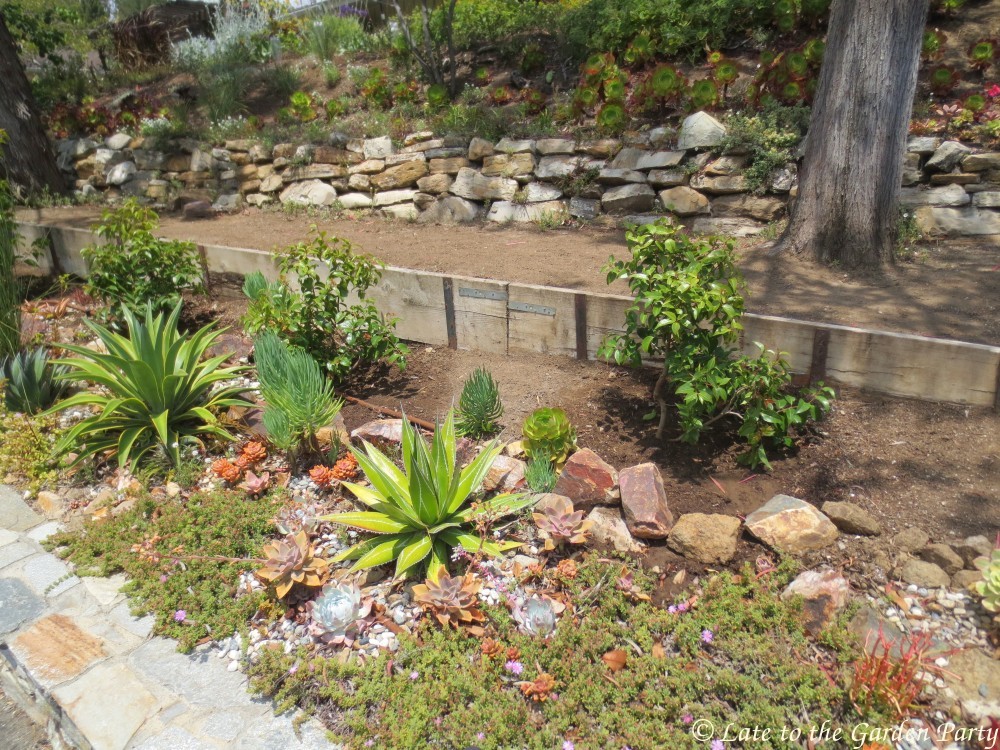
This space runs along the street on the southeast side of our property.  Those spindly shrubs you may be able to make out in the photo above are Pittosporum rhombifolium (I think).  They were in horrible shape when we moved in 3 years ago.  After years of being sheared from the top and sides, they were a thicket of dead wood with chlorotic leaves.  I cut one back last year and, when it responded by putting out healthy new growth, I cut them all back hard in January of this year.  Two were beyond saving and were removed.  The remainder have been slow to fill in.  I may eventually pull more - or possibly all - of them out as they don't match the Xylosma hedge that surrounds the rest of the property but, at present, I'm trying to work with what remains.  I cleared the weeds and thinned out the small-flowered ice plant at the base of the shrubs, leaving a lot of bare soil exposed.  As this is a relatively dry, sunny area, I thought planting it with succulents would be a good idea, especially given our worsening drought conditions.  (My wonderful husband is helping out by installing a new drip irrigation system here so we can eliminate all risk of sprinkler runoff.

I finished planting my newly purchased succulents on Sunday but there's still a lot of bare soil.

3 Agave 'Blue Glow,' Calandrinia spectabilis (aka Cistanthe grandiflora), Portulacaria afra and miscellaneous small succulent cuttings are planted here with 3 struggling Chondropetalum tectorum (aka Cape Rush)

Agave Impressa is surrounded by Dudleya (noID) and Senecio cuttings here

Agave desmettiana provides the centerpiece among Aeonium 'Kiwi,' Aeonium 'Sunburst,' Aeonium nobile, cuttings of the noID Aeonium given to me by a friend, and more Portulacaria afra

Agave 'Blue Flame' is surrounded by Aloe (noID), Sanseveriera (noID), Graptopetalum paraguayense, my noID Aeonium, and another noID succulent


While the slow-growing succulents will get larger over time, I think I need more to fill in some of the emptier spots.  Before I undertake another shopping expedition, however, I'm going to see what I can do with succulent cuttings from elsewhere in my garden.


Friday, January 24, 2014

January Projects

As we're lucky enough to be unaffected by the infamous "polar vortex" plaguing much of the US and blessed with unseasonably warm weather (if not, sadly, with rain), we've launched some new garden projects.  Okay, most of the "launching" was done by me but my husband has kindly cooperated.

I began tackling the misshapen hedge that runs along the street on the south side of our property a few weeks ago.  Oddly, half the hedge to the right side of our driveway is constructed of Xylosma congestum while the other half is comprised of what I think is Pittosporum eugeniodes.  It's the latter portion of the hedge that's in poor condition.  Clearly, for many years, gardeners have shorn both sections of hedge on the top and sides.  While that seems to do a fine job maintaining the appearance of the Xylosma, it has left the Pittosporum a twiggy mess with most of the new growth at the top.  I tried cutting a couple of the 9 Pittosporum back hard last year and the regrowth looked much better to my eye so, this year, I cut back all 9 shrubs.

Hedge before pruning, photographed from the back side

Hedge after pruning, photographed from the lawn above

Hedge after pruning, photographed from the street side


Hopefully, I haven't just made matters worse.  It looks very naked now and the area beyond the hedge is all too visible from the street but, if last year's experience is a guide, it should fill in within a few months.  In the meantime, I'm looking for plants to place in front of the hedge.  Behind it, along the top of the interior stack stone wall below the Ceanothus, I've already planted Liriope spicata, Liriope muscari 'Variegata' and Aeonium.

Newly planted Liriope, along with some self-seeded Santa Barbara daisy

New cuttings of Aeonium (A. arboreum, I think)


The Aeonium arboreum rosettes shown in the picture above were cut from existing plants and simply stuck into the ground.  I've produced many large, branched clumps of these Aeoniums from a few cuttings given to me by a good friend shortly after we moved into the house 3 years ago.

Clump of Aeonium arboreum grown from earlier cuttings


The second project of the year kicked off when my husband finally got around to dismantling the "snorkel spa" in the backyard (previously discussed here).

Photo of "snorkel spa" taken last January

Space after the main portion of the spa was removed last week

The stone gravel left behind after the spa's removal


You can't tell it from the picture above but the base of gravel underneath the spa we had to remove was about 6 inches (15 centimeters) deep.  I used some of it to fill shallow spots in the vegetable garden, previously lined using only gravel I'd dug up out of garden beds throughout the property.  (As our site was once part of a rock quarry, I uncover rocks whenever and wherever I dig.)

Gravel-filled pathways between the raised vegetable beds


My husband, with some help from me, used the rest of the gravel to cover the pathway behind the garage.

No more mud behind the garage!


As there's now a good-sized empty space in the backyard, my husband assumed that I'd immediately get started on planting; however, I need to get a load of topsoil in first and, before we do that, I announced that it would be prudent to take out the section of lawn I'd already identified for removal in the backyard.  I drew the lines of the new border earlier this week and my husband installed new bender board to delineate it.

I intend to treat the 8 foot wide grass area between the border on the right and the new border on the left as a pathway

The bender board around the fountain will be removed once the sod between it and the new bender board has been dug out


My husband wants to handle digging up the sod himself rather than call in reinforcements.  We're using some of the sod he removes to fill in holes in the remaining lawn.

The grass removed from alongside the backyard patio was used to fill in the space formerly occupied by stepping stones to the spa


It'll be awhile before the new areas can be planted but that gives me time to figure out how I'll knit these areas together with the existing borders.  In the meantime, there's always the empty space in front of the hedge to plant.


Saturday, March 23, 2013

Neighborhood Stroll

When we first moved into our current house a little more than 2 years ago, I made a habit of strolling my immediate neighborhood, eventually extending my walk-abouts into other local neighborhoods and along nearby public trails.  It was a great way to get exercise, acquaint myself with my new surroundings, and meet my neighbors.  Then my right knee started pitching a fit.  After consultations and tests, my orthopedist suggested that I find exercise that would put less strain on my knee.  Physical therapy, joint fluid injections, and arthritis medication have helped forestall surgery.  That's great but but I miss my walks - a stationary bike just isn't as interesting.  When I walked I was in tune with changes in my neighborhood but, now, almost 9 months after giving up those daily walks, I'm very out of touch.

I threw caution to the wind this morning and took a walk.  I wanted to see what was going on in early spring at other people's houses.  The first yards I looked at were those nearest to our house and, as I see these when I drive into and out of the neighborhood, there weren't many surprises there.

I can't put my finger on the name of this shrub, distinguished by its bright red spring growth
This house boat-like house has been empty for years and is currently for sale but I don't know what the Salvation Army is doing there

Nasturtium and pelargonium wrap a neighbor's mailbox


My fingers itched to pull the weeds in this recently installed succulent bed

Cistus in full bloom

Self-sown lupin

A lot of the houses in the large circle that constitutes our neighborhood are set behind tall hedges, gates or up steep driveways so there often isn't much to see from the street.  This hedge, with a mallow peaking through other shrub material represents a case in point.

8 foot hedge with mallow poking through

I could see bulbs in bloom behind the bars of this gate as I wound my way around the corner.  In addition to daffodils and a camellia in full bloom, this neighbor had tulips, which I've never been able to grow successfully here.  Maybe this spot is more protected from the strong Santa Ana winds that always knock out my tulip blooms before they get started.

Bulbs behind bars

I walked up to the entrance to our area, where I ran into a neighbor I hadn't spoken to in months.  While we got caught up, what little was left of the fog we started the morning with lifted, which made subsequent picture-taking more challenging.  However, even better photos probably wouldn't have helped the appearance of this bed at the entrance to our street.  To the credit of the neighborhood, residents have added drought-tolerant plants here and there but the mix hasn't coalesced yet.  It doesn't help that the area's ridden with weeds.  I may have to volunteer some time there soon.

Weedy bed near street entrance

As I came back into the "circle," I saw this pine covered with cones.


And then I saw that the house of an elderly neighbor has been put up for sale.  I haven't seen her in quite awhile.  One of her 8 cats showed up to say hello so I assume she hasn't moved out yet.

House for sale

Friendly cat

Here's another hedge long a wall 2 doors further down the street.

Hedge bordered by bedding begonias

A renovation that's been in process for 6 or more months is still in process.

A big house getting bigger or just a face-lift?

The next house on my left is one of the few in the area that maintains a large planting bed fronting the street.

Pelargoniums, agave, aloe and miscellaneous other succulents
Diverse mix including phromium, osteospermum, dietes, euryops and succulents

 The neighbor across the street has a vinca "lawn."  Vinca can be invasive here but these plants seem to be effectively contained between the agapanthus on one side and the street paving on the other.


Vinca in lieu of grass
Two neat front doors face a recently hatcheted hedge across the street.

This house always has succulents on the doorstep

The orange clivia looks perfect every spring

I''m not sure what this hedge is/was

As I proceeded in the direction of our house, I passed by an empty lot.  This property, consisting of 2 large parcels with a view of the harbor, has been empty for years.  I've been told that the house that once stood here burned down and the owner is unwilling to sell unless he gets the price he wants for it.   I'm sure the wildlife enjoys the space in the meantime.  There's an interesting plant growing there I wish I could identify.  It grows to the height of a small tree; has large, textured leaves; and produces lavender flowers that the bees seem to adore.

Weeds grow through what remains of the old driveway

This plant is everywhere but I can't identify it

In bud, the flowers resemble Borage on steroids

The blooms attract bees

This is the best close-up I could get

I passed the elaborately terraced front yard of another of my neighbors, an avid gardener.  In addition to alstroemeria, California poppies, salvia, and citrus trees, her front yard contains a spectacular leucospermum in full bloom.

View of terraced slope

Alstroemeria and California poppies

Another view of the terraced slope

Cleveland sage and polygala

More California poppies with daffodils

The Leucospermum

Her garden puts the rest of the neighborhood to shame.

A neighbor who finished construction on his house last year has finally put in a garden.  He's kept the front garden simple in keeping with the simplicity of the design of his house.

Poorly focused shot of neighbor's new garden bed

Iceland poppies in mass near driveway

I came across a pretty 6 foot tall Abutilon as I neared home.

Abutilon (variety unknown)

My own front yard is partially hidden behind a well-established shrub hedge as well.  I'll share a view of my front garden in a future post.

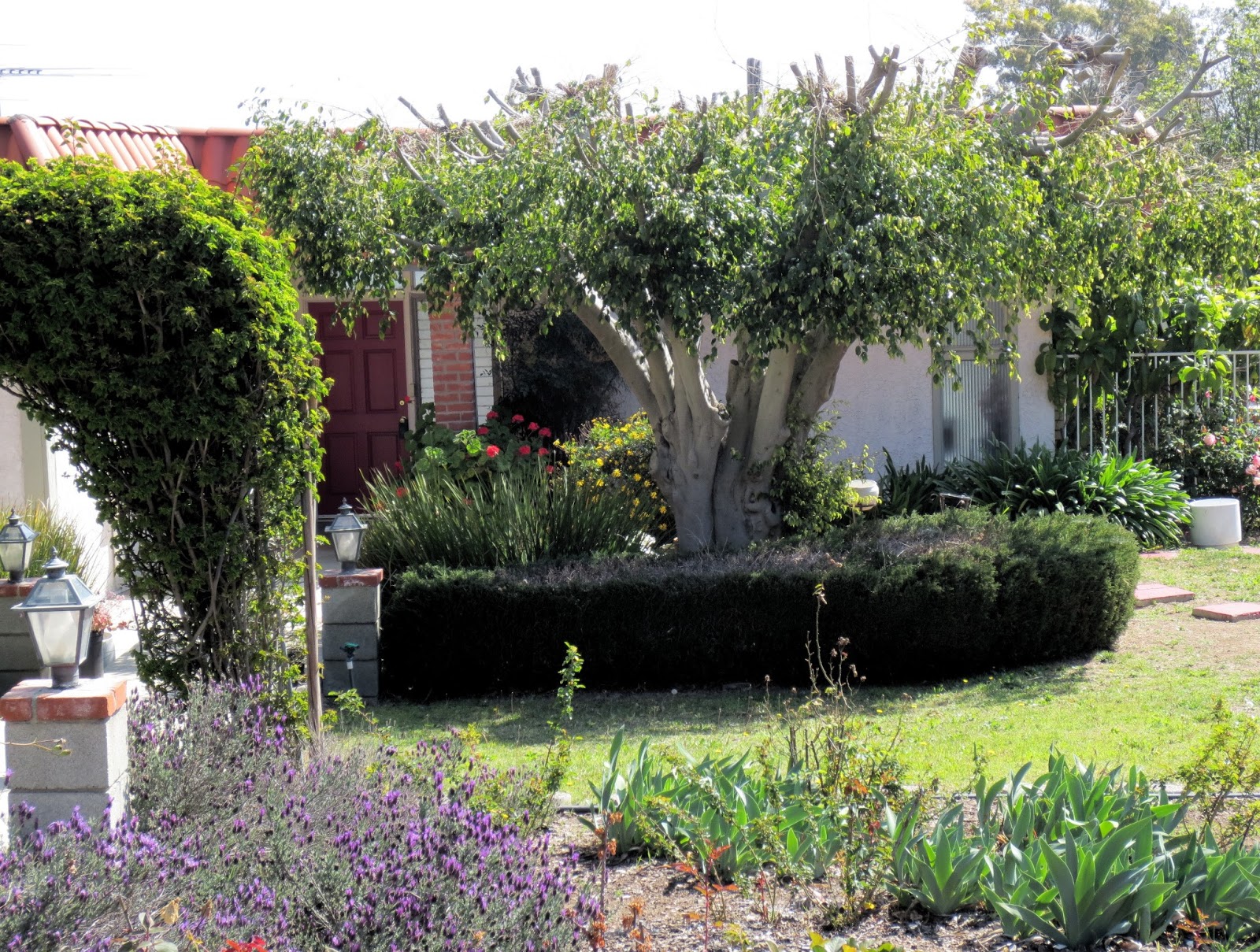
Hedge in front of our own house
I'm off to ice my knee.