Showing posts with label Persicaria microcephala 'Red Dragon'. Show all posts

Sunday, July 16, 2017

Foliage Follow-up - July 2017

As summer heats up, shade becomes all the more important so, when it came time to identify subjects for the foliage follow-up post hosted by Pam at Digging, trees came to mind.  This past winter I once again had our Magnolia grandiflora "thinned" to accommodate a neighbor's view concerns but the crew went further than I'd expected and, until recently, I felt it looked a bit sad, not to speak of the fact that it provided limited shade.  It's finally looking like it should again.

The Magnolia standing proud in the front garden (left) and a recent flush of new growth along its branches (right)


I also had all 4 of our Arbutus 'Marina' thinned.  They've filled out again too but, this month, even more than the shade they provide, you've got to admire their handsome peeling bark, which is particularly evident at this time of year.

This particular tree sits on the northeast side of the house.  Its bark peels to a degree all year but look at the curls it's got now!


A few other foliage selections also caught my eye.

Purchased as Chondropetalum tectorum, this Cape Rush may be more correctly classified as C. elephantinum, although mine seems to fall mid-way between the 2 species in size.  I originally planted 3 in my street-side succulent bed in 2013 but only this one thrived.  I wish you could see how the sheaths on the joint stems gleam in the afternoon sun but I wasn't able to capture it well in the mid-afternoon glare so I made do with this early morning shot.

The dominant plant in this foliage mash-up is Leucadendron 'Safari Sunset', which develops bright red bracts in summer.  L. salignum 'Winter Red' is planted in front of it.  At maturity, the former should be about twice the size of the latter.  The hedge of Xylosma congestum is shown in the background with Stipa tenuissima in between.  The gray-foliaged semi-weed threatening to engulf the Leucadendrons from the left is Helichrysum petiolare 'Silver Mist'.

I brought this Persicaria 'Red Dragon' with me as a cutting from my former garden.  It's struggled in my current garden even in this afternoon shade location next to the house but I thought it looked pretty good here with the window shade pulled down behind it in a our futile effort to keep the house cooler.  I'm going to try taking some additional cuttings this fall to see if I can find a more hospitable location for it elsewhere.


It's hard for me to let a foliage-focused post go by without featuring at least some succulents so here's this month's selection:

The planter stand here had belonged to my mother-in-law but the rusted steel bowl it originally held corroded and slowly fell apart.  I bought a cheap shiny steel wok, which accommodated me by quickly rusting outside.  I planted it up with a mix of succulent cuttings with a Graptoveria 'Fred Ives' in the center.  I like the way it glows in the mid-day sun in what's otherwise a fairly shady spot on the covered patio on the south side of the house.


Finally, as my Agapanthus flower stalks begin to look scruffy in July, mass decapitations are generally part of my summer tidying-up process.  This year, inspired in part by the Alliums spray-painted blue after the flowers faded I saw during the 2017 Garden Bloggers' Fling, I decided to try leaving some nude Agapanthus stalks in place.  I haven't decided yet whether it's worth the effort of cleaning them up.  We'll see.  For now it's just an experiment.

Painting the seedpods would probably improve the color contrast but I've no intention of taking things that far.  The contrast may be greater when the stalks dry and the Xylosma hedge behind them is trimmed, producing a flush of fresh orange growth.


For more foliage follow-up posts, visit Pam at Digging.


All material © 2012-2017 by Kris Peterson for Late to the Garden Party

Monday, October 6, 2014

In a Vase on Monday: Survivor Story

I'd hoped I might have Camellia sasanqua to use in my vase this week.  When the weather cooled a week ago, a few of these flowers began to appear in a shady area adjacent to my vegetable garden.  I also had a back-up plan: if there were too few Camellias, I could use stems of Tagetes lemmonii, which had also started to bloom in earnest.  Then, we got another heatwave.  The Camellias shriveled and even the moderately drought tolerant Tagetes, buffeted by the Santa Ana winds (aka "devil winds") that accompanied the heat, looked worse for the wear and tear.  So the search for flowers and foliage to fill this week's vase, prepared in connection with the meme sponsored by Cathy of Rambling in the Garden, became another scavenger hunt.  The resulting vase is a mix of flowers that survived the heat and a few plants that love the heat, including one recent acquisition.


If this composition has a focal point, I suppose it's the Bougainvillea, a heat-loving plant.  Our red Bougainvillea, inherited with the house, has never been a vigorous grower but, it it were, my husband probably would have removed it by now as he considers this an "evil" plant.  This stems from the fact that the Bougainvillea at our former house grew about a foot a week and scratched his beloved electric car, which he'd lovingly converted from gas-power.  Removing those plants with their vicious thorns was a monumental exercise he isn't likely to forget.  However, this Bougainvillea isn't anywhere near as ambitious - it gets by with an annual trim (which I handle as I wouldn't trust my husband not to get carried away).

The Bougainvillea picks up the color of the single stem of Asclepias tucked in against it


The other elements in this week's vase include:

  • Asclepias curassavica 'Silky Red'
  • Gomphrena (no ID), probably G. haageana, picked up on a whim on a recent swing through a garden center
  • Leucadendron 'Wilson's Wonder,' repeating last week's performance
  • Pennisetum setaceum 'Fireworks'
  • Persicaria microcephala 'Red Dragon'
  • Tagetes lemmonii (aka Copper Canyon Daisy)
  • Zinnia (no ID), one of the few seedlings which survived on nominal infusions of water this summer


The new Gomphrena came in red and orange so I got a few of each

The red-tinged bracts of Leucadendron 'Wilson's Wonder' almost look like flowers

The furry flowers of Pennisetum 'Fireworks' appeared with the heat

I picked the least scrappy looking Copper Canyon daisies to add a whiff of their delicious scent to the vase

I cut one of the few remaining Zinnia in my garden


I cut a variety of other floral and foliage survivors that didn't make the final cut, including Leonotis leonurus (aka lion's tail) and Bulbine frutescens 'Hallmark' (aka snake flower and cat's tail).  These ended up in another vase with single stems of coleus and the yellow form of Russelia equisetiformis.


The main vase landed in the foyer.


These are my contributions to Cathy's popular weekly meme focused on flowers gathered from one's own garden.  Please visit Cathy at Rambling in the Garden to see her creation and to find links to posts by other contributing gardeners.


All material © 2012-2014 by Kris Peterson for Late to the Garden Party

Monday, July 21, 2014

In a Vase on Monday: Watching and Waiting

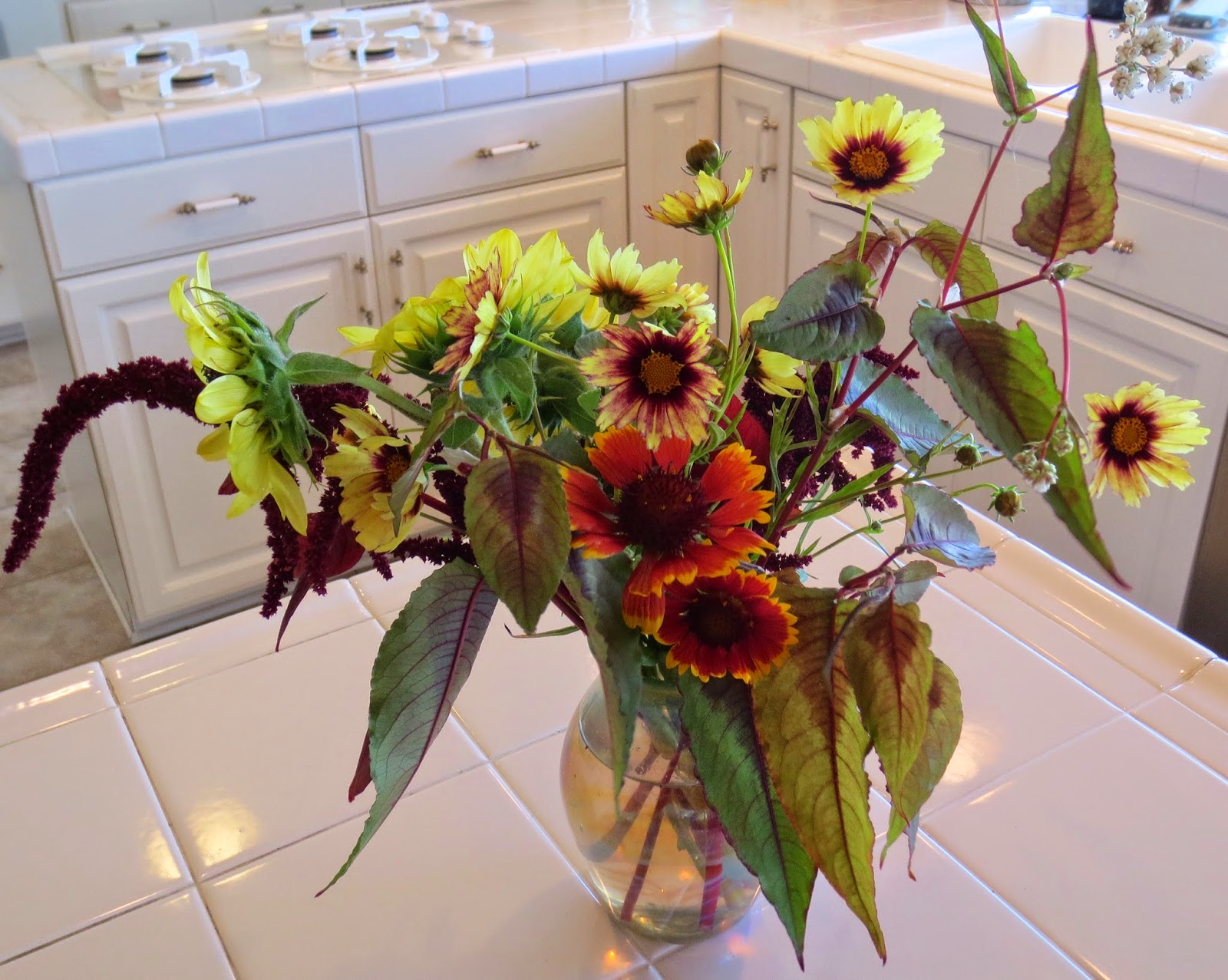
I've been watching and waiting for my Coreopsis 'Redshift' to start its bloom cycle.  In my garden, these blooms take over as the blooms on the Agapanthus taper off.  I have a total of 8 of these perennial plants in the back yard, 5 of which I added in March of this year.  The buds began appearing a month or more ago but, at the time of my July Bloom Day post, only a few buds had opened.  A day or two after Bloom Day, the 3 original plants were covered in blooms, making them a suitable choice to use "In a Vase on Monday," the meme sponsored by Cathy of Rambling in the Garden.  As the Coreopsis are rather wispy, they needed a centerpiece with greater impact, which was provided by Helianthus annuus 'Valentine,' but the Coreopsis dictated the overall color scheme.


The bouquet includes:

  • 2 stems of Amaranthus cruentus 'Hopi Red Dye'
  • 5 stems of Coreopsis 'Big Bang Redshift'
  • 1 stem of Gaillardia x grandiflora 'Goblin'
  • 2 stems of Helianthus annuus 'Valentine'
  • 3 stems of Persicaria microcephala 'Red Dragon'
  • 1 stem of Solenostemon scutellarioides 'Coleus Inky Fingers'


As the following picture shows, the color of the Coreopsis varies.  At the start of the bloom cycle in summer, the flowers open with butter yellow petals and a deep red halo around the center.  The red streaks at the center gradually radiate to the tips of the petals.  The flowers are temperature sensitive and, as the weather cools in the fall, the red color will dominate.

A fuzzy photo showing some of the color differences in the Coreopsis


I added the coleus at the last minute in an effort to lighten the heaviness created by the burgundy-colored annual Amaranthus.


While the daisy-like shape of the Gaillardia is similar to that of the tickseed and sunflower, the color was just a little off, so it ended up tucked into the back of the bouquet.


Other floral rejects - 2 stems of Echinacea 'Cheyenne Spirit,' 3 stems of Bulbine frutescens and a small piece of Coreopsis - ended up in a small vase consigned to the guest bathroom, where all my rejects seem to end up at present.


And the larger vase ended up in the front entry, as usual.


Go to Cathy's blog at Rambling in the Garden to see her creation this week. You'll also find links to photos of vases created by other participating gardeners.


Sunday, August 25, 2013

Good looking inside and out

I've been whining off and on for the last few weeks about the state of my garden.  Even my old garden, situated in an area with a strong marine influence, suffered during the mid-to-late summer months and the heat is 10 degrees higher on average at our current location.  Although we had a few weeks of cooler than normal summer temperatures this year, it still gets hot.  Many of the roses produced new blooms only to wither within a day.

Still, there's an area of my garden that's looking especially good right now, at least by comparison to the rest.  It's the area along our living room window, which looks out onto the backyard and, in the distance, the Los Angeles harbor.  That bed is long and skinny, about 3 feet wide and 23 feet long, which makes it difficult to photograph.

Here are photos taken from the backyard facing the bed, by segment, starting on the right side.

From the far right, the major plants here are Plectranthus ciliatus, Arthropodium cirratum, and Eupatorium sordidum with some ferns, Pseuderanthemum 'Texas Tri-star' and Alyssum thrown in

The middle of the bed is dominated by a tall Calliandra haematocephala with Persicaria microcephala and Eupatorium sordidum on the right and Arthropodium cirratum on the left

The left side of the bed contains the 2nd Arthropodium cirratum, Liriope muscari, and Plectranthus zuluensis with Campanula and Alyssum thrown in


My side view photos may show it better.


I took a couple of photos from inside the house too but their clarity is somewhat obscured due to the fact that I haven't tackled window washing in a few months.


This bed relies heavily on foliage; however, several of the plants do flower.  The Plectranthus ciliatus (variety unknown) came here as a cutting.  It has grown very large in 2 years.  The leaves are textured and purplish burgundy underneath.  The plant produces delicate lavender flower sprays in the fall.

Plectranthus ciliatus


There are 2 Arthropodium cirratum in the bed, placed on opposite ends.  This plant, commonly known as Renga Lily, also blooms, although I grow it mainly for its foliage.

Arthropodium cirratum (aka Renga Lily)

Renga Lily in bloom in May


Next to the Renga Lily on the right side are 3 Eupatorium sordidum (formerly known as Ageratum corymbosa), which have knitted together.  This plant has velvety green leaves with purplish edges and veins.  It flowers heavily in spring but it's producing a lighter crop of ageratum-like flowers now.

Eupatorium sordidum in bloom in August


Persicaria microcephala 'Red Dragon', also grown from a cutting, sits behind the Eupatorium.

Persicaria microcephala 'Red Dragon'


The middle of the bed is dominated by a 4+ foot tall Calliandra haematocephala (aka Pink Powder Puff).  This is the only plant left of those originally in this bed.  It's an unusual choice in the middle of a span of windows but the prior owners positioned their TV in front of the space and we have followed suit as it's the most logical placement to ensure that the main seating is positioned to face the view.  If money weren't an issue, I'd love to have a TV that raised up out of a hidden cabinet but that's not going to happen so we rely on shrubbery to make the TV's placement more presentable from the exterior.

Calliandra haematocephala (aka Pink Powder Puff)


This Calliandra doesn't get enough sun to bloom but the reddish color of the new foliage provides sufficient interest.


On the left side of the Calliandra, there's another Renga Lily, 3 Liriope muscari, and a Plectranthus zuluensis.  This spring-flowering Plectranthus hasn't done as well here as it did in my old garden, where it grew to more than 3 feet tall and wide.  It may simply need more time to mature but I think the drip irrigation system in this area also needs work as the space has been the hardest to keep full.

All in all, it's a nice bed.  I add pansies and other seasonal bedding plants that can manage with only morning sun to fill in but the plants featured above carry the show.  And, it looks good both from the garden and from inside the house.

Friday, July 19, 2013

Bouquets: The 'Red Dragon' Rises

The Persicaria 'Red Dragon' I planted from a cutting I brought with me from my old garden has filled out since the hard pruning I gave it in late winter.  Now that its stretched to 3 feet tall and more than 3 feet wide, I finally felt I could afford to cut some to use as a foliage accent in a floral bouquet - or two.  I started out composing a bouquet with Gaillardia 'Arizona Sun' as a centerpiece.  I thought I'd add Coreopsis 'Big Bang Redshift', which is just coming into flower, but, after cutting the Coreopsis, I decided that the red tones in the two flower varieties don't mix well - one red has an orange cast while the other has a purplish burgundy cast.   So, instead of one bouquet, I created two.

This is the bouquet based on the Gaillardia:


In addition to Gaillardia 'Arizona Sun' and Persicaria 'Red Dragon', this bouquet contains Euphorbia 'Ascot Rainbow' and Echinacea 'Pow Wow White'.  Although the red in the Persicaria leans a little closer to burgundy than orange, I think it effectively reflects the color at the center of the Gaillardia.

The second bouquet using Coreopsis 'Big Bang Redshift' is made of Persicaria 'Red Dragon', Tanacetum parthenium (aka feverfew), and a couple of 'Buttercream' roses.  I added the roses because the composition looked too wispy without a more substantial floral or foliage element.  The short-stemmed yellow roses were all I could find in the right color range.


That's it for the bouquets offered this week as a homage to the Garden Appreciation Society sponsored by Erin at The Impatient Gardener.

Wednesday, June 12, 2013

Bouquet #2: Garden Appreciation Society

Erin of The Impatient Gardener hosts a presentation of bouquets composed of blooms and foliage selected from participants' gardens each week.  For the last 2 years, focused on the composition of the garden, I've been loathe to cut anything to carry into the house, although I used to cut flowers periodically to bring to my mother when I visited.  I've decided that it's time to bring some of the garden's color, fragrance and joy into my own the house so I've joined in Erin's Garden Appreciation Society.

Here's my bouquet this week, photographed in particularly poor light last evening:


I selected the gold Tagetes lemmonii (aka Copper Canyon Daisy) because I recently noticed that it had sprung into bloom in one of the less visited areas of my garden.  I also like the scent (which, sadly, my husband does not).  I selected the ruffled Leucanthemum x superbum (Shasta Daisy) again this week because I have a lot of them to spare right now and the gold centers mesh well with the color of the smaller gold daisy.

My difficulty arose in selecting an appropriate filler.  I tried a few foliage plants, including:

Calliandra haematocephala

Xylosma congestum

Persicaria microcephala 'Red Dragon'

The problem with the Calliandra haematocephala is that the leaves close up at night, which makes the foliage look droopy in a vase.  The Xylosma congestum, used as a hedge here, is plentiful but, because it's kept closely shorn, it's hard to find pieces that are long enough to have an impact in an arrangement.  And I couldn't bring myself to cut the Persicaria microcephala 'Red Dragon' because its only now coming back from a hard pruning in the fall.

So I selected Nandina domestica (aka Heavenly Bamboo).  In addition to being plentiful here, it's currently flowering, which adds to the presence of the foliage in the vase.  As I recall, the flower buds drop heavily when placed in a vase.  It remains to be seen how long this arrangement will last.  Last week's arrangement held up for an entire week.

Please go to Erin's site to see bouquets posted by other gardeners.

Tuesday, April 16, 2013

April Foliage Follow-up

I drafted the following post prior to hearing news of the events at the Boston Marathon.  This is probably not the place to take a position on what happened but I find I can't ignore it either.  I want to express my profound sympathy for the residents of Boston and those who were in the city to participate in or observe the marathon.  Whether this was an act of domestic or foreign terrorism, it is both incomprehensible and unconscionable.  There is enough pain and sorrow in the world without its deliberate creation and I cannot understand why anyone would seek to add to this in an attempt to advance an agenda.  My prayers are with the victims, their families and friends.

*********

Foliage Follow-up Day is an opportunity to highlight the foliage that often gets short shrift with all the attention given to flowers.  To be honest, after so many years gardening in a shady, postage stamp-sized garden, I'm afraid I went more than a little bloom crazy when we moved to our current, mostly sunny, half-acre property a little more than 2 years ago.  However, I've recently begun focusing more attention on foliage as, after all, it's a more persistent presence in the garden and also essential to preventing the busy look that can come with an excessive reliance on flower color.

I'm lucky to have inherited a lot of established hedges.  I also have quite a bit of lawn - I've been chipping away at that and plan to continue to do so but I'll leave some as it offers an opportunity for the eye to rest.

I brought a few foliage plants with me from our old house in the form of cuttings.  The Plectranthus I placed in a bed running along our living room did very well, although I've had a harder time establishing it elsewhere.  It gets about 2 hours of morning sun along the living room and the foliage stays a rich green with purple undersides.  It also flowers well in the fall.  I've had some difficulty definitively identifying the species.  It's most likely Plectranthus ciliatus 'Zulu Warrior', although some of the descriptions suggest this plant is shorter than mine has proven to be.  In my experience, this plant gets to about 2 feet tall and can easily spread twice that distance.

Plectranthus ciliatus 'Zulu Warrior'?

Photo showing the underside of the leaf on this Plectranthus

My cutting of Persicaria microcephala 'Red Dragon' also took and, so far, has remained well-behaved in the same mostly shade bed.  I cut it back hard in the fall.  I'm thinking of trying it in another, somewhat sunnier location after seeing a vigorous example of the same plant in the Getty Center's garden.

Persicaria microcephala 'Red Dragon'

A friend gave me several divisions of a golden feverfew, which I've inserted in various locations that needed a jolt of chartreuse green.  It flowers but I grow it mainly for the ferny foliage.

Tanacetum parthenium 'Aureum'

In terms of major foliage accents, I've added Phormiums in several locations.  Here are a few of the larger varieties.

Installed shortly after we moved in, I kept no record of the name of this one

Phormium tenax 'Apricot Queen' (I think - I may have this and the next one confused)

Phormium tenax 'Yellow Wave' (I know - it needs grooming)

I've also added a lot of Heucheras, although their placement has posed an issue as I've found they don't do well in full sun here, where they can shrivel during the heat of summer.  Here are a few of the most interesting varieties.

Heuchera 'Miracle', returned this spring after partial die back last fall

Heuchera 'Melting Fire', a new addition

Heuchera 'Marvelous Marbles', still struggling a bit in an area that gets just morning sun

Heuchera 'Key Lime Pie', moved last year from a very shaded area to one that gets morning sun

The elimination of the large Eucalyptus tree from our side yard early this year, which I wrote about here, created a large new bed and an opportunity to add more foliage plants.  Two of the best additions are the Dryms lanceolata, inserted as the centerpiece of the new bed, and the 3 Coprosma repens 'Plum Hussy', inserted as accent plants.  The Dryms, also known as a Mountain Pepper, is still small - just over a foot tall - but it should eventually reach 10-15 feet tall and 10 feet wide.  True to its advertisement, it produced small greenish white flowers in early spring.  It's supposed to develop black fruit in the fall but, in the meantime, it displays the nice red stems shown below.

Dryms lanceolata, still an infant

The Coprosmas would show better against a green background.  As this is a fairly sunny spot, I'm thinking of adding a ground-hugging thyme as a backdrop.

Coprosma repens "Plum Hussey'

I'm going to have to be vigilant about cutting this plant back to keep it in scale.  The one I placed on the sloping edge of my dry garden is already getting too tall and skinny, which won't do in the other bed.

Coprosma repens 'Plum Hussy' living up to her name in the crowded dry garden

My final foliage offering will no doubt appear pitiful; however, I thought this Clerodendrum myricoides 'Ugandense', the second one I've tried in this garden, was a goner.  I had a beautiful shrub of this variety at a rental apartment in Santa Monica many, many years ago and it's a sentimental favorite of mine but I'm afraid it doesn't like our current location much.  My first try died within 6 months - or maybe I just gave up on it too soon.  I started with a smaller plant on my second try and, while it produced it's trademark blue butterfly-shaped flowers, it declined soon after flowering last summer.  I cut it back, gave it a healthy shot of compost, and waited.  Last month, I thought it was dead but, as this picture indicates, there are now signs of life!  As the saying goes, hope springs eternal.

Clerodendrum myricoides 'Ugandense'

Pam at Digging hosts this monthly foliage follow-up.  Please go to her site for more foliage photos.