Showing posts with label Echium webbii. Show all posts

Tuesday, December 7, 2021

A Week of Flowers 2021, Day 7

I'm back with a post for the final day of A Week of Flowers, sponsored by Cathy of Words and Herbs to brighten the gloomy days many in the Northern Hemisphere face as winter sets in.  I shared February blooms on Day 2 and April blooms on Day 4 so I've chosen some of my favorite May flowers to end the week-long celebration.

This is variegated Echium candicans 'Star of Madeira'Echium of all kinds do well in coastal Southern California's Mediterranean climate.  In fact, some literally grow as weeds here.

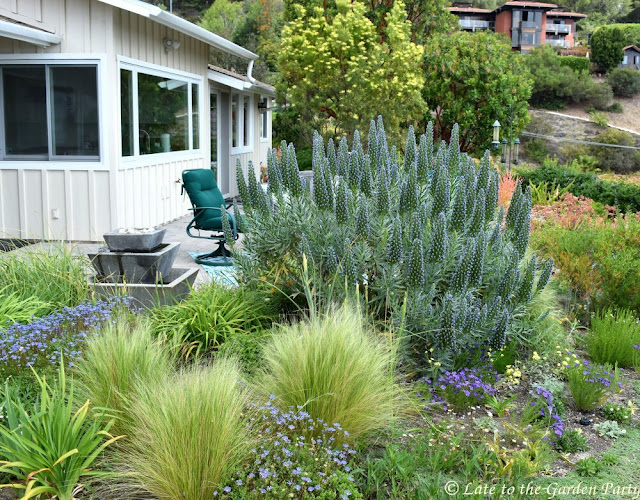
This is Echium webbii, which I love for the silvery sheen of its foliage as much as its flowers.  The blue of the Echium flowers is echoed in the flowers of Felicia aethiopica.  The yellow "blooms" in the background aren't flowers at all but the colorful bracts of Leucadendron 'Pisa'.

Visit Words and Herbs to find other posts on this theme.  Thank you Cathy for launching this effort!  Even my part of the world gets a bit gloomy at this time of year.  In fact, we're expecting mostly gray skies through Thursday this week but the silver lining is a chance of rain today and Thursday, which would be wonderful.  Southern California is very, very dry and we need something approaching "normal" rain this season if we want to see plentiful flowers in the coming spring.


All material © 2012-2021 by Kris Peterson for Late to the Garden Party 

Friday, January 8, 2021

Winter Foliage Highlights

When I sat down to write this post, I started with a rant about what happened in the US Capitol on Wednesday.  Disillusioned and disgusted as I've been with the current occupant of the White House for a long time, I was nonetheless shocked that a sitting President would actively incite violence as he did on Wednesday.  However, rather than repeating what you can find in news reports, I'll just share a song from John Fogerty.  A friend shared it with me just before the violent attack by terrorists on the US Capitol intent on asserting the President's will over the will of the people.  Fogerty had been distressed that his song, Fortunate Son, had been used on Trump's campaign trail over his personal objections.  This new song, Weeping in the Promised Land, is his own reflection on the damage Trump has wrought during his 4-year tenure.


As to the foliage standouts in my winter garden,  I'll start with the succulents on the south side of our house.  I took the first photos in late December.

There's a problem that stands out to me like a sore thumb here - do you see it?

Some of the leaves of Agave 'Blue Flame' were badly damaged by summer heat

The burned and tattered edges of the 'Blue Flame' Agave had bothered me for some time.  On Wednesday afternoon, needing to engage in physical activity to work out my anger and frustration with the day's events, I took a knife to the damaged leaves of the agave.  Here are the after shots:

I cut out many of the damaged leaves using a serrated knife.  In a few cases, I simply cut away the damaged leaf tips.

They're almost magazine pretty now

However, if you look closely, there's some pitting to the outside leaves, apparently the result of the brief hailstorm we experienced after Christmas.  I'd thought I've avoided any damage from the hail until I noticed this.

While cutting out selected leaves, I also removed seven 'Blue Flame' pups.  Only one of these had any roots hopefully the others can be encouraged to develop some.

In addition to the 'Blue Flame', 'Blue Glow', and mediopicta 'Alba' Agaves shown in the preceding photos, this area is home to several others, most notably the following:

I planted this Agave gypsophila from a 4-inch pot in 2016, not really considering the wisdom of placing it so close to the flagstone path.  I'm thinking about moving it to the recently replanted front slope nearby.

This Agave 'Mr Ripley', also originally planted from a 4-inch pot, was placed in another questionable spot along the dirt path used when trimming the hedge just a few feet away

Agave ovatifolia 'Vanzie' is several feet away from 'Mr Ripley' along the same path.  I think it'll be okay there but the Kniphofia in front of it may have to move.

Prominent as succulents are in my garden, my eye was drawn to other foliage as well.

The peppermint willow (Agonis flexuosa) trees that partially screen the garden from the street do a nice job imitating lace curtains this time of year

Although it's not as flashy as variegated Echium 'Star of Madiera', Echium webii is my favorite in this genus

I cut Melianthus major back to the ground in September, much earlier than usual, and I was worried that maybe I'd killed it but it's sprung back

I like how this Phormium 'Maori Queen'  echoes the color of the neighbors' maple tree leaves across the street, which you see in a peek-a-boo view through the foliage

I'll close with two new succulents I received as recent gifts from friends.

Mangave 'Barney' is on the left and Mangave 'Silver Fox' is on the right.  I'm still debating the placement of both.

Getting back to the subject matter at the top of my post, if you're sickened by the lies that lead to events like that we saw on Wednesday, you might consider signing the Pro-truth Pledge and, better yet, ask the officials who seek your vote to take the pledge too.  You can find more about it here.

May your weekend be calm and peaceful.


All material © 2012-2021 by Kris Peterson for Late to the Garden Party

Wednesday, April 29, 2020

Let's visit the back slope!

In the spirit of the "Coronavirus Tourism" posters created by Jennifer Baer, I'm providing another virtual tour of my garden, this time focused on my often-neglected and very steep back slope.  (You can view my prior tour of my lath house here.)

Despite its size, my back slope, situated on the eastern side of our half-acre lot, is easy to ignore.  When in our back garden, your eye stops at the Xylosma congestum hedge that runs the entire length of the back border.  On the other side, the property drops down dramatically and nothing planted there shows above the top of the hedge.  In fact, until the day of our final inspection prior to closing our purchase of the property, I didn't even realize it was there.

So let's pay a visit, shall we?  We access the back slope through the dry garden on the north side of the house.

From this angle, the gravel path I added after we moved in appears to end at the fence marking the property line between us and our neighbor on the north side

But, if you proceed as far as the grape arbor support my husband built, you can see signs that the path continues to the right

Rounding that corner, marked by a decaying tree trunk and a friendly Green Man, you see the first of the concrete blocks my husband installed as a stairway a year or so after we moved in

There was a slippery dirt path here when we moved in and, after I'd repeatedly fallen on my back side traversing it,  my husband laboriously dug these 50lb concrete blocks into the slope, working around numerous large rocks that studded the area.  I should mention that our entire neighborhood was the site of a large rock quarry in the 1940s.


Once we pass the hedge's northernmost edge, the back slope opens up to full view.

This area is bordered by the Xylosma hedge on the upper level (right) and a bay laurel on the lower level (left).  Our neighbor has a vegetable garden on the other side of that bay hedge, bordered on her side by a chain link fence.  When clouds aren't in the way you can see the harbor beyond those tall pine trees.


Those concrete blocks my husband installed are more widely spaced than they look and, without handrails, the trip to the bottom is usually made relatively quickly watching your feet as you go, without much attention to the plants on either side.

The stairway turns and ends with 4 more narrowly spaced concrete blocks


Once you turn the corner shown in the last photo, you reach a relatively flat area.  Here's what you might notice first:

A humongous crossvine (Bignonia capreolata), with a mammoth trunk, sits against the neighbor's chain link fence on our side of the property line.  My understanding is that the neighbor planted the vine decades ago when the property line was less well-defined.  The vine is trained along her fence but spills over in all directions, including the ivy-covered area belonging to our neighbor on the south side..  The vine is pretty but almost unmanageable in our climate, as I learned in my former garden.  I'd take it out except that this would impact my neighbors on both sides.

This is a view of our south property line looking in the other direction.  The wine barrels you see belong to the neighbors on our south side.  There was a huge Yucca elephantipes here when we moved in, which my husband lobbied to remove because it was also completely out of control.  We installed 3 Pittosporum tenuifolium 'Silver Magic' here to provide some of the privacy lost when the Yucca was removed.  There's a Ceanothus arboreum here too, which will eventually become a small tree.

I transplanted a few Centranthus ruber seedlings here years ago and they've gone crazy.  I tried sowing wildflower seeds here too but rampant alyssum (Lobularia maritima) choked most of those out.

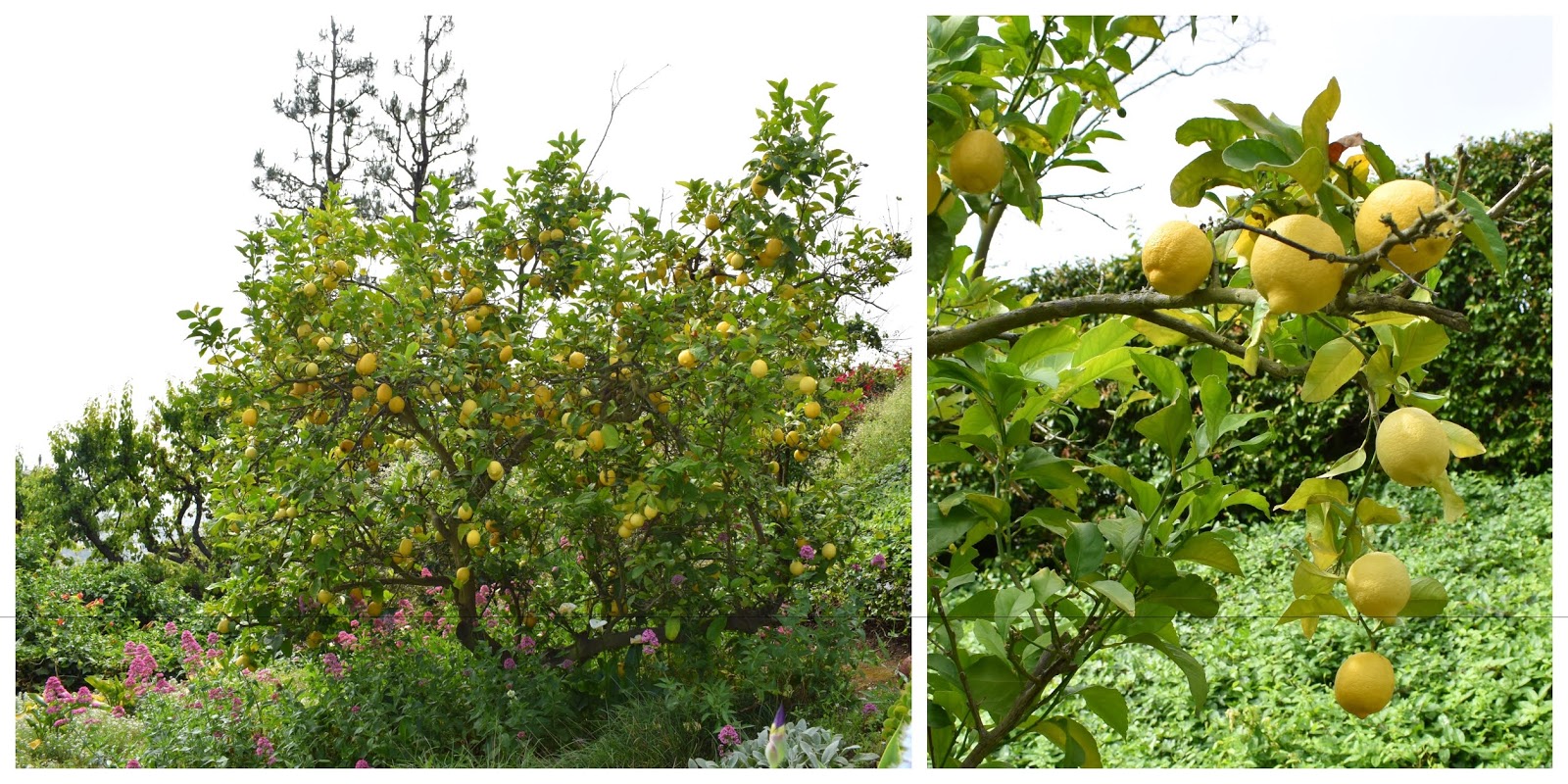
Of course, we can't ignore the lemon tree planted here as it's the areas's dominant feature.  It's been so much happier since the Yucca came out.  It produces lemons year-round except when a severe heatwave hits and knocks it out of commission for several months.


On closer examination, you might notice a few other things.

Calla lilies (Zantedeschia aethiopica) appear every spring following our winter rainy season.  They disappear when summer's heat hits.  After last week's early heatwave, most of those you see in this photo are now gone.

A purple Osteospermum (left) has planted itself down here.  I foolishly planted the Matilija poppy (Romneya coulteri, right), which grows too big for the area.  I'd planned to take it out this past winter and somehow never got around to it.  I'll take it out after it finishes blooming this season.

A week ago, too late to take constructive action to stem its impact, I discovered that the peach tree planted at the edge of the slope had been severely impacted by peach curl disease.  It looks hideous at the moment.


I'm not sure yet what I'm going to do about the peach tree.  It was planted by a prior owner and, while it often sets a little fruit, that fruit never has never survived long enough to ripen.  It may not help that it's irrigated by a gray-water system fed by our washing machine waste.  I could thin it's twiggy growth and spray it thoroughly in the fall in an effort to stop the fungal disease that causes the foliage to blister and curl but cleaning up the area below the tree, which is covered in a thicket of ivy, would be harder to accomplish, much less maintain.  I may end up taking it out entirely but I'll probably give spraying a try to see if it makes any significant difference first.

But let's forget about the ugly peach tree and focus on the more attractive features of the back slope.

The back slope is at its most colorful in spring


Moving to the other side of the lemon tree at the base of the lower tier of concrete steps, here's what we see:

I planted the foxtail agaves (Agave attentuata) here several years ago from pups taken from another plant in my front garden.  I added various Aeoniums at intervals since.  I moved the bearded Iris down here from other areas and, to my complete surprise, they've done better here than anywhere else in my garden.

This unknown dwarf Iris may be 'Darth Vader'.  It's wonderfully fragrant.

If you look up from this spot, above the Xylosma hedge you can see the mimosa tree (Albizia julibrissin, left), just beginning to leaf out now.  Shifting your eyes to the right, you can see 2 Arbutus 'Marina' in the upper level of the garden.


But let's take a look at the plants on either side of the concrete block stairway as we proceed more slowly back up the way we came.

Going up these stairs carrying anything heavy isn't fun and I almost always take the trip up slowly

The steep upper area on your left is covered with a dense layer of ivy and honeysuckle, punctuated by weeds.  I pull out what I can but, as you can see in the photo on the lower left, there's a patch of grass weeds I haven't managed to tackle along the southern property line.  Geranium incanum (lower right) is also a weed here.

But looking to right of the concrete stairway, we see a lovely Echium webbii I planted a couple of years ago.  In bloom now, it's a magnet for bees and butterflies.

I planted Euphorbia 'Dean's Hybrid' (left) and Pelargonium 'White Lady' (right) down here years ago and both move themselves around the area willy-nilly

The pink evening primrose (Oenothera speciosa) planted itself here after I cleared the area of the weeds that formerly covered this part of the slope

I planted seedlings of Centranthus ruber here too and it continues to spread on its own

Lampranthus 'Pink Kaboom' (left) is fading while gray Santolina chamaecyparissus (right) is just getting ready to bloom

Artichokes have done exceptionally well on this dry slope.  There are 2 varieties growing here but I can't name either.

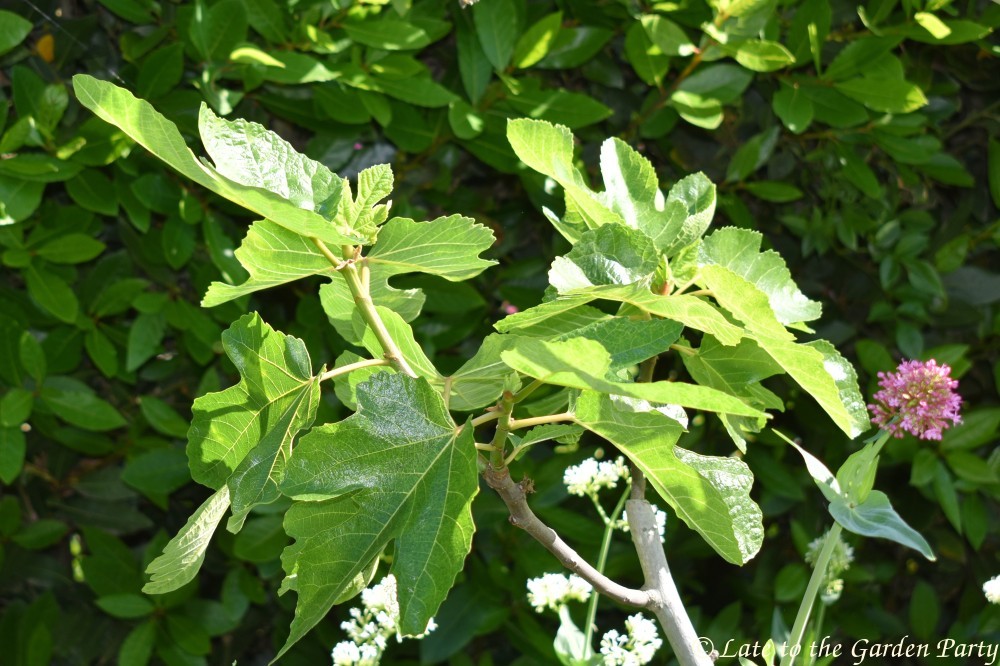
The prior owner we bought the house from put a fig tree in here.  It wasn't pruned well at the outset and my attempts to manage it since haven't improved things much.  The small amount of fruit it produces each year is snatched by critters before it ever ripens.


A dozen more steps beyond the fig and artichokes, we arrive back at the main level of the back garden.

Eventually I hope the centerpiece of this area will be the Callistemon viridiflorus you see in the middle of this shot.  I looked for this plant locally for years without success.  In October 2018, Tamara of Chickadee Gardens in Oregon sent me a one-gallon plant.  It's still small but it's just produced its first bloom and I'm thrilled.

Thank you Tamara!!!


So that's the back slope.  It offers opportunities that I find simultaneously tantalizing and daunting.  Terracing the upper level of the slope has been a dream of mine but access to the back area with heavy equipment is virtually impossible.  I've tried clearing small sections of the ivy and honeysuckle myself, working from the concrete block path but, given how steep it is, all I've managed to do is to crawl up on hands and knees 4-5 feet from its edge.  And the ivy and honeysuckle comes back quickly so the results of my efforts in one area are mostly erased by the time I clear the next small section.  Working down there during the hot summer months can be unpleasant too.  And then there are the fire ants, which I've run into on three occasions now...Thus far, I've decided to focus on the upper, more visible areas of my garden.

I hope you enjoyed today's tour.  Best wishes navigating the impacts of the coronavirus pandemic in your own backyard!  Take care.


All material © 2012-2020 by Kris Peterson for Late to the Garden Party

Friday, April 27, 2018

The Domino Effect

Last week I published photos showing the removal of a large Grevillea in the dry garden area on the northeast side of our property.  At that time, I commented on the domino theory and how one change can precipitate another.  Well, further changes were made this week.  The sad little non-blooming cherry tree came out and so did one of my two guava trees.  The latter change made the biggest difference in the area.

Here's a before shot showing the guava tree in question, which largely obscured the Leptospermums behind it

and here's the area after the guava tree, which we inherited with the garden, was removed

The flower and leaf-less cherry tree can be seen here, to the right of a persimmon tree that's in the process of leafing out

and here's a shot of the same area after the cherry tree was removed


I made the changes (with my husband's able assistance) despite the fact that I haven't yet decided what will go into the empty spaces.  I don't plan to put anything large into the space formerly occupied by the guava tree.  I want to give the 2 Leptospermums in that area a chance to fill out and I expect I'll just add ground cover plants beneath them, or possibly fill in with more Centranthus ruber, which is a virtual weed here.  Leptospermum scoparium 'Pink Pearl' is one of my favorite plants and it deserves an opportunity to shine.

The 2 shrubs need shaping but I'll handle that after the current bloom cycle.  They have a long bloom period, heaviest in spring with a light repeat bloom during the fall.


While I'm talking about favorite plants, I thought I'd join Chloris at The Blooming Garden and share my top 10 favorite bloomers for the month of April.  As I've got a flower fixation and as April is possibly the most floriferous month here, restricting myself to 9 other favorites wasn't easy but here we go:

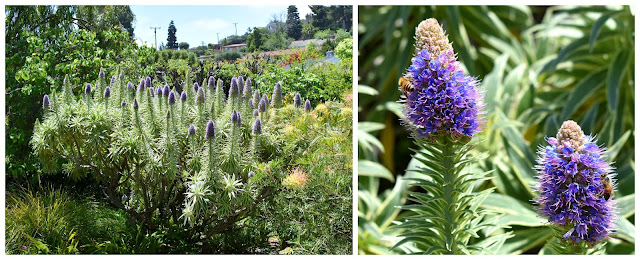
Echium webbii is my current favorite in the back garden.  It's a bee magnet.  I don't think I'd be exaggerating to say that there are at least a hundred bees swarming about the plant during the sunniest part of the day.  It's bloom cycle is well ahead of variegated Echium candicans 'Star of Madeira' this year.

Most of my Freesias are done blooming but this batch of blue Freesia in the back garden is still going strong.  In this case, I bought the plants in bud to replace the pink, red and orange Freesia that came up in place of the blue blooms I expected from the bulbs I planted last fall.  I'm much happier with the blue blooms here and, given my luck (or lack of it) with packaged bulbs, I may have to make it a practice to buy such bulbs in bloom in the future to ensure I get what I want.

I've bemoaned the failure of my bearded Iris to bloom over the past few years so I was delighted when this noID Iris germanica on the neglected back slope produced 3 tall bloom stalks this year, despite our truly pathetic winter rains. 

I look out at this Hunnemannia fumariifolia (aka Mexican tulip poppy) from my home office window and smile every time I see it

I featured Leucospermum 'Goldie' (top row) in my Bloom Day post.  Planted late last year, it represents my first real success with the genus; however, 2 other Leucospermums, 'Spider Hybrid' (lower left) and 'Brandi' (lower right, planted in March 2016) are also blooming and still another plant has buds.  I'm thrilled to think I may have finally overcome my problem with this genus.

While all my Alstroemeria are blooming, 'Indian Summer' is the most striking of them all.  In addition to the attractive flowers, its dark foliage is also attractive, especially when backlit.

These are the same photos I used for my Bloom Day post but I cut the Lotus berthelotii 'Amazon Sunset' here back dramatically a week ago so it doesn't look quite this good at the moment.  However, past experience suggests that it'll come roaring back.  It's a very vigorous plant and makes a great ground cover.  Its only fault is that it'll swamp anything in its path if allowed free rein.

Gazania blooms year-round here but it's at its flashiest in the spring.  The 2 top photos feature 'White Flame'.  The photo on the lower left is 'Strawberry Shortcake' and the bloom on the lower right is a noID self-seeded form.

Coleonema album (aka breath of heaven) adds white froth to the garden at this time of year


One plant that didn't make the cut this month is Festuca californica, a native California grass that's currently blooming.

It's hard to capture its beauty unless it's backlit


The grass adds an airy feeling to the garden and, rather than plant a tree in the area formerly occupied by the Grevillea and the cherry tree, I'm considering adding a mass planting of this grass and perhaps another large agave in that area rather than a tree.  My husband has made it clear that he really wants a tree to screen his view of the newly renovated house up the hill from us and I don't want to place two trees in such close proximity.

Enjoy your weekend and do check in with Chloris at The Blooming Garden to see what blooms gained her approval and that of other participating gardeners this month.


All material © 2012-2018 by Kris Peterson for Late to the Garden Party