Showing posts with label Centranthus ruber. Show all posts

Monday, June 8, 2026

In a Vase on Monday: Twisted

None of the dahlia tubers I planted in April and May are blooming yet, but two of the foxgloves I planted late last year have finally produced flowers so they kicked off today's "In a Vase on Monday" creation. They don't account for the title of the post, however. That was prompted by the unusual Pelargonium 'Colocho' I added to the mix, primarily as my foliage accent. It has twisted leaves with a delicious scent. I've had this plant in my garden for many years and I've propagated it from cuttings too but this is the first year it's developed a real presence there. It deserved the distinction of a starring role in this week's post.


The foxgloves and other flowers added rich colors

That included Centranthus ruber (aka red valerian), as shown at the back view of the vase.  It's essentially a weed here.  It was in full bloom earlier in the year but it's fading fast now.
 
Overhead view

Clockwise from the upper left, the vase contains:  Centranthus ruber, Cuphea 'Starfire Pink', Digitalis purpurea, Leucanthemum x superbum, Pelargonium peltatum 'Lavender Blizzard', and P. 'Colocho'

This is the arrangement in place in the front entry


It looks as though our afternoon temperatures will remain on the mild side (72F/22C) for awhile yet but we may finally get more sun each day starting mid-week as the marine layer backs off.  As I finally sowed some zinnia seeds, I hope that means some summer flowers by July or August!

Check in with Cathy at Rambling in the Garden to see what she and other IAVOM contributors are sharing thus week.


All material © 2012-2026 by Kris Peterson for Late to the Garden Party

Monday, May 4, 2026

In a Vase on Monday: The blues

It's been an odd spring.  It started off early as usual here in late February.  I posted photos of my first Dutch Iris on March 1st.  Unfortunately, as I ended up in the hospital, most of the Iris were gone by the time I got home later that month.  I only recently got back to doing any gardening.  My dahlia bulbs have gotten started in pots but it'll be a while before I see any flowers from them.  In the meantime, I'm making use of my blue flowers in the form of agapanthus and larkspur.  Here's this week's vase.

Too much?  Most of the noID Agapanthus came with house.  The flowers return reliably each year.

Back view: The larkspur (Consolida ajacis) flowered better this year than last but still not as well as in previous years.


Overhead view

Clockwise from the upper left: 'Abelia 'Hopley's Variegated, noID blue and white Agapanthus, Centranthus ruber 'Alba', noID Consolida ajacis, and Echium 'Star of Madeira'


After an extended heatwave in March, April was comfortable but it's been on the cool side for the past week.  I'm hoping for sunnier skies and warmer temperatures in the low 70s (22C) later this week.

For more IAVOM posts, check in with Cathy at Rambling in the Garden.


All material © 2012-2026 by Kris Peterson for Late to the Garden Party

Monday, May 12, 2025

In a Vase on Monday: Nose dive

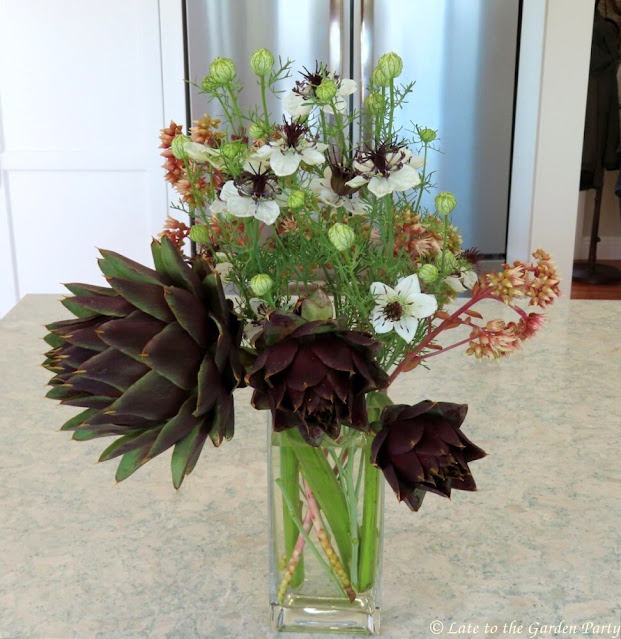
One of the plants in my back border took a nose dive a few days ago.  Although the gardeners trimmed the hedge behind it before we noticed it had toppled, I don't think anyone was responsible for knocking it down.  The plant in question was an artichoke with three very heavy chokes.  I think its sheer weight caused its nose dive.  Dry soil may have been a contributing factor as we've been dealing with our first heatwave of the year since Friday.  In any case, rather than tossing the entire thing in the compost bin, I decided to use part of it in an arrangement.

The 'Purple Romagna' artichoke has exceptionally sharp spines that glint like gold in the sun.  Unfortunately, I couldn't capture their color properly with my camera.

Back view: I added a few stems of the bronzy-colored flowers of the Aeonium haworthii to play off the choke's gold spines and white and purple flowers of Nigella papillosa to echo the choke's flesh.  In retrospect, it may have been better to stick with one or the other.

Overhead view

Clockwise from the upper left: Aeonium haworthii 'Kiwi Verde', Nigella papillosa 'African Bride', and Cynara cadunculus var. scoolymus 'Purple Romagna'


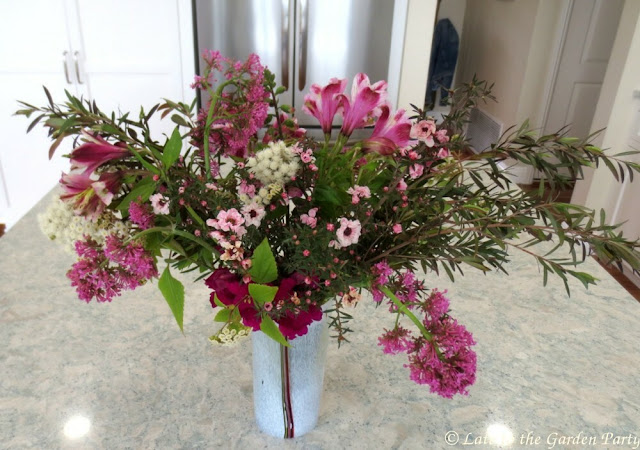
My second arrangement is more conventional.  Many of its components didn't appreciate the sudden surge in our temperatures over the weekend, peaking at 95F (35C) on Saturday, so I treated my selection process as a rescue operation, saving some flowers from a third day of high temperatures.  We're expecting a dramatic drop in temperatures today.

While I started off with a few stems of pink Alstroemeria, Centranthus and 2 varieties of snapdragons took over

I dressed up the back view with stems of 'April in Paris' sweet peas, which have suddenly burst into bloom

Overhead view

Clockwise from the upper left: Antirrhinum majus in dark pink and white, Argyranthemum frutescens 'Mount Everest', noID pink Alstroemeria, Centranthus ruber, Fuchsia 'Dollar Princess', and Lathyrus odoratus 'April in Paris'


I've a lot of work to do in the garden this week (as well as the foreseeable future) so I'm looking forward to temperatures in the pleasant range of the mid-to-upper 60sF (17-20C) at least through next Sunday.


For more IAVOM creations, visit Cathy at Rambling in the Garden.


All material © 2012-2025 by Kris Peterson for Late to the Garden Party

Monday, May 6, 2024

In a Vase on Monday: Casualties of wind and rain

It had appeared that our rainy season was over.  Even the UCLA climate scientist I depend on for a clear picture of what's happening with California's weather had said that the southern part of our state, with the possible exception of the mountain areas, would be unlikely to see any more rain after mid-April.  Local forecasters gave us a small chance of rain this past weekend but, when I checked the forecast on Saturday, the rainfall estimate was a paltry 0.01/inch.  As a result, I was surprised to wake up and find that we'd received 0.17/inch of rain.  We were also plagued by gusty winds.  The result was that Mother Nature selected most of what ended up in my vases this week.

I featured a post on my steep back slope last Friday.  The space looks its best in spring when everything is growing like crazy but I acknowledge that some of the plants are a bit too exuberant and in need of pruning, if only to eliminate tripping hazards.  That was all too clear on Sunday morning when the combination of wind and rain plastered flower stems across the stairway that offers the only passage in and out of the area.

I cut about 2 dozen tall stems of pink and white Centranthus, many of which I found lying flat on the ground

Back view

Top view: I selected pink Alstroemeria to complement the Centranthus

Clockwise from the upper left: noID pink Alstroemeria, Argyranthemum 'Grandaisy Dark Pink', Centranthus ruber, C. r. 'Albus', Daucus carota 'Dara', and Fuchsia 'Windchimes Upright White'


On Saturday, I'd eyed the Hippeastrum stems in one of my borders for possible use in a vase but I wasn't sure I wanted to sacrifice one of the few remaining stems.  Mother Nature made that decision for me too by snapping a couple of them.  One was no longer vase-worthy but the other became the focus of my second arrangement.

I added larkspur stems from my cutting garden, which had also been battered by the wind

I dressed up the back of the vase with a single stem of Argyranthemum, which has formed a dense mass of primrose yellow flowers filling most of a barrel in my cutting garden

Top view

Clockwise from the upper left: Alstroemeria 'Claire', Argyranthemum 'Angelic Maize', 2 variations of Consolida ajacis from the 'Summer Skies Mix', Hippeastrum 'Luna', Lathyrus odoratus 'April in Paris', and Prostanthera ovalifolia 'Variegata'


For more IAVOM creations, check in with our host, Cathy at Rambling in the Garden.


All material © 2012-2024 by Kris Peterson for Late to the Garden Party


Monday, April 15, 2024

In a Vase on Monday: Dashing about between rain showers

A chance of rain was forecast for this past weekend but it was predicted to be light, if it showed up at all.  When rain arrived in the form of intermittent showers on both Saturday and Sunday it was much more than expected.  We received four-fifths of an inch, which was a nice boon.  However, it complicated the process of collecting flowers to fill a vase (or two) on Sunday.  After all, given our patchy relationship with rain in coastal Southern California, I don't have a lot of practice in assessing when the next downpour may occur.  But flowers remain plentiful so at least I didn't have to dash far to collect materials.

I went all-out with pink flowers for the first arrangement.

Alstroemerias and Centranthus ruber show up in earnest in the spring

Back view: I clipped tall stems of the white-flowered Ageratum that mysteriously appeared in my back border.  I've no record nor recollection of planting such an AgeratumAgeratum is also said to prefer moist soil and isn't known for growing over 3 feet tall.

Top view

Clockwise from the upper left: Antirrhinum majus, Leptospermum 'Copper Glow', L. scoparium 'Pink Pearl', noID pink Alstroemeria, noID Ageratum, Centranthus ruber, and Digitalis purpurea


I'm delighted to report that at least some of the Hippeastrums I planted in the ground last year are handling that transition well.  Every one of the Hippeastrum 'Luna' bulbs in one back garden bed has a bloom stalk so I decided to rescue one from the pummeling rain.

Hippeastrum 'Luna' was one of my favorite potted selections last year so I'm especially pleased to see it again 

Back view: When temperatures soared in the low 80sF last week, many of my Dutch Iris blooms began to wither so I decided to take advantage of those that are left while I can.  I'm still waiting on some varieties of those Iris to make their first appearance so I hope their season isn't over yet.

Top view

Clockwise from the upper left: Acacia cognata 'Cousin Itt', Alstroemeria 'Claire', Felicia aethiopica, Hippeastrum 'Luna', Iris hollandica 'Sapphire Beauty, and Phlomis fruticosa


With two back-to-back years of rainfall well above average (our water year to date total is 19.31 inches!), my garden is especially colorful this year.  My neighborhood is also very colorful, which can be partly attributed to this fellow.

Credit for this photo goes to my neighbor CF. She caught our new resident showing off his fancy tail feathers.  He's clearly not one of the juvenile males who show up for a short period after being kicked out of the family nest.  My new theory is that he and a peahen (that I've yet to see) are minding a nest in one of the nearby pine trees.  Apparently, that's their favorite place to nest in our urban area rife with coyotes.  


For more colorful IAVOM contributions, visit Cathy at Rambling in the Garden.


Note: My Garden Bloggers Bloom Day post will be published on Wednesday, April 17th.


All material © 2012-2024 by Kris Peterson for Late to the Garden Party

Wednesday, June 28, 2023

Wild & Weedy Wednesday: Tolerable weeds

I'm joining Cathy of Words and Herbs this week for her "Wild and Weedy Wednesday" meme.  I've got a multitude of true weeds in my garden this year.  If there's a positive side to a prolonged drought, it's that there's fewer weeds to pull.  This year we've had more than five times the amount of rain we had in the prior water year (21.69 inches versus 4.12 inches in 2022) and it seems I spend a quarter of my time in the garden pulling weeds.  If I factor in the time I spend thinning out the more decorative, albeit weedy, plants I tolerate in my garden, it's probably more like half my time. 

This post focuses on my five favorite "tolerable weeds."  None of these plants are native to coastal Southern California but all have naturalized here.  One has been officially designated as invasive in California but all are aggressive spreaders.  In spite of this, all are commonly sold by local garden centers.

The first is Centranthus ruber (aka Jupiter's beard), arguably the most vigorous and the most decorative of the lot.  Native to the Mediterranean area, it's been found in wild areas in various western states of the US, including California.  According to Wikipedia, it tolerates alkaline soil and is often found in rocky areas below 200 meters in elevation.  It isn't classified as invasive but I see it along the roadsides here and I've noticed it popping up in many of my neighbors' front gardens.

I didn't introduce it to my garden.  I found it growing in my northeast side garden when we moved in.

However, I did transplant several divisions from that area to my back slope, which was relatively empty before I began developing it in the early years of our residence.  It took off with a vengeance despite very little irrigation.

In my climate, Centranthus prefers our cool spring season.  As temperatures rise, the plants quickly go to seed as shown here at the bottom of my back slope.  I can't deadhead them fast enough.  I need to get down there to cut the flower stalks to the ground but fear of the fire ants has led me to put off that chore.


Erigeron karvinskianus (aka Mexican fleabane and Santa Barbara daisy) is native to Mexico and parts of Central America.  It's not officially classified as invasive but the Plant Right site rated it a moderate potential risk in California, especially if it receives moderate water.  It was here when we moved in and it readily moves itself around without any help from me.

In my northeastern side garden, it's intermingled with English ivy (a plant that is classified as invasive in California), making it more difficult to manage

It's a lovely graceful plant when it's getting sufficient water but it starts to look sad and weedy once the rain stops (as shown on the left).  The plant on the right, mingling with a Teucrium aroarium, is doing better in partial shade.


Geranium incanum (aka carpet geranium) is a South African native that has naturalized in California.  Like the Erigeron, it moves itself around, although in my garden it's most prevalent in the same areas preferred by Centranthus ruber.  It's not classified as invasive but it's said to get by without irrigation in coastal areas.

In this photo, it's sharing space with Erigeron karvinskianus

The Geranium most often "hides" under taller plants, slowly making its way into the sunlight before it blooms.  In the photo on the left, it's growing up through a mass of rosemary.  In the photo on the right, it's growing up through ivy on the upper edge of the back slope.


Unlike the other plants covered in this post, Lobularia maritima (aka sweet alyssum) is classified as invasive by the California Invasive Plant Council.  It's native to the Mediterranean basin but it's naturalized here.  It's said to like sandy soil like mine.  I'm not sure I've every visited a local garden center that didn't have six-packs of this plant in stock year-round.  I admit that I've often purchased it for use as a filler in planted containers.

I don't go out of my way to photograph the ever-present alyssum but this wide shot taken of my back garden in early May provides a good idea of how widespread it is in the landscape.  All of the alyssum shown here was self-planted.

The foreground of this shot, taken at the bottom of the back slope, provides an idea of how much space it covered there.  Pulling it up isn't simple.  The plants have solid taproots and their side roots often extend over a good foot or more.

One of the few closeup photos I've ever taken of the plant.  They love to self-seed between and around flagstones.


The last of my attractive weeds is Oenothera speciosa (aka pink evening primrose).  Native to areas of the Midwest, Texas, and northeastern Mexico, it's naturalized in 48 US states but it's not considered invasive, although I've heard many gardeners complain about its spread.  I didn't introduce it here.  It spreads itself around more lightly than the other plants described here.  To date, it prefers my northeast side garden and back slope.

The top photo on the left shows the flowers in my northeast side bed.  The group shown on the lower left was photographed at the bottom of the slope.

It even self-seeds in densely packed gravel


Visit Cathy at Words and Herbs to see which wild and weedy plants she's featuring this week.


All material © 2012-2023 by Kris Peterson for Late to the Garden Party

Monday, April 25, 2022

In a Vase on Monday: Another take on orange and blue

Remarkably, we got a touch of rain late last week.  It wasn't much, just 0.18/inch (4.6mm) but, as I expected nothing, it was appreciated.  In what appears to be an unfortunate pattern, the low pressure system that permitted the rainstorm in the north to move into the south part of our state was quickly replaced by another round of Santa Ana winds and soaring temperatures.  We briefly hit 87F (30C) yesterday and today could be warmer still.  The winds can quickly wither flowers so on Sunday I cut blooms with relative abandon for In a Vase on Monday, the weekly meme hosted by Cathy of Rambling in the Garden.

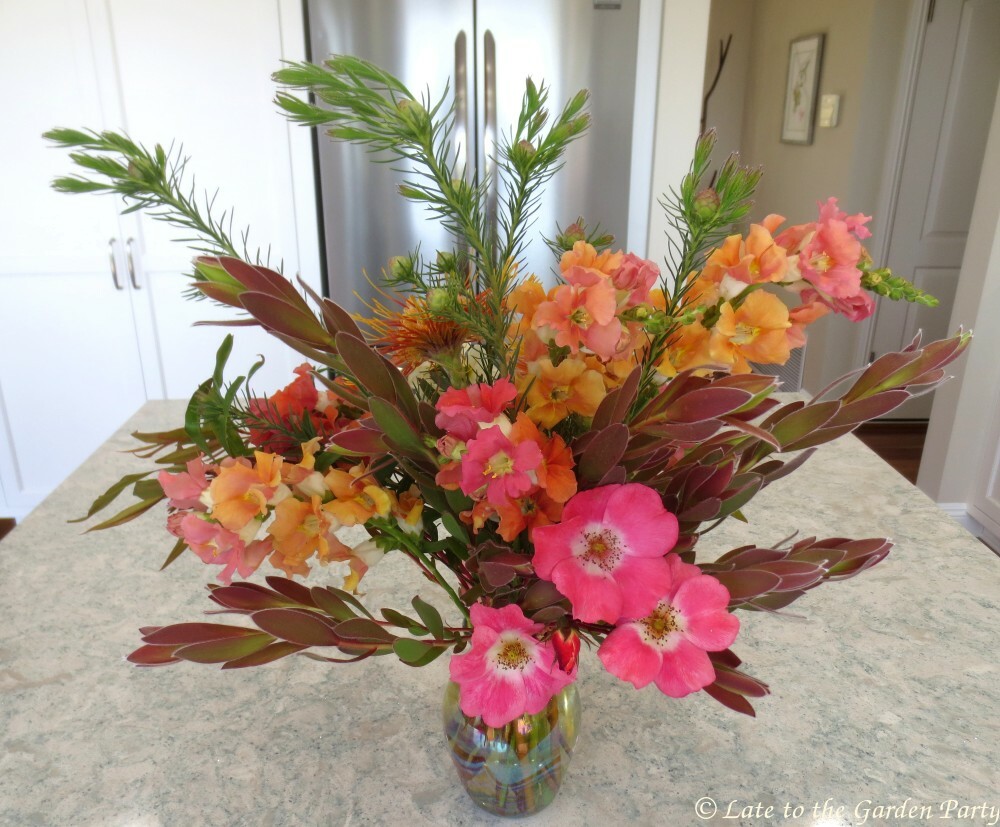
The rain spurred another flush of blooms on the snapdragons in my cutting garden, inspiring my first arrangement.  Thus far, the snapdragons are free of rust so I want to take advantage of them while I can.

I also took this opportunity to cut the last of my Narcissus, two remaining blooms of Leucospermum 'Brandi', and a single 'Lady Emma Hamilton' rose.  I won the David Austin rose in a drawing at the Capitol Region Garden Bloggers' Fling in 2017.  I received the rose in the spring of 2018 but it's produced fewer than a handful of flowers since.

I dressed up the back of the arrangement with 2 stems of my 'Pink Meidiland' rose and added some height using stems of Leucadendron 'Jubilee Crown'

Top view

Top: Agonis flexuosa 'Nana' and Antirrhinum majus 'Chantilly Bronze' and 'Chantilly Peach'
Middle: Leucadendron 'Cloudbank Ginny', L. 'Jubilee Crown', and Leucospermum 'Royal Hawaiian Brandi'
Bottom: Narcissus 'Geranium', Rosa 'Lady Emma Hamilton', and R. 'Pink Meidiland'


The first bearded Iris to bloom in my back garden prompted my second arrangement, although I admit I agonized awhile about cutting it.  It looked beautiful on Friday following our brief rainstorm but Saturday's vicious wind did it no favors and I was afraid that the blooms currently in bud would suffer if I left it alone so, without thinking about it too long, I cut the stem and moved on.

This is what the Iris germanica 'City Lights' bloom looked like on Friday.  It's a reblooming variety so I'm hopeful I'll see another bloom stalk this fall.

The Iris wasn't looking its best by Sunday morning but I trusted that the buds were far enough developed to open even after the stem was cut.  I grew the Nigella, Orlaya, and larkspur from seed.  I'd collected the Nigella seed from plants I grew last year.

The sweet peas tucked in the back of the arrangement were also grown from seed but they've been very disappointing.  Almost all are the same dark blue color even though I planted seeds of 4 different mixes.

Top view

Top: Centranthus ruber 'Albus', Consolida ajacis (aka larkspur), and Delphinium elatum 'Cobalt Dreams'
Middle: Globularia x indubia (aka globe daisy), Iris germanica 'City Lights', and Lathyrus odoratus
Bottom: Nigella papillosa 'African Bride', Orlaya grandiflora, and Scabiosa columbaria 'Flutter Deep Blue'


As usual, I cut too many flowers.  The pink Alstroemerias I thought I could incorporate into the first arrangement didn't mesh with the prevailing orange tones so they went into a small vase for the kitchen island.  When I couldn't cram everything I'd cut for the second arrangement into the vase I'd selected, the extra stems went into the kitchen island arrangement as well.

In addition to the noID pink Alstroemeria, this vase includes Orlaya grandiflora, self-seeded Lagurus ovatus (aka bunny tail grass), and Agrostemma 'Ocean Pearls'


For more IAVOM creations, check in with Cathy at Rambling in the Garden.


All material © 2012-2022 by Kris Peterson for Late to the Garden Party