Showing posts with label Echium candicans 'Star of Madeira'. Show all posts

Wednesday, October 26, 2022

Local oddities

Now that the daytime temperatures have fallen to comfortable levels, I've been spending hours and hours working in my garden every day.  Most of my activities aren't worthy of a blog post but I've come across a few miscellaneous things I found interesting.

While planting a new succulent bed last week, I leaned over the edge bordered by a wood retaining wall built by a prior owner to level the area where it slopes down at a sharp angle.  A very large shelf fungi, over a foot in length, is growing out of the wood.  I'm guessing that it may be the fungus known as "chicken of the woods" (Laetiporus sulphureus) but I'm open to other suggestions.

On a walk through the neighborhood several days later, I happened to notice a very similar fungi growing out of a dead tree on a neighbor's property.  (There's a large Eucalyptus tree growing next to the dead tree.)


The street-side bed containing the shelf fungus growing out of the neighbor's dead tree had a couple of other dead trees I couldn't help wondering about.

Why would someone leave a "stump" like this?  Removing the stump would be difficult but, if you're going to cut down the tree, why not cut the stump to one level as close to the ground as possible?  I can't imagine anyone could expect it to sprout from this base.  Could someone have contemplated using it as a plant stand?

Now this remnant of a dead tree (or maybe a vigorous vine), mere feet away from the other dead tree, has a sculptural quality about it.  It might work for displaying epiphytes.

On the other hand, the same area contained a live pine tree that I've fallen in love with.

I'm not usually drawn to pine trees but this small blue one grabbed my attention.  It's really as blue as it looks in this photo and it's only 2 feet tall at best.  I assume it's an infant but I'm not able to identify it so I've no idea how big it might grow.  My phone identified it as either Festuca glauca (!) or Pinus monophylla but the latter prospect doesn't account for its distinctive color.  A brief online search turned up Pinus peuce 'Pacific Blue' but, if it's that, it's well outside its suitable climate zone.  Any guesses?


While passing through a narrow path back in my own garden, I was startled to see something else.

Aloe labworana is flaunting both nice red foliage and its first flowers, which are a startling bright yellow

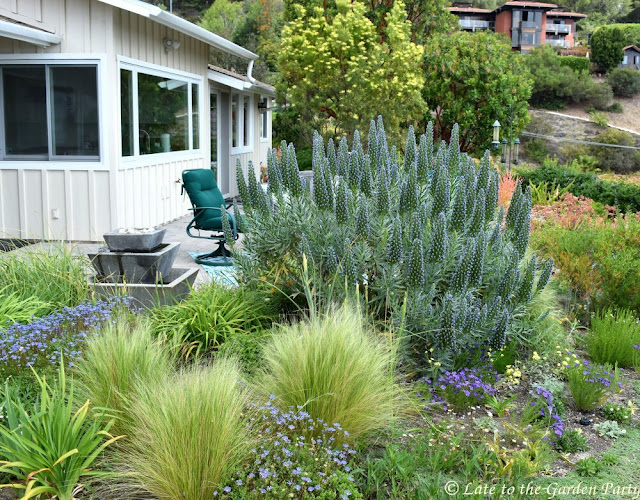
The Aloe is getting more sun because it seems the variegated Echium candicans 'Star of Madeira' is dying back faster than I'd realized.  I thought it might have another year of flowers in it but several large stems had lost all their foliage in the past month or so, possibly due to our worsening drought.  (I cut away the bulk of the dead branches before taking this photo.)


No garden is ever static, or lacking in surprises.


All material © 2012-2022 by Kris Peterson for Late to the Garden Party

Tuesday, December 7, 2021

A Week of Flowers 2021, Day 7

I'm back with a post for the final day of A Week of Flowers, sponsored by Cathy of Words and Herbs to brighten the gloomy days many in the Northern Hemisphere face as winter sets in.  I shared February blooms on Day 2 and April blooms on Day 4 so I've chosen some of my favorite May flowers to end the week-long celebration.

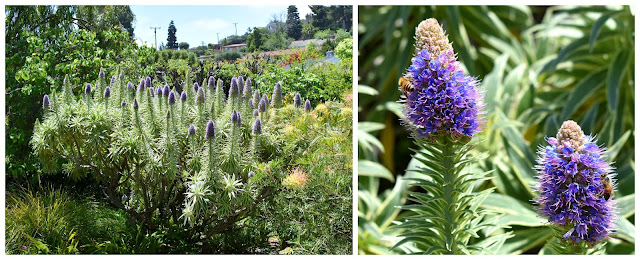
This is variegated Echium candicans 'Star of Madeira'Echium of all kinds do well in coastal Southern California's Mediterranean climate.  In fact, some literally grow as weeds here.

This is Echium webbii, which I love for the silvery sheen of its foliage as much as its flowers.  The blue of the Echium flowers is echoed in the flowers of Felicia aethiopica.  The yellow "blooms" in the background aren't flowers at all but the colorful bracts of Leucadendron 'Pisa'.

Visit Words and Herbs to find other posts on this theme.  Thank you Cathy for launching this effort!  Even my part of the world gets a bit gloomy at this time of year.  In fact, we're expecting mostly gray skies through Thursday this week but the silver lining is a chance of rain today and Thursday, which would be wonderful.  Southern California is very, very dry and we need something approaching "normal" rain this season if we want to see plentiful flowers in the coming spring.


All material © 2012-2021 by Kris Peterson for Late to the Garden Party 
Wednesday, May 13, 2020

Clean up, front garden

Last week I discovered that one of the large Auranticarpa rhombifolium shrubs growing in a bed facing the street was dead and that the shrub next to it appeared to be failing as well.   They were impossible to ignore.

The dead shrub was visible to anyone that drove or walked by but it was also readily visible from within the garden


I mentioned the shrubs to my husband and, voila, days later both shrubs were gone.

He even dug out the stumps for me


Of course, that left the area behind the border more open to view than I'd like.  When we took out three other dying Auranticarpa shrubs four years ago, we planted Xylosma congestum shrubs to extend the intact hedge fronting the rest of the street.  Those shrubs have grown at a very slow rate.  Rather than buy more Xylosma, I thought I'd try planting something else in that empty spot.  I decided that this was my chance to try growing Tithonia diversifolia, aka Mexican sunflower or marigold tree.

This is a photo I took last year of a mature sunflower tree growing in the South Coast Botanic Garden

I've never seen the plant in local garden centers so I'd ordered seeds last year but had never gotten around to sowing them.  I dug those out and sowed them as recommended earlier this week.  Estimates of the time required for the seeds to germinate vary greatly.


The Mexican sunflower tree might work to fill the empty spot, and it might not.  For now, I'll just wait to see if I can get the seeds to germinate.

While my husband did the heavy lifting in removing the two Auranticarpa, I tackled the somewhat easier task of cutting back Echium candicans 'Star of Madiera'.  It was just starting to bloom in mid-April when I published my monthly Bloom Day post.

These are the photos I included in my April Bloom Day post


We got our first serious heatwave in late April, followed less than two weeks later by a second one in early May.  I never even got around to posting a photo of the Echium in full bloom.  Last weekend, it was looking too awful to ignore.

This is the shrub as viewed from the front door

And this is the side facing the street


So I got to work, tip pruning all the dead flower spikes.

I left just a few intact flower spikes for the hummingbirds to fight over

It may not be readily apparent but the shrub is growing along a moderate slope.  Clipping all the dead flowers without tumbling down and breaking my crown took a bit of effort!


I've been surprised by just how much my husband and I've been able to find to do in the garden while we're staying at home.  I'm sure I'll run out of projects at some point but, for now, I'm still plugging away.  I hope you've been able to find diversions in your garden as well.


All material © 2012-2020 by Kris Peterson for Late to the Garden Party
Friday, June 15, 2018

Bloom Day - June 2018

Despite the heat that's been scorching some areas of Southern California and a flurry of wildfires across the Southwest US, we're still benefiting from an early morning marine layer most days here, which has held local temperatures down thus far.  I anticipate the situation is temporary but we're expecting below average temperatures (low 70sF) this weekend and I'm going to enjoy that while I can.  Summer flowers have begun showing up in earnest and the late spring blooms have yet to take cover from the heat so the garden is colorful to say the least.

Unequivocally, the stars of my June garden are Achillea 'Moonshine' and the Agapanthus.

I've lined both sides of the flagstone path in the middle of the back garden with 'Moonshine'.  On this side of the path, the yellow color is mirrored in the tiny blooms of Cotula 'Tiffendell Gold' and the foliage of Coleonema pulchellum 'Sunset Gold'.

Clumps of Agapanthus are spread throughout the garden.  Most bloom in shades of blue but there are some white blooms too.

The front garden is especially colorful right now, as you can see from the photo on the left.  The highlights include: more Agapanthus, Gaura lindheimeri, Hemerocallis 'Spanish Harlem', Cuphea 'Starfire Pink' and Rosa 'Pink Meidiland'.


While the Echiums are fading, the daylilies are pumping out new blooms

Echium candicans 'Star of Madeira', shown here, is waning and I've already cut back the spent bloom spikes of Echium webbii (not shown) in the back garden

New blooms of (left to right) Hemerocallis 'Indian Giver', 'Plum Perfect' and 'Spanish Harlem' greet me every morning.  'Spanish Harlem' has been especially prolific this year despite our very dry winter.


Like the front garden, some areas of the garden are putting on an especially strong show this month.

The bed shown on the left sits outside my home office window.  Clockwise from the upper right, the blooming plants include: Grevillea 'Ned Kelly', Lantana camara 'Irene', Leucanthemum x superbum, Leucospermum 'Brandi', Lobelia laxiflora, the first ever bloom I've had on Melianthus major, and Phylica pubescens.

The arbor over the gate between my cutting garden and my dry garden is once again blanketed in blooms this June.  The photo on the left shows the view from the cutting garden and the photo on the upper right shows the view from the dry garden side.  The flowering plants include: Pandorea jasminoides, a dark pink flowered Pelargonium peltatum that's chosen to climb, and Trachelospermum jasminnoides.

On the back slope Bignonia capreolata is sprawling over property boundaries into two neighboring gardens (photos top and lower left).  It's a beautiful but aggressive plant.  I didn't put it in but its trunk sits on our property.  I believe the neighbor on our north side planted it as she'd originally gardened on our lower slope, believing it was part of her lot until a prior owner of our property had an official survey done.


A few other areas offer more subtle displays of color.

In addition to Catananche caerulea and Convolulus sabatius, there's some noID Brachyscome and thyme in the mix here

Crassula pubescens ssp radicans has filled in the areas between various agaves and aloes on the south side of the house

Penstemon x mexicali 'Carillo Purple' and Polygala fruticosa 'Petite Butterfly' provide subtle color echoes of one another here


And here are some other plants just too pretty to ignore.

NoID Anigozanthos

Arbutus 'Marina'

Eustoma grandiflorum (Lisianthus) - so far, most of the blooms have been produced by the blue-purple varieties.  This is 'Rosanne Black Pearl'.  It didn't flower well last year but the plants that lived to bloom a second year look better than the first year blooms.

Gaillardias 'Arizona Sun' (left) and 'Fanfare Citronella' (right)

Globularia x indubia - it's also known as Globe Daisy but I call it my hairy blue eyeball plant

Hesperaloe parviflora 'Brakelights'

Magnolia grandiflora

Melaleuca thymifolia - the plant itself looks ungainly but the blooms are extraordinary

Romneya coulteri (aka Matilija Poppy), beloved by bees


I'll close with a few collages capturing the best of the rest.

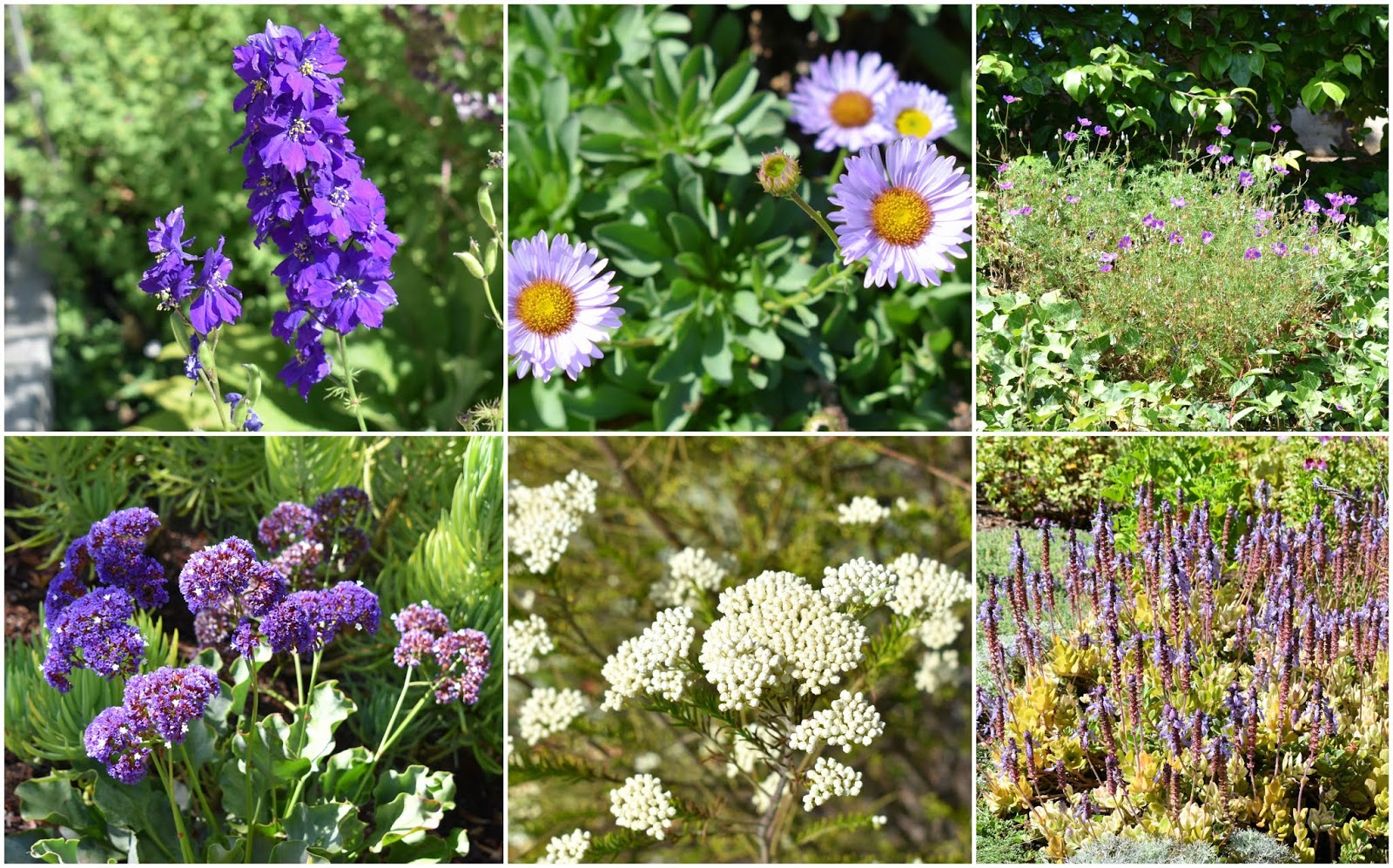
Top row: Consolida ajacis, Erigeron glaucus 'Wayne Roderick', and Geranium incanum, a weed in an unreachable spot
Bottom row: Limonium perezii, Ozothamnus diosmifolius, and Plectranthus neochilus

Clockwise from the upper left: Alstroemeria 'Indian Summer', self-seeded Anagallis 'Wildcat Mandarin', Cotula 'Tiffendell Gold', Euphorbia 'Dean's Hybrid', Grevillea 'Peaches & Cream', Hunnemannia fumariifolia 'Sunlite', Hymenolepsis parviflora, Tagetes lemmonii, and, in the center, Grevillea 'Superb'

Top row: Abelia grandiflora, Antirrhinum majus, Cistus x skanbergii, and C. 'Sunset'
Middle row: Dorycnium hirsutum, Grevillea 'Scarlet Sprite', Hebe 'Wiri Blush', and Leptospermum scoparium 'Pink Pearl'
Bottom row: Mimulus 'Jelly Beans Crimson', Pelargonium peltatum, P. cucullatum 'Flore Pleno', and P. 'Pink Blizzard'

And a fond farewell to Lathyrus odoratus, the remains of which I pulled out of my cutting garden on Wednesday evening


For more Garden Bloggers' Bloom Day posts, visit our host, Carol of May Dreams Gardens.


All material © 2012-2018 by Kris Peterson for Late to the Garden Party

Monday, May 28, 2018

In a Vase on Monday: Better than I'd anticipated

The Agapanthus are making their annual appearance throughout my garden.  Unlike prior years when they've arrived like a stampede of cattle, they're moseying in a few at a time.  However, as I have more clumps of the plants than I can count, that's still a lot of flowers.  The question this week wasn't would I use them in an arrangement for "In a Vase on Monday" but rather how I'd use them.  Although I like the flowers, I've seldom been pleased by how they look in a vase.  As the variegated Echium 'Star of Madeira' is also blooming at last, I decided to see how those two plants would look together.  Frankly, I wasn't too impressed by the combination once the cut stems were in my bucket but adding a few other plants seemed to improve the overall effect.

I tried to keep the arrangement airy but it could perhaps have used more splashes of white

Back view

Clockwise from the upper left, the vase contains: blue and white Agapanthus, Coleonema album, Echium candicans 'Star of Madeira', Consolida ajacis (aka larkspur and Delphinium ambiguum), and Osteospermum '4D Silver'


I managed to take out a small slice of one finger while cutting back the weed-like growth of Erigeron karvinskianus in the course of assembling flowers for this weeks' vases.  This put a damper on my flower arranging exercise but my husband bandaged up my finger and I persevered to create a second vase, using flowers I'd had my eye on since last week.

This was supposed to be the front of the vase but I changed my mind

This view shows off the flowers of Leptospermum 'Pink Pearl' and Dorycnium hirsutum, which were the inspiration for this arrangement.  The vase itself is new, picked up during a weekend botanic garden/nursery trip with a friend to celebrate my upcoming birthday.

Top view

Clockwise from the upper left, this vase contains: noID Alstroemeria, white and pink Centranthus ruber, Dorycnium hirsutum (aka Hairy Canary Clover), Jasminum polyanthum (hanging over the fence from my neighbor's garden), and Leptospermum scoparium 'Pink Pearl'


Those of you who've included peonies in recent arrangements know I suffer from a severe case of peony envy.  I have 2 peony plants but the Itoh peony hasn't bloomed since the year I purchased it (in 2013!) and the Majorcan variety, which generally produces at least a single bloom, has produced none this year.  So, when my hairdresser told me the market down the street from her shop had peonies, I treated myself to some.  It's an IAVOM cheat but here's my third vase:

The rose may be the queen of flowers but I think the peony is the empress.  This vase is sitting in the kitchen window where I can admire the flowers many times a day but it didn't photograph well there.


For more Monday vases, visit our host, Cathy at Rambling in the Garden.


And best wishes to all of you in the US for a happy Memorial Day holiday!


All material © 2012-2018 by Kris Peterson for Late to the Garden Party