Showing posts with label back slope. Show all posts

Friday, May 30, 2025

The garden is DEMANDING attention!

My garden has gotten away from me.  Not only do I have all sorts of empty spaces in need of tending but I've got weeds all over the place, the cutting garden requires assistance with its seasonal transition, and the back slope somehow exploded out of control.  I've been tackling the weeds and deadheading flowers here and there in the back and front gardens when I have a few minutes but this week I focused on the cutting garden as the dahlia tubers were ready to move out of their temporary pots and spread their roots.

I cleared most of two of the raised planters to make room for eleven of the sprouted dahlias.  Two other tubers were transferred to barrels in the cutting garden as well.

I left some of the Calendulas in place at each end of this bed and supplemented the soil before transplanting 6 dahlia tubers here.  The infant dahlias include: 'Creme de Cognac' (2), 'Kelsey Ann Joy', 'La Luna', 'Miss Brandy', and 'Summer's End'.  I sowed seeds of 4 varieties of Zinnia elegans in this bed too.

I left 3 foxgloves and a handful of larkspur in place in this bed.  I added the following 5 sprouted dahlias: 'Blue Bell', 'Cafe au Lait', 'La Belle Epoque', 'Mikayla Miranda', and 'Molly Raven'.  I've added 3 varieties of zinnia elegans to this bed.

Last year, this bed was crowded with larkspurs (Consolida ajacis) but, for whatever reason, few seeds germinated this year.  The foxgloves (Digitalis purpurea) I planted months ago as plugs haven't grown much so I removed all but 3 to make room for more dahlias. 

Dahlia 'Caproz Pizzazz' found a home in the barrel on the left after I removed all its contents other than the red Pelargonium peltatum.  The middle barrel received a Dahlia 'Labyrinth'.  The third barrel contains one of the foxgloves that has done well and the Argyranthmum 'Mount Everest' I moved from the first barrel to make room for the dahlia I planted there.


As the sweet peas have finally taken off, I'm going to give them another three or four weeks before I clear that raised planter to receive three or four more dahlia tubers.  I expect to give away a lot of sweet pea posies within the next few weeks.

Like last year, because the sweet peas (Lathyrus odoratus) took so long to vine, I failed to thin the plants so they're overcrowded once again


I've ignored the back slope for close to a month.  I was shocked when I headed there earlier this week.  Even walking down the concrete block stairway presented a challenge.  I spent a couple of hours clearing the pathways and cutting some of the overgrowth but several additional hours of attention is needed before it gets too hot and the fire ants make work even more difficult.  Although the hedge that lines the neighbor's wire fence gets routine irrigation, the rest of the area is dependent on rainfall and we've had little of that this year so I didn't expect exuberant growth.  I've done no hand-watering of the area at all in almost a year.

This is a view of the slope looking up from the lower area (in front of the lemon tree) after my initial cleanup effort.  The Arctostaphylos bakeri 'Louis Edmonds'  in the middle of the bed to the right of the stairway has leapt in size since last year despite our low rainfall.

Clockwise from the upper left: The Aeoniums fleshed out nicely; the Centranthus ruber is a buoyant as ever; one of the top heavy artichokes collapsed under its own weight once again; and the hybrid 'White Lady' Pelargoniums have spread themselves about 


The saddest discovery was this:

Ceanothus arboreus 'Clifford Schmidt' appears to have died while I wasn't paying attention.  It was in full bloom in early April!  I love this plant and can't entirely account for its sudden demise.  The lemon tree on one side and the Pittosporums on the other are fine.  However, I'd had a peach tree that had given it some shade cover removed in November and I speculate that the sun exposure combined with low rainfall and no hand watering may have been contributing factors.  I'll cut it back to see if it recovers but I'm not hopeful.


On the good news side of things, the Agapanthus in my garden are marshaling forces for their annual stampede and the first Shasta daisies are making an appearance, as well as the first gladiolas.  Even the lilies are gearing up to put on a show.  Hopefully these plants will fill the floral gap until the dahlias and zinnias get around to flowering.

A noID Shasta daisy (Leucanthemum x superbum) with fringed flowers

Gladiolus nanus

A noID white gladiola popped up in with the bed with the sweet peas

Two varieties of lilies among many that have produced bloom stalks.  The taller ones are Lilium 'Zelmira' and I think the smaller ones are 'Orange Planet'.  There are at least 5 more varieties gearing up to bloom elsewhere in the garden this summer.


Best wishes for a pleasant weekend!


All material © 2012-2025 by Kris Peterson for Late to the Garden Party

Friday, May 26, 2023

Under the weather

I've been under the weather, literally and figuratively.  Our heavy marine layer has been a persistent presence since early April.  At best, we get a little sun in the late afternoon.  On the positive side, we've picked up about 0.08/inch of precipitation in the process in the past week.  On the negative side, for someone who's lived in sunny Southern California her entire life, the persistent gloom is getting old.

Photo of my south side garden looking southeast toward the invisible Los Angeles harbor

From a figurative perspective, I've been fighting with my knee problem for a couple of weeks now.  A compression sleeve has helped there but then last week I developed an incessant cough.  I tested negative for COVID, but whether I have a sinus infection, an out-of-control allergy, or something else is unclear.  I saw a Nurse Practitioner and we developed a multi-faceted plan but I still feel crummy.  Oddly, however, I seem to cough less when working outside than I do sitting at my computer.

Before and after shots of my back slope looking up from the bottom of the stairway.  The photo on the left was taken last Saturday.  It was floriferous but treacherous to navigate.  Pruning the out-of-control bay laurel hedge is a job I leave to the gardeners but they could hardly get to it.  I cut back and pulled anything that impeded the stairway and the path between the hedge and the lower border as shown in the second photo.  Unfortunately, that included cutting down the Echium webbii, which was too big for the space.  I still need to remove its trunk but that's a task for another week.

After months of doing nothing, the cutting garden flowered, seemingly all at once.  Plants are crowding one another and falling over.  I cut back the contents of the raised beds enough to allow me to walk between them but I'll need to start pulling plants out soon to make room for the dahlia tubers that are sprouting in their temporary pots.  I'm also fighting mildew and rust, a byproduct of our high humidity levels.


In addition to working off and on in my own garden, I've continued to take daily walks around the neighborhood.  I thought this is a good time to share photos of one neighbor's front garden, which I consider a master class in planting on a slope.  It's looking particularly colorful at the moment.  Here are a couple of panoramic shots:

View of the long, sloped front garden border looking downhill

View of the same border from the other end


As the panoramic views hide a lot, I'm providing a series of closer shots.

Driveway adjacent area featuring noID orange roses, Pittosporum tobira, and Plectranthus neochilus

The next segment, featuring among other things: Calandrinia spectabilis, Polygala myrtifolia, red 'Knock Out' roses, Salvia leucantha, and Strelitzia

A closer look at the Geranium incanum, Oscularia deltoides, and Salvia leucantha surrounding the steps

Some sources indicate that Calandrinia spectabilis and C. grandiflora are synonyms for the same plant, others differentiate between the 2.  If they're different, I'm not qualified to clarify the distinction.

Repeats of many of the same plants with the addition of a variegated Agave americana, Echium handiense, Gazania, Lavandula multifida, Phlomis fruticosa, and Phormium

Closeup of red 'Knock Out' rose.  There are some pink ones in the mix elsewhere.

The succulents become more prevalent in the last sections of the border.  There's a wide range of Aeoniums, as well as Agaves, Aloes, a massive expanse of Bougainvillea, and Sencio amaniensis.

This final section is made up of succulents with Bougainvillea as a background.  There are a few Agave 'Blue Glow' (including one that bloomed earlier and shows no sign of dying back), Agave lophantha "Quadricolor', Aloe arborescens, and lots of Euphorbia tirucalli 'Sticks on Fire'.


That's it for me this week.  For those of you in the US, best wishes on Memorial Day and enjoy the unofficial start of summer (whether you have any sun or not).


All material © 2012-2023 by Kris Peterson for Late to the Garden Party


Wednesday, May 3, 2023

My colorful back slope

I completely lost track of time this week and, although this post has been in process since I took photos last week, it didn't click that today is Wednesday until this morning.  The focus is my back slope, an area I largely ignore for much of the year.  I have a bad knee that my orthopedist thinks is ripe for replacement and I inevitably strain it whenever I spend any significant time working there (as I did last week).  In addition, I've had three run-ins with fire ants there during the warmer months, which also keeps me away.  But, in spring, the area is at its best and it deserves some attention.  This post is a tribute to its fleeting beauty.

View from the upper section of the stairway looking down


The upper side of the slope, shown to the right of the concrete block stairway installed by my husband years not long after we moved in, is covered in ivy and honeysuckle.  The upper section of the slope on the left is covered in prostrate rosemary.
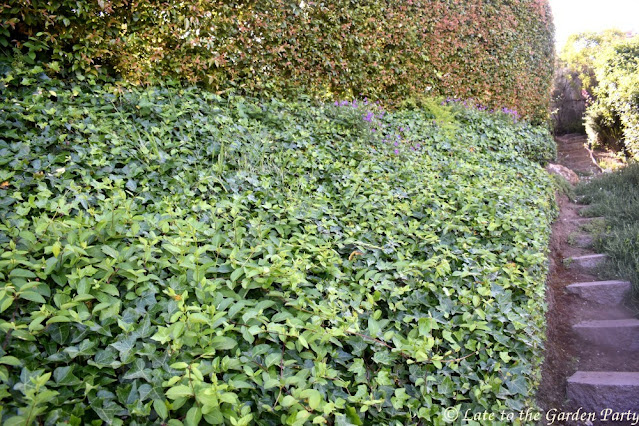
The gardeners take electric pruners to the ivy a few times a year but that's the only tending it gets, other than my periodic (and somewhat futile) efforts to pull out grass weeds embedded in the thicket

While the ivy has been there forever, I planted the prostrate rosemary.  I've been trying to keep it under control using hand clippers but I think I may need to invest in my own electric pruner soon.


I've used concrete bricks to level areas of the lower side slope to facilitate planting, making it more interesting.

View from the midway point on the stair looking down
 
Another view of the area from the dirt path between the lower border and the hedge marking the division between our property and one of our neighbors

Another view of the same area in different light.  The back slope faces east so it's in shade much of the day.

I'm happy with this vignette consisting of Aeonium arboreum 'Velour', Euphorbia 'Dean's Hybrid', and Lampranthus 'Kaboom'.  The Euphorbia moves itself around.  I've planted other Aeonium cuttings here and there.

I moved a handful of Centranthus ruber seedlings around here years ago and they've gradually taken over.  I cut it back to the ground each year but it continues to spread like the weed it is in my area.  It covers entire hillsides along some of the nearby roads.

I planted the artichokes (Cynara) many years ago when I had a 6-pack of plugs I didn't know what to do with.  They surprised me by coming back every year, bigger and bolder than ever.  They're already producing chokes too!

I added Pelargonium 'White Lady' and Santolina chamaecyparissus (aka lavender cotton) years ago as well.  Both continue to spread as low-level groundcovers.


The lower level of the stairway and the relatively flat area at its bottom are the most densely planted.

View from the bottom of the stairway looking up

Another view of the same area from a slightly different angle in lower light

In addition to Aeonium arboreum, I've planted Agave attenuata, Aeonium haworthii 'Kiwi' and 'Kiwi Verde', Aloe striata, and Aloe elgonica.  Almost all were grown from cuttings or divisions.  There's a pup of Agave 'Blue Flame' buried in an upper section of the border too.

I don't know what I was thinking when I planted a 4-inch pot of Echium webbii here several years ago.  It's way too big for the area now.

There are noID bearded Iris partially buried under the Echium.  I moved them here from elsewhere in the garden many years ago.  They're the only bearded Iris in my garden that bloom reliably each year.


The bottom of the slope is dominated by a lemon tree that's been there for decades longer than we've been here but there's a lot more there than the one tree.

A few very bad heatwaves and the persistent drought have lessened the citrus tree's lemon production but this year's rain has given it a boost

This orange trumpet vine (Campsis radicans) was planted by the neighbor on the other side of the fence decades ago when she gardened this area (until a former owner of our property had the area surveyed and informed her that the area wasn't hers).  I've been tempted to cut down its massive trunk as it's nearly impossible to control but that'd worsen the sore spot the one neighbor already has about the area.

The Ceanothus arboreus 'Cliff Schmidt' I planted here has already finished its bloom cycle for the year.  The house and trees you see in the background are on our south-side neighbor's property.  There was once a monster-sized Yucca elephantipes sitting along this property line but my husband had it removed because it was out of control.  (The Yucca still attempts periodic takeovers.)  There are 2 barely visible Pittosporum behind the Ceanothus.

The Centranthus has planted itself under the lemon tree too

More Centranthus, along with calla lilies (Zantedeschia aethiopica) and Osteospermum, between the lemon tree and the Ceanothus.  The calla lilies were planted by someone else decades ago.  They disappear every summer and return with the winter rain.  The Osteospermums planted themselves here.

Closeup of the calla lilies.  There are many more blooms than last year but still fewer than in the early years following our arrival.


The area is bordered on the east side by a laurel hedge and by on the south side by the rampant ivy that creeps over from the neighbor's property.

This bay laurel hedge (Laurus nobilis) sits alongside the wire fence that divides our property from that of our neighbor to the northeast.  The property lines are odd, the products of dividing the original lot occupied by our house into 3 lots.  The 2 lots on either side of us are "flag lots".

We're not entirely sure exactly where the property line is drawn on this south side.  We've treated the mass of the ivy here as the dividing line but, as the ivy is always expanding, it's fuzzy.  The property drops down again somewhere in the middle of that mass.


The ivy isn't the only problem.

I planted a Matilija poppy (Romneya coulteri, left) next to the Ceanothus, which was a big mistake.  We've tried digging it out without success.  I cut it down to the ground every year.  I've already cut it back once more this year.  It's about the bloom.  We didn't know there was a peach tree (Prunus persica, right) here until the Yucca was removed.  It's never produced fruit and it's routinely afflicted with peach leaf curl even when I remember to spray it.  I'd like to take it out but it provides a modicum of privacy between us and our south-side neighbor.

Weeds run amok in the area, especially following the rain.  In addition to the 2 shown here, scarlet pimpernel (Anagallis arvensis, left) and Geranium incanum (right), sweet alyssum (Lobularia maritima) and dandelions are everywhere.


Much as I've love to pull out all the ivy on the upper side of slope and terrace it, I've finally accepted that it's not practical.  There's no way to get heavy equipment down there and it would be very expensive to have all the work done manually.  As I've made periodic stabs at clearing the ivy along the stairway, I've learned it's also beyond my capacity - it grows faster than I can remove it.  However, nature has made an effort to help me out.

Centranthus ruber has planted itself in areas I'd (temporarily) cleared.  And it appears that a peach tree has planted itself behind it in the middle of the ivy too.


So that's the rundown on the current state of my back slope!  I'm sure it'll continue to change in minor ways.  The Echium webbii, for example, has to go once it finishes blooming.  I'll probably replace it with succulents.  Adding a groundcover to combat the out-of-control weeds is also something I'd like to do before next winter's rain arrives.


All material © 2012-2023 by Kris Peterson for Late to the Garden Party