Showing posts with label Dorycnium hirsutum. Show all posts

Friday, August 20, 2021

An easy fix

The garden and I reach a low point in August.  Even in good years (namely, those with decent rainfall), the garden looks badly stressed by this time of year.  I usually spend a lot of time dispensing emergency rations of water but this year, with virtually the entire State of California in severe drought, I think twice before administering any aid.  I gave the lemon tree at the bottom of our slope, which I suspect has been in place for 25 or more years, a good soak last Saturday when my husband (who usually pays no attention to plants) expressed concern that it was dying.  Two days ago, I accepted the fact that my favorite Correa, 'Sister Dawn', planted in 2018, was dead.  Large sections of creeping thyme in various areas have died out.  I could go on.  Wishing to avoid the bleak newscasts for at least awhile, I decided to see what I could accomplish in the garden to put a positive spin on its appearance.

Rather than tackle one of the areas that looks really bad, I decided to start with an area that looks relatively good.  My hope was that, with a little work, it could look even better.

This is the dry garden on the northeast side of the house.  The issues here aren't readily apparent in this wide shot.

Even in this closeup shot, the problem may be hard to see.  But there's a large, nearly invisible Agave ovatifolia lurking behind that Cistus shrub in the center.

The whale's tongue agave and the octopus agave next to it are still visible in this rear view photo, taken partway down the concrete stairway that leads to the back slope but, with the Callistemon viridiflorus in the foreground getting larger, that may not be the case for long

My first objective was to remove the Cistus 'Victor Reiter' I'd planted from a 4-inch pot in 2016.  It grew taller than I'd envisioned and didn't get enough sun to bloom well, and of course it was blocking the view of my oldest Agave ovatifolia.  I thought of relocating it but I didn't have an immediate placement in mind so I took cuttings instead.

I took twenty cuttings in all, storing them in this area behind the garage that gets only morning sun.  This is admittedly not the best time of year to take cuttings but I hope at least a few will root.

Other than periodically getting poked by the nearby agaves, the Cistus came out with relative ease.  Agave ovatifolia regained its rightful place as a focal point.

Ta-da!


And here's a closeup from the same vantage point used in my second photo

There's now an empty space in front of the agave that needs to be filled.  There are half a dozen agave pups I can't identify there but I'll probably pot them up to give away as they're too small to have any impact.  I noticed I have grass seedlings in another section of this area so I may transplant one or two of those here.

NoID agave pups.  There are several other agaves nearby, any of which might be the parent.

I'm fairly certain that this grass seedling is Melinus nerviglumis (aka ruby grass).  Unlike the Cistus, it doesn't get very big so it might be a good fit in the empty spot in front of Agave ovatifolia.

After a midday break, I tackled cleanup of the area behind the Agave ovatifolia.  In addition to pulling weeds, I trimmed back rosemary and lightly pruned both the 'Hachiya' persimmon tree (currently laden with fruit) and Coprosma repens 'Plum Hussey'.

As shown in the "before" shot on the left, the tall Coprosma was interfering with the massive arms of Agave vilmoriniana.  The photo on the right was taken after I cleaned things up.

I pulled out a lot of self-seeded Dorycnium hirsutum (aka Hairy Canary Clover), potting up one viable seedling to fill an empty space where another clover died last year.

Assuming the seedling on the left survives being roughly yanked out the ground, I'll transplant it in the empty spot shown on the right once our rainy season (hopefully) starts

Dorycnium is a lovely plant in and out of bloom but it's a rampant self-seeder and a vigorous spreader.  I cut back some of the plants swamping other plants during my cleanup operation as well.

The photo on the left shows a clover covering a clump of grass and infringing on nearby agaves.  The photos on the right show the clover in two areas after it was cut back.

The ivy growing into the area from the back slope needs to be cut back as well but that's a job for another time.  At least the day's cleanup effort left me in a more positive frame of mind.  I can't solve climate change or the world's other problems but at least I can accomplish little things that improve the appearance of my garden.  Best wishes for a pleasant weekend.


All material © 2012-2021 by Kris Peterson for Late to the Garden Party


Saturday, June 15, 2019

Bloom Day - June 2019

Summer usually kicks off well before Memorial Day here but the heat that marks its arrival didn't show up until the very end of May this year.  The return of the morning marine layer on Wednesday took the edge off the heat for several days but I know it's not going to last.  The only question now is: how high will it go?  Last year we hit 110F in early July, incinerating many of my plants and causing the loss of every piece of fruit on our lemon tree nearly overnight.  I'm hoping we won't have a replay of that event this summer.

I checked last June's Bloom Day post and, even if summer got off to a slow start, most of my plants seem to be right on track.  Like last year, the stars of my backyard garden this June are Achillea 'Moonshine' and Agapanthus.

There's a lot of yellow in my garden right now but Achillea 'Moonshine' leads the parade

The Agapanthus were at least 2 weeks late in getting started this year but they're now making up for lost time


Meanwhile some of my cool season bloomers are still putting on a good show.

Wind and the first heatwave of summer have taken out some stems of Arthropodium cirratum (aka Renga Lily, a New Zealand native) but there are still plenty in full bloom

Dorycnium hirsutum (aka hairy Canary clover) is still delighting the bees


Other plants that get their bloom on in late spring can be expected to continue blooming into early summer, absent another heat apocalypse.

Erigeron glaucus is doing particularly well this year.  'Ron's Pink' is shown in close-up on the lower left and 'Wayne Roderick' is on the right.

Globularia x indubia (aka globe daisy) is also blooming heavily this year


Plants that appreciate a touch of summer heat are also off and running.

I love the artichoke-shaped buds as much as the full-blown flowers of Centaurea 'Silver Feathers'

Among the Cistus (aka rockrose) 'Sunset' is currently making the biggest statement

Gaura lindheimeri peaks in early summer.  I understand that it's been reclassified as part of the Oenothera genus now but it's still better known as Gaura.

Gaillarida 'Arizona Sun' isn't the flashiest cultivar but it's surely the toughest

Gazanias are mutating - and proliferating - throughout my garden

Daylilies don't put on a spectacular performance in my garden but that hasn't prevented me from tucking them in here and there.  Hemerocallis 'Spanish Harlem' (top photo, backed by Gomphrena decumbens 'Itsy Bitsy') is one of my favorites.   Also blooming at the moment, bottom left to right: H. 'Plum Perfect', 'Indian Giver', and 'For Pete's Sake'.

The flowers growing over the arbor between my cutting garden and the backyard are performing their annual dance (marred a bit by the conduit set in place for the temporary kitchen necessitated by our remodel).  I inherited the Pandorea jasminoides 'Alba' (lower left) and Trachelospermum jasminoides (lower right).  I planted the dark pink Pelargonium peltatum (aka ivy geranium) when we moved in, never expecting it would climb as it has.

Romneya coulteri (aka Matilija poppy) is becoming a thug on the back slope but I'll cut it back even harder this winter in the hope of controlling it

Salvias love summer heat.  The top photos feature Salvia clevelandii 'Winnifred Gilman'.  Bottom left to right: Salvia lanceolata, S. heldreichiana, and S. canariensis.

I'd rather my Santolina didn't bloom but I can't seem to stop it from doing so.  Santolina chamaecyparissus is on the left and S. virens is on the right (mingling with Helichrysum 'Crystal Ice').


Some plants appear to ignore seasons entirely.

Grevillea 'Superb' literally blooms year round.  Cuphea 'Vermillionaire', growing next to it, also flowers through all seasons, although the blooms seem heaviest at this time of year.

Tagetes lemmonii is supposed to bloom in the fall and winter months.  It's confused.


I also have a few favorites this June I want to share.

I've let some of the artichokes on my back slope bloom.  Each flower always seems to have 3-5 bees wiggling through it.

I really love Calendula officinalis 'Zeolights'

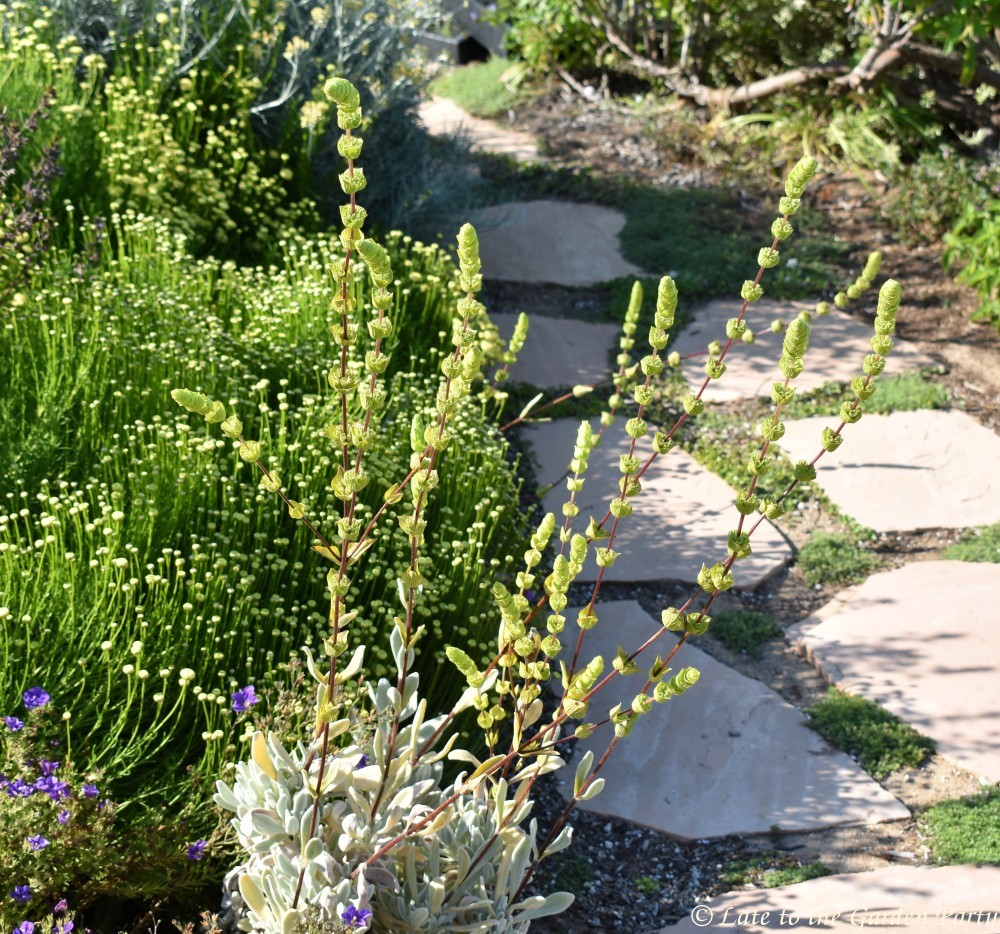
Sideritis cypria, with its gray foliage and red stems sporting lime green cups containing tiny yellow flowers, is truly unusual

I've had Wahlenbergia 'Blue Cloud' for years and it's slowly spread itself around in this bed consisting mainly of succulents


Another group of plants deserve a wave goodbye as they prepare to exit the garden scene for the year.

Centranthus ruber (top) doesn't look as good as it did a month ago but the butterflies don't mind.  Also waning, bottom left to right: Leucospermum 'Brandi', Limonium perezii, and Ozothamnus diosmifolius.


But as some plants prepare to exit, others are only just arriving on scene.

Still in limited release are: Leptospermum 'Copper Glow' (top) and (bottom, left to right) Eustoma grandiflorum (aka lisianthus), Leucanthemum x superbum, and Magnolia grandiflora

And the very first Dahlia, 'Enchantress', not quite fully open


I'll close as I usually do with collages showing the best of the rest currently on display.

Top row: Buddleja davidii 'Buzz Purple', Consolida ajacis, Corydalis flexuosa 'Porcelain Blue' and Iris douglasiana
Middle row: Lathyrus odoratus 'Celeste Blue', Linum perenne, and Pelargonium peltatum
Bottom row: Melaleuca thymifolia, Polygala fruticosa, and Teucrium cossonii majoricum

First row: noID Anigozanthos, Bignonia capreolata, and Cotula 'Tiffindell Gold'
Second row: Euphorbia 'Dean's Hybrid', Grevillea 'Peaches & Cream', and Hymenolepsis parviflora
Third row: Leucadendron 'Pisa', Lonicera japonica, and Mimulus 'Jelly Bean Buttercream'
Fourth row: Pelargonium  hortorum 'Tweedle Dee' and Rosa 'Lady Emma Hamilton'

First row: Abelia grandiflora, Alstroemeria 'Indian Summer', Arctotis 'Opera Pink', and Arctotis 'Pink Sugar'
Second row: noID Bougainvillea, Cistus 'Victor Reiter, Cuphea 'Starfire Pink', and Grevillea Ned Kelly'
Third row: Hebe 'Wiri Blush', Lobelia laxiflora, Lotus 'Amazon Sunset', and Lotus jacobaeus
Fourth row: Oenothera speciosa, Oscularia deltoides, Pelargonium peltatum, and Rosa 'Pink Meidiland'

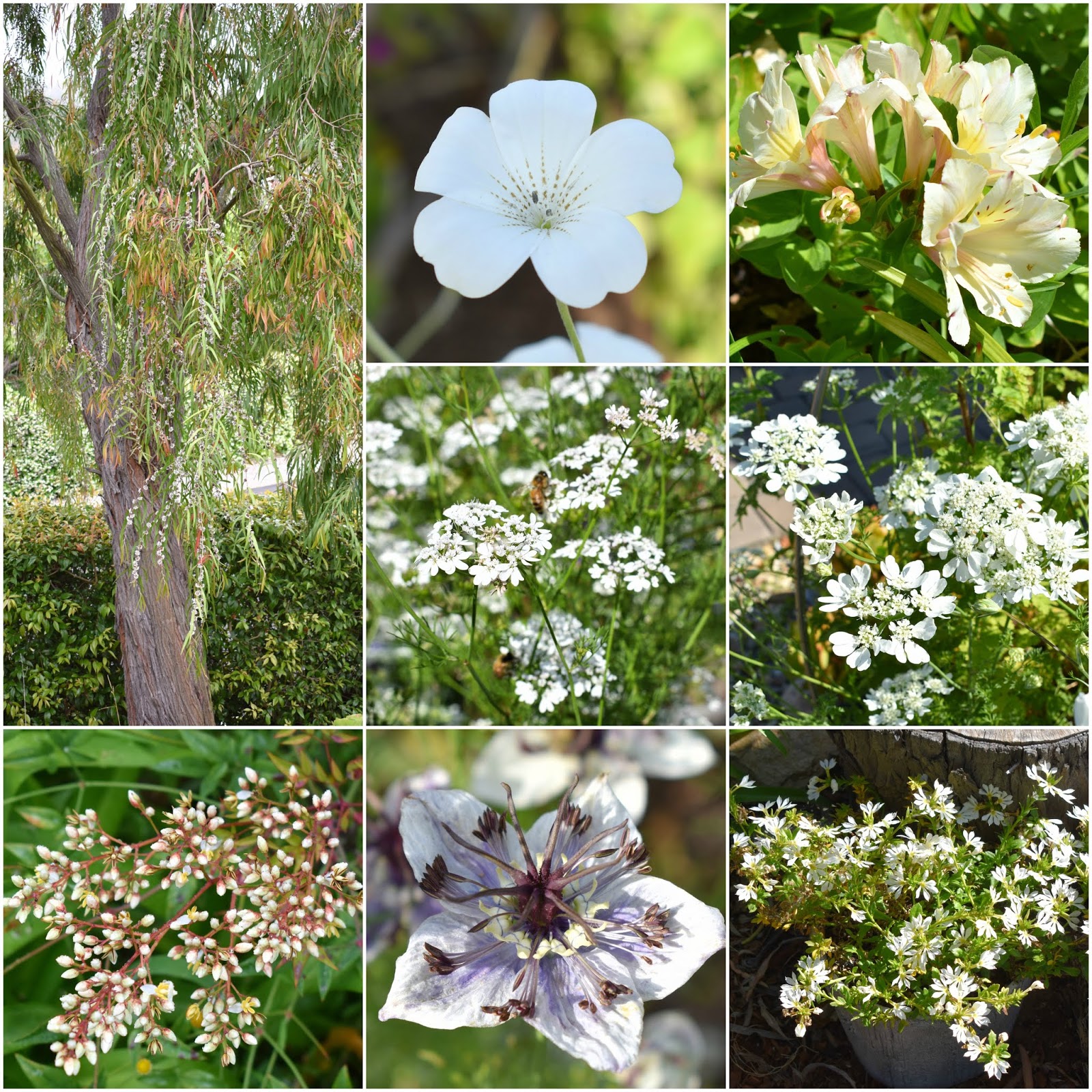
Top row: Agonis flexuosa, Agrostemma 'Ocean Pearls', and Alstroemeria 'Claire'
Middle row: Coriandrum sativum and Orlaya grandiflora (similar in form but not size)
Bottom row: Nandina domestica, Nigella papillosa, and Scaevola 'Surdiva White'


My Bloom Day posts haven't gotten any shorter, have they?  Oh well, one never knows when summer may kick my garden to the curb.  For more Garden Bloggers' Bloom Day posts, visit Carol at May Dreams Gardens.


All material © 2012-2019 by Kris Peterson for Late to the Garden Party

Monday, June 3, 2019

In a Vase on Monday: Wild in more ways than one

Ever since the Matilija poppies (Romneya coulteri) produced their first blooms a few weeks ago, I've been thinking of cutting some for a Monday vase.  However, with so many flowers still clamoring for attention, it was easy to ignore the poppies down at the bottom of my back slope for a time.  Sunday morning, I decided their time had come and marched down there to clip a couple of stems.

The poppies are already blooming well above my head.  I knew the plant could spread but I wasn't aware it' could grow 8-10 feet tall.

I've got plenty of white and yellow elements in the garden to accent the crinkled white petals and yellow centers of the poppies

I threw in a couple of the unusual flowers of Sideritis cypria for added drama (and because they'd toppled over into a pathway)

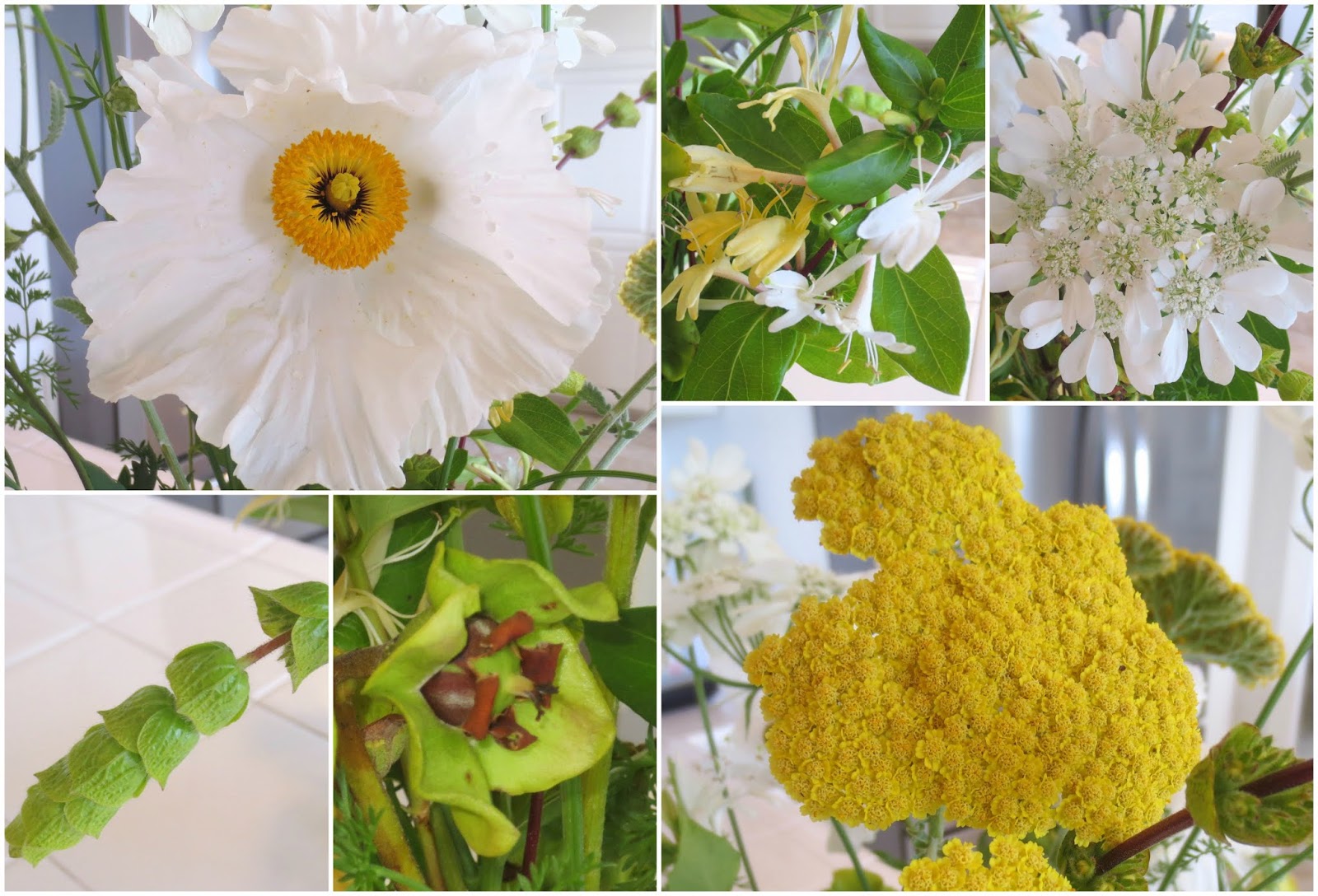
Clockwise from the upper left: Romneya coulteri, Lonicera japonica, Orlaya grandiflora, Achillea 'Moonshine', persimmon buds, and Sideritis cypria.  A critter of some sort broke 2 large branches of one of my persimmon trees over the weekend, resulting in the loss of dozens of the budding fruits.


An unexpected bloom in my back border provided the impetus for a second vase.  I'd almost entirely forgotten about the dozen dwarf Gladioli bulbs I planted there over a year ago.  One lone bulb produced a flower this year and the color wasn't at all what I'd expected.   While pretty on its own, it looked terrible among the surrounding plants so I cut it and went looking for suitable companions.  This year, I've become more confident about my ability to find appropriate color matches somewhere within my garden but this flower's wild colors presented an exceptional challenge.

According to my records, the Gladiola's flowers were supposed to be white and pink.  The coral, pink and magenta flowers were a surprise.

Once I'd assembled my odd mix of flowers, only this vase created in the form of manicured hands seemed right to hold them

I used stems of my 'Pink Meidiland' rose to pick up the coral pink in the Gladiola and stems of a magenta-flowered Pelargonium peltatum (aka ivy geranium) to echo the bright spots in the petals.  The gray foliage of Dorycnium hirsutum (aka hairy Canary clover) brings down the voltage a bit.

Clockwise from the top: Gladiolus nanus 'Nymph', Rose 'Pink Meidiland', Pelargonium peltatum, and Dorycnium hirsutum


As you may have noticed, our kitchen (where I take most of my photos) remains intact.  We're still awaiting the sign-off from the Air Quality Management District required by our city to issue our construction permit and, even after we have that, it may take 2 weeks before the asbestos removal crew is available to start.  Meanwhile, a huge storage pod is sitting in our driveway waiting to be loaded with our living and dining room furniture.  But at least I still have spots to put flowers!


For more "In a Vase on Monday" posts, visit Cathy at Rambling in the Garden.


All material © 2012-2019 by Kris Peterson for Late to the Garden Party