Wednesday, January 20, 2016

Where is El Niño?

While El Niño's impact has been felt in other areas of the world, its impact on Southern California has been trivial thus far.  Northern California has received somewhat higher rainfall this year and the snow levels in the north, the biggest contributor to fighting drought in the future, are good but those storms have been fueled by weather conditions in the northern Pacific, not El Niño storms from the west.  Only the storms during the first week of January here were fueled by El Niño and, in my particular location, those brought just 1.25 inches of rain.  As was true in prior years, a ridge of high pressure has prevented any significant rain from reaching us but the forecasters are still predicting that El Niño will come through, although perhaps not until February or March.

The best news at present is that we did get a little rain this week thanks to a storm out of Northern California.  We were given a 20-30% chance of receiving up to 1/10th of an inch of rain but, in my area, we got a little over three times that much.  My plants and I are happy, at least for the moment.

Rain drops on Arthropodium cirratum

Leucadendron 'Pisa'

Stipa tenuissima

Even Agave 'Jaws' looks good washed clean by the rain


The rainwater I've drained from my collection tanks has been replenished and I refilled my garden trugs twice before the latest storm moved on.

This is literally a drop in the bucket but my 50, 160 and 265-gallon tanks are also full


I'm grateful for the 475 gallons of water I've got stored but hauling it around my half-acre property is hard work so I hope El Niño does come through next month, dropping rain at a measured pace rather than all at once.  Our rain totals in SoCal remain significantly below "normal."


The year-to-date total reflects the rain received since the rainy season began on October 1st 2015


All material © 2012-2016 by Kris Peterson for Late to the Garden Party

Monday, January 18, 2016

In a Vase on Monday: Shy Grevillea

Grevillea 'Peaches & Cream' has been covered with buds for a couple of weeks and I fixated on using it in a vase even though I usually loathe cutting the blooms.  The problem is that the flowers appear in clusters, generally blooming one at a time but, once the stems are cut, the unopened buds never seem to bloom.  Still, there are quite a few buds on the shrub in my front garden so I gathered my courage and cut the stem with the smallest number of unopened flowers.

Front view

Back view (showing one of the unopened flowers)

Top view (showing another unopened flower)


The Grevillea bloom complements the rest of the cast but doesn't overwhelm any of them.  In fact, some of the other plant materials, like the Nandina berries, had to be shifted about so they didn't steal the stage.  Here's a closer look at what I included:

Clockwise from top left: Grevillea 'Peaches & Cream', Coprosma repens 'Inferno', Leucadendron salignum 'Chief', Leucodendron 'Wilson's Wonder', berries of Nandina domestica, and noID Narcissus


The vase assumed the position occupied by last week's arrangement in the front entry.  As expected, the Calliandra (pink powder puff) blooms in last week's vase survived only a few days but the rest of the plant material carried on for the balance of the week.  I wonder if I can expect more of the Grevillea?

Visit Cathy at Rambling in the Garden, the host of "In a Vase on Monday" to see what she and other gardeners have going on this week.


All material © 2012-2016 by Kris Peterson for Late to the Garden Party

Saturday, January 16, 2016

Foliage Follow-up: Winter Color

We don't get much in the way of fall color in my area of Southern California.  In recent years, at best the coral bark Japanese maple, persimmon trees and ornamental pear tree showed some color change.  This year, with warm weather extending well into November, even those trees didn't color up.  But since the temperatures dropped in December, things changed.  It's been cold here.  No, not cold like it gets in much of the US or Europe but cold for us, with daytime temperatures stuck between the upper 50sF and the low 60sF.  My friends and I complain about the cold when we meet for lunch.  My husband and I run the heater all night.  And the garden has reacted too.

Foliage that doesn't normally turn red did.

The variegated foliage of Abelia 'Kaleidoscope' (left) is mostly red and so is "evergreen" Abelia 'Edward Goucher' (right)

I've never seen the leaves on the gauva trees turn until now


Some plants turned pink.

The pink coloration on Agave 'Joe Hoak' may be a normal response to cold but I've never noticed this before

Aloe 'Blue Elf' is very, very pink - dry soil conditions may be a contributing factor in this case

My blueberries are pink too!

Yucca 'Bright Star' did turn pink last year as well but not this pink - I love these plants and wish I could find a few more in 1-gallon containers


Trees that showed no color change during the fall months began sporting rosy hues.

The leaves of Acer palmatum 'Mikawa Yatsubusa', a dwarf Japanese maple, turned brown and dropped off as summer extended into November but, when the nighttime temperatures turned cold, the plant produced fresh green foliage as if it was spring and, as the cold temperatures persisted, those leaves turned a beautiful orange

The last leaves left on the Pyrus calleryana (ornamental pear) eventually turned yellow, orange and red.  The tree also dropped more of its fruit (which even the birds won't eat) than it ever has before, making a horrific mess of the driveway.


These plants join a smaller group of plants that usually color up in winter.

The new foliage on the Agonis flexuosa 'Nana' is bright orange

Euphorbia tirucalli has responded to the cold with the bright winter color that gives it the common name of Sticks on Fire

And like the Abelia, variegated Pseuderanthemum 'Texas Tri-star' is now mostly red


I might be light on floral color this winter but the foliage is picking up the slack!

Visit Pam at Digging, the host of Foliage Follow-up, to find what plants are grabbing the attention of other gardeners this January.


All material © 2012-2016 by Kris Peterson for Late to the Garden Party

Friday, January 15, 2016

Bloom Day - January 2016

While many of the same plants that were blooming last January are also blooming this January, the blooms are less prolific.  I'm not sure whether this is attributable to our drought, colder temperatures, or a combination of the two factors.

If I were to pick the star of my January 2016 garden, the award would probably go to Arbutus 'Marina'.  Although these trees, along with many others, were trimmed in mid-December, they're still loaded with blooms, which makes the hummingbirds happy.

Blooms are present most of the year but they seem more noticeable when much of the rest of the garden is bloom-free


Another flowering tree, Bauhinia x blakeana, is still loaded with buds but the flowers took a beating from last week's rainstorm so it's not looking its best at the moment.

Battered blooms on what's commonly known as the Hong Kong orchid tree


The same could be said for Gomphrena decumbens 'Itsy Bitsy'.

The airy Gomphrena stems were beaten down by last week's rain and they're nearly impossible to untangle


Many specimens in my burgeoning collection of Grevillea have a smattering of blooms but they seem to be at least a few weeks behind their 2015 bloom cycles.  Grevillea lavandulacea 'Penola' (not shown), usually one of the stars of my winter garden, has yet to bloom at all, although it's finally developing buds.

Clockwise from far left: Grevillea 'Superb', G. 'Ned Kelly', G. 'Peaches & Cream, G. 'Pink Midget' and G. alpina x rosmarinifolia


Similarly, the Osteospermum, which generally bloom best in cooler weather, have been slow to get going this year.

From left: Osteospermum ecklonis '3D Berry White', O. 'Blue-eyed Beauty' and O. 'Summertime Sweet Kardinal'


There are plenty of Gazania plants in my garden but relatively few flowers.  The squirrels have developed a taste for them and they disappear almost as soon as they open.

Gazania 'New Day Yellow' (left) and G. 'White Flame' (right)


Nonetheless, there are some reliable bloomers.

Pink and white forms of Argyranthemum frutescens

Calliandra haematocephala (aka pink powder puff)

Coleonema pulchellum 'Sunset Gold'  blooms heaviest in cool weather

Cuphea ignea 'Starfire Pink' also blooms all year but it looks best if cut back severely in the winter - this one is about to get chopped

Lavandula multifida (left) and L. angustifolia 'Super Blue' (right)

Prostrate rosemary


Annuals are stepping in to provide seasonal color, most notably the Iceland poppies and the violas.

Papaver nudicuale

I planted a lot of the small violas from 6-pack plugs this year.  The plants on the left and in the top row are all part of a mix called 'Pandora's Box'.  


My Camellia sansanqua shrubs, which were covered with flowers before the last week's rainstorms, now look sad; however, after a disappointing performance in 2015, things are looking up for Camellia x 'Taylor's Perfection' in 2016.

Camellia x 'Taylor's Perfection' 


A few other plants are standing in the wings, poised to make a splash.

From left: Arctotis 'Pink Sugar', noID Narcissus, and Solanum xanti


I'll close with a photo of one of the poinsettias planted in a pot by the front door.  While the variegated poinsettia on the other side of the door is struggling, possibly in response to our colder than usually winter weather, this one seems unfazed.

The coral "petals" of this poinsettia (Euphorbia pulcherrima) are actually bracts but they look almost like roses here


For a look at what's blooming elsewhere, visit Carol at May Dreams Garden, the host of the monthly event that is Garden Bloggers' Bloom Day.


All material © 2012-2016 by Kris Peterson for Late to the Garden Party

Wednesday, January 13, 2016

Wednesday Vignettes: Pure Gold

The skies are cloudy today but there's no rain in sight.  For this week's Wednesday Vignette, the meme hosted by Anna of Flutter & Hum, I have a couple of photos taken under sunnier skies.

The first was taken from my bedroom window looking out across the front garden late last week after the rain had stopped.  It's a view I've shown before but the focus of this shot is the color echo created by the yellow succulent flower in the hanging basket in the foreground and the bright gold of the shrub in the middle background.

I believe the yellow flowering plant in the hanging basket is a Kalanchoe of some type.  The golden shrub is Duranta erecta 'Gold Mound'.  At least that's the name under which it was sold.  It's much taller than the 3 feet originally projected by the grower.

The second photo - or second and third photos as I was unable to pick just one of the five I snapped - shows a Monarch butterfly resting on the bright yellow foliage of Coleonema pulchellum 'Sunset Gold'.

Butterflies don't usually allow me to get anywhere near this close.  There was a scattering of pale pink flowers on the Coleonema in late December when this photo was taken but I've never heard the plant identified as one attractive to butterflies so I'm not sure why it was hanging about.

Western Monarchs generally winter in San Diego or Santa Cruz so it seems I'm not the only one late to the garden party.  I hope she (or he) made it to the proper destination.


For more Wednesday Vignettes, visit Anna at Flutter & Hum.


All material © 2012-2016 by Kris Peterson for Late to the Garden Party

Monday, January 11, 2016

In a Vase on Monday: Red!

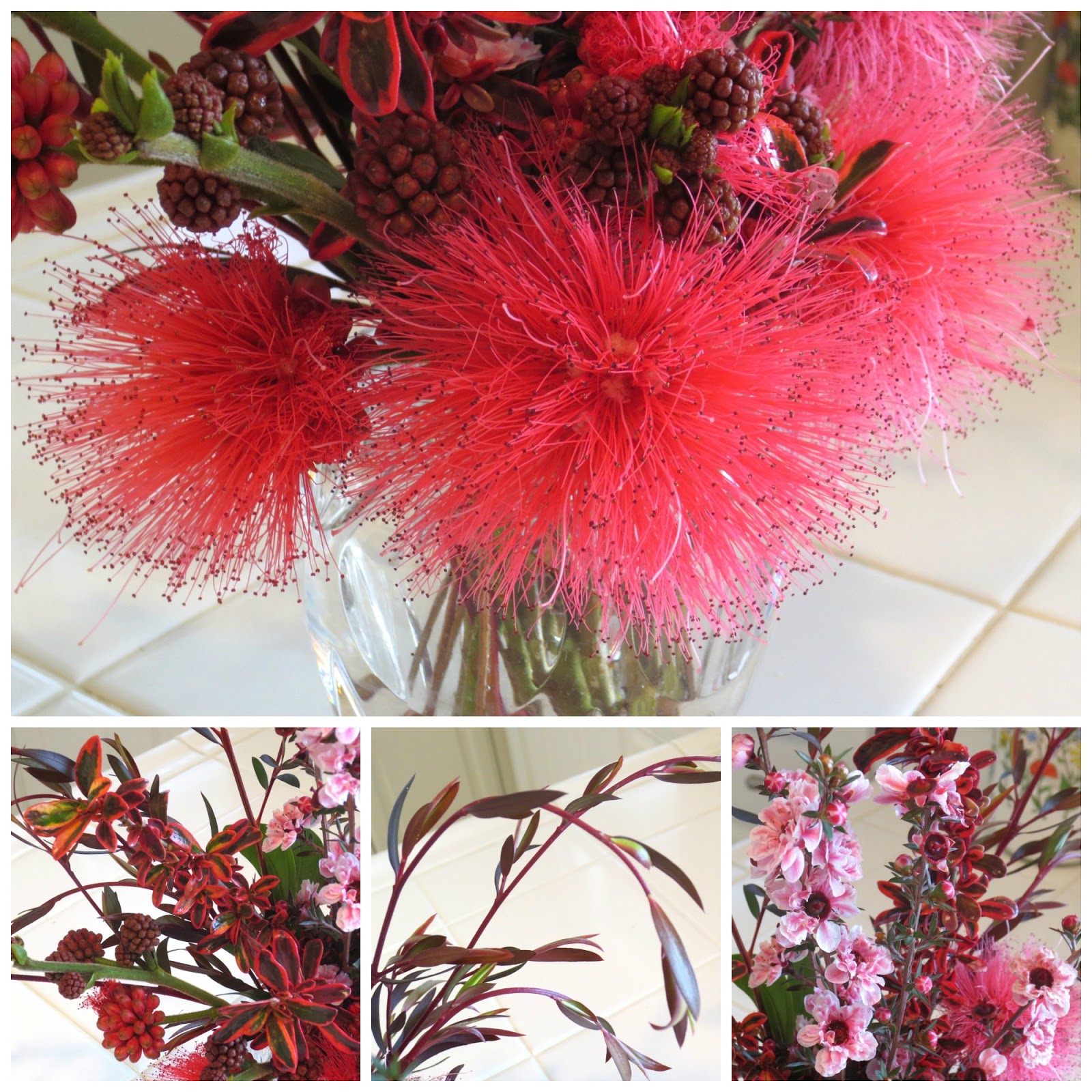
I avoided using red flowers and foliage in my former garden.  That garden was tiny and red seemed to overwhelm it.  Yet red, in measured doses, has a prominent role in my current garden, especially when it comes to foliage color.  I still have relatively few red-flowering plants but there are some.  Perhaps the flashiest of these is Calliandra haematocephala, popularly known here as pink powder puff.  I inherited 4 of these plants with the house, all grown as hedges along pathways and against the house.  They're generally sheared to keep them within bounds so they don't bloom as heavily as I'd like but the one grown alongside the garage blooms reliably at this time of year.  I've previously used it in vases with Grevillea lavandulacea 'Penola' but the blooms on those shrubs are tardy this year so I had to look further afield for companions.  Foliage plants came to the rescue.


Leptospermum 'Copper Glow' was a natural choice for foliage.  It's copper color has reddened dramatically since the temperatures dropped and I admire the plant daily as I go in and out the front door.

L. 'Copper Glow' in the bed along the front pathway


There's a second L. 'Copper Glow' on the other side of the pathway but for reasons that elude me it isn't nearly as red.  However, the Coprosma repens 'Fire Burst' planted below it provided my second foliage choice.  I added a few stems of Leptospermum scoparium 'Pink Pearl' whose flowers have dark burgundy centers to lighten up the arrangement a bit.  Here's a closer look at the individual elements:

You can see why Calliandra haematocephala (top row) is referred to as a "powder puff," although the color is more ruby-red than pink in my view.  The tight buds, shown above the blooms, start out brown in color.  In the second row, from the left, are: Coprosma 'Fire Burst', also reddened by exposure to cooler temperatures; the graceful stems of Leptospermum 'Copper Glow'; and the tiny blooms of Leptospermum 'Pink Pearl'.

The vase replaced last week's arrangement in the front entry.  Other than the Nandina foliage, last week's vase held up well.  I don't recall that the Calliandra blooms last very long but time will tell.


Visit Cathy at Rambling in the Garden, the host of the popular "In a Vase on Monday" meme, to discover what other gardeners have found to include in their vases this week.


All material © 2012-2016 by Kris Peterson for Late to the Garden Party

Saturday, January 9, 2016

In search of plants...

I've got lots of empty garden space but not the plants to fill it.  The available supply of garden-eligible plants in my local garden centers was reduced during the holidays as stock was pushed aside to make room for Christmas trees, poinsettias and other holiday decorations.  Since New Year's Day, I've visited 4 garden centers but the stock remains very limited.  With rain predicted this evening, I made a trek to Roger's Gardens this morning with a gift card burning a hole in my pocket.

As I was by myself, I took the time to check out the plant displays, starting with the ornamental grass and succulent garden that sits at the corner of the property along the street.  I've visited several times since its installation, usually with friends, but we've never hiked up to the front of the property to check it out.  With time to spare, I did so today.

This display garden sits at the intersection of 2 very busy streets

A gazebo serves as the focal point

Ornamental grasses and succulents are the mainstays of this display

Tall pine trees bordering the nursery's property provide a backdrop

Drought tolerant Arctotis was used liberally to add color

The orange red of the Aloes, many of which are coming into bloom, echo the color of the Arctotis, as well as the foliage color of some of the succulents, like the Kalanchoe shown here

Succulents in baskets add interest to the gazebo


Here's a look at some of the individual plants featured in the area:

My best guesses on plant IDs, clockwise from upper left: A mix of ornamental grasses (no ID), Agave attenuata, Agave 'Blue Flame', Aloe (no ID), Aloe dorotheae, Cordyline 'Electric Flash', Grevillea lanigera, Hesperaloe parviflora, Lomandra longifolia, and Opuntia (maybe santarita)


On my way to and from the corner garden, I took note of the plants along the sidewalks and the parking lot as well.

I was struck by how good Westringia fruticosa 'Morning Light' looked (shown in the 2 photos in the top row above) and I'm now considering adding some of these to the areas left bare by removal of 2 large Ceanothus along a slope in my own garden.  I think the plants used along the "parkway" (not actually open to parked cars) on the bottom left may be Chondropetalum tectorum and Aloe 'Rooikappie'.  The Grevillea on the bottom right (maybe G. 'Scarlet Sprite') was used effectively en masse and should be spectacular when in full bloom.

3 vignettes in the parking area


There was plenty to see in the front entry of the nursery area as well.

I'm a sucker for rusty metal things so I loved the displays at the front entry (top row, above).  Kids were still enjoying the model train display (bottom. left).  White and blue flowering plants were on center stage around the fountain (bottom, right).


The succulents on display in the sales areas also drew my attention.


While more well-stocked than the 3 garden centers I visited earlier, the plant stock at Roger's was more limited than usual, or so it seemed to me.  Pots, prices discounted, occupied prime plant space.


I wondered if Rogers was clearing stock prior to taking annual inventory, or if the construction at the back of the property was squeezing the area available for plants.

A restaurant is going in at the back of Roger's property, scheduled to open sometime this spring.  I have mixed feelings about this but, as land values are at a premium in SoCal, especially along the coast, a restaurant is certainly one way to maximize the value of this property.  The executive chef previously ran a restaurant I loved back when I worked in Irvine so I'm looking forward to eating there - as long as it doesn't unduly encroach on the plant inventory.


Plant stock may be low simply because the nurseries and garden centers are planning for light traffic during the heavy rain expected to accompany El Nino.  Despite the relatively light inventory of plants, I still managed to exhaust the credit available on my gift card and then some.  Here's what I came home with:

I brought home an Acanthus mollis, 2 Dianella tasmanica 'Yellow Stripe', several ornamental grasses (Seslaria 'Greenlee's Hybrid', Festuca californica, and Festuca glauca), more Gazania, Limonium perezii, Kalanchoe orgyalis, Cotyledon orbiculata, Coprosma 'Rainbow Surprise',  Tanacetum niveum, Aeonium 'Kiwi' and a Helichrysum I can't ecall the name of


But I'm still thinking of what I left behind.

Echeveria agavoides 'Vashon' and Protea cynaroides 'Mini King'


Maybe I'll get back next month.  There's still a lot on my wish list to fill in the vacancies left as as a result of removing my remaining lawn this past fall.  Planting what I've already bought is on hold for the time being anyway.  The ground is too wet to plant now.  It hasn't dried out from the rain we got earlier in the week, approximately 1.25 inches in my location.  We got a tiny bit more late this afternoon (less than 1/10th of an inch) but next week should be mostly dry before the rains return (hopefully) the following week.


All material © 2012-2016 by Kris Peterson for Late to the Garden Party