Showing posts with label Gomphrena 'Itsy Bitsy'. Show all posts

Monday, November 27, 2023

In a Vase on Monday: Goodbye Emanuelle and hello Itsy Bitsy

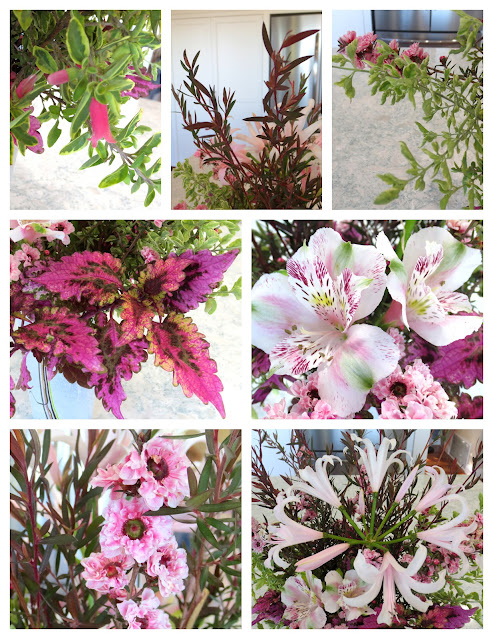
It's getting harder to pull together arrangements using what's blooming in the garden but I managed to do so again this week. My first arrangement was created around the last of the Amarines to flower.

I think the pale pink Amarine was upstaged once again, this time by a coleus rather than a dahlia.  Amarines are hybrids of Amaryllis belladonna and Nerines.

Back view: I used a second stem of Plectranthus scutellarioides 'Florida Sun Rose' (aka coleus) to dress up the back.  The coleus stem in the front view is the one I used 3 weeks ago.  It's developed roots and I hope to overwinter the cutting in my shade house.

Top view

Clockwise from the upper left: Correa 'Wyn's Wonder', Leptospermum 'Copper Glow', Prostanthera ovatifolia 'Variegata', Alstroemeria 'Inca Vienna', Amarine belladiva 'Emanuelle', Leptospermum scoparium 'Pink Pearl', and Plectranthus scutellarioides 'Florida Sun Rose'


The second arrangement features some flowering plants emerging from their summer dormancy.  Gomphrena 'Itsy Bitsy' has also returned with a mass of tiny blooms.  I cut the shrub down to the ground months ago.  The foliage bounced back quickly but the flowers took their time.

Stems of Polygala myrifolia (aka sweet pea bush) provided the base of this arrangement but it's really an ensemble cast

Back view

Top view

Clockwise from the upper left: Antirrhinum majus, Pelargonium peltatum 'Lavender Blizzard', self-seeded Osteospemum, Digitalis purpurea, Gomphrena decumbens 'Isty Bitsy', Polygala myrtifolia, and Vitex trifolia


For more IAVOM creations, visit Cathy at Rambling in the Garden.


All material © 2012-2023 by Kris Peterson for Late to the Garden Party


Monday, February 6, 2023

In a Vase on Monday: Foxgloves

I cut my first foxglove of the season for In a Vase on Monday in early January.  At that time, there were two more plants that also had flower spikes.  They developed somewhat after that but, as our temperatures dropped, it was as if they'd entered a long period of stasis.  I eyed them week after week, waiting for them to beef up - and for other flower spikes to appear.  This week I finally got fed up and decided to go ahead and cut both.  One is peach and the other is purple so they went into separate arrangements.


Vase #1:

The peach foxglove has looked like it does here for weeks

The back view shows off the interesting peach flowers of Grevillea 'Poorinda Leane' to greater advantage

Top view

Clockwise from the upper left: Digitalis purpurea 'Dalmatian Peach', Grevillea 'Poorinda Leane', Leucadendron salignum 'Safari Sunset', L. 'Winter Red'. Nandina domestica, and Pennisetum advena 'Rubrum'


Vase #2:

Foxglove flowers generally open gradually from the bottom of the flower spike.  The bottom half of this one remained bare of flowers for weeks until flowers appeared midway up the flower spike and moved on upward.

The back view looks much like the front with only slight differences in the color of the Dianthus flowers tucked in at the base of the vase

The top view shows off the wiry stems and small round flowers of Gomphrena 'Itsy Bitsy'

Clockwise from the upper left: 2 variations of Dianthus barbatus, Digitalis purpurea 'Dalmation Purple', Gomphrena decumbens 'Itsy Bitsy', and Prostanthera ovalifolia 'Variegata'.  Included, but not shown in closeup, are stems of Coleonema album (aka white breath of heaven).


After two warm days late last week, we were cold again (by our definition, that means daytime temperatures in the low 50sF/11-13C) on Sunday.  We're expecting a gradual warm-up over the next several days, after which we'll cool down again.  There's a small chance of rain next week.  Overall, February, historically our wettest month, is expected to be drier than average but then again, everyone was surprised by the series of rainstorms we had in January so I'm taking no bets.  Our chimney has yet to get a real test of my husband's latest patches as the last rainstorms we've had were very light so even he'd like to see a good, solid storm before our rainy season comes to an end in early April.


For more IAVOM posts, visit Cathy at Rambling in the Garden.

Last week's vase containing the large Aeonium arboreum flowers and tall stems of Leucadendron 'Chief' looks largely the same as it did last week, except that the Acacia 'Cousin Itt' foliage has dried (while retaining its deep green color).  This week's new arrangements ousted those I had in the front entry and kitchen island.


All material © 2012-2023 by Kris Peterson for Late to the Garden Party

Monday, December 21, 2020

In a Vase on Monday: Itsy Bitsy tangles with the queen of flowers

A friend of mine stopped by on Saturday with gifts, including peonies!  The same market that offers peonies in late spring/early summer now has "winter peonies" so of course I had to use them in a vase this Monday.  She brought two sleeves of peonies in different colors but, as one group opened far more quickly than the other, I ended up displaying them in separate vases.

I partnered the peony blooms with Gomphrena 'Itsy Bitsy' and foliage from my garden.  According to legend, peonies are the queen of flowers (or king or empress, depending upon the source). 

Back view: I cut so many of the spindly 'Itsy Bitsy' stems, they repeatedly got tangled with the peonies and themselves, hence the title of this post

Top view

From left to right: Gomphrena decumbens 'Itsy Bitsy', noID peonies, and Prunus caroliniana

The peonies in the second vase were still stubbornly curled in tight balls on Sunday afternoon but I'm expecting they'll open overnight.

These peonies were also paired with 'Itsy Bitsy' and the same foliage

Contrary to expectations, my garden produced yet another Lisianthus (Eustoma grandiflorum) bloom so, to celebrate its persistence, I constructed another arrangement around it.

I collected a range of blue and purple blooms to accent the dark blue Lisianthus

Back view

Top view

Clockwise from the upper left: noID Ceanothus, Eustoma grandiflorum, Lavandula multifida, Osteospermum 'Violet Ice', Prostanthera ovalifolia 'Variegata', and Trichostemma 'Midnight Magic'

I showed a single photo of a wreath I constructed from scratch (my first ever!) in my Friday post but, thinking that members of the IAVOM community were perhaps most likely to appreciate the process, I saved the details for this post.

From left to right, the main ingredients were cuttings of Leucadendron salignum 'Chief', berries of Nandina domestica paired with stems of Coleonema pulchellum 'Sunset Gold', and Leucadendron 'Winter Red'.  I tied the cuttings tightly together using fishing line.  In retrospect, I should have made more and smaller bundles of each material to create a denser wreath.

I used a wire frame I'd saved from a store-bought wreath purchased last year.  When I started, I hadn't planned to add the red berries or chartreuse Coleonema.  I placed two Leucadendron 'Chief' bundles for each 'Winter Sun' bundle, wrapping the wire around each bundle hree times before overlapping it with the next one.  I didn't cut the wire until I'd covered the entire frame.

I was fairly pleased with it when I reached this phase but I decided I needed some bright spots of red, which is when I assembled the berry bundles.  I wired these in separately but it would have been better to have wired in everything at the same time, as well as using smaller bundles of materials to create a denser wreath.

Luckily, I had some chartreuse ribbon on hand.  I watched an online video about making a bow with multiple loops.  Stiffer ribbon would have worked better in this instance.

This is the finished wreath.  Knowing what I do now, next time I'll: create smaller bundles of materials (about 4 inches long), alternate bundles facing in and out, and wire all materials as part of one continuous process.  As this wreath has dried out rapidly indoors, I think I'll also place it outdoors if possible.
 
All Christmas decorating is now complete for this year.  With Covid-19 filling our ICUs and stretching local hospitals to the brink, my husband and I will be spending our holiday alone this year.  However you're celebrating I hope you find a safe and pleasant way to enjoy the comforts of the season.  Best wishes!


All material © 2012-2020 by Kris Peterson for Late to the Garden Party


Tuesday, December 15, 2020

Bloom Day - December 2020

It's been ridiculously dry here in coastal Southern California.  Other than one light rainstorm in mid-November, which delivered just a twentieth of an inch of rain in this location, we've had no rain and, without much in the way of a marine layer, humidity levels have been very low on average.  Plants that usually bounce back in the fall are lagging, even though I'm still running our irrigation system.  The long-term forecast isn't very promising either.  The latest update I read suggests that dry conditions in Southern California may continue through January.

It's cool here but we don't normally get freezes so there are still plenty of flowers, if not as many as I'd like to see.  At this time of year, I truly appreciate the plants that bloom year-round so I'll start off with those those this month.

I don't think I've ever given Gomphrena decembens 'Itsy Bitsy' the starring role in a Bloom Day post so that's long overdue.  The flowers might be small but they're certainly plentiful.

I can always count on the large-flowered Grevilleas when everything else is in decline.
Top row - Grevilleas 'Moonlight' and 'Ned Kelly'
Middle row - two views of Grevillea 'Peaches & Cream'
Bottom row - two views of the well-named Grevillea 'Superb'

A close-up of hybrid Cuphea 'Starfire Pink'.  I have 10 of these shrubs in my garden.  They need to be pruned back hard at least once a year but I never cut them all back at the same time as I fear the bees and hummingbirds wouldn't forgive me.

Many of the plants that were blooming last month are continuing to put on a good show.

Correas 'Ivory Bells', 'Pink Eyre', and 'Sister Dawn'

Most of the Gazanias in my garden are now self-sown offspring of those I introduced years ago

Pennisetum advena 'Rubrum' makes the most of the light in the fall garden

Tagetes lemmonii (aka copper Canyon Daisy) is starting to get lanky but I'll give it a bit more time before I cut it back

Some of the usual cool-season bloomers are making a splash right on schedule despite our dry conditions.

Two of the Aloes that have developed bloom spikes are 'Safari Sunrise' (left) and hybrid vanbalenii x ferox (right)

Blooms are back on the Hong Kong orchid tree (Bauhinia x blakeana), although most are way above my head

Calliandra haematocephala (aka pink powder puff) was used as a foundation plant in several spots by a prior owner of our property.  All are regularly sheared within an inch of their lives but one or two manage to produce some blooms every year at this time.

Two varieties of Camellia sasanqua in similar colors were planted by a prior owner under the roof eave on the north side of the house.  This is one of these.

This, lower-growing form, is the other.  I've no names for either cultivar.

I've had Cyclamen in my shade house for years but I admit that I refreshed the plants in this pot this year and moved the older specimens to a shady border

I introduced Mahonia x media 'Charity' in 2016 and it's finally gained some substance

I'm incapable to resisting the allure of Violas and always end up buying plugs at some point even though they're thirstier than most of my plants

I planted several Westringia fruticosa 'Morning Light' in 2016 for their foliage but they do produce tiny white flowers in the fall

The biggest surprise this December was a very late-blooming milkweed I'd thought was long gone.

I planted three Asclepias cancellata years ago and thought all were gone until this one bloomed when the butterflies have moved along.  The bees seem to like the plant, though.  (Aphids too.)

Another surprise was a bloom spike on my xMangave 'Silver Fox'.

Over the last several years, I've accumulated more Mangaves (intergeneric hybrids of Manfreda and various Agaves) than I can count off-hand, most purchased as small specimens.  'Silver Fox' is the first to produce a bloom spike but it's taking its time to flower.  Agaves are monocarpic but Manfredas aren't.  It remains to be seen which parent 'Silver Fox' will emulate.


And to conclude this post, here are my usual scavenger hunt finds, organized into color collages.

Top row - Eustoma grandiflorum (still producing blooms now and then!), Felicia aethiopica, and Lavandula multifida
Middle row - Limonium perezii (early or late?), Osteospermum 'Violet Ice', and Polygala fruticosa
Bottom row - Primula x polyantha, noID Scaevola, and Trichostemma 'Midnight Magic'

Top row - Arctotis 'Pink Sugar', Argyranthemum 'Angelic Giant Pink', and Callistemon 'Cane's Hybrid'
Middle row - Coleonema pulchellum 'Sunset Gold' and Osteospermums 'Berry White' and noID pink
Bottom row - Pelargonium peltatum 'Flamingo', Pentas lanceolata, and Persicaria capitata

Dianthus 'Dash White', Lantana 'Lucky White', and self-seeded Osteospermum

Burgundy Pelargonium peltatum and Penstemon mexicali 'Mini Red Bells'

Top row - Argyranthemum 'Yellow Beauty', Euryops chrysanthemoides 'Sonnenschein', and Osteospermum 'Double Moonglow'
Middle row - Primula x polyantha, Cuphea 'Vermillionaire', and Leonotis leonurus
Bottom row - Osteospermum 'Zion Copper Amethyst' and Zauschneria californica

Thanks, as always, to Carol of May Dreams Gardens for organizing this monthly bloomfest.  For more Garden Bloggers' Bloom Day posts, visit her here.


All material © 2012-2020 by Kris Peterson for Late to the Garden Party