Friday, June 10, 2022

New plants, garden chores & rabbits

I aim to avoid planting anything new during SoCal's "warm season" but I seldom succeed in stopping altogether.  I cut myself some slack when it comes to succulents as most of them handle summer's soaring temperatures and dry soil better than other plants.  As the last few weeks have been relatively cool here, it's also easier to bend my self-imposed rule.  Our morning marine layer has remained intact.  Although it generally clears before noon, the clouds keep the afternoon heat at bay.  Thus far, our temperatures haven't strayed much above a comfortable 72F (22C), however, the temperature this morning suggests a break in the trend.

I haven't gone crazy but I've added a few plants this week.

A friend gave me 2 bulbils still attached to a piece of the flower stalk produced by one of her Mangaves, recently identified as 'Catch a Wave'.  It was growing in shade in a pot and produced a stalk nearly 6 feet tall.  I planted one bulbil in a small pot and one directly in the ground.

My local botanic garden's plant stand  is now well stocked with leftovers from the garden's spring plant sale.  I picked up an unlabeled Aloe, which looks to be the same hybrid I bought year's ago at another sale (shown on the lower right).  If I'm right about that, it's Aloe vanbalenii x striata.  Mine original plant also turns orange with sun exposure during the summer months.

I tweaked the succulent bed on the west side of our garage as I'm still unsatisfied with it.  The small succulent planter I'd had in front was blocking water to the plants behind it so I moved it.  I planted an Agave 'Mr Ripple' pup I had in reserve in its place.  I also replaced some unhappy succulents with Echeveria agavoides, which have generally done well here.

I'm hoping 'Mr Ripple' (left) bulks up now that its roots are in the ground.  I added 3 Echeveria agavoides 'Red Tips' (shown upper right) and plan to get more to create a mass in that area.  I added 6 Echeveria agavoides 'Gilva' in another section (shown lower right).

The Agave 'Mr Ripple' on the left is the parent of the pup I just planted.  The succulent planter on the right is the one I moved to another spot on the west side of the garage.

It's already too warm and dry for the ox-eye daisies (Leucanthemum vulgare) I planted in one backyard border last fall.  Those that haven't already died back look terrible so I'm trying out Helianthemum 'The Bride' as an alternative groundcover.  It's supposed to grow only 6-8 inches tall with a spread of 2-3 feet.


I continued pruning shrubs that recently finished their bloom cycles.

Echium candicans 'Star of Madeira' has been in place in this spot since December 2014, which makes it old by the standard for this species.  It's getting increasingly tall and woody and, as it doesn't take well to hard pruning, I take only the growing tips off. My guess is that I'll need to replace it in another year.

The 'Star of Madeira' sits atop a moderate slope at the front of the garden so pruning it is something of a challenge but I managed without breaking my neck.  I cut it back further in front as it had been covering up some of my favorite Agaves, as well as Aloe laworana (shown on the right).

I left some of the Echium's debris in place a this seems to be a favorite hang-out for this dove

I also pruned my second Echium webbii on the back slope.  The Centranthus ruber below the lemon tree needs to be deadheaded as well but I had yet another unfortunate encounter with fire ants while working there so I've put that off.

I was nervous about pruning the Leucospermums but read that they can be cut back as long as 4 sets of leaves remain on the stem.  I took that advice and cut back both 'Goldie' and 'Sunrise' after the last of their flowers dropped.

Leucospermum 'Royal Hawaiian Brandi' has barer stems so I was more cautious when pruning it.  I was treated to a butterfly sighting while work was in process.


After previously taking a casual approach to rabbits in my garden, this year has shown me what a blasted pain in the neck they can be.  During the first seven years here, I never saw a single rabbit.  They made their first appearance three years ago but during the first two years they disappeared in early spring, presumably as a result of activity on the part of coyotes and other predators.  This year, our little ecosystem is completely out of sync and a whole extended family of bunnies appears to have taken up residence.  In the past, any movement I noticed out of the corner of my eye was usually due to the presence of a lizard or a bird but I'm now encountering bunnies at every turn.  I've learned that they're voracious and seemingly willing to taste-test every plant I've got at least once.

This one let me get within 2 feet of him before he sprinted off

My husband made me cages to protect the plants the rabbits have taken a particular shine to.  I've deployed close to a dozen of these already.


The good news is that the plant cages are effective in keeping the rabbits out and my husband prepared extras to be called into service as needed.  That's a good thing, especially as I have a small mail order plant delivery pending.  A friend gave me a few plants as birthday gifts late last month that I still need to get in the ground too.

Best wishes for a peaceful, pest-free weekend.


All material © 2012-2022 by Kris Peterson for Late to the Garden Party


Wednesday, June 8, 2022

Should it stay or should it go? (round 2)

The dwarf Jacaranda 'Bonsai Blue' I raised questions about two weeks ago is still in place but, absent a remarkable change in its appearance it isn't reasonable to expect, it'll probably go as soon as I find the right plant to replace it.  That sorted, as I scrutinized the area surrounding it, questions came to mind concerning two other plants.

After digging out the rampant native aster in the bed adjoining the backyard fountain last fall, I didn't have a full complement of plants in mind to fill the space.  I was open to trying new plants and happened upon one unfamiliar prospect at my local garden center.  It wasn't labeled and no one there was able to identify it for me but, intrigued by the flowers and foliage, I brought three plants home with me.

I planted the three plants in a triangle to play off the foliage color of the 2 Cistus 'Little Miss Sunshine' nearby


Based on its the mystery plants' growth habit, I was a little concerned about them from the start.  I posted a photo of it on Instagram asking if I'd just purchased weeds.  One commentator identified the genus for me as Grindelia but I wasn't able to identify the species until a couple months later when the garden center got new stock of the same plant, this time with labels.  When I confirmed the plant's identity as Grindelia camporum, a native California herb, I removed two of the plants leaving just one in place.  Now, seven months after the one remaining specimen was planted, I still have questions about its placement there.

One source claimed that this plant grows 18-24 inches tall, whereas another said it may grow 2-6 feet tall and 3 feet wide.  Of even greater concern was the floppy habit it demonstrated early on.  It entangles itself in neighboring plants.  I also learned that it's semi-deciduous in summer.

While I planned to use a mix of blue, white and yellow plants in this bed, I also think I've gone overboard with yellow.  I'm feeling the need to eliminate some of the yellow, preferably in favor of adding more blue.


Given it's floppy habit and my concerns with the excess of yellow in this bed, I'm inclined to move it to the back of a bed elsewhere in my garden or even to the back slope.  As summer isn't a great time to move plants, I may hold off on taking this action until fall, although, if I find a suitable replacement for its spot, I might pot it up until conditions are more conducive to planting it out in the garden.

The second plant that brought me up short is a Yucca 'Blue Boy'.  I have five of these plants but the one that concerns me most is the largest one directly adjacent to the back patio.  Its foliage was badly scarred last year by an unidentified pest that left it encrusted with what appears to be dried honeydew.  I treated it but it's still not looking particularly good.

I don't have record of exactly when I planted it but I think this photo taken in March 2019 was early on

This is what the foliage looked like in June 2021.  Two other specimens were affected as well but not as badly.

This is the plant after I treated it for unknown insect pests and cut off the most damaged foliage

This is what it looks like on its east-facing side.  It's a little wonky but doesn't look too bad from this angle.

On the patio side, it doesn't look as good

Closer inspection shows more evidence that the insect pests are back at work

'Blue Boy' is the only one of my Yuccas that has experienced this particular problem.  I don't know if it's related to this cultivar or if it has something to go with its placement in this area.  Three of the other four plants, all located nearly, look fine, although one that I also treated last year shows signs of the same crusty honeydew

These two Yucca gloriosa 'Variegata' have never presented a problem.  The one on the left, tucked into the cavity of a tree stump, never gets watered and, in the past, raccoons have used that cavity as their on-site toilet but it's still held up better than 'Blue Boy'.

In this case, I'm inclined to cut the large Yucca 'Blue Boy' down level with the ground to see if it will regenerate from its base as Yucca 'Bright Star' has done.  I'll try treating the smaller affected Yucca with alcohol, followed by a weekly regime of insecticidal soap to see if that takes care of whatever pests (aphids, mealy bugs, or soft scale) are causing disfiguration of the foliage.

Any other suggestions?


All material © 2012-2022 by Kris Peterson for Late to the Garden Party


Monday, June 6, 2022

In a Vase on Monday: A new spin on the same old flowers

I'm still trying to make use of my remaining cool season blooms while they're presentable.  Our morning marine layer has been present more often than not over the past two weeks, keeping our afternoon temperatures very pleasant.  On Saturday, it was so thick our roof-top weather station recorded one one-hundredth of an inch of precipitation - during a severe drought even that is appreciated.

My foxgloves have produced another flush of bloom.  Their stems, like those of the snapdragons, are shorter now but I made use of both to stuff my first vase this week.

I crammed more into this vase than I'd planned (as usual)

Back view: My cool season daisies (Argyranthemum frutescens) are also showing signs of fading even though our temperatures haven't crept above the low 70sF for some time now

Top view

Clockwise from the upper left: Agonis flexuosa 'Nana', Antirrhinum majus 'Chantilly Peach' and 'Double Azalea Bronze', Argyranthemum frutescens 'White Butterfly', Digitalis purpurea 'Dalmatian Peach', and Grevillea 'Poorinda Leane'


My second arrangement was inspired by the first bloom of self-seeded Daucus carota 'Dara' but the concept I had in mind didn't come together as planned.

'Dara' was relegated to the back of the vase and what may be the last of the pink Alstroemeria took center stage, accompanied by stems of Hebe 'Wiri Blush'

Back view

Top view

Clockwise from the upper left: Daucus carota 'Dara', Digitalis purpurea 'Dalmatian White', noID Alstroemeria, Gomphrena decumbens 'Itsy Bitsy' (she's back!), Hebe 'Wiri Blush', Leptospermum 'Copper Glow', and Orlaya grandiflora


I cut a stem of a noID pink lily late last week for our kitchen island.  Its scent was so strong I considered putting it outside at first but the scent, like its color, has faded somewhat so it remains.  (However, I decided to pass on using a second stem in another arrangement.)  I embellished the lilies with Lisianthus recycled from one of last week's arrangements, as well as flowers I cut but didn't use in the arrangements shown above.

Arrangements on the kitchen island don't really have a front and back.

Clockwise from the upper left: Angelonia 'Archangel White', Eustoma grandiflorum (aka Lisianthus), noID Asiatic hybrid Lilium, and Nigella papillosa


For more arrangements created from garden foliage and flowers, visit our IAVOM host, Cathy at Rambling in the Garden.


All material © 2012-2022 by Kris Peterson for Late to the Garden Party


Friday, June 3, 2022

The lath house's summer spruce-up

Despite predictions that our morning marine layer is doomed to fall prey to climate change, it remains intact for now.  Visitors to coastal Southern California may be disappointed by our gray morning skies in May and June but most locals appreciate the value of nature's own air conditioning system.  However, the condition rarely extends into July and August so it's just a matter of time until the heat is on.  With that in mind this week, I dusted off and installed the sun shades designed to protect the shade plants in my lath house from the intense summer sun.

My husband built the shades to exactly fit the interior area of the lath house on its west and south sides.  (He built the lath house for me as a Christmas present in 2017.)  Installing each shade requires me to take out all the plants that line the interior shelves.  It's a cumbersome process but it gives me an opportunity to sweep the area clean twice a year (i.e. when the shades go up and when they come back down in late fall).

Exterior view of the structure with the shades now in place, photographed from the upper level of the front garden looking down


Once again, I neglected to take any "before" photos but here are some "after" shots:

My husband imprinted the location for each shade in its wood frame (e.g. "South Middle") to help with placement.  There are 2 large shades for the interior roof of the structure too but I don't usually put those up unless there's a stretch of extreme heat.

West wall of plants, photographed from the window on the structure's east side

View from the window on the north side


Here are a couple of shots taken from inside the structure:

This shows the 2 shelves along the south wall.  The top shelf houses orchids.  The 3 plants hanging from the edge of the top shelf are orchid cactus (Epiphyllums)

This is a closer view of the plants on the shelves on the west side.  The Hoyas on the top shelf are all looking pale, although they're developing flowers.  Hopefully the cactus fertilizer I gave them will provide them a boost.


In addition to sweeping the shelves and the floor of dust and debris, I watered, primped and fertilized the plants that needed that.  For some reason, I thought that would be easier to photograph individual plants once the shades were up but I was wrong.  My camera struggled to focus on the plants with the shades behind them so I'll share only a handful of closeups.

This is the only one of the 3 Epiphyllums to ever bloom, E. oxypetalum 'Queen of the Night'.  It has a single bud at the moment.  True to its name, it blooms only at night so catching it at the right time is a challenge.

This is a terrestrial bromeliad, Orthophytum gurkenii.  I picked it up at a Sherman Gardens' plant sale last year.  It's foliage markings are looking faded but it's produced a bloom spike.  If you look closely at the photo on the right you can see one of its tiny white flowers.


Formerly known as Epiphyllum anguliger, the fishbone cactus on the left is now classified as Disocactus anguliger.  It hasn't bloomed yet but it's produced a lot of new foliage in the past year.  The plant on the right is Lepismium cruciforme, an epiphytic cactus I picked up at South Coast Botanic Garden's recent plant sale.

My ornamental begonias struggled last year, although these 2 are doing well (or better than my sad fuchsias anyway).  I've no ID for the one on the left.  The one on the right is 'Bundy Plum'.

So far, the Tillandsias I mounted on a grapevine cut from my garden last year are doing okay.  I've given up soaking those I wired in place in favor of misting them.  I've no ID for the delicate Tillandsia on the bottom left but the next 2 are T. 'Spirit' and T. xerographica.


I added a few plants to replace those that had seen better days as well.

Anthurium 'Maine' (upper left) replaced an ornamental begonia that withered away.  I squeezed in the Hoya macrophylla 'Variegata' on the upper right.  I planted Kalanchoes and coleus (Plectranthus scutellarioides) in 2 narrow sections of soil surrounding the structure's cement flagstone floor.


The plants immediately outside the lath house didn't need anything at the moment but a little water.

The window boxes on the east and north sides of lath house are now filled with succulents


This collection of pots, almost all of which contain succulents, has gotten a little out of hand

This group of pots on the lath house's east side get partial shade.  The 2 pots containing Billbergia were looking sad several months ago in full sun but they appear to be recovering now.  There are 3 Fuchsias here but I'm not sure any of them will amount to much.  I really can't seem to grow Fuchsias here at all.

The best looking plant outside was this one, which is actually growing from the edge of the dry stacked stone wall bordering the slope.

Oscularia deltoides flowers like clockwork as spring turns to summer.  My original plant was grown from a tiny cutting I (literally) pinched 10+ years ago.  I've got at least 4 clumps like this now.

That's it from me this week.  Best wishes for a pleasant weekend.


All material © 2012-2022 by Kris Peterson for Late to the Garden Party


Wednesday, June 1, 2022

Back patio refresh

During the height of the pandemic, we hosted several informal lunch get-togethers on our back patio.  At mid-day, it's generally a very sunny spot and, to provide our guests relief from the sun's heat and glare, we hauled out a large umbrella.  As the wind picks up in the afternoon more often than not, keeping the umbrella in place was a challenge that required adding concrete blocks to its base to prevent it from flying away.  My husband decided it might be easier to attach a retractable screen to the roof.  It turned out to be quite a construction project but he got it up and working last week.

The photo on the left shows the screen fully retracted and the photo on the right shows it as it's unfolding.  My husband made sure that the screen didn't block the view from the kitchen window or interfere with the tree-sized Leucadendron 'Pisa' adjacent to the patio.

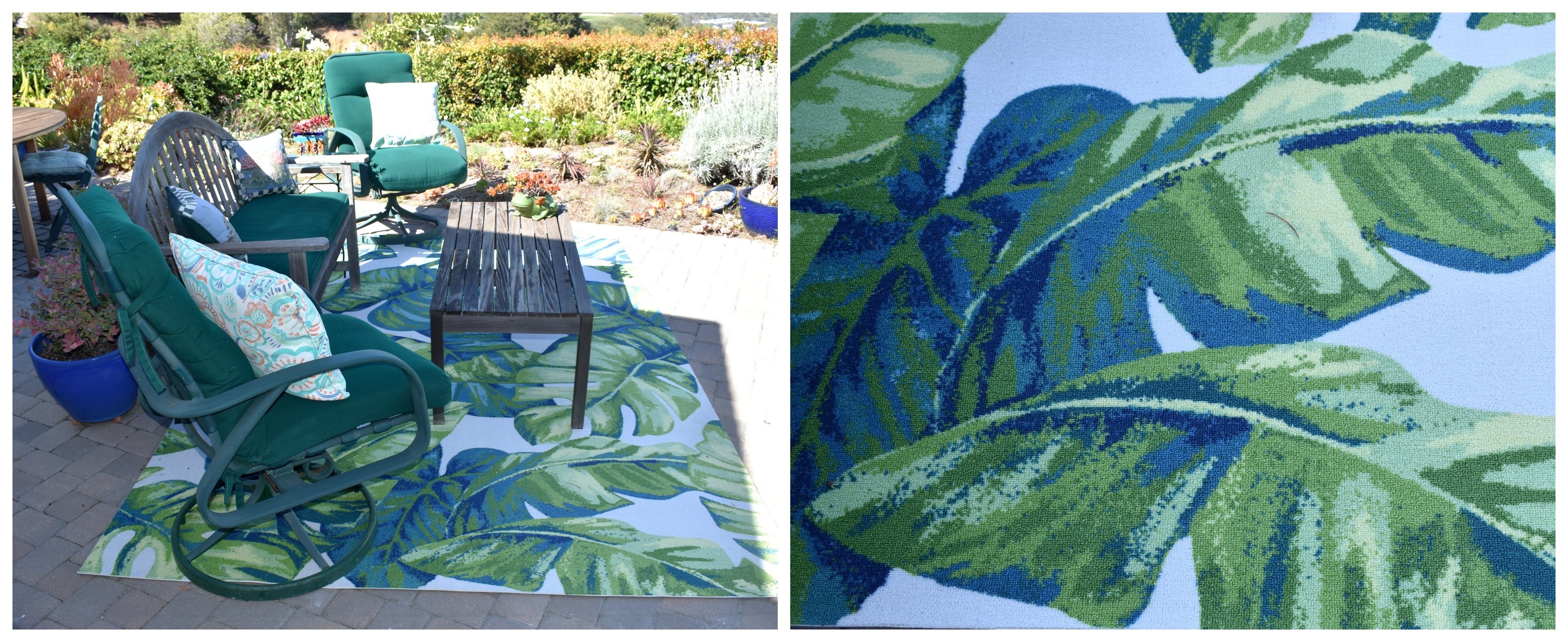
I took the opportunity to clean all the patio furniture and cushions.  I also replaced the old outdoor rug, which had deteriorated badly over the past year.

Photo of the patio taken in late afternoon with the screen fully extended


Our back patio is on the east side of the house so, by late afternoon when this photo was taken, sun exposure isn't much of an issue


Here's a closer look at the new rug:

The rug remains in place all year with just an occasional wash.  The last one held up for 5 years so I expect at least as much from this one.

 I replanted the circle pot on the dining table as it was looking pretty sad.

I used 3 small rosettes of Aeonium arboreum 'Velour' and several cuttings of Aeonium haworthii 'Kiwi'.  They should do for a year or more (provided I remember to water the pot every once in a while).

These pots could use some attention too but I'll get to them eventually


Virtually the only time I sit down in my garden is when we have visitors but I did plunk myself down a couple of times as I was cleaning up the patio.

The marine layer never fully cleared yesterday so the view of the Los Angeles harbor in the distance looks fuzzy

The plants surrounding the patio have gotten denser in recent years so they hide some of the view too.  Odd how that happens!

View looking south when sitting on the bench

I could use some new pillows for the bench but that's probably the extent of any further fluffing for this this year.  How about you?  Have you made any changes to your outside areas to make them more welcoming for you and your visitors?


All material © 2012-2022 by Kris Peterson for Late to the Garden Party