Showing posts with label Grindelia. Show all posts

Wednesday, July 12, 2023

Wild & Weedy Wednesday: Not quite weeds

I'm joining Cathy of Words and Herbs once again this week to share four plants that aren't classified as weeds (at least in California) but behave a bit like them.  I've found the first three of the four somewhat difficult to manage as they self-seed wherever they like and can be difficult to remove when they settle where they're not wanted.

The first one is known by the colorful common name of Hairy Canary Clover.  Despite its common name it's native to Portugal, not the Canary Islands.  It's now classified as Lotus hirsutus but it's appeared in my blog posts on earlier occasions under its former classification, Dorycnium hirsutum.  Its foliage is soft and ever-gray.

As I recall, I originally planted it from a 4-inch pot in one of the driest areas of my garden.  It's since spread widely within that area and, although it prefers to seed itself, I've managed to transfer seedlings into my front garden as well.

As you can see in this closeup, the flowers look very much like clover.  The bees love it too.

One transplant in my front garden overtook its space and grew into the driveway following this year's heavier rain.  It doesn't look so good after being cut back (right) and I'm tempted to pull up the mother plant and let the fallen seeds replant the area.

It produces gobs of seeds

It likes to plant itself in gravel but its takes some effort to get those seedlings out.  The seedlings take their time to get established if they're moved.


It's an attractive groundcover and lovely in and out of flower, although as the photo of the plant adjacent to our driveway shows, it doesn't look great immediately after it's been pruned back hard.


Gaura lindheimeri is another plant that seeds itself wherever it likes but it's not as prolific as the Lotus.  I like its airy look but I wish it was more accommodating about its placement as it's seedlings don't transplant well.

In my garden it looks best early in the season as it's just taking off.  This photo was taken in mid-June.

These plants seeded themselves right in the middle of a path.  I haven't removed them yet but that's in my near-term plans.


I sowed seeds of the third wildflower, Daucus carota 'Dara', and then promptly forgot about it until a large plant appeared.  Before it flowered for the first time back in 2019, I was afraid that poison hemlock, a plant it resembles, had sprung up in my garden.  This one is regarded as a noxious weed in Washington state but not in California.  It's known for planting itself in disturbed places and is said to compete with native grasses and impact agricultural sites.  It's very pretty but it has a deep taproot so it isn't always easy to remove.  It also self-seeds broadly.

The plants shown here have self-sown close to its original position but seedlings have also appeared elsewhere in my back garden

It's a useful cut flower; however, it's best cut before it's fully developed as it drops seed once it's in full bloom


The last plant is native to California and, like the Daucus, it spreads in disturbed areas and is reportedly often found in ditches and along roadsides, although I can't say I'd ever seen it before I purchased an unlabeled plant from my neighborhood garden center on a whim.  I later learned that it's a form of gumweed, Grindelia (probably Grindelia camporum).  It's semi-deciduous in summer.  After it finished blooming last year I cut it down nearly to the ground.  It formed a nice compact clump this year - until it suddenly shot up over three feet in height and flopped all over its neighbors.

Loaded with buds, it produced its first bright yellow daisy flowers last week

It was planted in a spot way too small for its current size and flopped over all its neighbors

It had to go and I made relatively quick work of its removal.  The surrounding plants looked much better afterwards.

I cut a few stems and put them in a small vase.  The only criticism of the plant I have is that every part of it - the flowers, the leaves and the stems - are super-sticky.

The Grindelia didn't belong where I originally placed it when I had no idea what I was dealing with.  It needs a larger, open space where it can spread out.  If I find such a spot elsewhere, I may plant it again as it's said to be attractive to pollinators.


That's this week's weed report.  To find more wildflowers, visit Cathy at Words and Herbs.


All material © 2012-2023 by Kris Peterson for Late to the Garden Party


Monday, June 13, 2022

In a Vase on Monday: Better than expected

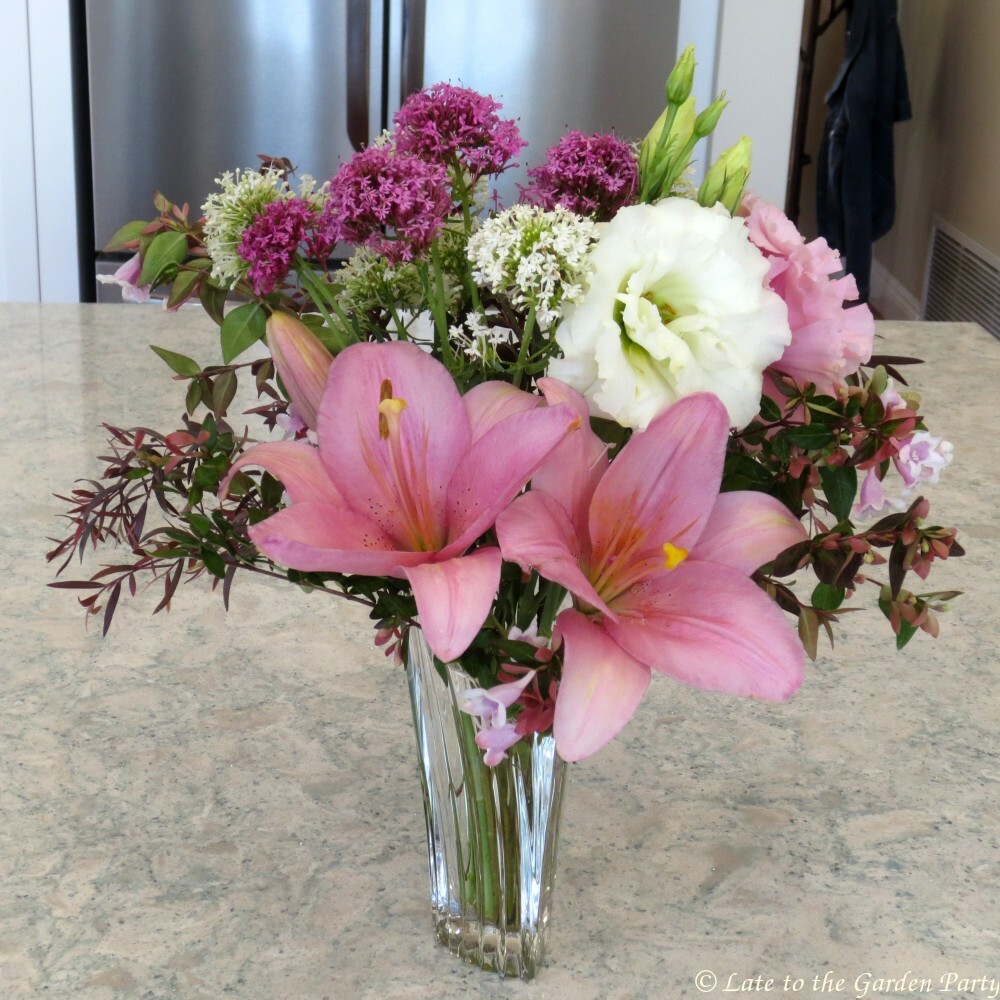
I wasn't feeling particularly inspired by the contents of my garden this week.  I decided to cut two stems of the pink lily in my backyard border, not because it was especially compelling, but because I could tell it wasn't going to hold up another week.  As the plant was also surrounded by a wire cage to protect it from the rabbits who apparently have a huge appetite for lily foliage, it also wasn't doing much for the landscape.

I've had the noID pink lily for at least 5 years.  The bulb was a gift with purchase and it blooms reliably but it's nothing special.  The fluffy blooms of the pink and white Lisianthus (Eustoma grandiflorum) upstaged it in my view. 

Back view: I used pink and white Centrantus ruber as filler material

Top view

Clockwise from the upper left: Abelia grandiflora 'Edward Goucher',  Centranthus ruber, pink and white Eustoma grandiflorum, Leptospermum 'Copper Glow', and noID lily


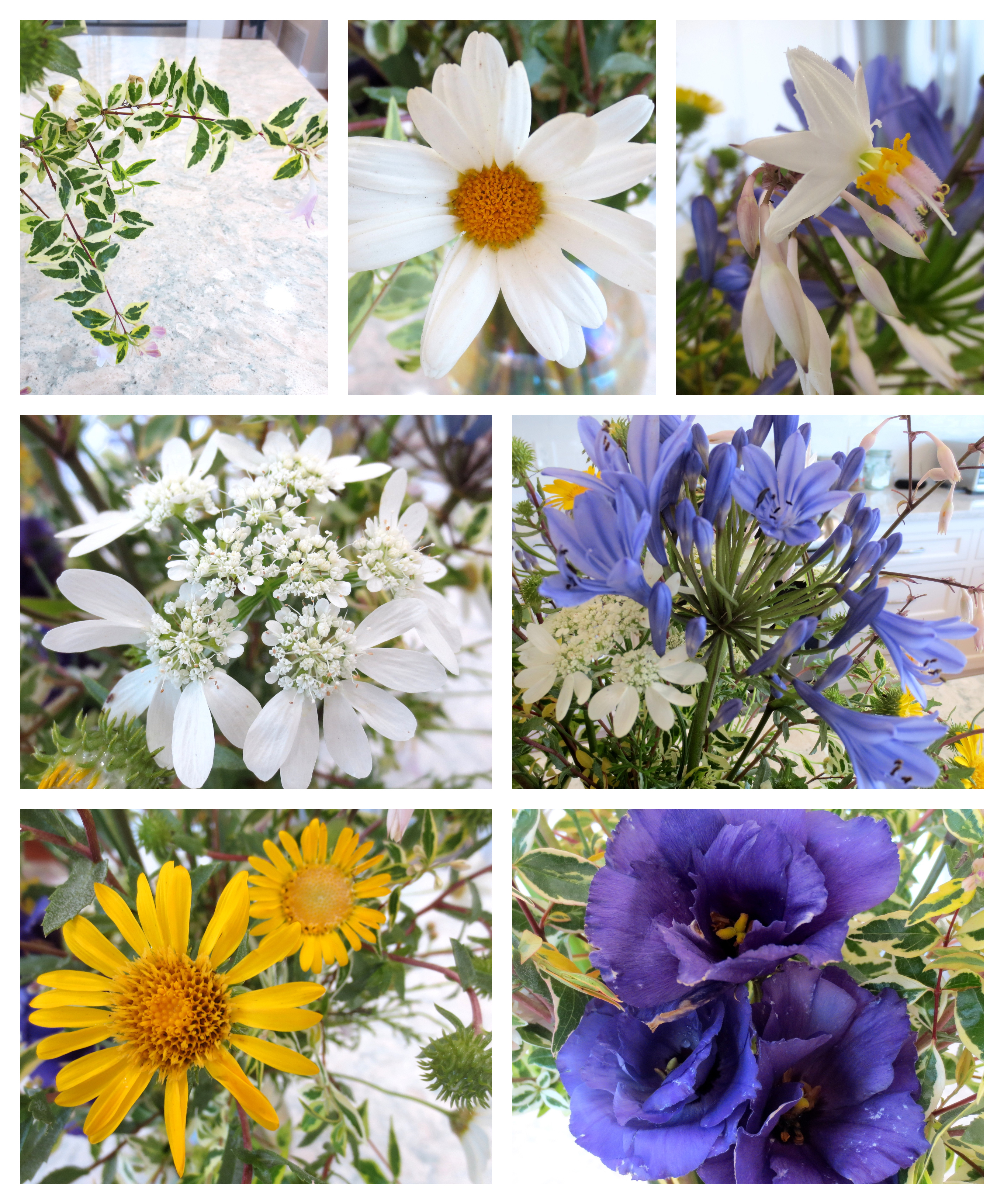
I decided on a blue, white and yellow arrangement to make use of some of my blue Lisianthus, as well as the yellow-flowered gumweed (Grindelia camporum) in the same bed.

I planted the blue Lisianthus earlier this year and, unlike the more well-established pink and white varieties that have been in the garden for over a year, many of the plants are struggling.  In contrast, the native Grindelia is thriving (like the weed its common name suggests it is) but it's also flopping all over its neighbors so I took the opportunity to cut it back until I can move it somewhere more appropriate.

Back view: The Agapanthus are now in full bloom so they're a logical choice in any blue-themed arrangement

Top view

Clockwise from the upper left: Abelia grandiflora 'Hopley's Variegated', Argyranthemum frutescens 'White Butterfly', Arthropodium cirratum, noID Agapanthus, Eustoma grandiflorum, Grindelia camporum, and Orlaya grandiflora


Both arrangements turned out better than I'd expected but, with the drought taking its toll on the plants in  my borders, I'm looking forward to the dahlias in my cutting garden.  One plant is already showing multiple buds...

For more floral creations, visit our IAVOM host, Cathy at Rambling in the Garden.


All material © 2012-2022 by Kris Peterson for Late to the Garden Party


Wednesday, June 8, 2022

Should it stay or should it go? (round 2)

The dwarf Jacaranda 'Bonsai Blue' I raised questions about two weeks ago is still in place but, absent a remarkable change in its appearance it isn't reasonable to expect, it'll probably go as soon as I find the right plant to replace it.  That sorted, as I scrutinized the area surrounding it, questions came to mind concerning two other plants.

After digging out the rampant native aster in the bed adjoining the backyard fountain last fall, I didn't have a full complement of plants in mind to fill the space.  I was open to trying new plants and happened upon one unfamiliar prospect at my local garden center.  It wasn't labeled and no one there was able to identify it for me but, intrigued by the flowers and foliage, I brought three plants home with me.

I planted the three plants in a triangle to play off the foliage color of the 2 Cistus 'Little Miss Sunshine' nearby


Based on its the mystery plants' growth habit, I was a little concerned about them from the start.  I posted a photo of it on Instagram asking if I'd just purchased weeds.  One commentator identified the genus for me as Grindelia but I wasn't able to identify the species until a couple months later when the garden center got new stock of the same plant, this time with labels.  When I confirmed the plant's identity as Grindelia camporum, a native California herb, I removed two of the plants leaving just one in place.  Now, seven months after the one remaining specimen was planted, I still have questions about its placement there.

One source claimed that this plant grows 18-24 inches tall, whereas another said it may grow 2-6 feet tall and 3 feet wide.  Of even greater concern was the floppy habit it demonstrated early on.  It entangles itself in neighboring plants.  I also learned that it's semi-deciduous in summer.

While I planned to use a mix of blue, white and yellow plants in this bed, I also think I've gone overboard with yellow.  I'm feeling the need to eliminate some of the yellow, preferably in favor of adding more blue.


Given it's floppy habit and my concerns with the excess of yellow in this bed, I'm inclined to move it to the back of a bed elsewhere in my garden or even to the back slope.  As summer isn't a great time to move plants, I may hold off on taking this action until fall, although, if I find a suitable replacement for its spot, I might pot it up until conditions are more conducive to planting it out in the garden.

The second plant that brought me up short is a Yucca 'Blue Boy'.  I have five of these plants but the one that concerns me most is the largest one directly adjacent to the back patio.  Its foliage was badly scarred last year by an unidentified pest that left it encrusted with what appears to be dried honeydew.  I treated it but it's still not looking particularly good.

I don't have record of exactly when I planted it but I think this photo taken in March 2019 was early on

This is what the foliage looked like in June 2021.  Two other specimens were affected as well but not as badly.

This is the plant after I treated it for unknown insect pests and cut off the most damaged foliage

This is what it looks like on its east-facing side.  It's a little wonky but doesn't look too bad from this angle.

On the patio side, it doesn't look as good

Closer inspection shows more evidence that the insect pests are back at work

'Blue Boy' is the only one of my Yuccas that has experienced this particular problem.  I don't know if it's related to this cultivar or if it has something to go with its placement in this area.  Three of the other four plants, all located nearly, look fine, although one that I also treated last year shows signs of the same crusty honeydew

These two Yucca gloriosa 'Variegata' have never presented a problem.  The one on the left, tucked into the cavity of a tree stump, never gets watered and, in the past, raccoons have used that cavity as their on-site toilet but it's still held up better than 'Blue Boy'.

In this case, I'm inclined to cut the large Yucca 'Blue Boy' down level with the ground to see if it will regenerate from its base as Yucca 'Bright Star' has done.  I'll try treating the smaller affected Yucca with alcohol, followed by a weekly regime of insecticidal soap to see if that takes care of whatever pests (aphids, mealy bugs, or soft scale) are causing disfiguration of the foliage.

Any other suggestions?


All material © 2012-2022 by Kris Peterson for Late to the Garden Party