Monday, June 16, 2014

Foliage Follow-up - Mastering the Mimosa?

I was initially at a loss for plants to feature in this month's foliage follow-up, sponsored by Pam at Digging.  Then I looked out my home office window and found myself admiring the mimosa tree in our backyard, Albizia julibrissin.  It recently leafed out and, although it will be a 2-3 weeks before it flowers, I think it's at its prettiest right now.  I admit that the tree has been a regular source of frustration for me since we bought our current house three and a half years ago.  Its messiness is something I've complained about many times and I won't repeat myself here but, giving the devil his due, the tree does provide a dramatic backdrop in our backyard.


While the Albizia makes a major statement in the garden, I find myself relying more and more heavily on succulents to add decorative touches.  There are pots of succulents throughout the garden.

A new Aloe striata and an unidentified stacked Crassula in a pot on the main patio

A collection of succulent pots on the southeast side patio

I planted this birdbath with succulents a couple of months ago but I recently swapped out an ailing Aloe in the center for the Agave victoriae-reginae shown here - it and the Oscularia deltoides in front will fill in (eventually)

The struggling Aloe deltoideodonta moved into this pot, which I hope will provide a more hospitable home

This recent acquisition wasn't labeled but I think it may be Aloe variegata

Echeveria pulvinata 'Ruby,' purchased at a succulent show in April, is happy in the partial shade alongside the dry garden


I've also been planting more succulents in the ground in areas in which herbaceous plants and shrubs have failed to thrive.  This started when, as I may have mentioned before, I placed pieces of an unidentified Aeonium given to me by a friend in the hard-packed soil underneath our citrus trees for lack of a better idea as to what to do with them.

I've cut pieces of these plants for other areas of the garden dozens of times without any apparent harm to the source plants


Later, at a loss for plants that could survive in the poor, fast draining soil of the sloped area beneath our Ceanothus hedges, I tucked pieces of Aeoniums in there too.

I'd estimate that these Aeonium, planted from a few single stems, have been in place about a year now, steadily multiplying


After seeing an entire border of Aeonium outside a design studio in Orange County, I think I may fill in the remaining space along the stacked rock wall under that hedge with Aeonium.

New ground for additional Aeoniums

This is the look I aim for (photo taken at a design studio adjacent to Laguna Nursery)


If the drought continues here, as it's expected to do, I expect you'll see even more succulents in future foliage follow-up posts from me.  Please visit Pam at Digging for her foliage highlights and to connect to the contributions of other gardeners.

In a Vase on Monday: Summer Sunshine

I didn't plan to do it.  I can't believe I did it.  But I did.  I cut the first 2 sunflowers to bloom in my garden for the floral bouquet composed in connection with the meme sponsored by Cathy at Rambling in the Garden.  As perspective on my crime, I had recently read about a gardener who routinely cuts back her sunflowers to get shorter, bushier flower stalks later in the season.  I'd wondered if that would be a good idea in my garden, where the tall sunflower stalks have previously blown over or been snapped by the strong winds that blow through here almost daily.  However, I'd planted my sunflowers, Helianthus annuus 'Valentine,' from seed and, given the spotty nature of my success in growing plants from seed, I was especially hesitant to cut them, particularly as they were the only blooms I had thus far.  I don't know what possessed me but here they are, front and center, in today's bouquet.


I accented them with stems of Abelia grandiflora 'Kaleidoscope,' Coleonema pulchellum 'Sunset Gold,' Tanacetum parthenium 'Aureum' and sprigs of an unidentified lavender.

A slightly blurry close-up showing the beautiful variegated foliage of Abelia 'Kaleidoscope' and the feathery foliage of the Coleonema (aka Breath of Heaven)

Bouquet photographed from the back


Even my cat, Pipig, seemed surprised.


Do I sense judgment in her eyes?


Please visit Cathy at Rambling in the Garden to see her bouquet.  You'll also find links to other gardeners' creations.  I'm sure there are other surprises to discover.

Sunday, June 15, 2014

Bloom Day - June 2014

It's Garden Blogger's Bloom Day.  Hosted by Carol of May Dreams Gardens, it's a time to take stake of what's blooming in one own's garden and an opportunity to have a look at what's flowering in gardens across the US and in other parts of the world.

My May garden was dominated by Agapanthus and, although some blooms are now looking a bit bedraggled, the flowers still dominate my garden in mid-June.

Agapanthus in the backyard border

Agapanthus in the front yard


Most of the daylilies finished blooming last month but a few are still putting on a show, most notably Hemerocallis 'Indian Giver,' which is new to me this year.

This clump of Hemerocallis 'Indian Giver' has pumped out an impressive number of bright purple blooms this month

In contrast, this clump of H. 'Indian Giver,' obtained from the same grower at the same time and planted only several feet away from the clump featured above, hardly looks like the same plant

Hemerocallis 'Persian Market' got a late start but is still putting on a nice show

And Hemerocallis 'Spanish Harlem' is still producing blooms in the front yard border (against a backdrop of mostly dead grass) 


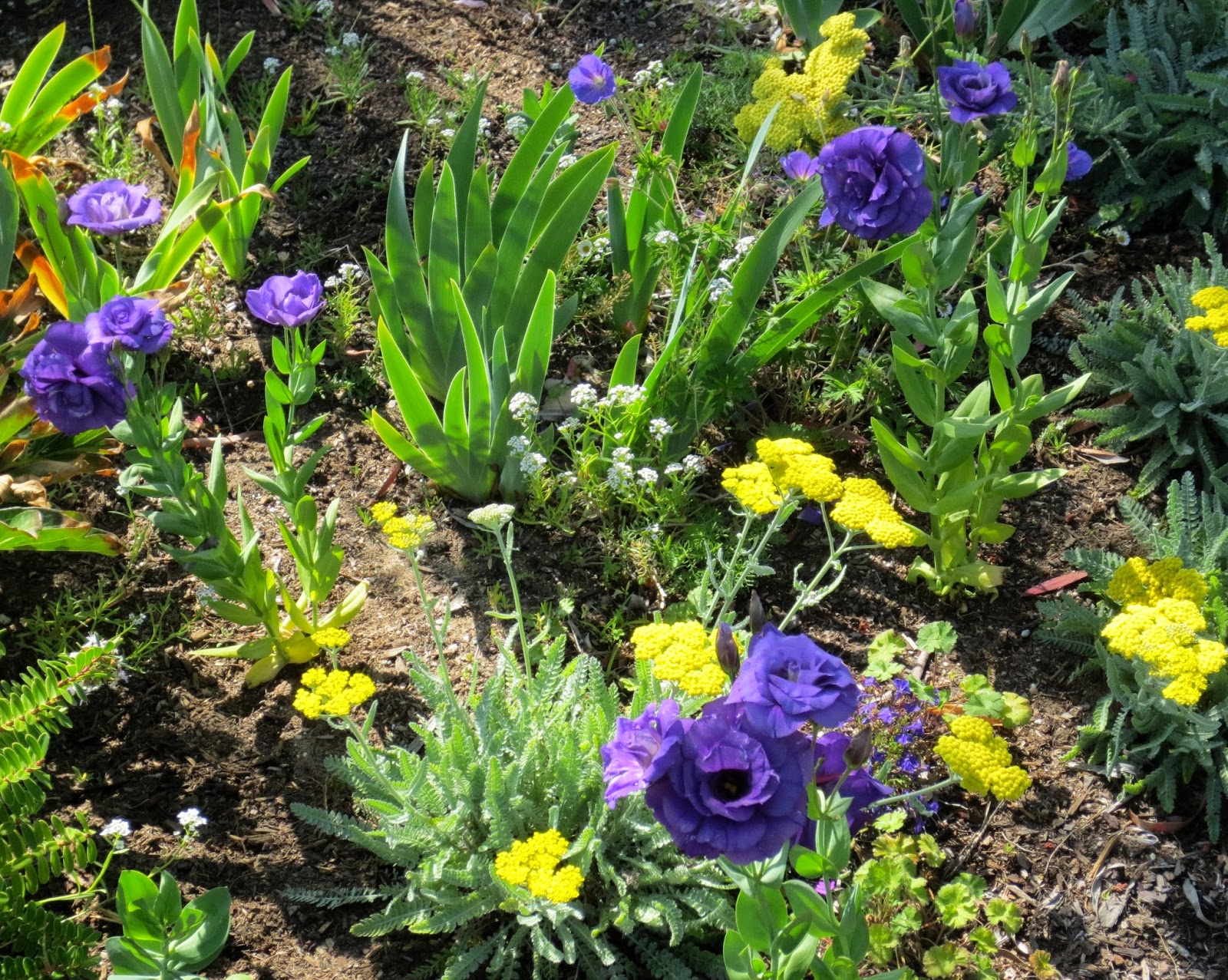
Lisianthus (Eustoma grandiflorum), a short-lived perennial generally grown as an annual here, has added a bolt of purplish blue to my backyard border.

Eustoma grandiflorum 'Borealis Blue' stands out next to Achillea 'Moonshine'


Borage (Borago officinalis), another annual, is filling in some of the empty spaces in the border we added early this spring as an extension to the bed surrounding our backyard fountain.

Borage, planted among Salvia 'Mystic Spires, lobelia, and red-orange daylilies


The first of the Echinacea have returned.

Echinacea 'PowWow White' alongside Erysimum linifolium 'Variegatum'


Shrubs making a splash in the backyard include:

Hebe 'Wiri Blush'

Lupinus chasmissonis

Leonotis leonurus


While none of the common foxglove (Digitalis purpurea) I planted last fall have done well this year, the perennial Digitalis x mertonensis and the hybrid Digiplexis 'Illumination Flame' have fared better.

My Digitalis purpurea, if they bloomed at all, produced only short, stumpy bloom spikes like this one

Digitalis x mertonensis 'Polka Dot Pippa' was attacked by aphids but seems relatively unfazed and isn't the color pretty next to Yucca 'Bright Star'?

Only a few weeks after I cut the central bloom spike of this Digiplexis 'Illumination Flame', the plant has produced almost a dozen new bloom spikes


On the southeast side of the house, an area seemed to suffer most from our May heatwaves, Verbena bonariensis and Ageratum houstonianum 'Blue Horizon' have added a welcome touch of color.


On the outskirts of this section of the garden, two plants less known for their flowers than their foliage are providing an unexpected floral display.

I usually cut the flowers off this Helichrysum petiolare 'White Licorice' in the belief that they detract from the foliage but I let them do their thing this year

Crassula radicans 'Small Red' has produced a mass of flowers this year (despite very little water)


On the largely unattended back slope, crossvine (Bignonia capreolata) and Yucca elephantipes are demonstrating their ability to take care of themselves.

I inherited this Bignonia, a plant I'd intended to avoid after it swallowed a fence at our former house

Yucca Elephantipes continues to produce one giant bloom after another despite my husband's battle to cut the plant back to a more manageable size


And last, but not least, a Phalaenopsis sitting in a pot in an area along the street I largely ignore, is proving that orchids don't deserve their reputation as difficult or demanding plants.

I water this unidentified Phalaenopis when I happen to pass by it, which isn't often - nevertheless, it somehow it made it through 2 horrible heatwaves outside in partial shade


That's it for my June bloom highlights.  Please visit Carol at May Dreams Gardens to discover what's blooming in her garden and to find links to posts from gardeners far and wide.


Thursday, June 12, 2014

My favorite plant this week: Lupinus chamissonis

My favorite plant this week, Lupinus chamissonis, also known as bush lupine and silver dune lupine, is the one that was in contention with last week's choice.  It's also a beautiful plant but its charms are more subtle than those of the brilliant blue Lisianthus.  I originally bought this plant in April 2013, only to have it shredded by a rampaging raccoon shortly after it went into the ground.  I acquired another in March of this year and placed it in my new backyard border.  So far, it hasn't been bothered by any raccoons and it has grown quickly, more than doubling in size since I planted it.


It's native to coastal California, although I can't say I've seen it in garden settings here.  Its evergreen silvery palmate foliage is attractive in its own right but, from April through June, it produces the lavender blue flowers characteristic of lupines.


It tolerates some drought but requires exceptionally good drainage.  It needs full sun and is said to be cold hardy to 20F (-6.7C).  Its seeds, leaves and stems are mildly toxic.  Projections of its size vary significantly but most commentators project growth to 3-5 feet (1-1.5 meters) tall with approximately the same width.  I hope mine remains on the smaller end of the spectrum and doesn't overgrow its current placement.  It's useful in blending blue, lavender, purple and white plants in a border.


As I love lupine, I'm happy to have this evergreen form in my garden.  It's my contribution to the weekly meme hosted by Loree of danger garden.  Please visit her to find her choice this week.  If you have a favorite plant you'd like to highlight, write a post about it and provide a link in the comments section of Loree's post.

Tuesday, June 10, 2014

Transformation

Last week my husband finished the patio table he's been working on and we put it in place in the backyard.


The table top was constructed of wood salvaged from the firewood-heated "snorkel spa" we inherited with the house.


I've previously written about the snorkel spa (here).  We used it as a spa a few times but it was more trouble than it was worth.  It took about 2 hours to heat up the water and, if too long passed between uses, it had to be drained and refilled, which was hard to justify during a drought, even when we used the discarded water in the garden.  I used it for awhile to store patio furnishings.  We disassembled it in January (as described here).

Re-using the wood to construct a patio table involved more work than my husband (or I) had anticipated.  Some of the wood had warped and some panels weren't in pristine condition.  He ended up re-planing the wood before putting the table together.  Sanding and finishing it using a marine grade varnish was also time-consuming.

Delivery of the finished table required rearrangement of the backyard patio.  I expect we'll juggle things some more but here's what it looks like now.


The chiminea was relocated to create space to move around the table.  It's now on the other end of the patio with a collection of pots, most of which I had before.


I stuck a plant in the top of the chiminea, which we've never used to burn wood.  It's an ailing Cordyline 'Renegade' that formerly occupied one of the pots by the front door, which I recently changed out.  It was small enough to fit the space but I think I'll eventually replace it with a trailing plant, maybe Lotus berthelotii (aka parrot's beak) or Russelia equisetiformis (aka firecracker plant).


The pot formerly in that space moved to the spot previously occupied by the chiminea.


I also spruced up the seating area on the north side of the house facing the dry garden.  I'd like to replace the disintegrating wicker chairs there but, for now, I made do with cleaning them and replacing the seat cushions.  I also refreshed a couple of my succulent pots.


So now I'm ready for whatever summer throws my way.  After the heat we had last month, we're currently experiencing the "June gloom" that usually shrouds the coastal areas of Southern California in clouds and fog for half the day.  It's actually a welcome change - we'll take our moisture in whatever form it comes.


What are you doing to prepare for the summer season?

Monday, June 9, 2014

In a Vase on Monday: Moody Blues

Unlike Cathy at Rambling in the Garden, the gracious host of the weekly meme entitled "In a Vase on Monday," my floral compositions don't usually bring music to mind.  However, when searching for a descriptive title for today's bouquet, "Moody Blues" popped into my head.  I can't say that I've thought of that British rock band in many, many years but they were among my favorites when I was a kid.  Despite that fact, my choice of the title relates to the colors of my floral and foliage materials rather than any song written by the band.


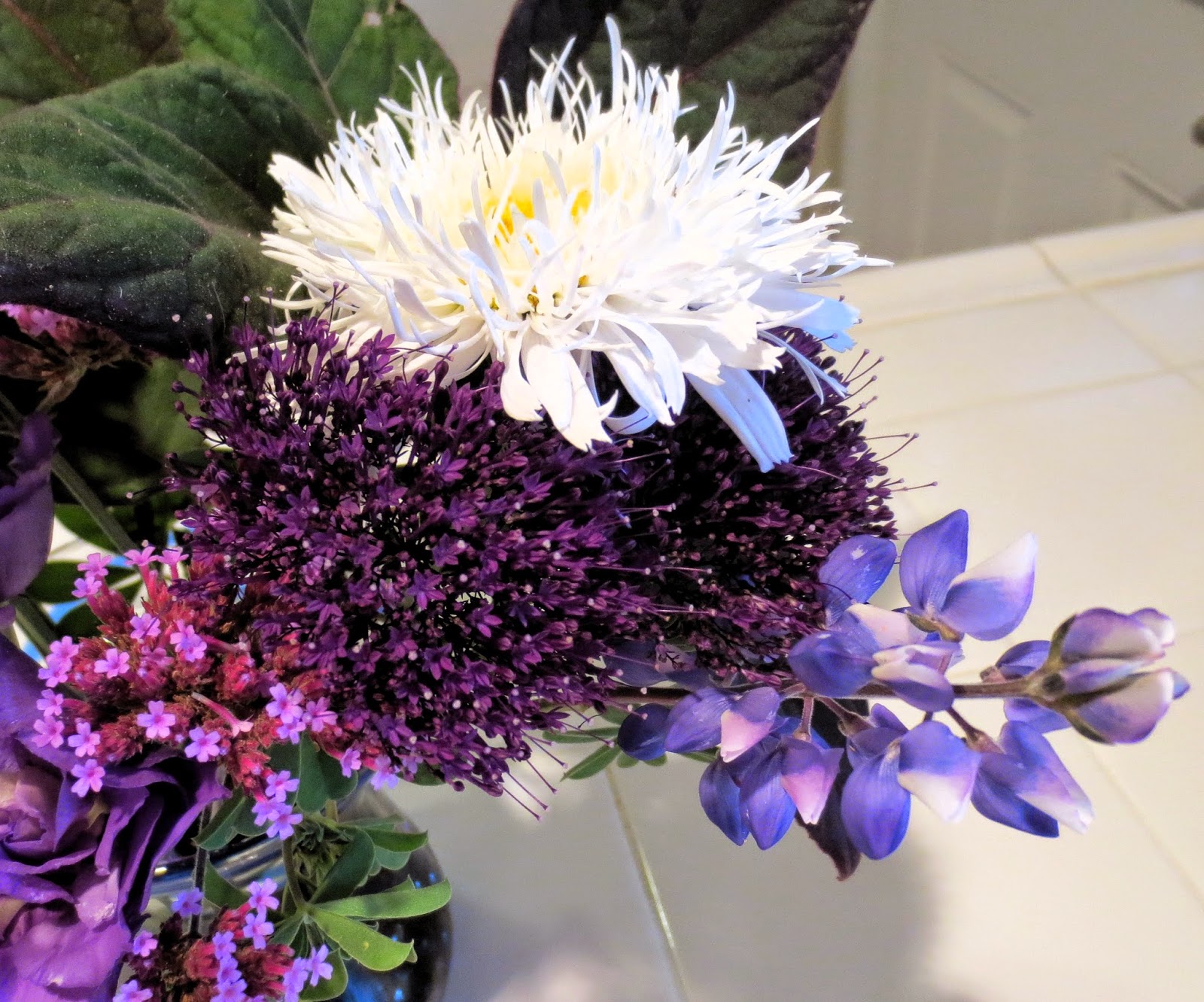
I picked a stem of the beautiful Eustoma grandiflorum 'Borealis Blue' (aka Lisianthus) I featured as my favorite plant of the week last Thursday.  One stem, consisting of 3 flowers, was all I could bear to cut.  While it looks quite blue in the garden, it reads more purple than blue inside the house in a vase but some of the petals show a blue tinge.  There's also a tiny touch of white in the central blossom.


I cut 3 stems of a wild lupine to accent the Eustoma.  I have a bush lupine growing in my garden but this is the first year a wild lupine has made an appearance.  I think the seed must have hitchhiked here in a load of topsoil I ordered when we built our newest border in the backyard.  Although it doesn't match the color scheme I was going for in that particular area, I'm going to let it be in the hope that it will establish itself in my garden.


I also added a few stems of a frilly form of Leucanthemum x superbum (aka Shasta daisy), Trachelium caeruleum (possibly 'Hamer Pandora'), which is just now coming into bloom here, and Verbena bonariensis.  The Verbena doesn't appear to make a particularly good cut flower as it continuously drops tiny petals but the amethyst color picks up the pinkish purple tones in the lupine so it remains in the vase for now.  The foliage accent is a stem of the "ever-purple" Ageratum corymbosum I've used before - it definitely adds a moody touch to the arrangement.


Please visit Cathy at Rambling in the Garden to see her composition this week and to find links to the creations of other contributors.  To give the Moody Blues their due, here's a link to one of their compositions, titled "Blue World."


Thursday, June 5, 2014

My favorite plant this week: Eustoma grandiflorum

I've got the blues coming on - the blue-flowered plants in my garden, that is.  Agapanthus dominate my borders at the moment but some of the smaller specimens of blue-flowering plants are also commanding attention.  I was torn between two prospects this morning, unable to decide which to feature in today's post in connection with the favorite plants meme hosted by Loree of danger garden.  I took photos of both and decided to make a decision based on which of the two took better pictures.  Hey, I live in the shadow of Hollywood - that's how decisions are made here!

The winner is Eustoma grandiflorum, commonly called Lisianthus, specifically a variety called 'Borealis Blue.'  I usually end up planting one or more colors of Lisianthus somewhere in my garden each year.  I find myself unable to pass them by when they arrive in the nurseries.  I bought the first of mine this year in late April, just before our first heatwave.  Three of the 6 I bought perished in their pots before I could get them planted but those I got in the ground are flourishing.

Eustoma grandiflorum 'Borealis Blue' in the backyard border alongside Achillea 'Moonshine'


I found the plants in the 'Borealis' series, which grow 18-24 inches (46-61 cm) tall, in 4-inch pots but I've since found another double-flowered variety, 'Mariachi Blue,' in 6-packs so I've recently added more to my backyard border.  The smooth, gray-green, slightly succulent foliage is nice but it's the flowers that make this plant.  The largest flowers of the 'Borealis Blue' are 3 inches (7.6 cm) wide.  The stems  bear 3-5 flowers.  These flowers come closest to what I imagine a blue rose would look like if such a thing actually existed.


Eustoma grandiflorum is native to the warm regions of the southern US, as well as Mexico, the Carribean and the northern regions of South America.  It's suited to USDA zones 8-10.

Lisianthus come in a variety to colors in addition to blue, including pink, purple, white and, occasionally, pale yellow, carmine and bi-colors.  Last year, I put in some in a pale pink variety.  Although I pulled most of these last winter, I left one in the back border, where it's also in bloom now.

Eustoma grandiflorum 'Echo Pink'


I'm thinking of looking for some white or yellow Lisianthus for my weather-worn front borders; however, the double-flowered blue varieties remain my favorites.


Eustoma grandiflorum 'Borealis Blue' is my favorite plant this week.  Please visit Loree at danger garden to see her favorite.  You'll also find links to other gardeners' selections.