Showing posts with label lawn. Show all posts

Tuesday, September 8, 2015

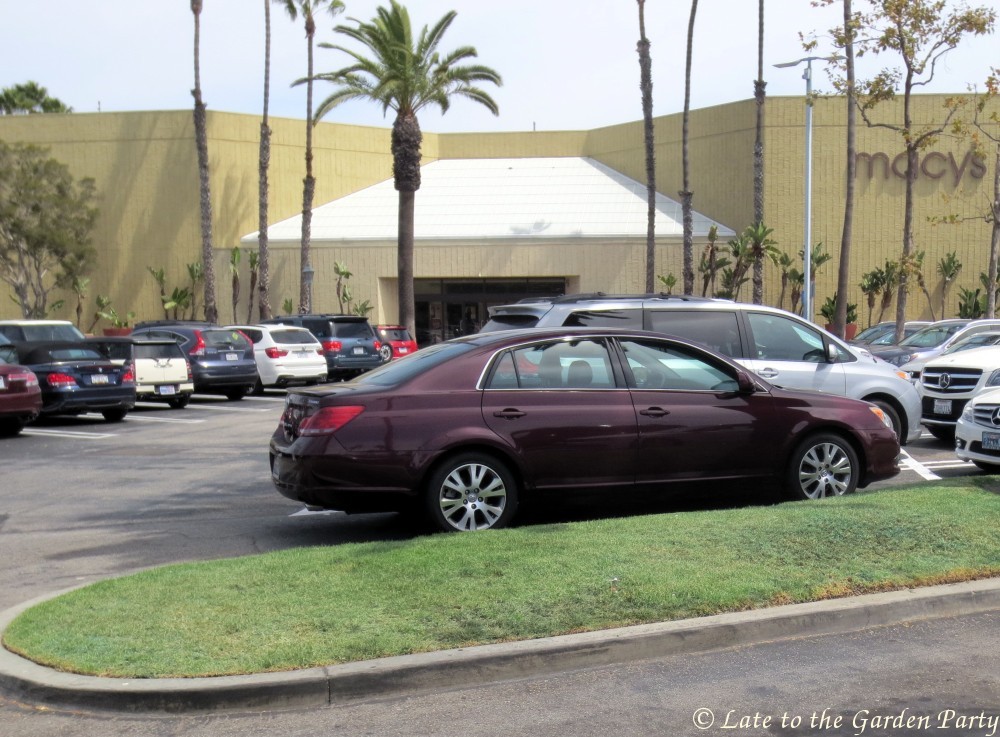
Are painted lawns a sensible response to the drought?

California has been in a serious drought for 4 years but the public response changed dramatically in 2015 when the governor declared mandatory water restrictions.  Water districts were ordered to reduce water use by 4% to 36%, depending upon their history of prior use, with the goal of reaching a 25% reduction in urban water use by 2016.  The battles and finger-pointing that accompanied the announcement have moved into the background and Californians have made surprising progress in meeting the new requirements.  As of July, California as a whole had exceeded the goal, achieving a 31.3% reduction.  People are taking shorter showers, gardeners are changing out their plants for less thirsty specimens, and many lawns are going brown.  Local garden centers are advertising artificial lawns but I've seen relatively few installations in my own area to date.  However, I recently saw a brown lawn go green overnight with the help of a coat of paint.

Painted parking median at a local mall


When I first noticed the painted lawn at a nearby beach city mall, I didn't think it looked too bad, at least from a distance as I stared out the window of the restaurant where I was having lunch.  A couple of weeks later, when I was back at the mall, I brought a camera and took a closer look.  Again, if you're passing by quickly, it doesn't look too bad.


But a close inspection reveals its drawbacks.


It hasn't stood up well to foot traffic.  The color seems bluer than it was when the paint was first applied but, with sun exposure, perhaps that's to be expected.  When the rain returns, the grass will presumably return to green on its own, assuming the paint doesn't cause permanent damage, but as our rainy season is short it will as quickly revert to brown.  What do you think?  Is lawn paint a reasonable option for public spaces?  And does it make sense for use by homeowners?  

I'm linking to the garden bloggers' Q&A hosted by Ricki at sprig to twig.


All material © 2012-2015 by Kris Peterson for Late to the Garden Party

Friday, August 21, 2015

The State of the Lawn (in my neighborhood)

I took a walk recently to check the status of the lawns in my neighborhood.  Since June, my area has been required to reduce residential water use by 36% in response to California's severe drought.  As they require a lot of water to maintain, especially during our hot, dry summers, lawns are the major target when it comes to meeting that goal.  I began eliminating my own lawn in increments shortly after my husband and I bought our house in December 2010 but I have 2 segments of the lawn left, both slated for removal this fall.

The remaining lawn segment in the front garden, just behind the hedge on one side of our driveway, currently dormant (and ugly)

The swath of half-dead lawn that, for the time being, serves as a pathway through the backyard garden


Walking through the neighborhood, I found some lawns still in relatively pristine condition.

Inexplicably, this includes a small patch of lawn at the entrance to the neighborhood

This homeowner and his next door neighbor had the most pristine lawns in the entire neighborhood - I initially thought they might be synthetic grass

This garden is mostly lawn
This neighbor loves his lawn but I know he's watching his water usage closely


Other homeowners, like us, have allowed their lawns to die back.


Some homeowners are maintaining small lawns, while using more drought-tolerant plants elsewhere in their front yards.

This homeowner has small sections of lawn in between wide planting beds filled with drought-tolerant plants

This homeowner has been replacing thirsty plants with succulents, while allowing the lawn to turn brown


Some homes have been lawn-free (or virtually so) since we've lived in the neighborhood.

I guess lawn could be lurking behind the shrubbery that hides this house but the shady conditions make it unlikely

This huge property spills down into a canyon but most everything at street level behind the gate appears to be concrete 

This neighbor replaced a mass of Vinca along the street with more drought-tolerant Dymondia

This terraced garden, still my favorite in the neighborhood, recently changed hands but they retained the former owner's gardener, which I see as a sign of commitment to maintaining the garden.  That's a Leucospermum on the right - the largest one I've ever seen.

This home has lots of palms and plants with a tropical feel

Many of the homes in our neighborhood, like this one, are "flag lots" with only a driveway fronting the street


One home is lawn-free because it's been gutted to make room for a larger house.


And one has a front yard full of dirt because the septic system is undergoing replacement (which is taking a long time).


There are more than 50 homes in the circle that makes up my neighborhood so what I've shown here is only a sample of what's out there but I think it's fairly representative.  I've seen only some of the backyards associated with these homes but enough to conclude that they're a mix too.  It'll be interesting to see whether lawns continue to die off and disappear, or if the expected arrival of El Nino this fall will hold the trend at bay.

I'll leave you with a few of the brighter spots from my neighborhood walk.

There are masses of Agave attenuata throughout the neighborhood - these are 2 of the best ones

I find it comforting that this plant, a form of Borage I believe, is growing wild through cement pavement without any supplemental water whatsoever in this empty lot

Clockwise from top left, plants growing with little or no supplemental water: Lagerstroemia (no ID but mildew-free), Agave (americana?), Bougainvillea, Cassia didymobotrya, Plumbago, and Solanum ratonnetii


All material © 2012-2015 by Kris Peterson for Late to the Garden Party

Friday, May 16, 2014

Foliage Follow-up - May 2014 Heatwave Edition

As I've mentioned (ad nauseum), we're in the middle of yet another spring heatwave.  The heat reached a ridiculous level for awhile yesterday - not that any temperature above 80F (27C) in May isn't ridiculous.

Nearly 105F (40.5C) outside at 2pm


The effects on the flowering plants have been obvious but the weather has impacted my foliage plants as well.  There are clear winners, plants that continue to thrive under heat and drought conditions, and losers, plants that are struggling, so I thought I'd use this month's Foliage Follow-up, the meme sponsored by Pam at Digging, to highlight some of each.

In the popular plants category, Yucca 'Bright Star' is doing so well that I kept myself awake recently wondering where I could put more.  My 3, planted in January in the backyard border, are still small but they get prettier with each passing month.


In contrast, Acacia cognata 'Cousin Itt,' another popular newcomer reputed to be drought tolerant, has had more difficulty adapting to the abrupt increases in temperature.  Prior to the first heatwave, I'd have said the Acacia in the large pot near to the house was the best-looking of its brethren; however, despite receiving only morning sun and regular watering, it lost a lot of its leaves and now has a visibly thinner appearance.  To be fair, the 4 plants in the ground experienced less leaf loss than the one in the pot even though they get more sun and less attention.

Acacia cognata 'Cousin Itt' has receding foliage

Leaf debris dropped by 'Cousin Itt'


In the Japanese maple category, 'Sango Kaku,' growing in a partial shade location next to the garage, and 'Mikawa Yatsubusa,' which gets mid-afternoon shade in the backyard, are both looking good despite exposure to heat and wind.

Acer palmatum 'Sango Kaku' hasn't shown any ill effects to the heat thus far

Acer palmatum 'Mikawa Yatsubusa' has only the slightest leaf tip burn


This is not the case with Acer palmatum 'Purple Ghost' despite extra water the other 2 didn't receive.  'Purple Ghost' stands on the southeast side of the house and, although it gets some shade from nearby trees, it probably gets more sun overall that the other 2.  The wind that whips through that area as it moves around the house  may be an even more significant issue.  And, of course, the visits by raccoons and a gopher can't help things.  I'm afraid that 'Purple Ghost' may have to be moved in the fall (if it lives that long).

My sad 'Purple Ghost'


All my Phormium are doing well.  They don't appear to notice the heat at all.

Phormium 'Amazing Red'


That's not true of Cordyline 'Renegade,' despite similarities in appearance and place of origin.  Perhaps, as in the case of the Acacia cognata described above, part of the problem is that my Cordyline are in pots.

'Renegade's' growth is stunted and the foliage has lost some of its intense color while the Pelargonium planted with it enjoys its sunny setting


In the decorative shrub category, Agonis flexuosa 'Nana' is performing very well in full sun conditions in the windy southeast side yard.


Justicia brandegeeana,' on the other hand, doesn't seem happy.  Although it seemed fine before the temperatures soared this week, it clearly needs more shade under current conditions.  I'll have to find another spot for it.

This Justicia brandegeeana is frying - the other one, in partial afternoon shade, is faring better


Some groundcovers are doing better than others as well.  The St. Johnswort is slow growing but seemingly impervious to heat.  The red hook sedge gets a touch of shade during the first half of the day but takes the sun's full blast from mid-day with no ill effects thus far.  But my experiment in stretching my zone to include Nepeta 'Pink Cat' was short-lived.

Hypericum x moserianum 'Tricolor'

Uncinia uncinata 'Rubra' in the midst of our 2nd heatwave

Nepeta 'Pink Cat' was dead after the 1st heatwave


The ugliest parts of my garden right now are the remaining areas of lawn, most of which are quickly turning straw yellow even though I've delivered far more water during the current heatwave than I did during the first one.  I've been reading about drought tolerant grasses, grass substitutes, and even fake grass.  Although we've eliminated various sections of grass since we moved in 3 years ago and I'd already slated other sections to go, I hadn't originally planned to take it all out but it may come to that.  Looking at this, in mid-May, is depressing:

This patch of lawn in the backyard was mostly green just a week ago


This, in contrast, is not depressing.

Lomandra 'Breeze'

Stipa tenuissima


If current conditions represent the "new normal," then I need plants that are better at adapting to sudden temperature fluctuations, more intense heat, and less water.  At present, my plants aren't the only ones having trouble adapting.  Heat and low humidity (plus dying plants) has made me cranky.  In contrast, at least one of my household companions takes the heat in stride.

Pipig has no problem with the heat despite being covered by fur


Please visit Pam at Digging to read her Foliage Follow-up post and to find links to other gardeners' flaunting their foliage.