Showing posts with label Cordyline 'Renegade'. Show all posts

Friday, November 17, 2017

Foliage Follow-up - New Plants!

I recently posted photos of a dramatic change to the southwest corner of my garden resulting from a neighbor's removal of several large oleanders suffering from leaf scorch.  As plans were afoot this week to install replacement shrubs, I'd planned to provide photos of the newly installed Pittosporum hedge for this week's Foliage Follow-up, the feature hosted by Pam at Digging each month following Garden Bloggers' Bloom Day.  But, as the schedule for the planned installation stretched out, I began looking for a new topic.  I've been on a few fall planting sprees of late so I focused on some of my new foliage purchases.

On a trip to Seaside Gardens last weekend, I picked up 3 Cordyline 'Renegade', which I planted this week.  Their burgundy color nicely mirrors the color of Leucadendron 'Ebony' in the background (currently in danger of being swallowed up by Leucadendon salignum 'Chief').  The grasses in front of the Cordylines, Melinus nerviglumis, are also relatively new introductions.

I also picked up Leucadendron 'Little Bit' at Seaside, shown here planted in front of Echium candicans 'Star of Madeira''Little Bit' should eventually grow to 3 feet tall and wide, relatively small for a Leucadendron but a nice accent to the larger Echium.

In last month's Foliage Follow-up, I focused on the Acacia cognata 'Cousin Itt' that threatened to encompass everything in its path.  Commentators were nearly universal in supporting removal of the succulents that stood in the path of these shrubs and I recently moved the succulents.  However, as I can't abide an expanse of bare soil (and didn't want to give the local raccoons an invitation to dig), I planted Lotus berthelotii, a low-growing ground cover, to bridge the gap between the Acacia and the creeping thyme.  The new plants are shown in the photo on the left.  The photo on the right shows an expanse of established Lotus on the other side of the path.  The Lotus (aka Parrot's Beak) develops red flowers but shouldn't fight with 'Cousin Itt' the way the taller succulents did.

The area in the foreground here was a sloppy mess of overgrown thyme and raggedy Carex testacea.  I moved a Stipa arundinacea 'Sirocco' that had been growing in the front garden (the orange grass shown above) and picked up 2 more of these plants to fill in the area in front of Leucospermum 'Goldie'.  The new plants should take on the same orange color as the transplant in time.


Near dusk yesterday afternoon, the neighbor's garden crew finally finished work on the installation of the new hedge of Pittosporum tenuifolium 'Silver Sheen'.  The light wasn't great for photos but I'm going to include these anyway.

The first photo on the left shows the property line between us and our neighbor to the south before the mass of oleanders on the neighbor's side was removed.  The middle photo shows the area as it looked immediately after the oleanders were removed, exposing the neighbor's driveway to our view.  The third photo is a blurry shot of the new Pittosporum hedge just beyond our property line.

This is a closer view.  There are a total of 7 Pittosporum 'Silver Sheen' here.  The neighbor also laid new irrigation, jute to hold the slope as the plants become established, and plugs of ice plant to serve as a ground cover.  We're sharing in the cost of both the oleanders' removal and the new installation so I appreciate all the work that went into getting the new hedge off to a good start.


Our side of the property line is also a mess as work has finally begun on the lath (shade) house planned for the southwest corner.  While I've been slowly clearing out the pots and detritus that had accumulated in the area during the 7 years we've lived here, my husband has the hardest job: building the structure.  Thus far, only the footings are in place but that's progress!

The lath house will be a 5-sided structure.  The space between the 2 footings in the foreground on the left will hold a door.  The 2 walls on either side of the door will have windows (and window boxes).  All the walls and the roof with be constructed of lath to allow air and light into the structure.  I expect I'll fill in with plants around the structure but I probably won't figure that piece out until the structure is complete.  My husband tells me that the pitched lath roof is likely to be the trickiest part of the project. 


For more Foliage follow-up posts, visit Pam at Digging.


All material © 2012-2017 by Kris Peterson for Late to the Garden Party

Friday, May 16, 2014

Foliage Follow-up - May 2014 Heatwave Edition

As I've mentioned (ad nauseum), we're in the middle of yet another spring heatwave.  The heat reached a ridiculous level for awhile yesterday - not that any temperature above 80F (27C) in May isn't ridiculous.

Nearly 105F (40.5C) outside at 2pm


The effects on the flowering plants have been obvious but the weather has impacted my foliage plants as well.  There are clear winners, plants that continue to thrive under heat and drought conditions, and losers, plants that are struggling, so I thought I'd use this month's Foliage Follow-up, the meme sponsored by Pam at Digging, to highlight some of each.

In the popular plants category, Yucca 'Bright Star' is doing so well that I kept myself awake recently wondering where I could put more.  My 3, planted in January in the backyard border, are still small but they get prettier with each passing month.


In contrast, Acacia cognata 'Cousin Itt,' another popular newcomer reputed to be drought tolerant, has had more difficulty adapting to the abrupt increases in temperature.  Prior to the first heatwave, I'd have said the Acacia in the large pot near to the house was the best-looking of its brethren; however, despite receiving only morning sun and regular watering, it lost a lot of its leaves and now has a visibly thinner appearance.  To be fair, the 4 plants in the ground experienced less leaf loss than the one in the pot even though they get more sun and less attention.

Acacia cognata 'Cousin Itt' has receding foliage

Leaf debris dropped by 'Cousin Itt'


In the Japanese maple category, 'Sango Kaku,' growing in a partial shade location next to the garage, and 'Mikawa Yatsubusa,' which gets mid-afternoon shade in the backyard, are both looking good despite exposure to heat and wind.

Acer palmatum 'Sango Kaku' hasn't shown any ill effects to the heat thus far

Acer palmatum 'Mikawa Yatsubusa' has only the slightest leaf tip burn


This is not the case with Acer palmatum 'Purple Ghost' despite extra water the other 2 didn't receive.  'Purple Ghost' stands on the southeast side of the house and, although it gets some shade from nearby trees, it probably gets more sun overall that the other 2.  The wind that whips through that area as it moves around the house  may be an even more significant issue.  And, of course, the visits by raccoons and a gopher can't help things.  I'm afraid that 'Purple Ghost' may have to be moved in the fall (if it lives that long).

My sad 'Purple Ghost'


All my Phormium are doing well.  They don't appear to notice the heat at all.

Phormium 'Amazing Red'


That's not true of Cordyline 'Renegade,' despite similarities in appearance and place of origin.  Perhaps, as in the case of the Acacia cognata described above, part of the problem is that my Cordyline are in pots.

'Renegade's' growth is stunted and the foliage has lost some of its intense color while the Pelargonium planted with it enjoys its sunny setting


In the decorative shrub category, Agonis flexuosa 'Nana' is performing very well in full sun conditions in the windy southeast side yard.


Justicia brandegeeana,' on the other hand, doesn't seem happy.  Although it seemed fine before the temperatures soared this week, it clearly needs more shade under current conditions.  I'll have to find another spot for it.

This Justicia brandegeeana is frying - the other one, in partial afternoon shade, is faring better


Some groundcovers are doing better than others as well.  The St. Johnswort is slow growing but seemingly impervious to heat.  The red hook sedge gets a touch of shade during the first half of the day but takes the sun's full blast from mid-day with no ill effects thus far.  But my experiment in stretching my zone to include Nepeta 'Pink Cat' was short-lived.

Hypericum x moserianum 'Tricolor'

Uncinia uncinata 'Rubra' in the midst of our 2nd heatwave

Nepeta 'Pink Cat' was dead after the 1st heatwave


The ugliest parts of my garden right now are the remaining areas of lawn, most of which are quickly turning straw yellow even though I've delivered far more water during the current heatwave than I did during the first one.  I've been reading about drought tolerant grasses, grass substitutes, and even fake grass.  Although we've eliminated various sections of grass since we moved in 3 years ago and I'd already slated other sections to go, I hadn't originally planned to take it all out but it may come to that.  Looking at this, in mid-May, is depressing:

This patch of lawn in the backyard was mostly green just a week ago


This, in contrast, is not depressing.

Lomandra 'Breeze'

Stipa tenuissima


If current conditions represent the "new normal," then I need plants that are better at adapting to sudden temperature fluctuations, more intense heat, and less water.  At present, my plants aren't the only ones having trouble adapting.  Heat and low humidity (plus dying plants) has made me cranky.  In contrast, at least one of my household companions takes the heat in stride.

Pipig has no problem with the heat despite being covered by fur


Please visit Pam at Digging to read her Foliage Follow-up post and to find links to other gardeners' flaunting their foliage.


Thursday, September 5, 2013

My favorite plant this week: Cordyline 'Renegade'

Last week I had some difficulty coming up with a favorite plant; however, I think that was mainly due to my general irritation with the fact that the garden was hunkering down under the onslaught of the summer heat that finally arrived with a vengeance.  Until recently, we were enjoying relatively mild summer temperatures.  Compared to other areas hit with monsoonal rain and flash floods, I probably shouldn't complain at all but I'm afraid the unrelenting heat takes a toll on my disposition.

In any case, my only difficulty this week was choosing which plant to feature.  I settled on Cordyline 'Renegade.'  This plant appeared in an earlier blog post (which you can view here), when I picked up 2 of them to fill pots on the front porch of my mother-in-law's former home when we were readying the house for sale.  With the sale completed in record time, we brought the 2 pots home.   They now sit at the front of our house.


The pots may get moved again but the plants are keepers.  Each pot contains a Pelargonium peltatum 'Pink Blizzard,' Calbracohoa, and Alternanthera but Cordyline 'Renegade' is clearly the star of the composition.


'Renegade' is a clumping Cordyline with purplish, almost black foliage.


According to internet sources, it's the offspring of C. australis and C. banksii.  Bred in New Zealand, it's said to be hardy in USDA zones 8-11.  It should reach 2-3 feet tall and wide at maturity.   It needs full to partial sun and a moderate amount of water.  Apparently, it even produces fragrant lavender blooms in winter, although I was unable to find a photo of it in bloom anywhere.

The Cordyline is my contribution to Loree's favorite plants round-up at danger garden.  You can see Loree's current favorite (also a Cordyline!) here, as well as find links to other favorite plant posts.

Before I close, I do have a runner-up to share this week.  It's Hibiscus acetosella 'Mahogany Splendor,' which is just now coming into bloom in my garden.


The buds blend in so well with the plant foliage that I didn't realize it was coming into bloom until an open flower confronted me early one morning this week.  It's pretty, isn't it?


Friday, August 16, 2013

August 2013 Foliage Follow-up Day

I've described myself a few times as a recovering flower fanatic.  In my former shady, postage stamp-sized garden, foliage plants served mainly as supporting players for the few flowering plants I could get to bloom on a reliable basis.  However, since moving to our larger, sunnier property over 2 years ago, I've gained a greater appreciation for foliage plants.  The fact that our new environment provides an opportunity to expand my foliage choices to include plants that would never have survived, much less thrived, with limited to no direct sunlight has also helped to broaden my perspective.

In mid-summer, my flowering plants all seem to look a little bedraggled.  In contrast, the plants grown mostly for their foliage are looking good, leading me to ask myself why I haven't added more of these.  The current star of my foliage collection is a Leucadendron I brought from my former garden.  I don't have any record of the variety but, judging from its pale yellow winter coloration, I'm guessing that it's L. salignum 'Wilson's Wonder'.  It had been in a large pot at the front of our old house in a spot that received about a half day's sun.  When we moved, I pulled it out of the pot and plopped it into a mostly sunny location along the driveway of our new house.  I expected little but it delivered a lot.  Here it is in all its glory:

Leucadendron salignum (probably 'Wilson's Wonder')

The same plant photographed from another angle to show its red/orange summer foliage

Close-up of red/orange bracts


This particular Leucadendron is currently about 5 feet tall and 5 feet wide but I've kept it within bounds by pruning it back a little after it finishes its winter bloom.  It's evergreen and drought tolerant like other plants of its genus.

While I haven't found another 'Wilson's Wonder' for my garden, I did pick up L. salignum 'Chief' last January, which I placed in the dry garden on one side of the house.  It hasn't reached the size of the one in the front of the house (yet) but it's also looking good.  The foliage of this one is finer and the coloration is slightly less vivid.

Leucadendron salignum 'Chief'

This Leucadendron stands out nicely against the grey foliage of the Grevillea lavandulacea 'Penola' behind it.  You may have noticed that the Leucadendron in the first photos was underplanted with Abelia grandiflora 'Kaleidoscope', which is another of my favorite foliage plants.  Last year I added 3 of these to my back border.  They're still relatively small but they're nonetheless doing a lot to brighten my August garden.


Another plant I've used in multiple locations is Arthropodium cirratum (aka Renga Lily).  It produces a nice spray of white flowers touched with yellow and purple in the spring but the reason I've planted so many of these has more to do with the attractive foliage, its drought tolerance, and its ability to handle a wide range of sun conditions.  The only upkeep it requires is an annual clean-up of the dead foliage at its base.  It looks best with a little afternoon shade but it can hold its own in the hot afternoon sun as well.  This one is planted outside our living room window.

Arthopodium cirratum (aka Renga Lily)


Coprosma repens 'Plum Hussey' is yet another plant I've installed in multiple locations.  It reportedly can get up to 8 feet tall and 4 feet wide but I'm trying to keep mine smaller and bushier by clipping them back a few times a year.  I think it looks best surrounded by green plants to highlight its plum and green coloration.

Coprosma repens 'Plum Hussey'


Other foliage plants that look particularly good now include the following:

Cordyline 'Renegade' in a pot appropriated after the sale of my mother-in-law's home

Crassula radicans 'Small Red', planted from a 6-pack last February in various locations, forming a nice mound

Unknown ruffled Echeveria (Why can't more nurseries label their succulents?)

Guava 'Mexican Pear', inherited with the house

Plectranthus ciliatus (unknown variety), brought from my old house to the new one as a cutting

Prosanthera ovalifolia 'Variegata' (aka mint bush) doesn't photograph well but it's beautiful - it would be spectacular against a dark-leaved foliage plant in partial sun if I can find an appropriate companion and placement for another one

Solenostemon scutellarioides 'Mocha Mint Coleus', which is looking more yellow than mocha in my garden


Stachys byzantina 'Countess Helen Von Stein' (aka 'Big Ears), which I'm gradually introducing to replace the more common variety of Lamb's Ears


My husband and I are currently working to remove a large area of battered lawn in our side yard and, while my fall planting plan is still in development, I'm looking mainly to foliage plants to fill the space.  Among those I'm considering are Agonis flexuosa 'Nana', Stipa tenuissima or perhaps a larger grass, and more Cordyline 'Renegade' or a dark purple/burgundy Phormium.

I'm joining Pam at Digging to celebrate this month's choicest foliage plants.  You can find more foliage selections here on her site.

Sunday, July 21, 2013

A quick pre-sale garden spiff up

My husband is handling the sale of his parents' home on behalf of his siblings.  During our initial meeting with the real estate agent, she said that the back garden felt overgrown and expressed concern that prospective buyers might see it as smaller than it actually is.  My husband agreed and, as the family gardener, I was assigned the task of sprucing up the backyard. Complicating the situation was the short timetable set to get the house on the market, the fact that there was still a lot of packing and clean-up required inside the house, and my conscription for jury duty.

Frankly, the idea of doing anything to my mother-in-law's garden struck me at first as something close to sacrilege.  While she'd spent less time personally tending to the garden as she got older, in my view the garden was very much her creation and fiddling with it felt, well, like an intrusion.  A professional designer put together the original design and oversaw the installation and subsequent maintenance but she was very involved in the initial plant selection and all later decisions about the garden.  I can still remember some of our early discussions about plant choices.  Her focus, then and always, was on utilizing plants that supported the birds she so loved.  While she certainly considered color, shape, size and texture, what was really important was whether the plants served the birds - by providing food, cover, nesting material, and the like.  Earlier this year, months before she became ill, I wrote a post about her garden (which you can view here).

As we cleaned out and emptied the house, it came to feel like a shadow of the family home it once was.  I accepted my assignment to spruce up the garden and, once I was sprung from jury duty, I got to work.  My husband and I spent one full day just trimming back trees and shrubs.  It's a good-sized yard as backyards in Southern California go but the volume of foliage diminished the sense of its size.  Among other things, we took out 3 scraggy mid-sized Artemisia and a misshapen 'Iceberg' rose.

Before picture of bed adjacent to the main patio

After selected plants were removed and the bed was replanted

More sun-exposed "after" picture

Our real estate agent wanted to create an open flow from the patio to the raised area beyond the planting bed so I selected plants that didn't obscure the low stacked wall (created from concrete cut from the front driveway during the original garden installation).  The plants I added here were Trachelium 'Lake Michigan Violet' with purple, dome-shaped flowers and reddish foliage; low-growing annual Cuphea purpurea  'Firecracker' with red and purple flowers that will coordinate with the existing red-flowered Callistemon (bottlebrush) nearby; Vinca 'Cora Cascade Polka Dot', a very short, trailing plant with white flowers accented by a reddish pink dot at their centers; and white Alyssum.  I'm afraid it still looks bare but then I've noticed this is common in the gardens of newly listed houses.

I also cleaned up and added color to the large circular bed that previously held a solar-powered fountain.  My mother-in-law liked it so much that she got others for my sister-in-law and for me.  My solar control burned out and the base of by sister-in-law's fountain was damaged by some large night-visiting creature so she and I each took pieces of my mother-in-law's fountain, which left an empty hole in the middle of the bed.  I cut the large Coprosma back, moved a succulent planter my mother-in-law had created to the center of the bed, and added plants to address the real estate agent's request for more color.

Before picture

Fuzzy "after" picture with succulent planter and new plants

On both sides of the succulent planter I added Echinacea 'Pow Wow Berry', Lantana camara 'Lucky Sunrise Rose', and a few Coreopsis grandiflora 'Early Sunrise' as filler material.  This Lantana is supposed to be a low-grower.  I like the way the Echinacea picked up the color in the existing Loropetalum on the right and may try the same combination in my own garden.

I also added some color to a shady area off to the side under the canopy of a large pine.  I trimmed and neatened the existing orange-flowered cigar plant (Cuphea ignea) and added 9 New Guinea Impatiens (Impatiens x hybrida 'Painted Paradise Pink Improved'), as well as Scotch moss (Sagina subulata 'Aurea'), along the path.
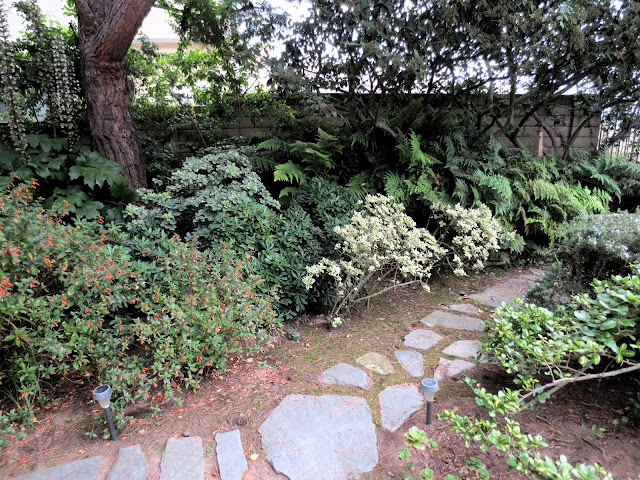
Before

After, still a bit bare


The rest of the work in the backyard consisted of trimming to open up the space, clear pathways, and improve the general appearance of existing plants.  We could have cut many of the shrubs and trees back further but we didn't have space in the green bins to dispose of additional garden debris before the start of the open houses.  The plants also didn't have sufficient time to recover from a hard pruning at this stage.

Before picture of Arbutus unedo and Leptospermum

Picture of Arbutus after it was limbed up and the Leptospermum was cut back

Before picture of overgrown shrubbery (Camellias, Pittosporum and Raphiolepsis) below the kitchen window

After relatively light pruning used to create nominal separation between the varieties of shrubs


I feel as though I should have done more to make the backyard shine but there just wasn't time.  And, as my husband cynically commented, the new owners are likely to yank out everything I added, as well as my mother-in-law's established bird-friendly plants, to put in grass.

In the front yard, all I did was to add 2 pots by the entrance to the front door.  Both pots were planted up with the same mix: Cordyline 'Renegade', Pelargonium peltatum 'Pink Blizzard', Calibrachoa 'Cherry Star', and Alternanthera 'Yellow Joseph's Coat'.  The Cordyline is a particularly nice plant and, as I could find only 2, I'm planning to take at least one of the pots home with me once the house is sold.

Front doorway with new matching pots

Close-up of one pot 

The listing went up on Friday night.  The first open house was held yesterday and another is scheduled for today.  It's currently a seller's market in this area and we're hoping for a quick sale.  It will be a relief for both my husband and myself to shift our focus back to our own home.  However, on a sadder note, the sale also marks the end of an era in the family's history.