Showing posts with label Plumbago auriculata. Show all posts

Thursday, October 15, 2020

Bloom Day - October 2020

Last month on Garden Bloggers' Bloom Day we'd just put our worst heatwave of the season behind us but California and a good part of the Pacific Northwest were dealing with catastrophic wildfires and truly terrible air quality.  We've had more heatwaves since, including this week, and our air quality has been up and down but at least things are better than in mid-September.  We enjoyed a brief flirtation with fall last week and I'm hoping that, when the current heatwave passes, cooler temperatures will stick around for the long haul.

This month I'll start my bloom review with the newest arrivals.

These Anemone hupehensis (Japanese anemones) came with the garden but it still startles me when they return despite our generally dry conditions.  The pink variety in the front garden has yet to appear but I'm not about to count them out.

I invested in a flower-less one gallon container of Barleria obtusa (bush violet) at the local botanic garden's fall plant sale in 2014 and the plant now occupies several areas in my garden.  If I hadn't been vigilant, it probably would've taken over by now.  It certainly keeps trying but I can forgive a lot for those blue blooms.

The Australian fuchsias (Correa) are off to their usual slow, measured start.  From left to right are: Correa 'Ivory Bells', 'Sister Dawn', and 'Wyn's Wonder'.  Correa pulchella 'Pink Eyre' is covered in buds but appears to be waiting out the heatwave before it flowers.

This Hibiscus trionum (flower-of-an-hour) is a recent gift from a friend.  I grew it previously but it died out, while she's blessed with more seedlings than she can use.  Like daylilies, the blooms don't last long.

Plumbago auriculata 'Imperial Blue' is a virtual weed in this climate and I've never planted it in the ground but I have two plants in pots that take off at this time of year.  I love the color of the flowers if not their stickiness.

Zauschneria californica (California fuchsia) is making a big splash this year, although it's battling for space with a Grevillea I'd forgotten was planted just behind it

I planted rain lilies (Zephyranthes candida) here in 2014 but never remember they're there until they appear each fall, rain or not

While the new blooms have added flashes of color here and there, the old summer stalwarts still dominate the stage.

The dahlias went crazy during the last heatwave.  I photographed these last weekend before the current heatwave set in.  The blooms are steadily decreasing in size and their foliage is getting grungy so I suspect this is their last Bloom Day appearance of the year.
Top row: Dahlias 'Belle of Barmera', 'Labyrinth', and 'Candlelight'
Middle row: 'Enchantress', 'Iceberg', and 'Sellwood Glory'
Bottom row: 'Loverboy', 'Mr Optimist', and 'Rip City'

This is one of 15 buds on Dahlia 'Gitts Crazy'.  I planted it in late April and it sprouted less than three weeks later.  As all the other dahlias are finishing up, it's only just now preparing to bloom.

The large-flowered Grevillea bloom all year but they're really floriferous right now.  The closeups in the top row are, left to right: Grevillea 'Ned Kelly', 'Peaches & Cream', and 'Superb'.  Photos of the last two shrubs are shown below.  When grooming the shrubs, I'm surrounded by a constant buzz of bees, none of which have ever stung me.

These Lantana are blooming especially well this year.  The orange and yellow varieties (left), planted in a half barrel container three years ago, may have gotten a boost from the fertilizer I've been adding to get another dahlia, planted late in the season, to bloom, but the variegated Lantana 'Samantha' (right) never received any fertilizer and it's going strong after being cut to the ground last winter.

I can always count on Pennisetum to put on a show starting in late summer.  On the left is Pennisetum 'Fireworks' and on the right is P. advena 'Rubrum'.

Salvia leucantha is also having a good year

This is probably the last hurrah for the Zinnia elegans this year too.  The foliage is developing a bad case of mildew due to the mixed influence of our damp morning marine layer and the continuing high temperatures.

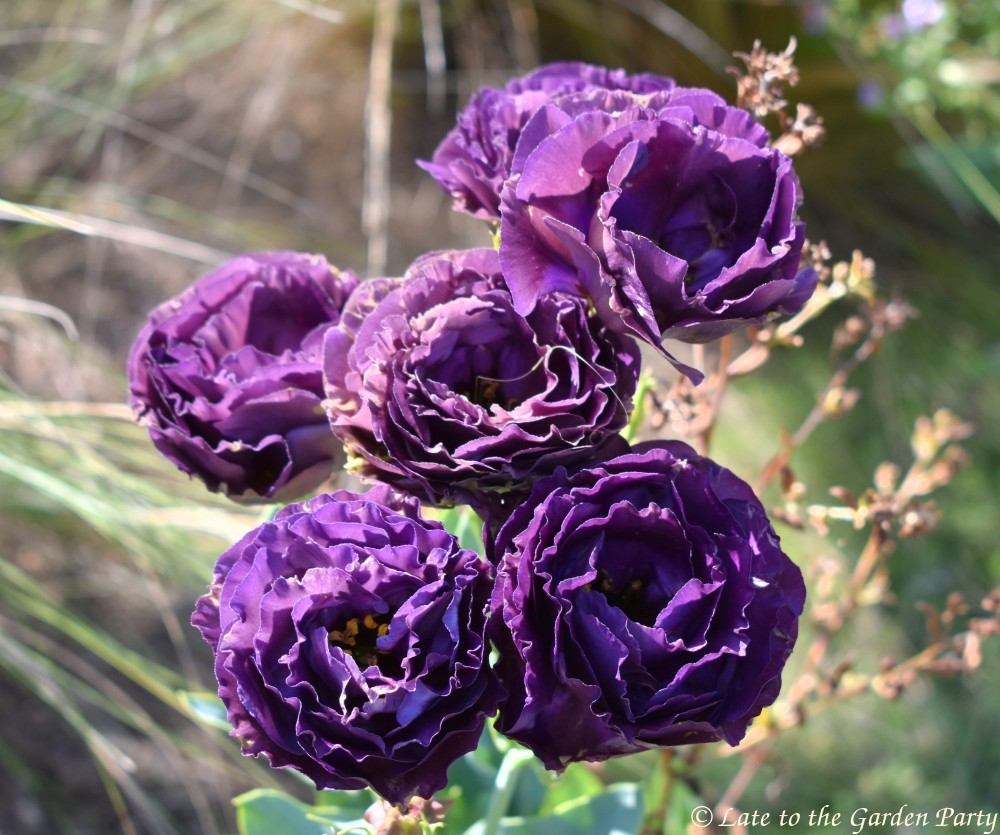
The Lisianthus (Eustoma grandiflorum) that had burned out earlier this summer also staged a recovery, or two varieties did anyway.

I'm always happy to have them back

There were several other surprises as well.

A friend gave me this Iris germanica 'Autumn Circus' in late May.  I didn't expect any blooms until next year but I got this one earlier this month.  Another bud followed but it was incinerated by the last heatwave.

I planted Lessingia filaginifolia 'Silver Carpet' (carpet beach aster), a groundcover, in 2015.  It's persisted but I seldom notice it until it flowers, partly because Helichrysum petiolare 'Petite Licorice', a weed here, is constantly seeking to overwhelm it, as shown.

Stapelia grandiflora made another appearance.  Its bud, shown on the left, opened a couple of days after I discovered it.  I took the photo on the right before its characteristic odor began attracting flies.

This isn't quite a bloom yet but it's the first time I've ever seen a bloom stalk on Vriesea ospinae cv gruberi (now classified as Goudaea ospinae)

This Yucca 'Bright Star' bloomed earlier this year but it unexpectedly developed a side bloom I only just noticed last week

That brings me to the the usual color collages I end my Bloom Day posts with, featuring the best of the rest.

Clockwise from the upper left: Trichostemma 'Midnight Magic', Brachyscome 'Brasco Violet', Lavandula multifida, Plectranthus neochilus, Polygala myrtifolia, Oxalis triangularis, and Wahlenbergia 'Blue Cloud'

Clockwise from the upper left: Cuphea 'Honeybells', Rosa 'Pink Meidiland', Cuphea 'Starfire Pink', Pentas lanceolata, noID rose, noID Phalaeonopsis, and Bauhinia x blakeana

Clockwise from the upper left: Alstroemeria 'Inca Sundance', Abelia grandiflora 'Edward Goucher', A. 'Kaleidoscope', Euryops chrysanthemoides, Hemerocallis 'For Pete's Sake', Oncostele 'Wildcat', noID self-seeded Osteospermum, and noID Phalaeonopsis

Clockwise from top left: Rosa 'Medallion', Alstroemeria 'Indian Summer', noID Amaranthus, Cuphea 'Vermillionaire', Gaillardia 'Arizona Sun', Pelargonium peltatum, Penstemon mexicali, and Rosa 'Joseph's Coat'

For more on what's blooming in other parts of the country and around the world, visit our bloom-fest host, Carol at May Dreams Gardens.


All material © 2012-2020 by Kris Peterson for Late to the Garden Party

Wednesday, August 22, 2018

Top 10 Blooms in my Mid-Summer Garden

I'm joining Chloris at The Blooming Garden in featuring my top 10 blooms this August.  August isn't a month I usually associate with flowers but, as mentioned in my earlier Garden Bloggers' Bloom Day post, judicious applications of extra water this year have had a major input on the floral output.  We haven't received our August water bill so I'm not yet feeling as terribly guilty as I'm afraid I may feel soon.

Winnowing down the flowers in my garden to 10 selections wasn't easy.  The sheer volume of bloom was a major factor in my choices.  The current condition of the flowers was another, as was their photogenic qualities, but ultimately it's an emotional decision.

Rosa 'Medallion' was an easy choice because it surprised me by making its first appearance of the year by blooming en masse.  Roses here usually bloom best in spring before our temperatures soar, if they bloom at all.  I had very few rose blooms last year and even fewer this spring after the lowest winter rain levels I've ever measured.

I inherited 2 'Medallion' rose shrubs with the garden.  Of the paltry number of rose bushes I have, these had once been the most reliable spring bloomers but they didn't bloom at all this spring and they lost all of their foliage to a combination of rust and the nuclear heat that hit in early July.  They leafed out again after repeated deep watering sessions but I hadn't really expected them to bloom in mid-summer even after I saw a few buds forming.  Then I came home from a trip last weekend to find this!  This may not be a lot of roses for some of you but it's a mass of bloom in my garden.


Heteromeles arbutifolia was another surprise.  If this tree-sized shrub was blooming a week ago, I hadn't noticed it but now the blooms can't be missed.

The common name for this plant is Toyon.  It's been selected as the official native plant for the city of Los Angeles.  This one balances atop a steep slope on our property's boundary line and I estimate it's 15 feet tall.  The flowers will be followed by a plentiful supply of red berries.  The berries, although toxic for humans, are consumed by mockingbirds, robins, and cedar waxwings, as well as coyotes.


My dahlias were another obvious choice as a favorite but which one can be said to rule my cutting garden is another question altogether.  Each and every one deserves recognition.  Could you pick just one?

'Loverboy' (upper left) is flashy semi-cactus variety.  'Otto's Thrill' (upper right), a dinnerplate variety, has been the most prolific bloomer thus far, although it's quickly being overtaken by the smaller, semi-cactus 'Terracotta' (lower left).  Dinnerplate 'Strawberry Ice' (lower right) is new on the scene.

But it's 'Punkin Spice' that keeps drawing my eye.  I don't remember that it impressed me as much last year but this year every bloom is a glowing orb.  It's classified as an informal decorative type but the flowers are as large (or larger) than any in the dinnerplate class.


The zinnias in the cutting garden also came on with a bang this month but there is one, grown from seed rather than plugs from the local garden center, that impresses me every time I see it.

This is Zinnia elegans 'Benary's Giant Giant Salmon Rose'.  Each bloom is perfect.


Have I forgotten my Lisianthus (Eustoma grandiflorum) you might ask?  Of course not but, like choosing a favorite dahlia, the Eustomas that draw my eye shift from one week to another.

A week ago, it was the delicate green-flowered variety (left) that won my heart.  A new variety, 'Mint Cocoa' (right) has been a favorite with commentators and I admit I'm impressed by how well it's performed this year.  My biggest issue with it is that its unusual color doesn't mix well with most of the flowers surrounding it.  I'll need to find a better placement for it next year.

Eustoma grandiflorum 'Black Pearl' wins my thumb's up for late August.  It's blooming on last year's plants.  Last year I found its performance disappointing but it's a happier plant in its second year.  The flowers are tighter and more heavily petaled than most of the other varieties of Eustoma growing in my garden.  Its shape and growth habit closely resemble that of 'Mint Cocoa'.


A number of more common flowering plants make up the rest of my mid-summer bloom list.

This is the native California aster, Symphyotrichum chilense.  I put in 2 plants in 2015 but, if you looked at the bed it's growing in, you might think there were a half dozen or more plants there.  It spreads by rhizomes and is a little more exuberant than I'd expected but it's the only aster I've ever considered a success here.

Plumbago is VERY common here.  From my home office window, I can see a large mass of it in bloom across the canyon.  It's blooming up the street and I see masses of the blue flowers along the road every time I leave my neighborhood.  My plants, Plumbago auriculata 'Imperial Blue', are better behaved in large pots outside my lath (shade) house.  

Lantana 'Samantha' is having a banner year.  I love the cheerful yellow flowers but the variegated foliage is its main attraction.  It makes me think of Ceanothus 'Diamond Heights', a plant I've killed at least 3 times, but in contrast this Lantana is easy to grow and happy here.

Gaillardia 'Fanfare Citronella' in the same bed as the Lantana is another current favorite.  While the flower stems are annoyingly short, the flowers are prolific and of course loved by bees.

I've got as many as a half dozen varieties of Abelia in my garden, all of which I love, but at the moment this older variety, Abelia grandiflora 'Edward Goucher' is what's grabbing my attention.  The 2 large shrubs came with the garden and, unlike the varieties I've introduced, there's no variegation in the foliage of these but they do pump out the blooms!  I cut the 2 shrubs back hard in late winter and I've been rewarded this year with lots of long flowering stems.  When the flowers drop, they leave behind reddish bracts just as pretty as the flowers themselves.


Could you distill the bloomers in your garden down to just 10 plants?  Visit Chloris to find her list.


All material © 2012-2018 by Kris Peterson for Late to the Garden Party

Monday, January 8, 2018

In a Vase on Monday: No, it's not spring yet

It's not spring here yet but perhaps my first vase will make you think it is.  Winter in my area of Southern California is admittedly different from many places in the Northern Hemisphere.  I hope those of you dealing with snow, ice and freezing temperatures will forgive me for pointing that out.

The blue Plumbago was the starting point for this arrangement.  I came across it at my local garden center last week and couldn't pass up buying 2 plants to fill the large pots that sit outside my new lath (shade) house.

The Plumbago flowers really are as blue as they appear in these photos

The blue and purple Anemones came from inside my lath house

Clockwise from the upper left, the vase contains: purple and blue Anemone coronaria, noID Lonicera japonica, Argyranthemum 'Go Daisy Mega White', Osteospermum '4D Silver', Rosmarinus officinalis, and, in the center, Plumbago auriculata 'Imperial Blue'


The Hong Kong orchid tree (Bauhinia x blakeana) in the front garden has been blooming more heavily than I can remember for well over a month now and, although past experience indicates that the flowers will not last long in a vase, I couldn't stop myself from cutting some this week.

I always believed that the tree bloomed best when the air was on the humid side but that must not be the factor I thought it was as December was unusually dry

I found a surprising number of plants to complement the almost glow-in-the-dark Bauhinia blooms but they didn't all fit in the vase I selected

The wire-thin stems of Gomphrena were the primary accent

The vase contains Gomphrena decumbens 'Itsy Bitsy' (shown with Lobularia maritima), Bauhinia x blakeana, and Pseuderanthemum 'Texas Tri-star'


Finding the right vase for the Bauhinia stems proved a problem as the stems are top-heavy and need support.  I ended up using a vase with a small opening that couldn't accommodate everything I'd cut so the extras went into a tiny vase that now sits by the kitchen sink.

The small vase contains Alternanthera 'Little Ruby', Ocimum hybrid 'African Blue Basil', and Persicaria capitata


I moved this week's vases around a bit before they finally found their spots.

The blue vase sits in the front entry and the pink one on a side table in the living room


Last week's vase remains in its place on the dining room table, looking little different than it did last week.

Ignore the blue tape on the wall in the background.  My husband is starting another project, which I fear may involve drilling through walls.


For more IaVoM, visit our host, Cathy at Rambling in the Garden.


All material © 2012-2018 by Kris Peterson for Late to the Garden Party