Showing posts with label Scabiosa. Show all posts

Monday, April 18, 2022

In a Vase on Monday: Unlikely Companions

Yellow is one of my favorite colors (along with blue and green) but even so, I find some strong yellows off-putting.  Still, the Didelta 'Silver Strand' I planted in November had recently produced so many flowers, I found I couldn't ignore it.

Unfamiliar with Didelta, a succulent, I planted a single specimen in a 4-inch pot in one of my back garden borders.  I selected it for its silver foliage and drought tolerance.  The tag said it produced yellow flowers but I didn't expect a display like this.

The question was: what do you combine with flowers in an intense yellow like that?  Rather than attempting to provide a distraction by using other strong colors that would compete with it, I decided to lean in with other yellow flowers, creating a combination of plants which probably would never be found together in nature.

The Didelta flowers tended to droop when placed in a vase, making them appear less prominent.  The 'Golden Celebration' rose easily handled the competition presented by the succulent's flowers.  However, as most of those roses fried during our recent heatwave, I only had one presentable bloom to include.

Back view: Alstroemeria 'Inca Sundance' offered a softer influence and tied in well with the foliage of Agonis flexuosa 'Nana'

Top view: The flowers of Iris 'Lion King' also tied in well - and I'd previously been perplexed about what to pair with them

Clockwise from the upper left: Agonis fleuxosa 'Nana', Alstroemeria 'Inca Sundance', Argyranthemum frutescens 'White Butterfly', Didelta 'Silver Strand', Iris hollandica 'Lion King', and Rosa 'Golden Celebration'

While my first arrangement is vivid, my second consists primarily of softer colors.

My cutting garden finally produced foxgloves in shades other than peach

Back view

Top view

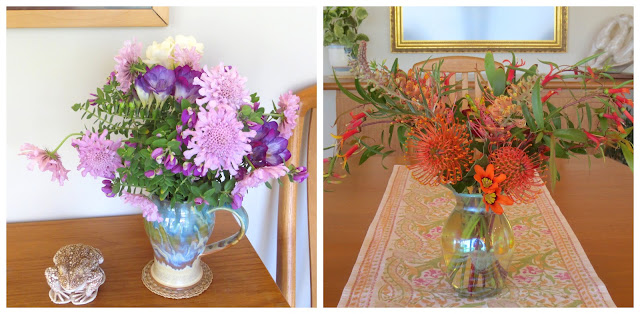
Clockwise from the upper left, Digitalis purpurea in pink and white, Orlaya grandiflora, Pelargonium cucullatum 'Flore Pleno', Prostanthera ovalifolia 'Variegata', and Scabiosa columbaria 'Flutter Rose Pink'

Like last week, my IAVOM preparations were temporarily interrupted by an unexpected visitor, one much rarer than the bunny that stopped by last week.

As I was cutting flowers for this week's vases, I heard the tell-tale cries of a male peacock nearby but I was still surprised when I looked out the kitchen window and caught him eating blueberries from the pots just outside our back door.  He allowed me to follow him for several minutes before flying over the fence into my neighbor's garden.  These birds are well known on our peninsula but I haven't seen one in almost 2 years.  (You can read more about the birds in a 2020 post here.)


When finished, my new arrangements assumed their usual positions in the front entry and on the dining room table.


 I had flowers left over from last week's arrangements I couldn't bear to toss too.

The Aeonium haworthii 'Kiwi' flowers (left) have a very long vase life.  The Dephinium elatum 'Cobalt Dreams' flowers don't but I cut the stems down in order to preserve the florets as long as possible, although I see fallen petals every time I glance in the direction of that vase.


For more IAVOM creations, visit our host, Cathy at Rambling in the Garden.


All material © 2012-2022 by Kris Peterson for Late to the Garden Party

Monday, March 14, 2022

In a Vase on Monday: Flowers aplenty

As I ran around my garden taking photos for Garden Bloggers' Bloom Day this coming Tuesday, it's overwhelming how much is in bloom.  In dry years like this one, I wonder if every flowering plant is rushing for the finish line before the heat settles in for an extended stay and soil conditions get even drier.  I know it's not spring yet in most of the Northern Hemisphere but it's well underway here.  Meanwhile, the latest projections don't hold out much hope for rain in Southern California in March or April so I'll take advantage of the flowers I've got while I can.

The Dutch Iris are still building on their flower power but the Scilla peruviana, which only just started its bloom cycle at the end of February, are already fading after a couple of stretches of warm weather.

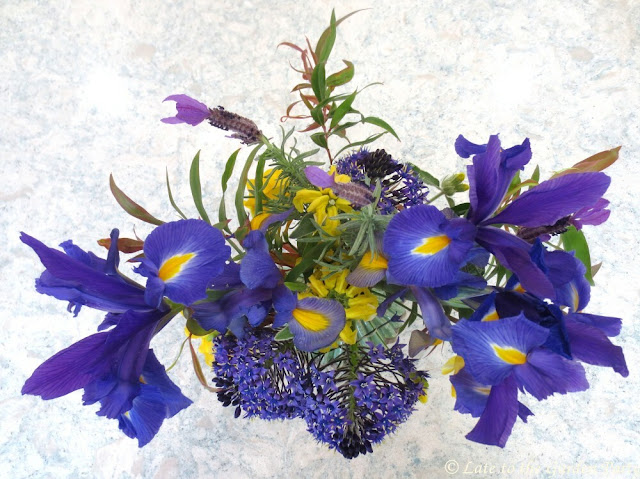
More blue and yellow to express solidarity with Ukraine.  There are 2 varieties of Dutch Iris in this arrangement but they're very similar in color.

Back view

Top view

Top row: Agonis flexuosa 'Nana', Freesia, and self-seeded Lavandula stoechas
Middle row: Iris hollandica 'Mystic Beauty' and 'Sapphire Beauty'
Bottom row: Phlomis fruticosa and Scilla peruviana

Every time our daytime temperatures soar the Anemones fade, only to slowly recover when temperatures come down again, but I've got to wonder how many flip-flops they can handle.

A couple of months ago, I planted plugs of ornamental kale (Brassica oleracea) with the idea of using it to complement Anemone coronaria 'Admiral' but it never bulked up much and now it's preparing to bolt so I thought I'd use it before it fades away

Back view: The vase is the thrift store find I picked up years ago featuring a lady's well-manicured hands clasped to hold flowers but those hands are mostly hidden in this arrangement

Top view

Clockwise from the upper left: Anemone coronaria 'Admiral' and 'Mount Everest', Boronia crenulata 'Shark Bay', Brassica oleracea var acephala, Coleonema album (aka white breath of heaven), and Scabiosa columnaria 'Flutter Rose Pink'

I had a few leftovers I couldn't cram into the first vase so I popped them into a small vase rather than tossing out the stems.

The cactus-shaped vase of leftovers is sitting in the kitchen window (where it's impossible to photograph)

The other two arrangements found spaces in the usual places.


For more IAVOM creations, visit our esteemed host, Cathy at Rambling in the Garden.


All material © 2012-2022 by Kris Peterson for Late to the Garden Party


Monday, February 21, 2022

In a Vase on Monday: It's not an illusion

My calendar reads the same as yours but it IS spring here in every way that counts.  While it's not nearly as warm as it was two weeks ago, new flowers are awakening daily.  The pace of bloom isn't retreating even as daytime temperatures slip back into the 50sF (14C).  I can also swear that I saw my first monarch butterfly on Saturday.  (It could have been a painted lady as I didn't get a close look before it flitted away but massive numbers of monarchs were sighted on California's central coast in January so it seems within the realm of possibility.)  Sadly, rain seems to be a pipe dream, although there's another small chance of precipitation between late Tuesday and early Wednesday.  Last Tuesday evening, we got 0.08/inch (2 mm) of rain, which at least refilled my empty 50-gallon rain tank.  If any rain manages to reach us this week, it's expected to be on the same order of magnitude.

Another sign of spring is the sudden arrival of masses of aphids on tender green foliage.  On Sunday morning, I spent more time trying to eradicate those miserable sap-suckers than I spent cutting flowers but I still have two arrangements to share.

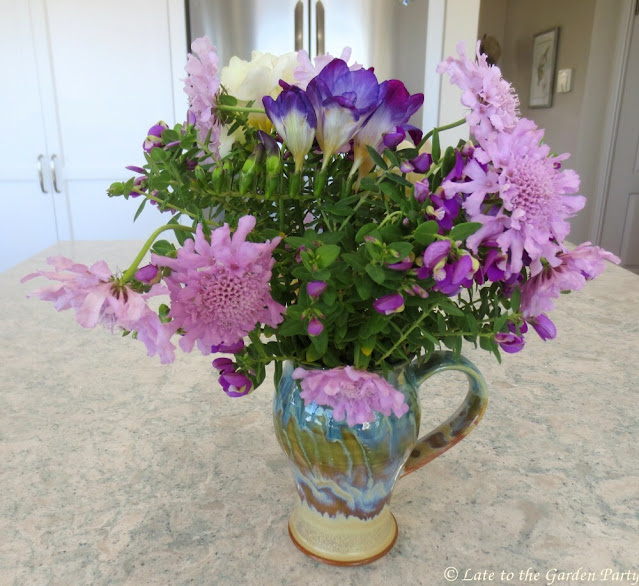
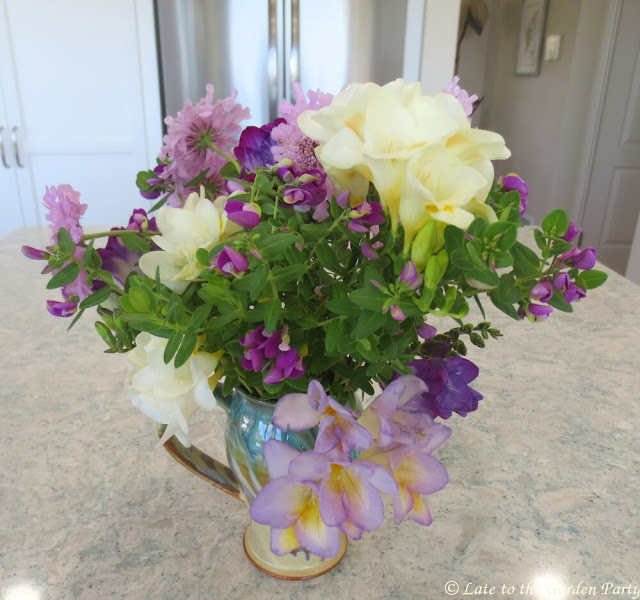
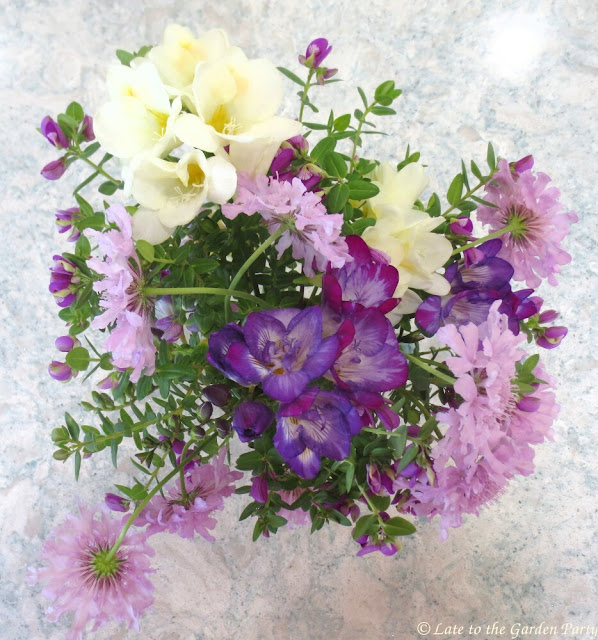
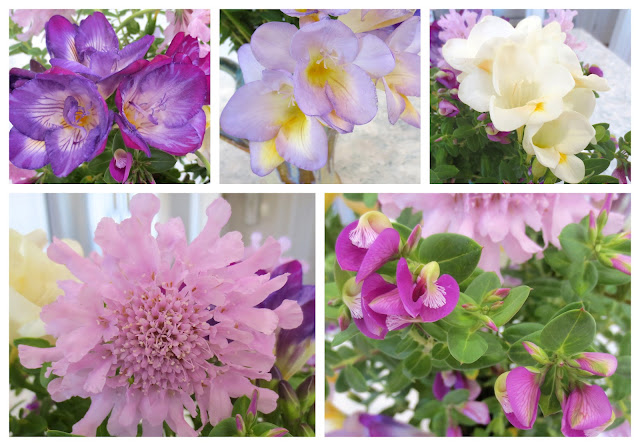
The flowers of Polygala fruticosa (aka sweet pea shrub) set the color scheme for this arrangement.  I'm planning to pull out the shrub that supplied these flowers as it's developed a woody base and become much too large for its spot but there was no reason to waste the flowers!

Back view, highlighting some of the Freesia that are popping up all over my garden

Top view

Clockwise from the upper left: Freesias in 3 colors, Polygala fruticosa, and Scabiosa columbaria 'Flutter Rose Pink'

My second arrangement couldn't be more different in terms of color.

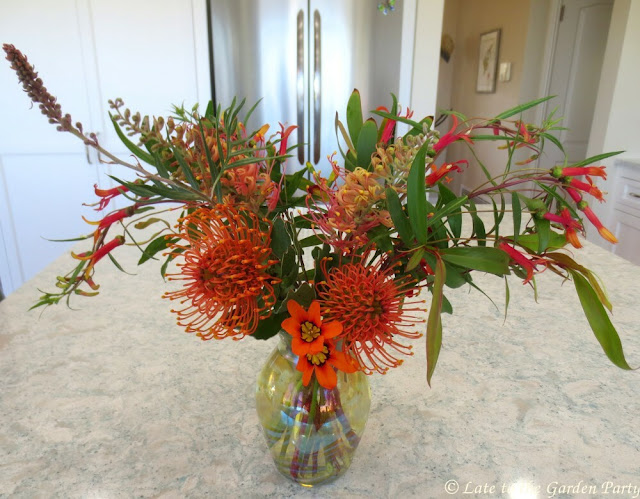
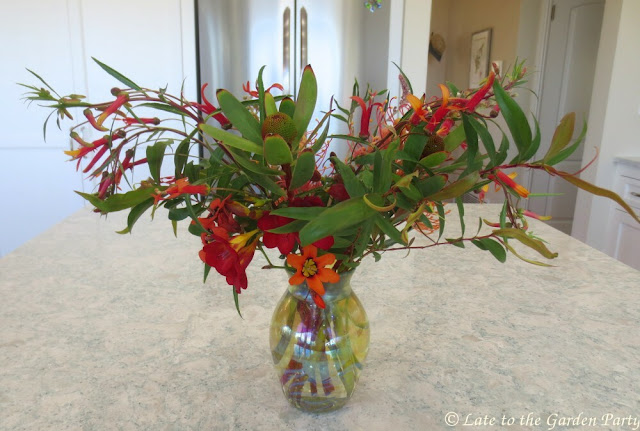
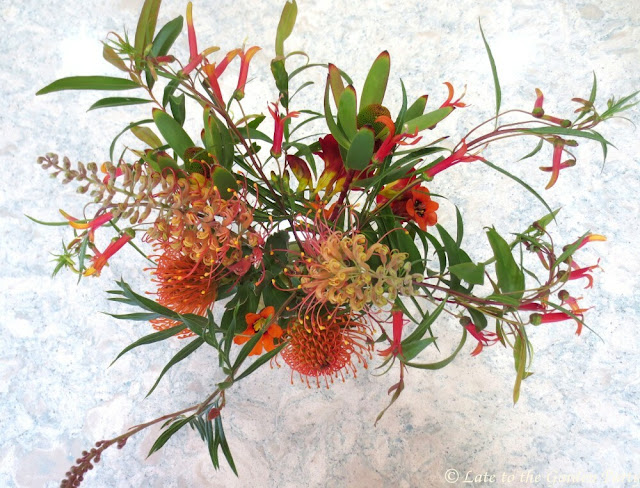
My Leucospermum 'Sunrise' is blooming for the first time after nearly a 3-year wait and I felt compelled to celebrate by cutting 2 short stems.  In retrospect, the arrangement could have used more color variation.

Back view

Top view

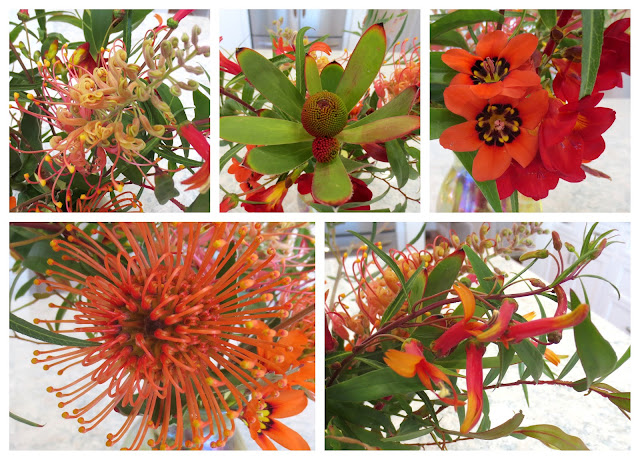
Clockwise from the upper left: Grevillea 'Superb', Leucadendron 'Cloudbank Ginny', red Freesia with Sparaxis tricolor, Lobelia laxiflora (shown with Agonis flexuosa 'Nana' foliage), and Leucospermum 'Sunrise'

For more IAVOM posts, visit Cathy at Rambling in the Garden.


All material © 2012-2022 by Kris Peterson for Late to the Garden Party

Tuesday, February 15, 2022

Bloom Day - February 2022

Spring arrives early in coastal Southern California.  Despite the complete lack of rain in November and again in January, the heavier-than-usual rain in December raised my expectations for a bountiful spring.  And, generally speaking, that's what we have this February, despite an utter lack of rain this month too.  However, after an extended blast of exceptionally warm, dry weather, some cool-season bloomers have beat a rapid retreat, while others are hustling to take center stage ahead of schedule.

I'll focus on the plants making the biggest splash first.  As it's impossible for me to choose favorites this month, I'm going to show them alphabetically by genus.

Arctotis 'Pink Sugar' started blooming in January and should keep on going throughout our cool season (unless winter and spring heatwaves become the norm)

Arctotis 'Opera Pink' got its start last week

Bauhinia x blakeana (aka Hong Kong orchid tree) handled last week's gusty winds better than expected

Ceanothus arboreus 'Cliff Schmidt' went from buds to full bloom seemingly in the blink of an eye when temperatures soared last week.  Last year it didn't bloom until mid-March.

Literally, all my Grevilleas are in bloom this month.
Top row: Grevillea alpina x rosmarinifolia, G. 'Poorinda Leane', and G. sericea
Second row: Grevillea lavandulacea 'Penola', dwarf G. rosmarinifolia, and G. 'Scarlet Sprite'
Third row: Grevillea 'Ned Kelly', G. 'Peaches & Cream', and G. 'Superb'

Leptospermum scoparium 'Pink Pearl' is flowering well despite significant pruning in the fall

Two of my Leucadendrons, L. 'Safari Goldstrike' (left) and L. 'Wilson's Wonder' (right), are doing their best to emulate flowers

Like the Grevilleas, the Osteospermums make the best of the cool season.  Clockwise from the upper left: Osteospermum 'Berry White', O. 'Double Moonglow', O. 'Summertime Sweet Kardinal', O. 'Purple Spoon', O. 'Violet Ice', and a noID self-seeded trailing variety.

Pyrethropsis hosmariense (aka Moroccan daisy, syn Rhodanthemum hosmariense) is brightening up my front garden

Scabiosa columbaria appears to be turning into a nearly year-round bloomer.   The one on the left is 'Flutter Deep Blue' and the one on the right is 'Flutter Rose Pink'.

Although bulb blooms will appear at intervals into April or May, there are enough flowers in that category this month to address them as a separate group.

Unfortunately, the Anemone coronaria didn't respond well to last week's dry winds and 80+F temperatures.  'Admiral' (left) and the noID blue variety (right) went underground after their photos were taken.

Freesias in a variety of colors are popping up all over the garden

I planted 5 Hippeastrum 'Luna' bulbs in pots in mid-November.  All have produced at least 3 bloom stalks.  This is the most recent pot to produce blooms.

Ipheion uniflorum (left) and this noID Narcissus come back every year


At this time of year, new flowers appear almost daily.  

Antirrhinum majus 'Chantilly Bronze' (upper left) and 'Chantilly Peach' showed up in my cutting garden nearly in unison and the noID snapdragon varieties planted in a barrel in my front garden (bottom row) trailed them by less than a week.  All gave up their first blooms in service to 'In a Vase on Monday' yesterday.

Aristea inaequalis, a South African native related to Iris, surprised me on Sunday with its first blooms.  I hadn't even noticed bloom stalks prior to that.  The flowers are bluer than they appear in these photos.

The rockroses on the south side of the house all produced their first flowers within days of one another last week.  From left to right are: Cistus 'Grayswood Pink', C. x skanbergii, and C. x pulverulentus 'Sunset'.

I'm over the moon about the first flowers on this Leucospermum 'Sunrise' even though none are yet fully open.  I put the shrub in a large pot in March 2019 but moved it in June 2020 to provide better sun exposure in the process of renovating a bed on the south end of my back garden.  That was one of my first pandemic projects.  This is the first time this particular Leucospermum has flowered. 

This is a wild cucumber plant that always manages to surprise me when it stealthily starts winding its way through the south end of my garden.  Marah macrocarpa is a California native vine.  All parts of the plant are poisonous.

This climbing 'Joseph's Coat' rose is the first to appear since I pruned all the roses in my meager collection in early January.  I didn't even notice it until the heatwave had nearly done it in.


Accompanied by steady dry winds, last week's version of a winter heatwave triggered an early exit by some flowers that were looking great just ten days ago.  The Anemone coronaria flowers offer one example, although I'm still hoping for a recovery in that group as temperatures continue to drop this week.  The lack of rain since December has also had a significant impact in that many of my direct-sown seeds simply failed to germinate when I didn't make up the difference using irrigation.

Camellia williamsii 'Taylor's Perfection' has been dropping its flowers at a record rate and even those still on the shrub look like they're struggling to hold on

Daphne odora 'Leucanthe' hasn't grown much since I planted it over 2 years ago but it's still alive, if not thriving.  This variety is supposed to require only "moderate" water.  The flowers have dried up since I took this photo a week ago.

The ornamental pear tree (Pyrus calleryana) shows how quickly plants can be transformed by a run of unseasonably warm, dry weather.  The photo on the bottom left was taken on February 5th and the one on the bottom right was taken yesterday.

 
I'll close this Bloom Day survey as I usually do with collages showing the best of the rest that's flowering this month, organized by color.

Top row: Campanula portenschlagiana, Echium handiense, and Felicia aethiopica
Second row: Lavandula multifida, Limonium perezii, and Lobelia erinus
Third row: Pericallis 'Senetti Blue', Salvia 'Bee's Bliss', and Viola cornuta 'Penny Peach'

Left to right: trailing Lantana, Pelargonium peltatum, and Polygala fruticosa

Top row: Arbutus 'Marina', Agryranthemum frutescens 'Comet Pink', and Boronia crenulata 'Shark Bay'
Second row: Centranthus ruber, Coleonema pulchellum 'Sunset Gold', and Cuphea 'Starfire Pink'
Third row: Hebe 'Wiri Blush', Helleborus 'Anna's Red', and Pelargonium peltatum 'Pink Blizzard'

Left to right: Argyranthemum frutescens 'White Butterfly', Crassula multicava, and Westringia fruticosa 'Morning Light'

Top row: Agryranthemum 'Yellow Butterfly', Euphorbia rigida, and Euryops chrysanthemoides 'Sonnenschein'
Second row: Gaillaridia 'Spintop Copper Sun', noID Gazania, and noID Grindelia
Third row: Phlomis fruticosa,  Phylica pubescens, and Tagetes lemmonii

Clockwise from the left: Aloe deltoideodonta, Lobelia laxiflora, Metrosideros collina 'Springfire', Sparaxis tricolor, and Tropaeolum majus

Clockwise from the upper left: Calliandra haematocephala, Gazania 'White Flame', Pelargonium sidoides, and Ribes viburnifolium


For bloom surveys from other parts of the country and spots around the world, check in with Carol of May Dreams Garden, the creator and champion of the phenomenon that is Garden Bloggers' Bloom Day.


All material © 2012-2022 by Kris Peterson for Late to the Garden Party