Showing posts with label Cercis. Show all posts

Tuesday, March 15, 2022

Bloom Day - March 2022

Although the calendar says otherwise, it's the height of spring here in my part of coastal Southern California.  A few early spring plants are already showing signs of decline and, as daytime temperatures are expected to soar (again) this week, I expect to see some heading for the exits soon but, at this time of year, more blooms arrive each day than disappear.  That's one way of saying that this will be another long post, even though I split off the bulb flowers in a separate post, published last Friday.

I'll begin with the plants I consider the stars of my March garden, starting with the Leucospermums (aka pincushion shrubs), which are having a very good year despite the woefully low rainfall we've had.  January and February are traditionally our rainiest months but what we got was well short of what the State of California has called "measurable rainfall" for a single storm.  According to one source, those were California's driest months in 127 years.

Leucospermum 'Goldie' was my first experiment with this genus and it's currently the most floriferous

Leucospermum 'Royal Hawaiian Brandi' has the largest flowers

Leucospermum 'Hybrid Spider' is perhaps my favorite.  Its flowers look very different at each each stage but I like the halfway-opened stage the best.

Acquired about 3 years ago, this is the first year Leucospermum 'Sunrise' has bloomed


Plants in the Osteospermum genus, one of several genera commonly referred to as African daisies, are also having a banner spring season.  As temperatures get higher they'll stop blooming but the flowers will return in the fall.

Most of the Osteospermum shown here are self-seeded.  The single-petaled varieties have always self-seeded freely but I recently noted that some of the so-called "double-petaled" varieties have also done so.

This is 'Double Moonglow'.  The nice thing about the double-petaled varieties is that they don't close in low light, making them useful subjects for floral arrangements.

Top: Recent acquisitions 'DarkViolet & White' and '4D Pink'
Middle: '4D Silver', 'Violet Ice', and 'Purple Spoon'
Bottom: self-seeded single-petaled plants in purple, pink, and lavender


Here are some of the other plants putting on a particularly good show:

Arctotis is another genus of African daisies.  From top to bottom are 'Large Marge', Pink Sugar', and 'Opera Pink'.

Argyranthemum (aka Marguerite daisies): 'Pink Comet', 'White Butterfly' and 'Yellow Butterfly'

The flowers on my tree Ceanothus on the back slope, featured last month, faded quickly in response to warm temperatures but those on this noID Ceanothus hedge, inherited with the garden, have been blooming non-stop since January

Cercis occidentalis (aka western redbud) is doing well despite the heavy pruning I did in late fall

Cistus x skanbergii scatters its delicate pink blooms every time the wind blows but the flowers keep coming

This month, Coleonema album (aka white breath of heaven, left) joined its pink-flowered cousin, Coleonema pulchellum 'Sunset Gold', in bloom.  While, like the pink version, the foliage of the white-flowered variety has a pleasant scent, I find the smell of its flowers slightly unpleasant.

Accurately capturing the periwinkle color of Felicia aethiopica 'Tight & Tidy' in photos is always a challenge

Lavandula stoechas in the front and back garden.  The plant on the right was self-seeded.

Sometimes disparaged as a common plant, I find Limonium perezii (aka sea lavender) is an attractive addition to the landscape (although the old foliage should be cut back at least annually)

Maybe I should have called March "daisy season."  This is Pyrethropsis hosmariense (syn Rhodanthemum hosmariense, aka Moroccan daisy).


Of course, my ever-dependable large-flowered Grevilleas are still doing their part.

Grevillea 'Peaches & Cream' (left) and 'Superb' (right)


As always, there are a few surprises worthy of note.

I acquired this plant by mail order in January 2012, labeled simply "Abelia species."  The grower no longer shows it even among its discontinued offerings and I've yet to find a more precise ID for it.  The leaves aren't glossy like the Abelias commonly sold here and its flower color distinguishes it from others I've seen, like 'Edward Goucher'.  My most recent search turned up Linnaea uniflora 'Bumblebee' but the leaf size doesn't look right.  It flowers routinely this time of year on my difficult back slope.

My best guess is that this is the white form of Ageratum houstonianum, which to my recollection I've never planted.  It popped up for the first time this year in a backyard border.

This Dombeya burgessiae is a passalong plant I received from Denise of A Growing Obsession last fall.  I didn't expect to see it bloom this soon after getting its roots in the ground.

I hadn't planned to include any bulb blooms in this post but this species tulip, Tulipa clusiana 'Lady Jane', produced its first 3 blooms the day I published my Friday post.  The following day, there were 11 blooms.  They'll be gone long before the the next Bloom Day post in April so here you are.


A few prominent plants are poised to conclude their annual bloom cycles within the next couple of weeks.

Those preparing for near-term departures include: Aeonium arboreum, Aristea inaequalis, and Camellia williamsii 'Taylor's Perfection'.  The Camellia in particular was hit hard by our yo-yo weather conditions.  In January the shrub had more buds than I'd ever seen but, in response to constant bouts with wind and warmer temperatures, it dropped dozens and dozens of buds, as well as perhaps a quarter of its leaves.  The bloom shown on the right is one of the few that haven't fallen while still in bud.


I'll close as usual with the best of the rest, organized by color into collages.

Top: noID pink Alstroemeria, Centranthus ruber, and Hebe 'Wiri Blush'
Middle: Cuphea 'Honeybells' and C. 'Starfire Pink'
Bottom: Leptospermum scoparium 'Pink Pearl' and noID orchid 

Top: Pelargonium cucculatum, dark pink P. peltatum, and P. 'Pink Blizzard'
Bottom: noID peach tree blooms, noID rose, and Scabiosa columbaria 'Flutter Rose Pink'

Top: Geranium incanum (a weed), G. 'Tiny Monster', and Lavandula multifida
Middle: lavender Pelargonium peltatum, Polygala fruticosa, and Salvia 'Bee's Bliss'
Bottom: Scabiosa columbaria 'Flutter Deep Blue', Trichostema 'Midnight Magic', and Viola 'Penny Peach'

Top: Auranticarpa rhombifolium, Centranthus ruber 'Albus', and Leucanthemum paludosum
Middle: Crassula multicava 'Red' and C. orbiculata var rosularis
Bottom: white Pelargonium peltatum, P. 'White Lady', and Philotheca myoporoides 'Profusion'

Top: Euphorbia rigida, Gazania 'Gold Flame', and Grevillea 'Moonlight'
Middle: Lantana 'Lucky Yellow', noID Nemesia, and self-seeded Nigella orientalis
Bottom: Oncostele 'Wildcat', Phlomis fruticosa, and Phylica pubescens

Top: Aloe striata, Alstromeria 'Indian Summer', and Antirrhinum majus 'Chantilly Bronze'
Middle: Cuphea 'Vermillionaire' Gasteria 'Kyaka', and Lantana 'Irene'
Bottom: Lobelia laxiflora, Pelargonium 'Tweedle Dee', and Salvia africana-lutea

Top: Calliandra haematocephala, Lotus berthelotii 'Amazon Sunset', and Pelargonium sidiodes
Middle: Leucadendron 'Safari Sunset' and noID dwarf Cymbidium
Bottom: Grevillea 'Ned Kelly', G. lavandulacea 'Penola', and G. 'Scarlet Sprite'

For more Garden Bloggers' Bloom day posts, check in with Carol at May Dreams Gardens.


All material © 2012-2022 by Kris Peterson for Late to the Garden Party

Friday, June 25, 2021

A neighbor's viewpoint on my garden

Chickadee Garden's "Facility Manager" recently presented his favorite picks among the late spring blooms in the garden he shares with his spouse.  That reminded me that I hadn't asked for my husband's input on our garden in some time.  (The input he provided on our summer garden last year can be found here.)  To compensate for cutting his hair, a chore I somehow acquired decades ago when he was still in graduate school which I've never managed to shed, I asked him to provide a current take on what he liked about the garden.  He grumbled that he'd already done that once but he didn't refuse so, when his haircut was done and I suggested a stroll around the garden before dinner, he proposed foisting the task on asking a neighbor to provide input.  He argued that because he's severely red-green color blind he couldn't fairly assess the garden - and then he shot across the street to see if our neighbor was willing to fill in before I could respond.  Neighbor S was accommodating and the two of them were back to join me on a spin through the upper level of the garden within minutes.  (Note: Familiar with our fire ant problem on the back slope, S declared it off-the-table at the outset.)

Here are the plants that grabbed S's attention:


Front Garden

He surprised me by picking Scabiosa columbaria 'Flutter Rose Pink' almost immediately.  I asked him what he liked about it and he referred to the flower's color and the plant's lacy foliage.

The next choice, Agave 'Jaws', couldn't have been more different.  S said the plant had "personality."  I offered him a large pup I recently found growing nearby but he said he didn't want to worry about having a grandchild fall into it.

The magenta seedpods of Cercis occidentalis (aka the western redbud) earned favorable comment next.  (I know one SoCal blogger who is probably shaking her head over this choice but I have to say it hasn't self-seeded in my garden.)

The color contrast provided by Cuphea 'Vermillionaire' earned it a thumb's up.  S was less than impressed by the flowers of Grevillea 'Superb' behind the Cuphea.


South Side Garden

The selection of Hymenolepsis parviflora (aka Coulter bush) startled me, even though the flowers stand out from the surrounding plants.  I love this plant myself - until the flowers turn this mustard brown color.  Earlier in the season, the yellow flowers provided an echo of other yellow colored flowers in the back garden, carrying one's eye along the full length of the area.  (Mum's the word but I cut the flowers back the day after S voiced his appreciation of the plant.)


Back Garden

Daucus carota 'Dara' grew from seed.  The four foot tall flower S pointed out (left) popped up on the edge of the flagstone path opposite the larger, taller clump of Daucus in the back border (right).  Like the flowers of Hymenolepsis parviflora, the Daucus forms umbels.

Lilies often draw people and this pink one, no longer at its best, received S's nod

This Hebe 'Wiri Blush' is one of my oldest plants but people seldom notice it.  I love the red of its stems and leaf undersides, as well as its flowers but the shrub is currently a mess.  Something, probably a gopher, tunneled underneath it last year, causing die-back at the plant's center.  S noticed the flower and the foliage but not the shrub's misshapen appearance.

This photo may give you a better idea of the shrub's current shape.  I'm vacillating between making an attempt to divide it or simply replacing it. 

Nierembergia scoparia 'Purple Robe' deserves more acclaim than it generally receives.  S loved its purple flower color, delicate foliage and low-growing habit.

The selection of Arbutus 'Marina' (aka strawberry tree) wasn't a surprise.  Nearly every visitor remarks on the beauty of this tree and I'm lucky to have inherited four of them with the garden.

The red trunk and peeling bark of the tree, which reminded S of manzanitas (Arctostaphylos), were major factors in its appeal


North Side Garden

Although I recently gave Grevillea 'Scarlet Sprite' a major haircut and most of its flowers are gone, it also earned a thumps up.  S cited its "exotic" flower for its appeal.


In the process of our walk-through, there were also a couple of what I'll call "honorable mentions":

Heuchera 'Marmalade' was noticed due to its unusual foliage color

This pineapple guava (Feijoa sellowiana), with flowers already giving way to fruit, drew S's attention as he prepared to return home.  I commented that the squirrels seem to be paying the plant a lot of attention at the moment.  When asked what drew them, I said I wasn't sure whether its the developing fruit or the flower petals, which have a sweet taste.  I offered him a petal to chew on his way home.


It's always interesting what draws someone's attention in the garden.  Several times during our spin of the garden, S asked "what's that?" and walked briskly ahead while I tried to ascertain what he was referring to.  I was almost always wrong on my first guess.  Do visitors ever surprise you with their preference of certain plants over others?


All material © 2012-2021 by Kris Peterson for Late to the Garden Party


Thursday, April 15, 2021

Bloom Day - April 2021

Despite our abysmally low rainfall, the garden is full of flowers this month.  And by that, I mean it's bordering on crazy, even by my standards.  As I knew I had a busy week coming up, I started taking my Bloom Day photos last week.  Every time I walked through the garden I saw something I'd missed and snapped more photos until I had to declare that enough was enough and call a halt to that.  As it was, I ended up dropping most of the photos I'd collected into collages just to manage their volume.  To make up for the photo overload, I've mostly limited commentary to plant identifications.

Here we go with this month's main floral contributors:

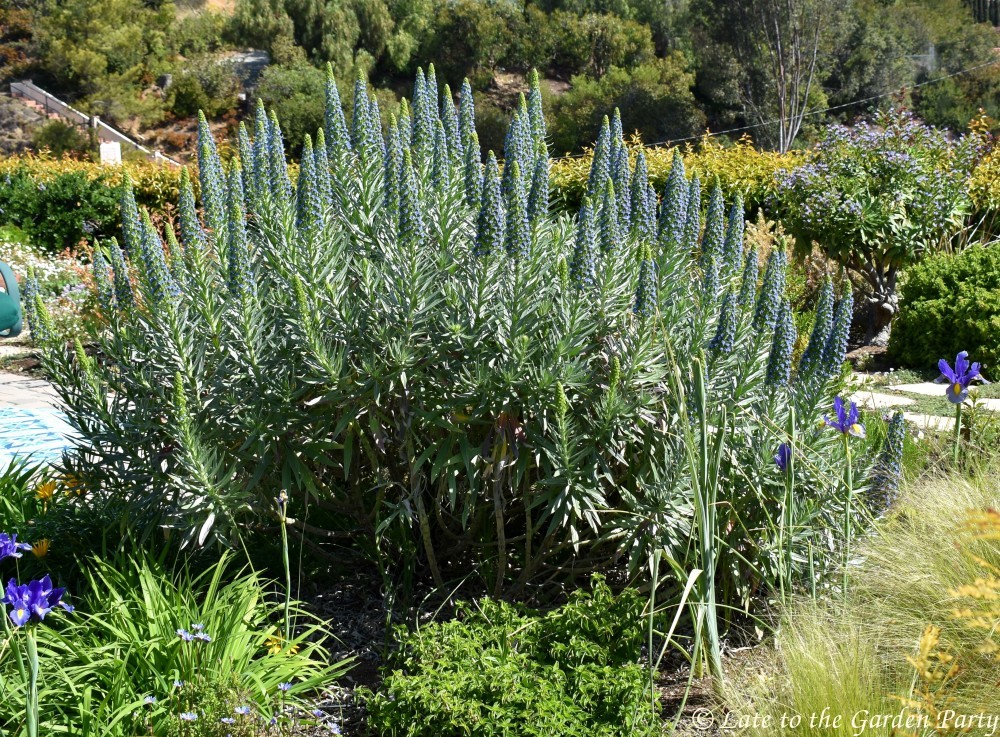
Echium webbii is currently in full flower, much to the delight of the bees.  Echium handiense in the background still has some blooms too.

The Dutch Iris peaked early this month and quickly began to wane when we had a stretch of very warm weather.  The varieties shown here are 'Sapphire Beauty' (top right) and 'Mystic Beauty' (bottom right).

Pacific Coast Iris douglasiana 'Santa Lucia'

The blooms of Ceanothus arboreus 'Cliff Schmidt' are declining but still beautiful

Limonium perezii is tough and relatively common here but it's a great performer

Ageratum corymbosum with its "ever-purple" foliage

Cercis occidentalis

Leptospermum scoparium 'Pink Pearl'

The next photos feature plant genera that are putting on a good show in spots throughout the garden.

Clockwise from the upper left: Alstroemeria 'Claire', 'Inca Vienna', 'Inca Sundance', 'Indian Summer', and two noID varieties inherited with the garden

Snapdragons: Antirrhinum majus 'Chantilly Bronze' and 'Chantilly Peach' are first and second from the upper left.  The half-barrel shown in the upper right contains a mix grown from a 6-pack of plugs and the pink ones in the lath house window box are a noID dwarf variety.

Arctotis 'Pink Sugar' and 'Large Marge' (yellow variety).  A third variety, 'Opera Pink', missed her photo opportunity.

Clockwise from the upper left: Cistus 'Second Honeymoon', 'Grayswood Pink', 'Sunset', and skanbergii

Coleonema pulchellum 'Sunset Gold' (left and top right) and Coleonema album (lower right).  Collectively, these plants are commonly known as Breath of Heaven.

Clockwise from the upper left: Euphorbia 'Ascot Rainbow', 'Black Pearl', 'Dean's Hybrid', and rigida

Top row: the large-flowered Grevilleas 'Ned Kelly', 'Peaches & Cream', and 'Superb'
Bottom: small-flowered Grevillea lavandulacea 'Penola', sericea, and 'Scarlet Sprite'

Hellebores, clockwise from the upper left: Helleborus 'Anna's Red', 'Phoebe', 'Pacific Frost', and 'Red Lady'.  'Blue Lady' didn't show up well in her photo.

Lavandula dentata, multifida, and stoechas

Because I love them so, the Leucospermums each got their own collages.  This is 'Brandi'.

Leucospermum 'Goldie'

Leucospermum 'Hybrid Spider'

Tow row: Osteospermum 'Berry White', 'Summertime Kardinal', and 'Purple Spoon'
Middle row:  Osteospermum 'Double Moonglow', 'Sunshine Beauty', and 'Zion Copper Amethyst'
Bottom row: noID self-seeded Osteospermum and O. 'Violet Ice'

Clockwise from the upper left: Pelargonium cucculatum 'Flore Pleno', 'Lemona', 'Lady Plymouth', 'Tweedle Dee', and 'White Lady'

Pelargonium peltatum aka ivy geraniums

My first roses of the year: 'Joseph's Coat', 'Pink Meidiland', and noID

Salvias originating from Africa: S. lanceolata and S. lutea

There's actually just one of these.  Not just one member of the Zantedeschia genus: just a single white calla lily (Z. aethiopica).  I usually have dozens of these at this time of year but the low rainfall combined with a stretch of excessive heat has crushed these plants at the bottom of my lightly irrigated back slope.  I miss them but I hope they (and the rain) will be back next year.

I'll close as usual with the best of the rest, organized by color.

Top row: Anemone coronaria 'Lord Lieutenant'Babiana rubrocyanea, and Campanula poscharskyana
Middle row: Felicia aethiopica, Geranium 'Tiny Monster', and noID dwarf bearded Iris
Bottom row: Plectranthus neochilus, Polygala fruticosa, and noID Scaevola

Top row: Anemone coronaria 'Rosa Chiaro', Argyranthemum 'Angelic Pink', and Centranthus ruber
Middle row: Cuphea 'Starfire Pink', Digitalis purpurea, and Hebe 'Wiri Blush'
Bottom row: noID Nemesia, noID Prunus (peach tree), and Scabiosa 'Flutter Rose Pink'

Tow row: Argyranthemum frutescens 'Everest', Centranthus ruber 'Albus', and Freesia
Middle row: Mimulus bifidus, Nandina domestica, and Narcissus 'Geranium'
Bottom row: orange blossoms, Pyrethropsis hosmariense, and Westringia 'Morning Light'

Top row: gift Berlandiera lyrata (thanks Kay!), Cotula lineariloba, and Euryops chrysanthemoides 'Sonnenschein'
Middle row: Gazania (one of many varieties), Lantana 'Lucky Yellow', and Primula polyanthus
Bottom row: Ranunculus californicus, Senna artemisioides, and Tulipa clusiana 'Cynthia'

Left to right: Anagallis 'Wildcat Mandarin', Arbutus 'Marina', and Digitalis 'Dalmatian Peach'

Top row: Anemone coronaria 'Bi-color' and noID red and Gomphrena decumbens 'Itsy Bitsy'
Middle row: Lobelia laxiflora, Lotus berthelotii 'Amazon Sunset', and Metrosideros collina 'Springfire'
Bottom row: Melianthus major and Calliandra haematocephala


If you made it this far, thanks for hanging in there!  You can find more of what's flowering elsewhere in the country and the larger world by checking in with Carol, our Garden Bloggers' Bloom Day host, at May Dreams Gardens.


All material © 2012-2021 by Kris Peterson for Late to the Garden Party