Showing posts with label Allium. Show all posts

Monday, May 22, 2023

In a Vase on Monday: A joy, even if brief

As a by-product of this year's heavier-than-usual rainfall, my back slope is now grossly overgrown.  It's difficult to walk down there at the moment as plants crowd the narrow concrete stairway from both sides.  On Saturday afternoon, I decided it was past time to cut back some of that exuberant growth.  I've only made a stab at that thus far but, while I was there, I noticed that the Matilija poppies (Romneya coulteri) were blooming.  Although I've repeatedly tried - and failed - to remove this plant since discovering what a thug it is, I can't ignore those lovely flowers.  They don't last long in a vase but I cut the freshest blooms I could find and created an arrangement around them.

Even the freshest of these poppies shatter within 2-3 days, collapsing in a pool of ruffled petals and yellow stamens.  They make quite a mess so I may regret my decision to cut so many of them for this vase.

Back view: I used my peach snapdragons as filler material because those flowers were overdue for deadheading.  The rust-resistant snapdragons aren't so resistant this year either.

Top view

Clockwise from the upper left: Achillea 'Moonshine', noID Lonicera (honeysuckle), Xylosma congestum, Antirrhinum majus 'Chantilly Peach', and Romneya coulteri


My second arrangement is something of a disappointment.  The purple foxgloves in my cutting garden have been begging for their time in the limelight and I had plenty of material to pair with them.  I tend to lean toward combinations of plants that coordinate closely in color but I took that a bit too far this week.  The resulting arrangement could have used more contrast to allow each element to show off against its companions.

All the stems I cut were tall so they demanded the heavy cut-glass vase.  Unfortunately, the center of the arrangement ended up looking like a dying star forming a black hole.

Back view: In retrospect, I should have skipped the Allium atropurpureum.  I looked for more Arthropodium cirratum (aka Renga lily) but the single stem I'd included was the only one with open flowers I could find. 

Top view

Clockwise from the upper left: Allium atropurpureum, Arthopodium cirratum (aka Renga lily), Coriandrum sativum, Digitalis purpurea 'Dalmatian Purple', Cotinus coggygyria 'Royal Purple', Nigella papillosa, Salvia canariensis var candidissima, and Orlaya grandiflora


Our marine layer remains a persistent presence, seldom clearing before late afternoon.  The high level of humidity it creates. combined with warmer afternoon temperatures, is encouraging mildew and rust among the densely planted flowers in my cutting garden, many of which now stretch above my head.  I think it may be time to assemble bouquets to give away before the flowers lose their appeal.


For more IAVOM creations, visit Cathy at Rambling in the Garden.


All material © 2012-2023 by Kris Peterson for Late to the Garden Party


Monday, November 8, 2021

In a Vase on Monday: Cut & Dry Challenge

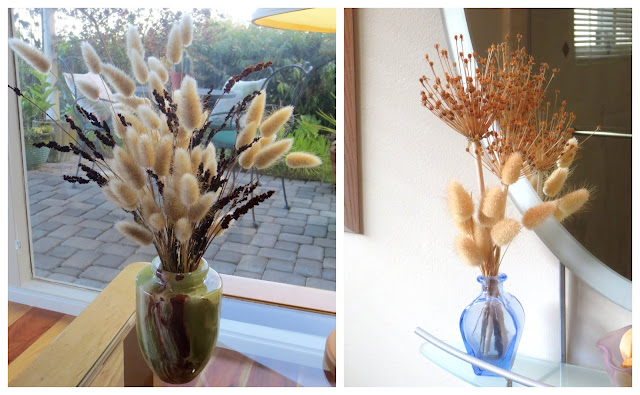
Today, Cathy of Rambling in the Garden is celebrating the eighth anniversary of her popular "In a Vase on Monday" meme.  Last week she posed a challenge, encouraging contributors to do something different this week, specifically to create arrangements of dried materials.  I've cheated a bit in that the two dried arrangements I have to offer are comprised of materials that have been kicking around my house for months.

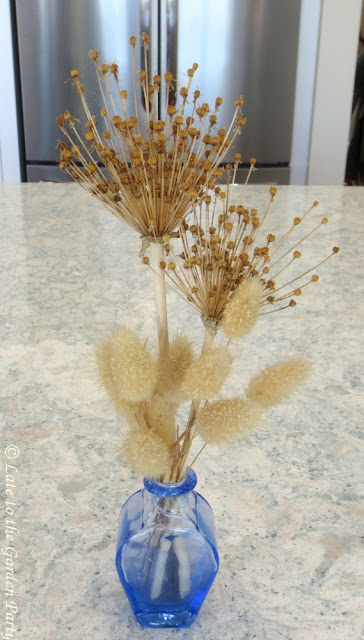
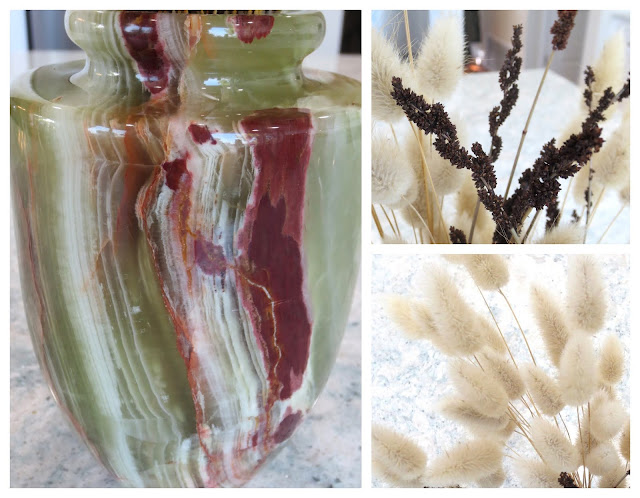
This arrangement is as much about the green onyx vase as the materials in it.  The vase doesn't hold water well and the opening is too small to accept any good-sized glass or plastic insert so I've only used it for dry arrangements.

Top view

Clockwise from the left: Closeup of the stone vase, Chrondropetalum elephantinum (aka large cape rush), and Lagurus ovatus (aka bunny tail grass)


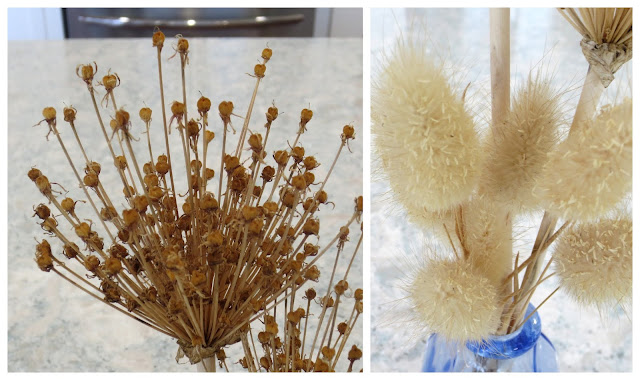
The second dry arrangement is a twist on the first.

In this case, the bunny tail grass has been combined with dried Allium seed heads

I've only planted a few Alliums in my garden as they don't usually hold up and I'm fairly certain these seed heads came from Allium aflatunense 'Violet Beauty'.  The dried material on the right is more bunny tail grass.

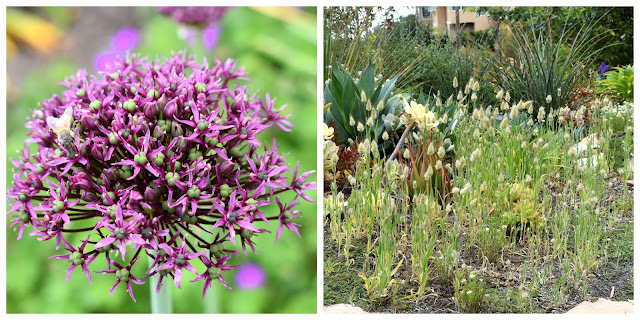
These are photos of Allium 'Violet Beauty' and Lagurus ovatus in bloom in my garden in May.  I planted 18 of the Alliums in 2017 but I think there were only 3 blooms this year.  On the other hand, I sowed Lagurus ovatus seeds in 2017 and they've been spreading to cover a larger area every year since.


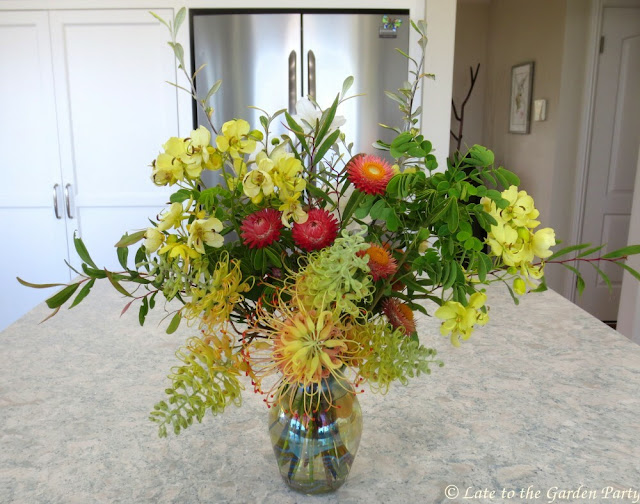
Of course I have a fresh arrangement too.  I've been cutting flowers on a weekly basis for years, even before discovering Cathy's meme and it's become a habit.  The dahlias may be done for the season and my cool season annual flowers are only a dream as yet but I can almost always scrounge up something.

In retrospect, I probably should have tried drying the strawflowers for an arrangement but I didn't consider that early enough to have them dried by Sunday.  In addition, I understand strawflowers are best used in a beheaded state as their stems don't hold up well without being wired.

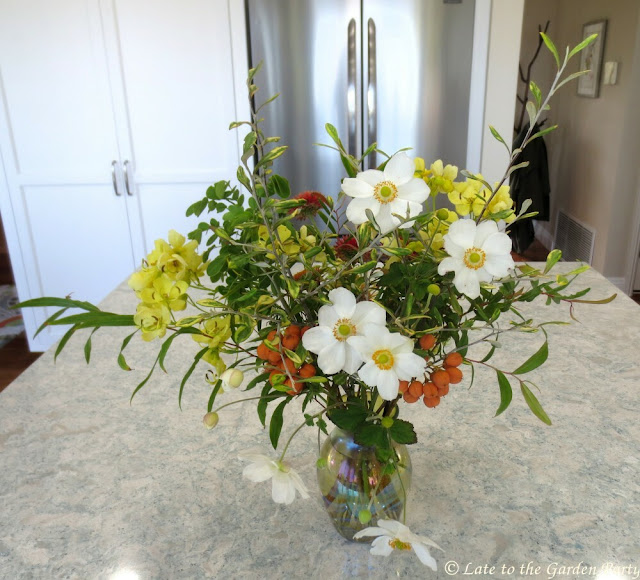
Back view, featuring the last of my Japanese anemones (Eriocapitella hupehensis)

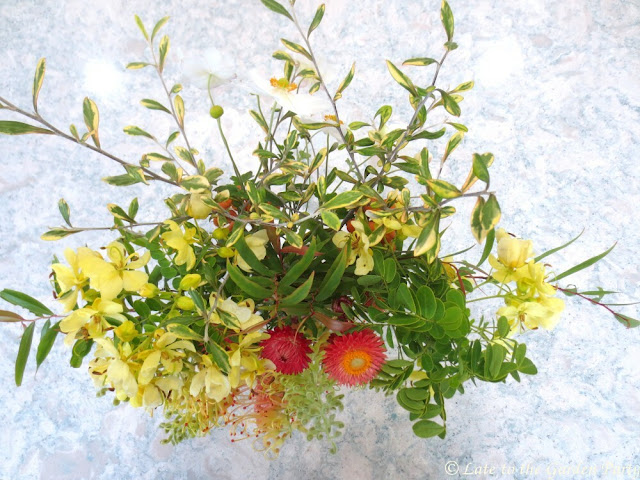
Top view

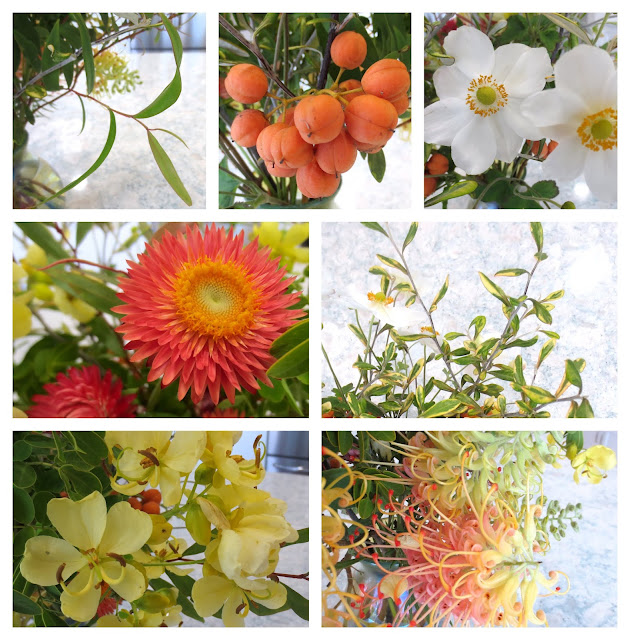
Clockwise from the upper left: Agonis flexuosa 'Nana', berries of Auranticarpa rhombifolia, Eriocapitalla hupehensis, Corokia virgata 'Sunsplash', Grevillea 'Peaches & Cream', Senna bicapsularis, and Xerochrysum bracteatum (aka strawflower)

For more IAVOM arrangements, visit Cathy at Rambling in the Garden.


All material © 2012-2021 by Kris Peterson for Late to the Garden Party
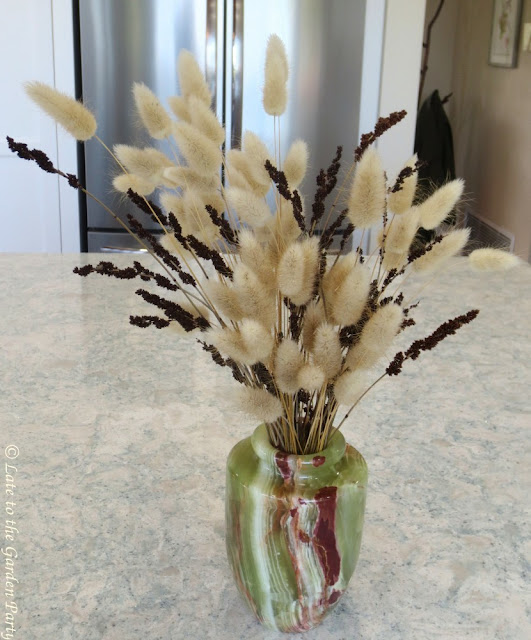

Monday, May 10, 2021

In a Vase on Monday: New arrivals

Sunday was Mother's Day here in the US.  Both my mother and my mother-in-law passed away in 2013 and my husband and I don't have children (unless you count the furry kind) so we had no specific plans for the day but I thought it might be nice to put together a few small arrangements and leave them curbside for neighbors to take.  I've done this before but I didn't really think about a giveaway until early Saturday evening when it was too windy to accomplish much.  As it turned out, I received a call from a family member about a medical emergency that got me up before dawn Sunday morning.  I was rattled by the call and found it hard to focus but, once I was up and moving around, I started cutting flowers to distract myself.  By the time I'd filled two water jugs with cuttings, I'd received a text letting me know that an emergency room visit had ruled out the worst case possibility.  Although it was already a bit late to put flowers on the curb, I threw together several tiny bouquets anyway.

If I give away flowers, I try to leave them out either in the late afternoon or early morning to catch the attention of people that walk the neighborhood but I didn't get these out until late Sunday morning.  They didn't represent my best effort but they'd still disappeared by early afternoon.

Calmer, I went to work creating my own arrangements for "In a Vase on Monday," both built on blooms that have only recently appeared in my garden.  The first, inspired by the fragrant purple pea-like blooms of Psoralea pinnata,  is a mish-mash and not entirely satisfactory.

The noID bearded Irises are also new blooms but their color, which leans toward the red end of the purple spectrum, seems off to me relative to most of the rest of the materials

Back view: I added a few stems of the color-chameleon 'Blue Shift' sweet pea to the mix in an effort to play off the Iris but they didn't help much

Top view

Top row: Centranthus ruber 'Album' and blue and white Consolida ajacis (aka larkspur)
Middle row: noID Iris germanica and a variety of Lathyus odoratus, including 'Blue Shift', 'Navy' and 'High Scent'
Bottom row: Orlaya grandiflora (aka Minoan lace) and Psoralea pinnata (aka Kool-Aid bush because the flowers smell like that grape drink)

The second arrangement is more pulled together in my view.

The new arrivals in this arrangement include Allium 'Violet Beauty' and Salvia canariensis, visible in the front view

and Melaleuca thymifolia (aka thyme honey-myrtle), visible in the back view

Top view

Top row: Allium aflatunense 'Violet Beauty', Centranthus 'Alba', and Consolida ajacis 'Splish-Splash'
Middle row: Digitalis purpurea, Lathyrus odoratus 'High Scent', and Melaleuca thymifolia
Bottom row: Pelargonium 'Lady Plymouth', P. 'Lemona', and Salvia canariensis var candidissima

For more IAVOM creations from contributors drawing inspiration from the materials around them, visit Cathy at Rambling in the Garden.


All material © 2012-2021 by Kris Peterson for Late to the Garden Party
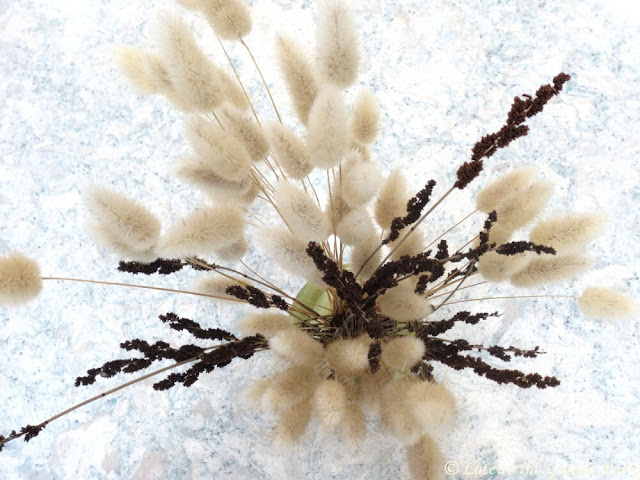
Monday, July 9, 2018

In a Vase on Monday: Blast Furnace Survivors

Heat was predicted for the weekend but the forecasts for my immediate area called for temperatures in the low 90sF, which wasn't too ominous.  I gave the areas I thought were at greatest risk extra water and applied some additional mulch on Thursday, thinking that would be sufficient until our irrigation system ran in the wee hours of Saturday morning.  I was wrong.  When we awoke to soaring temperatures on Friday morning, I ran around watering more plants while my husband shuttered the house against the heat.  The air conditioning went on before 10am.  Still, when I left the house to meet friends, I'd no idea just how bad things were going to get.  By the time I got back home mid-afternoon, our temperature had hit 110F (43C) and the humidity was in the single digits.  Strong winds that persisted well into the night made things worse.  At 8:30pm when I went back outside to do more spot watering, it was still 102F and when I went to bed around 11pm the temperature was stuck at 101F (38C).

The temperatures dropped into the low 90sF on Saturday, and Sunday was about the same, but the damage was done.  Flowers shriveled and some plants had outright died.  Even plants in my lath (shade) house were impacted.  Perhaps the biggest shock was the damage done to my Acacia cognata 'Cousin Itt', plants that have survived prior heatwaves without any sign of difficulty.

The tawny bronze color of the leaves here isn't normal and it's worsened since I took this photo.  I've 6 of these large plants scattered about the garden and only the one in the deepest shade is unscathed.  I'm not going to cut the damaged foliage until fall as I assume it'll help protect the foliage underneath from any further heat blasts.


Every time I walked outside, I found further evidence of damage.  I wasn't sure what I would find to cut for a vase and I seriously considered posting a photo of the lemons I picked Friday evening.

During the last horrific heatwave we had back in 2015 2016, my lemon tree dropped every piece of fruit virtually overnight and, although I now give the tree more supplemental water, I feared a repeat of that event.  I'd already gifted bags of lemons to friends that week but I picked buckets more for us and our neighbors Friday evening.


However, while my supply of flowers has been vastly depleted, I was able to find some that made it through the blast furnace undamaged when I surveyed the garden Sunday morning.

Almost all the Lisianthus (Eustoma grandiflorum) blooms were shriveled by the heat but I found 2 in good condition to decorate the front of this arrangement

I dressed the back of the arrangement with one of the few daylilies I found in bloom

The Abelia and Renga Lily blooms shown here were protected by deep shade.  The Artemisia foliage and Allium flowers seemed impervious to the heat.

Clockwise from the upper left, the vase contains: Abelia x grandiflora, Artemisia ludoviciana, Allium sphaerocephalon, Arthropodium cirratum, Jasminium polyanthum, Hemerocallis 'Apollodorus', and, in the center, pink and white Eustoma grandiflorum


Most of my Agapathus look awful and I've already cut down a few dozen flower stalks just because I couldn't stand seeing at them in that state but I found a few in good condition in a relatively shaded area and cut those for a second vase.

The Matilija poppies (Romneya coulteri) at the bottom of the back slope took the heat in stride, although half the blooms I cut shattered before I got them in the vase

The feverfew flowers shown in this back view surprised me - they appeared to bloom in response to the heat!

Top view

Clockwise from the upper left, this vase contains: noID Agapanthus, Abelia x grandiflora 'Hopley's Variegated', Romneya coulteri, noID Lonicera, and unkillable Rosmarinus officinalis.  Included, but not shown in close-up, is the feverfew (Tanacetum parthenium).


I'd foolishly hoped that, after a very dry winter, Mother Nature might favor us with a mild summer.  May and June were unusually cool on average and that gave me an artificial sense of security.  I'm disappointed to say the least and more than a little shocked that our temperature here hit 110F.  I can't recall a temperature that high in the seven and a half years we've lived here.  However, while I the garden sustained some losses, I expect that most of the damaged plants should survive - I just have to face several months of ugliness until they rebound.  Still, I know we're lucky that we haven't been affected by wildfires as many areas in California and the Southwest have.  The only one happy about the weather at the moment are the lizards.


For more "In a Vase on Monday," visit our host, Cathy at Rambling in the Garden.

In addition to this week's vases, one of last week's vases got a face-lift and remains in the front entry.  The dahlia blooms that were in last week's vase reacted badly to the air conditioning but the Lisianthus held up well. 


All material © 2012-2018 by Kris Peterson for Late to the Garden Party
Monday, June 25, 2018

In a Vase on Monday: Mutants!

Although my Agapanthus continue to produce a few new stalks here and there, I think their floral display has reached its peak.  There are fewer blooms this year, presumably due to our exceptionally poor winter rainy season, but I have enough clumps of these plants to provide a good show nonetheless.  So cutting a handful of those tall stalks for this week's vase was a no-brainer; however, to change things up just a little, I included two of the mutant stems I recently discovered in my arrangement.

Normally, Agapanthus produce single flowers at the top of each long, straight stalk.  As you can see in the photo above, this Agapanthus produced a second bloom mid-way along the stalk, which has curved in a gentle arc.  I'm assuming this is an example of fasciation.

I liked how the fasciated stem stretched out of the vase as if offering its blooms for closer examination.  Unfortunately, the second fasciated stem got lost in the middle of the arrangement but it's in there!

The top-heavy stems tended to flop so I added glass marbles to the vase to give them support

This was yet another vase that was hard to photograph from overhead

Clockwise from the upper left, the vase contains: noID Agapanthus, Eustoma grandiflorum, Pandorea jasminoides 'Alba', Abelia x grandiflora 'Hopley's Variegated', and Leucanthemum x superbum


Of course I didn't stop at one vase.  With our morning marine layer firmly in place along the coast, we're still enjoying cooler than average temperatures and flowers remain plentiful.  It's a huge difference from the start of summer 2016, when a sudden spike in temperature to 105F (40C) caused the widespread loss of not just flowers but entire plants and every lemon on my tree.  It took a good year for the lemon tree to recover and I count myself lucky it did.  This is a long-winded way of explaining why we so appreciate our gray summer mornings.

My second vase was inspired by the Drumstick Alliums in bloom this month.  I planted three species of Alliums in early November.  Allium aflatunense 'Violet Beauty' was a complete bust - I planted 18 bulbs and got no blooms.  Allium rosenbachianum bloomed early and well but I'd planted only 3 bulbs.  I wasn't impressed with the foliage of Allium spharocephalon but most of those 10 bulbs surprised me by blooming this month despite their spindly stalks.

It didn't take me too long to find flowers and foliage to pair with those lime and raspberry Allium blooms

I used a small glass cream pitcher unearthed during a recent purge of unused kitchen items as a vase

Top view

Clockwise from the upper left, this vase contains: Arthropodium cirratum (aka Renga Lily), Abelia x grandiflora 'Edward Goucher', Allium spharocephalon (aka Drumstick Allium), Westringia fruticosa 'Morning Light', Hebe 'Wiri Blush', and Origanum 'Monterey Bay'


For more Monday vases, visit our gracious host, Cathy at Rambling in the Garden.


All material © 2012-2018 by Kris Peterson for Late to the Garden Party