Thursday, December 15, 2016

Bloom Day - December 2016

Rain is virtually certain here today so I got out early this week to snap photos for Garden Bloggers' Bloom Day, hosted by Carol of May Dreams Gardens.  By contrast to gardens in colder climates, I have quite a bit of floral color.  It's chilly here (low 60sF) but we don't generally get frost.  Sadly, we also haven't gotten much in the way of rain the past few years but, with each rainstorm, I remain hopeful that the tide will turn and, in the meantime, I collect every drop I can in rain barrels.

I'll start this Bloom Day report with the plants providing the biggest floral impact.

Bauhinia x blakeana (aka Hong Kong orchid tree) flourishes when the air is moister and the temperatures are cooler

Camellia williamsii (left), a hybrid of C. japonica, is just getting started, while the Camellia sasanquas are already beginning to wane

The flowers of Gomphrena decumbens 'Itsy Bitsy' (sold in some locations as 'Little Grapes') are small but plentiful

I suppose it's getting old but I can't help giving applause to the Grevilleas each month.  Grevillea 'Superb' (top) deserves its name.  Grevillea 'Peaches & Cream' (bottom, left) also blooms almost continuously while G. 'Scarlet Sprite' (bottom, right) is a a winter bloomer.

Leptospermum scoparium 'Pink Pearl' produces sporadic blooms at intervals during the year but it goes to town during our cool season

Most of the ivy geraniums (Pelargonium peltatum) are blooming now.  'Pink Blizzard' (upper right) is another consistent bloomer.  'Caliente Coral' (lower left) is a cross between ivy and zonal geranium species.

Phylica pubescens (aka Featherhead) is doing very well in a pot.  I lost 2 I planted in the backyard border in late spring to the horrific start-of-summer heatwave.

Tagetes lemmonii (aka Copper Canyon Daisy) responded almost instantly to the greater sun exposure it's getting since we trimmed a nearby tree

Although Violas struggle with the dry conditions here, I love their cheerful faces and can't help but buy some plugs every year


There were a couple of surprises from plants producing out-of-season blooms.

A stray noID Agapanthus bloom turned up recently and Hemerocallis 'For Pete's Sake' has produced one flower scape since I moved 2 plants a month ago, signifying a preference for its new location perhaps


Small collections of flowers are scattered throughout the garden.  I rounded them up into a few color-specific collages.

Clockwise from the upper left, white and yellow blooms include: noID Narcissus, Achillea 'Moonshine', Alstroemeria 'Claire', Gaillardia aristata 'Gallo Peach', Gazania 'White Flame', and G. 'Yellow Flame' 

Orange and red blooms include: noID Antirrhinum majus, Aloe 'Johnson's Hybrid', Gaillardia 'Arizona Sun', red Gaillardia, Leonotis leonurus, and Papaver nudicaule

Pink blooms include, from the top left: Cuphea ignea 'Starfire Pink', Arctotis 'Pink Sugar', Argyranthemum frutescens, Cistus x skanbergii, Coleonema pulchellum 'Sunset Gold', Correa pulchella 'Pink Eyre', noID Dianthus, and noID Schlumbergera

Blue and purple blooms include, from the left: Polygala myrtifolia 'Mariposa', Erigeron glaucus 'Wayne Roderick', Felicia aethiopica, Hebe 'Grace Kelly', noID Lavandula, Limonium perezii, and Osteospermum '4D Violet Ice'


I'll end with what I suspect will be the last photos of the Eustoma grandiflorum (Lisianthus), which bloomed in large numbers from May through the present.  I don't expect a reappearance until spring but, who knows, they may surprise me.

Stray blooms of the pink and yellow varieties of Eustoma grandiflorum managed to survive until December's Bloom Day, a first even here!


Visit Carol at May Dreams Gardens to discover what's blooming in other parts of the country and around the world.


All material © 2012-2016 by Kris Peterson for Late to the Garden Party

Monday, December 12, 2016

In a Vase on Monday: Oops, I did it again

Regular readers probably won't believe me when I state that I rarely plan on preparing more than one arrangement for "In a Vase on Monday," the meme hosted by Cathy of Rambling in the Garden.  When I step out into my garden to look for material, I feel lucky if I have just one idea as to what to pick as a floral focus.  On Sunday, when I ventured out following a storm that brought us just 0.04/inch of rain overnight, I headed straight for an orchid stem I'd discovered in a corner of the property the day before when I was cleaning up after the tree trimmers we'd had on-site that morning.  The unusual color combination in the orchid had me combing the rest of the garden looking for burgundy accents.

This is the second flush of flowers on the noID Oncidium orchid I picked up at an orchid show hosted by my local botanic garden in September

The acid yellow foliage of Duranta erecta provided a nice echo of the orchid's yellow color

The yellow and burgundy color echoes show up best in this top view

Clockwise from the upper left, the vase contains: noID Oncidium; shiny Coprosma repens 'Plum Hussey'; yellow/green Duranta erecta NOT 'Gold Mound'; Gaillardia 'Arizona Sun', included to fill in some empty space upfront; Leucadendron salignum 'Chief', which is beginning to take on its beautiful red winter color; and Leucadendron 'Safari Sunset'.  The yellow in the Gaillardia bothered me here but I didn't have a good substitute.


As I was rounding the opposite end of our property, I noticed that the first bud of Camellia 'Taylor's Perfection' had bloomed.  More rain is expected on Thursday and the Camellia blooms don't like rain so I decided to clip that flower to enjoy it in the house.  One thing led to another and soon I had more than enough material for a second vase.  Oops!

Second vase featuring one flower of Camellia williamsii 'Taylor's Perfection' front and center.  This Camellia is a hybrid of C. japonica and C. saluenensis.

Back view: I picked the snapdragons after discovering 2 plants infected with rust.  The rust is particularly frustrating as I've been careful to avoid overhead watering and have given the plants ample space to ensure air flow around the foliage; however, 2 rainy weekends and the return of fog associated with the marine layer probably tipped the scales.

Top view, showing off the variegated leaves of Pelargonium peltatum 'Crocodile', a gift from Denise of "A Growing Obsession" last year.  I'm more excited about the Pelargonium leaves than any other elements of this vase.

Clockwise from the left, the vase contains: Camellia williamsii 'Taylor's Perfection', noID Camellia sasanqua, noID orange/pink Antirrhinum majus, Correa pulchella 'Pink Eyre', and Pelargonium peltatum 'Crocodile'.  Also included, but not highlighted, are stems of variegated Correa 'Wyn's Wonder'.  Correa flowers often "hide" mid-stem, making them harder to show off in arrangements.


Spending time outside collecting plant material was particularly enjoyable as the air was cool and fresh.  We played peek-a-boo with rain clouds all day but received no further precipitation; however, I remain hopeful that we'll get another good soaking later this week.  At present, our seasonal rainfall total (since October 1st) stands at a paltry 1.72 inches.


This week's vases are in place.

With Christmas decorations popping up throughout the house, vase space is becoming harder to come by


For more vases, visit Cathy at Rambling in the Garden.


All material © 2012-2016 by Kris Peterson for Late to the Garden Party

Friday, December 9, 2016

Finally, a little foliage color

With the official start of winter close at hand and much of the nation beset by an arctic blast, we're finally getting a bit of foliage color in coastal southern California.  I thought it was late this year but, when I look back at earlier posts, I see that I didn't report on foliage color until mid-January of this year so it appears that the schedule isn't running late at all.

The brightest spots of fall/winter color aren't on our property.  They're across the street in the neighbors' front garden.

These noID maples across the street put on a good show every year


But I do have a few plants that turn color when our temperatures drop, as they have in the last few weeks.

Abelia x grandiflora

One of the 2 species of guava trees in my garden, neither of which I can definitively identify

This peach tree was uncovered when the gigantic Yucca elephantipes was removed.  It sits at the unfenced boundary line between us and our next-door neighbor at the bottom of our back slope.

Persimmon 'Fuyu' produced some colorful foliage, while the leaves of 'Hachiya' simply turned brown and dropped


I've got berries developing on the Nandina domestica, the Auranticarpa rhombifolium, the self-planted noID Cotoneaster and the Arbutus 'Marina' trees but nothing does berries here like Heteromeles arbutifolia, commonly known as the California Holly or Toyon.

This tree-like shrub sits on the backyard boundary between us and our next-door neighbor


Some plants are confused.  The fig tree dropped most of its leaves in response to the heat in late summer and early fall but, when the temperatures cooled and we got some rain, fresh new leaves began to appear.

Fresh new fig leaves contrasting with one of the older leaves still on the tree


Meanwhile, the ornamental pear, Pyrus calleryana, the tree that produces the largest mass of colorful leaves on our property, looks as green as it did in mid-summer.

The tree is just now dropping its tiny unpalatable fruits and the first few leaves are coloring up


I checked my photos to see when the Pyrus turned color in prior years and it appears that it's also right on schedule.  I should see more color within the next several weeks.   I clearly need to shake the perception that foliage color is a fall phenomenon - here it's really a brief winter event.

Best wishes for a colorful weekend, wherever you are.


All material © 2012-2016 by Kris Peterson for Late to the Garden Party

Wednesday, December 7, 2016

Pumpkin Deconstruction & Wednesday Vignette

With Halloween already a distant memory and Thanksgiving now passed, it was time to deconstruct the succulent-topped pumpkin I created in late October.  The pumpkin was still in good shape, although some of the succulents had lost their luster.

Pumpkin immediately before deconstruction this past weekend


Although the succulents remained firmly in place for 5 weeks, the cuttings were easily removed.

The succulents were removed, exposing the pumpkin's moss toupee


I threw away the berries I'd used but most of the succulent cuttings were in fine shape for replanting.  They found a new home in the new succulent border I created in November when a dying hedge was removed.

Many of the succulent cuttings had already developed roots.  Clockwise from the left: Aeonium haworthii 'Kiwi' cuttings were added to those planted earlier; Graptosedum 'Darley Sunshine' cuttings were added above the rock; noID Rhipsalis were inserted above another rock; and miscellaneous noID succulents were used to edge the area below an Agave attenuata cutting planted earlier.


I passed the pumpkin off to the squirrels.  Have they touched it?  No.  Yet they consumed all the pumpkins I used as decorations out by the front door in short order.

My gift to the squirrels remains untouched.  Maybe the moss toupee is putting them off?


Maybe they're just tired of pumpkin - they've eaten a lot of it already.

In addition to the mid-sized pumpkin shown here, they - or possibly their raccoon friends - carried off 3 mini pumpkins, including one that had been placed in a hanging basket


I hope the pumpkin gets eaten before it starts to mold in place.  My garden isn't short of fungus this season.

This fungus is growing on the inside of a half wine barrel used as a planter.  Trametes versicolor is my best guess.


I'll close this post with another succulent, offered as my Wednesday Vignette.

This noID Gasteria produced a pup, which is held suspended above the parent plant, making me think of Simba's introduction to the pride in "The Lion King"


For more Wednesday Vignettes, visit Anna at Flutter & Hum.


All material © 2012-2016 by Kris Peterson for Late to the Garden Party

Monday, December 5, 2016

In a Vase on Monday: Taking cues from a snapdragon

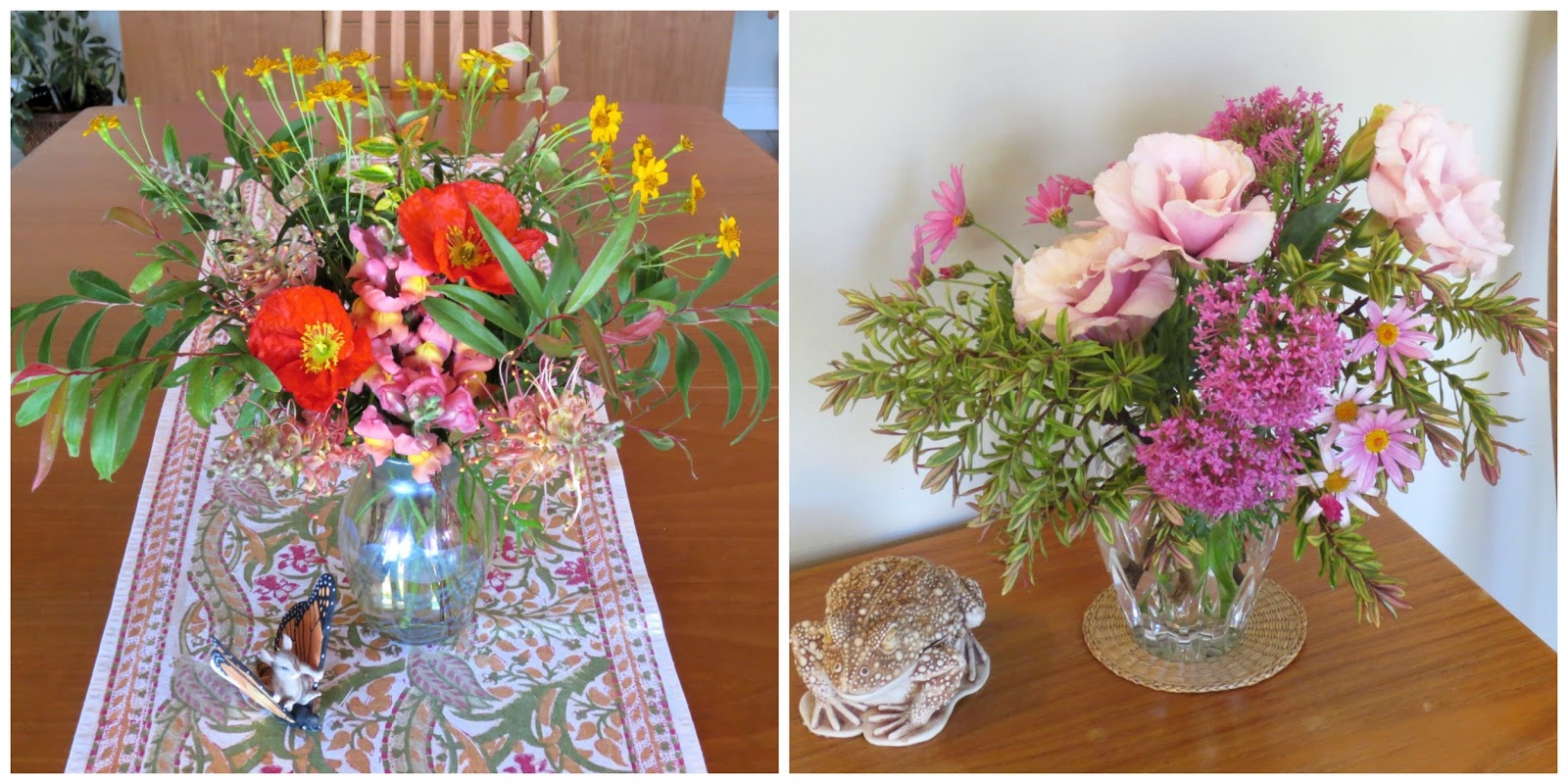
The orange snapdragons in my small cutting garden provided the starting point for this week's vase.  After a couple of good rains, the flowers are coming on well, although their stems are still relatively short.  I clipped 4 stems and then wandered about seeking companions.  Two Iceland poppies in the same area were shedding their bud covers so I clipped those too.  From that point, it wasn't hard to select foliage and floral accents.

With their saturated color, the poppies steal the show

Back view: The arrangement contains many of the same materials as I've used the last couple of weeks, albeit in a different combination and with the new element of the snapdragons

Top view

Clockwise from the left, the vase contains: noID Antirrhinum majus, Agonis flexuosa 'Nana', Grevillea 'Superb' (an almost prefect match in color with the snapdragons), Papaver nudicaule, and Tagetes lemmonii.  Abelia 'Kaleidoscope' was also included, although not highlighted here.


I usually carry around a jar containing my cuttings while assembling an arrangement - it cuts down on the number of poor matches I make.  But, when I trooped down the back slope to water my lemon tree, I saw pink Centranthus in bloom in the middle of a pathway and, thinking that it might pick up the pink tones in the snapdragon, I snapped off a few stems to take back to the kitchen.  As soon as I placed the Centranthus flower next to the snapdragon, I knew they'd make poor companions as the undertones in the pink Centranthus are blue while the undertones in the snapdragon are yellow.  So 4 Centranthus stems prompted the creation of a second vase.  Surprise! 😉

The last of the pink Eustoma grandiflorum (Lisianthus) is looking a little ragged but I thought it deserved a farewell bow so it went into this arrangement

In this case, I think I managed to make the back of the arrangement look remarkably similar to the front

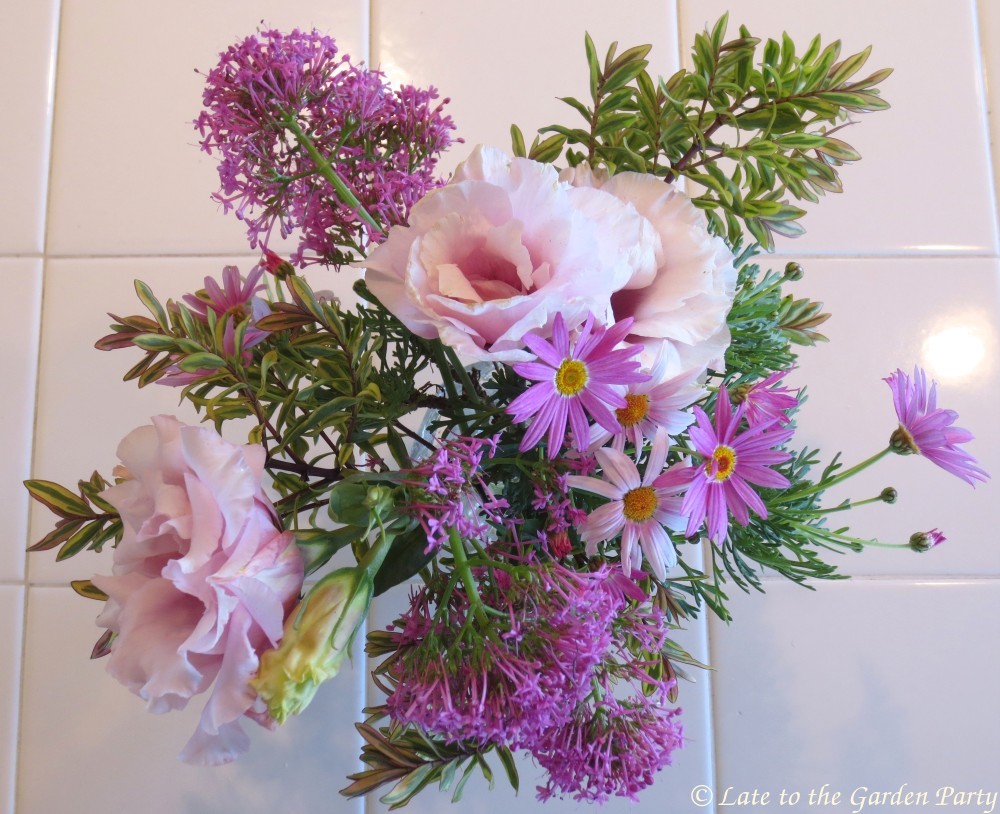
Top view

Clockwise from the left, this vase contains: Eustoma grandiflorum, Centranthus ruber (virtually a weed here), Argyranthemum frutescens, and Hebe 'Purple Shamrock' (which I think is the real star of this arrangement)


For at least a couple of days, our daytime temperatures are expected to be unusually cold, which means below 60F (15C) here, but I understand that an arctic blast is expected to affect much of the USA this week.  Wherever you are, I hope you stay warm and safe!

To see more "In a Vase on Monday" creations, visit our host, Cathy at Rambling in the Garden.  Here are my vases in their places.


All material © 2012-2016 by Kris Peterson for Late to the Garden Party

Friday, December 2, 2016

After the Rain

It's a pleasure to walk through the garden right now.  Our temperatures have remained in the low to mid-60s, cool but not uncomfortable.  The air is relatively clear and, despite the return of our Santa Ana winds, the plants generally aren't crying out for water.  I've given collected rain water to some of those I recently planted but, thus far, I've been able to leave the irrigation system off.  There's even another chance of light rain in the forecast for next Friday, although that's still too far out to feel confident about.

The foliage looks fresh.

The 3 Acacia cognata 'Cousin Itt' (left) planted under the peppermint willow (Agonis flexuosa) in the backyard border are looking better than ever.  The 'Cousin Itt'  planted in the front garden in November 2014 (right), which I almost pulled several times, is finally settling in.

Prostanthera ovalifolia 'Variegata', planted in the same bed as the second 'Cousin Itt' shown above, seems to be thriving.  I love this shrub but it hasn't ever had a long lifespan in my garden.  I've got hopes that it'll enjoy a longer life in this spot, where it seems to be getting just the right mix of sun and shade.


Bulb foliage has appeared.

Foliage of Amaryllis belladonna (left), not to be confused with its cousins in the Hippeastrum genus, has suddenly appeared everywhere.  I received about 2 dozen bulbs from Tammy of Casa Mariposa in April 2015.  Planted soon after receipt, they produced foliage off-schedule in spring of this year.  An untimely heatwave caused the foliage to die off early and I got no flowers this summer but it's right on schedule now to produce blooms in summer 2017.  Meanwhile, the Freesias (right) I planted in areas throughout the garden at intervals since moving here are coming on like gangbusters.


Seedlings are also showing up.

Left to right: Borage, Osteospermum, and Pelargonium seedlings


There have also been some surprises.

Left to right: A late - or very early - Agapanthus bloom; a bud of Camellia 'Taylor's Perfection' ready to take off about a month ahead of schedule; and foliage of Helleborus x 'Anna's Red', which I'd feared I'd lost


But then there are the weeds.  Weeds haven't been much of a problem for many months.  Apparently, they knew better than to appear when temperatures ran high and water was in short supply.  They're popping up everywhere now, though.  In addition to the conventional weeds, I've got a healthy number of weed-like thugs that aren't wasting any time spreading wherever there's an inch of bare ground.

The worst is Geranium incanum, something one of the prior owners of the property must have planted.  I've been pulling out swaths of this plant continuously almost since we moved in.  It's admittedly pretty but, if not promptly pulled, it spreads everywhere, growing over and through other plants.  I shudder every time I see it offered in the local garden centers.

Here it is, with its innocently dainty foliage swamping Amaryllis, Lantana and Alstroemeria foliage among other things.  By the time I took this photo, I'd already pulled out trugs full of the stuff.


There are plenty of other aggressive plants also on the move in the garden.

Clockwise from the left: Cotula lineariloba, a plant with pretty foliage and flowers but aggressive tendencies, which I thought I'd eradicated last spring; Erigeron karvinskianus, a useful filler that came with the house with which I try to coexist but which will probably consume the entire garden one day; Helichrysum petiolare minus (aka Plecostachys serpyllifolia), also inherited with the house, which spreads with abandon even in the driest areas of the garden; and Lotus berthelotii, planted by me, which is shown here swallowing succulents and daylilies, but which does put off digging by the raccoons

I'll be back in the garden pulling weeds and thinning out the weed imitators this weekend.  More rain, should we be lucky enough to get it, will only support their march and there's no frost here to put a stop to that.


All material © 2012-2016 by Kris Peterson for Late to the Garden Party