Friday, March 8, 2024

Tiny transient plants

It's been a busy week for appointments and, with rain complicating matters on Wednesday, I got relatively little done in the garden.  However, I did spend several chunks of time pulling weeds, especially on the back slope, taking advantage of the lower temperatures to tackle that thankless chore while the fire ants are still inactive.  While I was pulling up large clumps of grass weeds weighed down by muddy soil, I caught sight of something green I'd never noticed before.  At first I wondered if it could be lichen, which I've never seen locally, but my phone identified it for me, correctly on this occasion I believe.

This is Lunularia cruciata, aka crescent-cup liverwort, one of the world's smallest plants.  It's reported to have antibacterial, antifungal, and antioxidant properties.  It's native to the Mediterranean area but it's gone "wild" in California.


Unlike lichens, which are described as symbiotic combinations of fungi and algae, it turns out that liverworts are plants, ancient ones at that.  According to Britannica, fossils of liverworts more than 470 million years old have been found in Argentina.   Liverworts are related to mosses, which are also ancient plants.  Both are classified as Bryophyta.  They both lack vascular systems and produce spores rather than flowers.  Both have also managed to survive and thrive through dramatic changes in earth's climate.

Moss is also a relative anomaly here, albeit something we see on a seasonal basis provided we get a decent amount of rain.  This year's rainfall is proving to be almost as substantial as what we got during the last "water year" (calculated from October 1st through September 30th of the following calendar year).  Even though our total to date is just over sixteen inches, the accumulation of moss looks thicker than ever.  It's particularly noticeable on my shady, east-facing back slope.

Closeup of a relatively chunky segment of moss, which seems to like growing next to the concrete block stairs

View of the moss-lined stairs on the route down to the bottom of the slope in January

View along the route up the stairs in March with the moss even thicker

And it's crept to the top of the concrete stairway in the main level of the garden too


Moss has also fared well in the crevices between paving stones in many areas.  I've heard people complain about moss creating a slipping hazard, particularly when it shows up in paved areas, but it's not been a problem here.  For one thing, our summer heat sends it into a rapid retreat.  But I've also read that it's not moss but rather algae, which develops under similar circumstances, that creates slippery surfaces.  You can find an interesting article about the myths regarding moss here.

I like the soft footpath that moss creates in areas of my garden.  It's too bad that most of these disappear once summer arrives.

Moss-coated front garden path from the driveway to the lath house


Much as I appreciate the bright chartreuse green color of these transient plants in my garden, I recognize that they may have less appeal to some readers.  Here are a few of the newest spring arrivals in my garden to give you a jolt of color to start off the weekend.

Arctotis 'Large Marge'

"Blue" Freesia

Iris hollandica 'Sapphire Beauty'

Leucospermum 'High Gold' (which I formerly identified as 'Goldie' based on the seller's ID)

Tulipa clusiana 'Lady Jane'


Enjoy your weekend!


All material © 2012-2024 by Kris Peterson for Late to the Garden Party


Wednesday, March 6, 2024

Surrounded by a ring of fire

Reference to a "ring of fire" may conjure a number of images in your mind.  If you're a student of geology, you might think of the path of volcanoes and seismic activity rimming the Pacific Ocean.  According to National Geographic, seventy-five percent of the world's volcanoes lie on the Pacific Ring of Fire, which also accounts for ninety-five percent of its earthquakes.   (I should note that this includes coastal California.)  However, the reference may also make you think of the classic country song co-written by June Carter and popularized by Johnny Cash, who first sang it in 1963.  'Ring of Fire' is also the name of a 2013 television movie about the relationship between Johnny Cash and June Carter Cash, who became his wife in 1968.

"My" ring of fire has nothing to do with any of those things.  For me, the expression refers to the Xylosma congestum hedge that surrounds a large part of my garden.  I inherited it with the garden and, although I've never had any particular fondness for hedges, I admit that I gradually fell in love with this one.  It's particularly attractive when it produces fresh new foliage.

The fresh foliage has a bronze-orange cast but the older, shiny green leaves look good year-round.  The hedge responds well to pruning too.  It also produces masses of tiny yellow flowers that the bees love but those flowers are relatively rare due to its regular pruning.

Section of the hedge on the north end of the back garden.  This entire back garden section hides the sharp drop of the slope on its other side (which also protects the gardener and visitors who might otherwise take nasty falls).

View of the mid-section of the back garden hedge with the entrance to the Port of Los Angeles in the distance

This section of the hedge winds around the south-side garden, flowing into the back garden

View of the back hedge from the bottom of the back slope.  The trees poking up behind the hedge are the 2 Arbutus 'Marina' trees on the upper level of the back garden.

This section of the hedge sits on the north end of the front garden, where it borders the edge of a path mainly used to move our trash and recycle bins to the street for pick-up

This section runs from the driveway south.  It's mirrored on the other side of the driveway looking north.

When we moved in, there was a break in the front Xylosma hedge on its south end.  I was told that the entire stretch facing the street was originally planted with a different shrub, Auranticarpa rhombifolium.  When those shrubs started dying, they were replaced by Xylosma everywhere except in this last area.  When the remaining Auranticarpa here died off, I planted more Xylosma behind the succulents I'd used to fill gaps between the Auranticarpas.  They've only just now reached the height of the original Xylosmas.


Coincidentally (or not), there are lots of plants that echo the color of the fresh Xylosma foliage at this time of year too.

Aloe striata and Euphorbia tirucalli 'Sticks on Fire' complement the Xylosma foliage

Clockwise from the upper left, flowers that do the same include: Arbutus 'Marina', Leucospermum 'Royal Hawaiian Brandi', L. 'Sunrise', L. 'Spider Hybrid' (still in bud), Grevellea 'Superb', and Metrosideros collina 'Springfire'

More complementary flowers, clockwise from the upper left include: Arctotis 'Pink Sugar', Erysimum 'Wild Orchid', orange Ranunculus, Gazania 'Gold Flame', Lobelia laxiflora, and Sparaxis tricolor


The "ring of fire" phenomenon in my garden isn't a once-a-year event.  The hedge produces a fresh flush of reddish-orange foliage a few weeks after the hedge is pruned, which happens three or four times a year.  However, the color appears brightest during this first flush during our rainy season.


All material © 2012-2024 by Kris Peterson for Late to the Garden Party


Monday, March 4, 2024

In a Vase on Monday: Spring is off to a bright start

Even though our daytime temperatures are back in the mid-50sF (that's cold for us!), I can feel spring advancing its pace.  I've already found buds on some species tulips.  I thought that seemed early but, when I looked back at my records, I discovered that the 'Lady Jane' tulips flowered in late March in 2023 and mid-March in 2022 so it appears my plants are right on target despite our rainy season's slow start.

In spring, I'm often tempted to cut everything in sight; however, I'm trying to slow down a bit and enjoy the season as it unfolds.  My first arrangement this week celebrates the red and white anemones in my cutting garden.

Catching Anemone coronaria 'Rosa Tigrato' at the right time has been a challenge.  Two of the flowers included in this arrangement are a bit past their prime whereas 2 others may have been cut too soon.

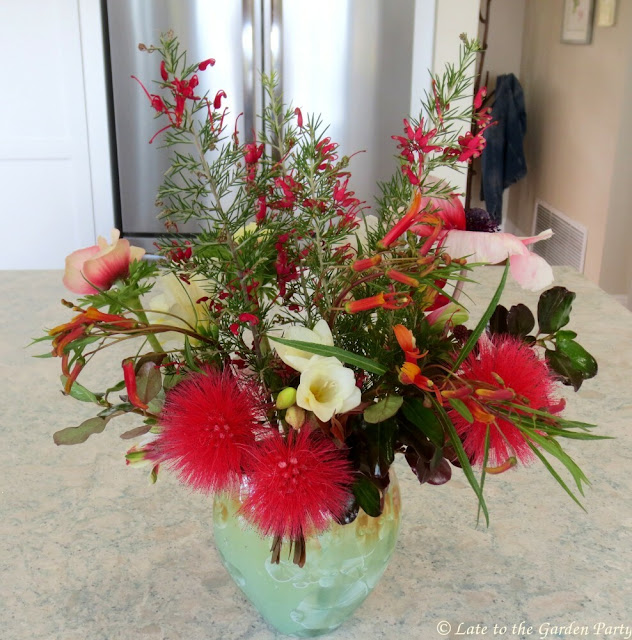
I used 3 stems of Calliandra haematocephala (aka red powder puff) to dress up the back of the vase

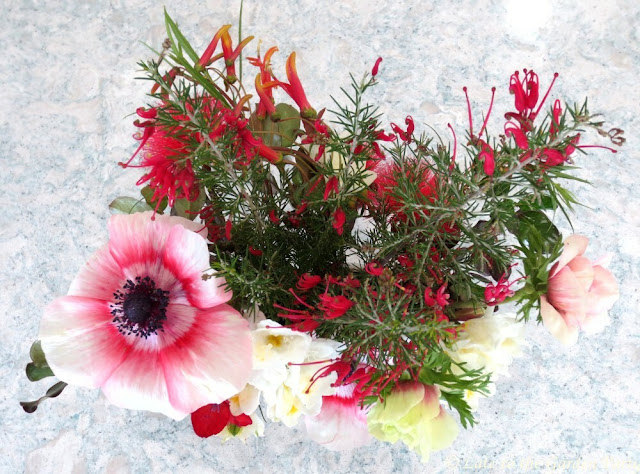
Top view

Top row: Alstroemeria 'Inca Lucky' and 2 Anemone coronaria 'Rosa Tigrato' at different stages of bloom
Middle: Calliandra haematocephala, Coprosma repens 'Plum Hussey', and red Freesia
Bottom: white Freesia, Grevillea 'Scarlet Sprite', and Lobelia laxiflora


The white and yellow Freesias are blooming in large numbers at present so I decided to focus an arrangement around them rather than using them as accessories to other, bolder flowers for a change.

The flowers are all Freesias and Narcissi

Back view

Top view

Clockwise from the upper left: Acacia cognata 'Cousin Itt', white Freesia, yellow Freesia, noID Narcissus, and noID tazetta-type Narcissus


I cut flowers for a third tiny vase to enjoy at my desk just because I couldn't help myself.

Deep blue Anemone coronaria and noID purplish sweet peas.  I planted 5 different varieties of Lathyrus odoratus, 2 of which were mixes.  My guess is that this is one cultivar from one or another of the 2 mixes but I can't put a name to it.  Nor can I explain why none of the other cultivars within the mix are blooming.


We had low expectations for last week's storm but we received more rain than was forecast.  Another storm is on the horizon for mid-week and I'm hoping for a little more than is forecast there too, although not so much as to cause any more flooding or landslides in California.


For more IAVOM posts, check in with Cathy at Rambling in the Garden.


All material © 2012-2024 by Kris Peterson for Late to the Garden Party


Friday, March 1, 2024

I've got the blues

As any regular reader of my blog knows, I have a pronounced affection for flowers.  I'm especially fond of blue flowers.  I'll grow - or at least attempt to grow - any plant known to produce blue blooms.  As spring gets started, the blues have started to accumulate.  Here's a look at what currently has me singing (about) the blues:

After failing with other bugloss species, I tried Anchusa capensis 'Blue Angel' based on a recommendation by blogger Phillip at Dirt Therapy.  I've got just one plant but it's done well enough to encourage me to plant more.

The blue Anemone coronaria are prolific this year.  I ordered 'Lord Lieutenant' bulbs but I'm not sure that's what I got; however, I'm happy with the flowers in any case.

This is Aristea major, which is much brighter when viewed in person.  I've difficulty capturing the true color of most blue flowers with my camera.

Campanula portenschlagiana is just getting started

Ceanothus arboreus 'Cliff Schmidt' on my back slope is a challenge to photograph because it sits on our property's border and I can't get far enough away on our side of the line to get a good shot.  The tree-sized plant is hidden behind a lemon tree on our side, backed up by a neighbor's fence on the east side, and drops off sharply into another neighbor's property on the south side.

This is a closeup of a noID Ceanothus that came with the garden.  It was grown as a hedge about one foot away from the Xylosma hedge that runs the full length of the back garden.  There were several of these same Ceanothus growing in the front garden (a foot away from another Xylosma hedge).  Those plants died back suddenly a few years after we moved in and we removed them - or thought we did.  After 2 years of good rain, I've seen signs that 2 of the shrubs are attempting a comeback.

This is one of 3 Echium handiense I've grown from cuttings

I grow several Felicia aethiopica sub-shrubs in the back garden

Ipheion uniflorum (aka spring starflower and Mexican star) is a very pale blue

I planted 5 varieties of sweet peas in my cutting garden but only one is blooming so far and I can't say with certainty which one it is.  My best guess is that it's Lathyrus odoratus 'Mermaid's Dream'.

Lavandula multifida (aka fernleaf lavender and Egyptian lavender) blooms year round

Not flowers but the berries of Mahonia x media 'Charity' put on a better show than the flowers anyway

Top row: Osteospermum '4D Pink' has a purple-blue center
Middle: O. '4D Silver'
Bottom: O. 'Purple Spoon' and O. '4D Violet Ice'

Pericallis hybrids (aka cineraria), grown as annuals. The true blue varieties on top were included in a mix of plugs, most of which were blue.  The one on the bottom is Pericallis hybrida 'Magic Salmon', a favorite of mine.

I've a lot of prostrate rosemary (now classified as Salvia rosmarinus), all of which is blue even if it looks white in photographs

NoID Scaevola and Teucrium fruticans 'Azureum', both best viewed in closeup

Top: Viola 'Sorbet XP Neptune'
Bottom: Viola cornuta 'Penny Peach'


If my records from prior years can be relied upon, many more blue flowers can be expected to show up by the end of March.  These are likely to include some of the brightest blues: Delphiniums, Iris douglasiana, Iris hollandica 'Sapphire Blue', Limonium perezii, and Scilla pervuviana.


Before I exit for the weekend, I'll share a few of the white flowers that are currently putting on a good show as well:

My ornamental pear tree (Pyrus calleryana) finally bloomed

The white Freesias (left) are well ahead of the blue ones this year,  The Osteospermum '4D White' (right) are off to a very good start.


Have a great weekend!


All material © 2012-2024 by Kris Peterson for Late to the Garden Party