Friday, December 9, 2022

A walk interrupted by diversions and roadblocks

I visited South Coast Botanic Garden this week, my sixth visit this year.  My motivation was to check out their gift kiosk for something I had in mind for a friend but of course, knowing they had a few major activities in the works,  I had to check out the garden as well.  I'll introduce those later but I'll start with the images that grabbed my attention as I made my rounds.

Even though they're just beginning to bloom, the Aloe vanbalenii and the hybrid variety behind them looked great

This display of fall color on the walkway bordering the rose garden stopped me in my tracks.  I'm not positive but I think these are crape myrtles (Lagerstroemia sp.).

I appreciated the new plantings in the beds on either side of the entrance courtyard too.  I should have taken a closer look at the trees in the top photo.  Could that be Podocarpus 'Icee Blue'?

No post on SCBG is complete without a de rigueur photo of the Living Wall.  At first it bugged me that the cafe tables had been moved right in front of the wall but I decided that arrangement gave people a better opportunity to appreciate the wall while eating and talking.

There were fewer flowers but there are always some.  Clockwise from the upper left: Aloe 'David Verity' (I think), noID Brugmansia, Dalia imperialis (aka tree dahlia), Justicia aurea, noID Senna, Tecomaria capensis, and Tithonia diversifolia (aka Mexican sunflower tree).

There were 3 of these holiday trees constructed of potted Cyclamen.  I wanted to like them but I couldn't warm up to them.  Maybe they'd have been more appealing if they were surrounded by colorful foliage and flowers at their base.


The garden opened a Lego exhibit, Nature Pop, on November 5th.  I loved the previous Lego exhibit in 2016 but, while I admired the artistry that went into the new exhibit, I couldn't get excited about it.  However, to be fair, I only viewed only a handful of the 40 sculptures.

Note the complexity involved in incorporating a polar bear cub on its mother's back (photo top, right).  This exhibit runs through January 24th.


My attention was diverted by the activity involved in readying the Astra Lumina light show for its opening on December 8th.  SCBG is hosting the event but more information is available here from the parties responsible for logistics.

Map showing the different staging areas associated with the exhibit, which is scheduled to run through January 15th

I think these photos captured most of the sites on the map, other than the Celestial Trail and probably the Starburst Rays.  If I guessed correctly, clockwise from the upper left, the sites shown follow the map from the photo station through the Archway (with the 2 exceptions I noted).

These are closeups of the Starlight Lanterns, located in the Garden for the Senses


As I walked through the garden I ran into several areas that were closed to the public.  I was aware that SCBG has begun work on its new children's garden but, as familiar as I am with the garden due to my prior stint as a volunteer, I was temporarily disoriented about where I was and how to navigate the garden areas that were still open.

Access to the Banyan Grove (perhaps my favorite area in the garden) was partially blocked but it and the blue sphere sculpture (second row, right) told me where I was.  The lavender field and the desert willow trees that stood along the tram road appear to be gone.

I'd already surmised that the enclosed area is the staging ground for the new children's garden but I didn't see any official notice of this until I found this relatively small sign adjacent to the bridge in the existing children's garden.  More signage around the fenced area would be helpful but with the light show and other events kicking off perhaps someone felt it would be confusing,

The upper meadow and parts of the rose garden were also closed


I checked the gift kiosk for the gift I was looking for but didn't find what I wanted.  Regrettably, the garden shut down its propagation area early in the pandemic and apparently has no plans to reopen it, which I think is a pity on several counts.


At least I got my steps in on the day of my visit.  I recorded over 16,000 steps that day, the most since I started tracking them - and I didn't even cover half the botanic garden on this visit.  


We're looking forward to a wet weekend.  Hopefully, Mother Nature isn't planning to pull the rug out from under us once again this time.  Whatever your weather, I hope you enjoy a pleasant weekend.


All material © 2012-2022 by Kris Peterson for Late to the Garden Party

Tuesday, December 6, 2022

A Week in Flowers: The finish line

Cathy of Words and Herbs launched her annual 'Week of Flowers' last Wednesday to brighten the outlook of gardeners in the Northern Hemisphere facing all too many gloomy days during the colder winter months.   Coastal Southern California isn't nearly as cold or as gloomy as many areas but, after a long hot, dry summer and a steady decline in flowers, I find myself looking forward to spring, when every day reveals something new.  However, reflecting the name of my blog, I'm once again "late to the garden party" in pulling together photos to celebrate a Week in Flowers, delivering these on its very last day.

Spring arrives very early in my frost-free part of the world.  We don't have a winter in the sense that most people envision that season.  In fact, we often say we have just two seasons: a cool season and a warm-hot season.  Our cool season coincides with our rainy season, although we've been seriously short on rain for the last two years and we seem to be stuck in the same pattern this year.  But the combination of whatever rain we get and the lengthening days that follow the winter solstice begin the charge that leads to the flourish of flowers that arrive with spring.

I reviewed my floral photos from January through March 2022 to remind me of what I have to (hopefully) look forward to in 2023.


JANUARY

Last year, Arctotis 'Pink Sugar' started blooming in my back garden in January and continued for months.  The plants take a beating every summer but revive in response to rain.  Although the plants in my front garden look like they've thrown in the towel, I think those in the back are in better shape.

Camellia williamsii 'Taylor's Perfection' normally trails Camellia sasanqua in my garden by a couple of months.  An untimely heatwave has at times cost me the majority of the flowers.  I saw the first touch of pink in one bud yesterday so maybe the shrub is plotting an earlier appearance this year.

Last year Hippeastrum 'Luna' put on a magnificent performance in January.  I subsequently planted the bulbs in the ground in the hope that they'll naturalize.  If they do, they'll probably bloom several months later but that's okay - I planted other Hippeastrums bulbs in several pots this year for an earlier display.

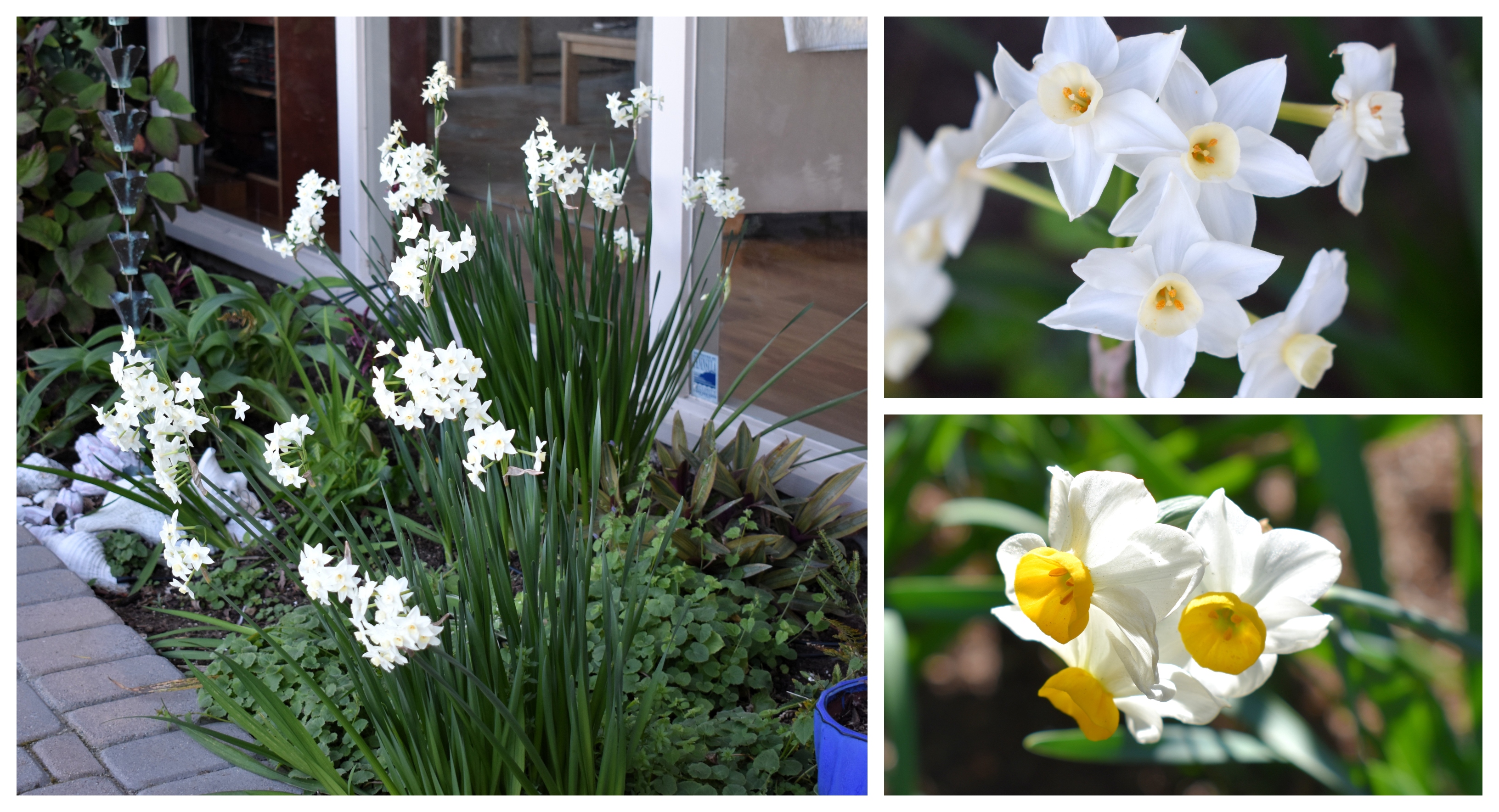
These noID paperwhite Narcissi, inherited with the garden, bloom early every year.  I've already noticed the stems poking up through the soil in this area.

FEBRUARY

Ceanothus arboreus 'Cliff Schmidt' was planted on my neglected and very dry back slope from a 1-gallon container in January 2018.  It's 7-8 feet tall now  and could eventually grow to 15-20 feet tall and wide.

Together with the paperwhite Narcissi, the first bulbs to bloom in my garden are usually the Freesias.  They began developing foliage a couple of months ago, although the voracious rabbits may be setting them back this year.

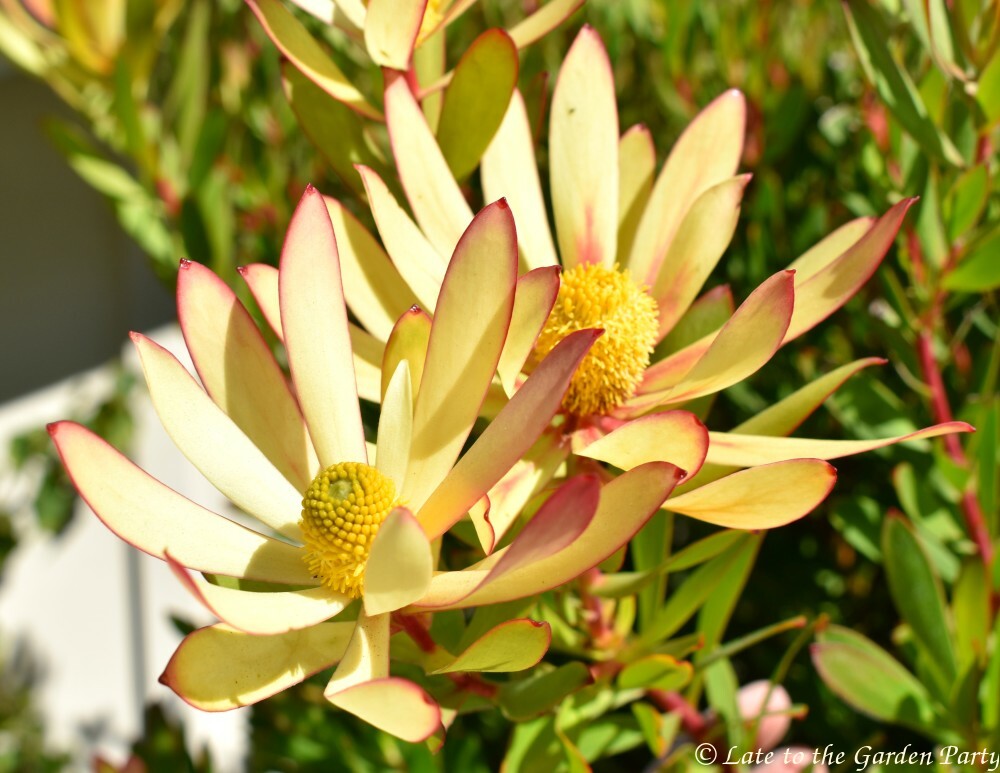
The colorful bracts of Leucadendron 'Wilson's Wonder' mimic flowers early each year; however, the gardeners mistook them for a hedge last month and I can't say what that's going to do to their normal "bloom" schedule.

The ornamental pear tree (Pyrus calleryana) is currently in the process of shedding all its leaves (and its annoying fruit).  It's also scheduled for its annual pruning in 2 weeks but I expect it'll still be blooming like this in late February.  It's very pretty even if its flowers do have a mildly unpleasant scent.

MARCH

The Anemone coronaria may start blooming as early as February in my cutting garden but these bulbs and others really take off in March

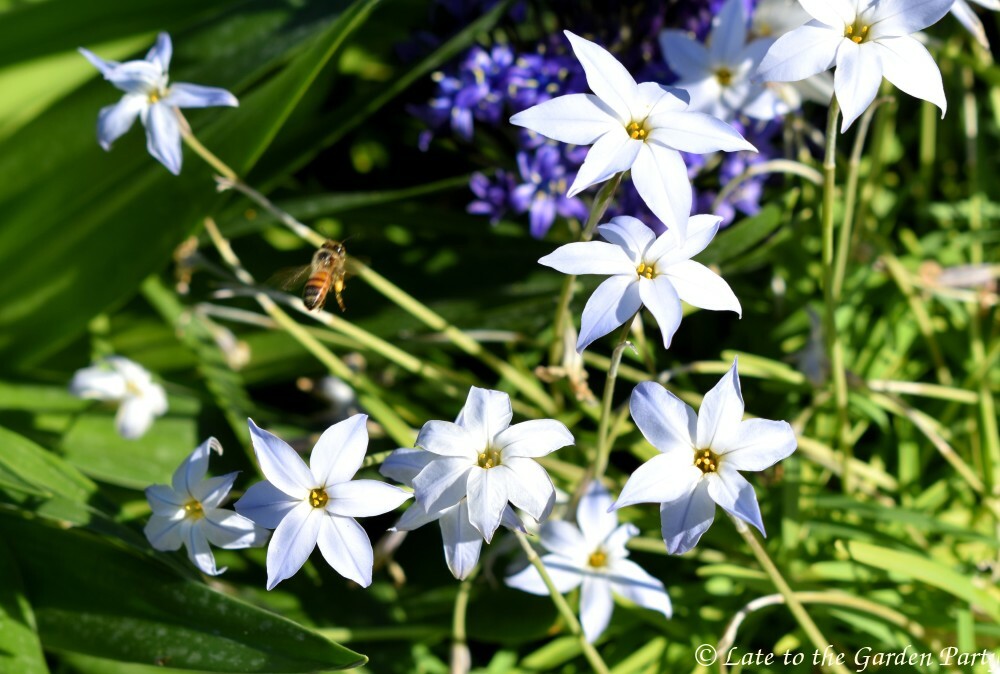
The foliage of the spring starflowers (Ipheion uniflorum) is already developing in some areas.  The tiny bulbs will probably begin flowering in February but should peak in March.

The tips of the Dutch Iris are already pushing up in some areas as well.  The majority of mine are 'Sapphire Beauty' (left) and 'Mystic Beauty' (right) but I plant more bulbs every fall.  This fall's addition was 'Pink Panther'.

The foliage of Scilla peruviana began to develop in September this year so maybe those flowers will appear earlier this coming spring as well

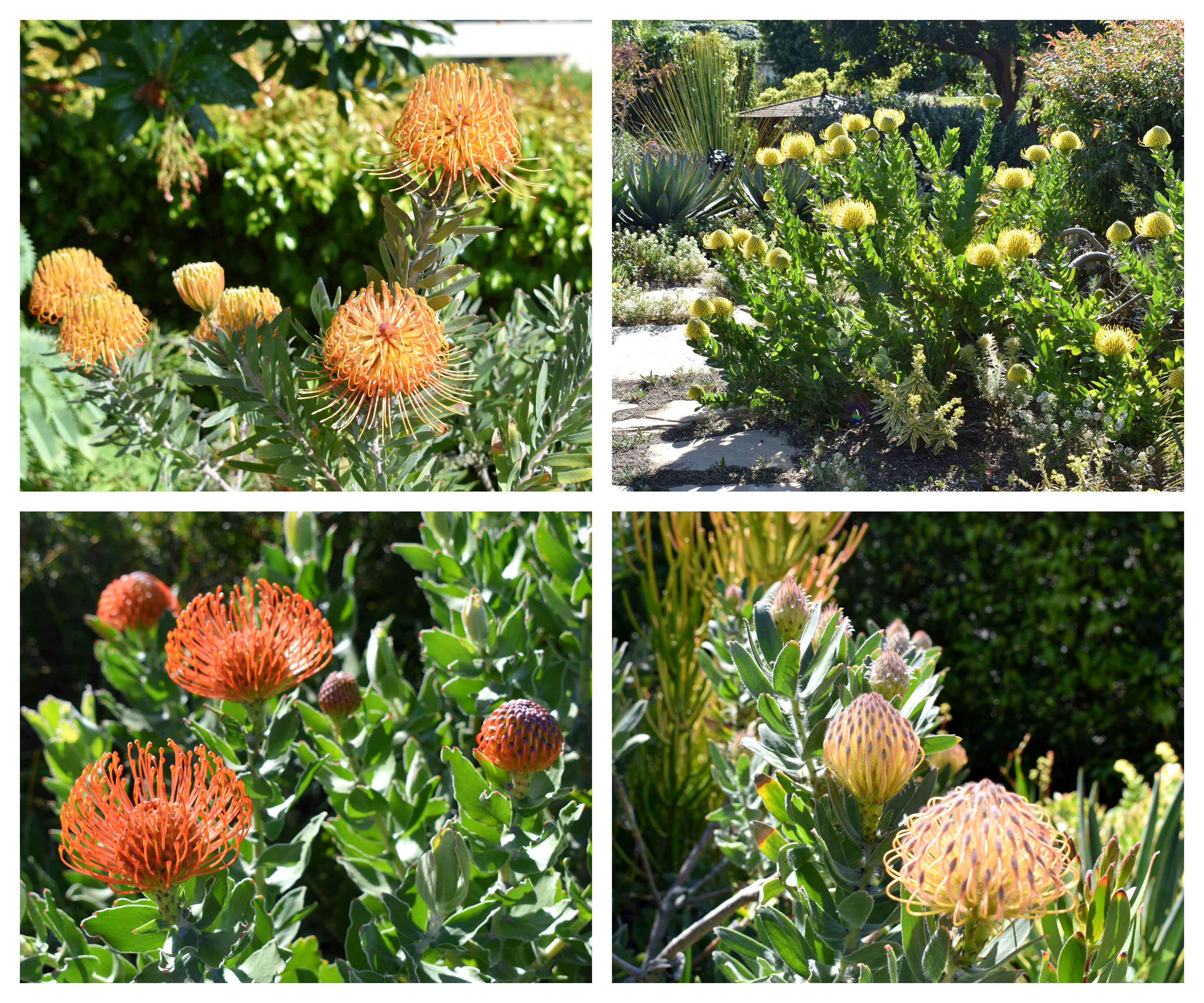
The pincushion shrubs, members of the Protea family, generally begin flowering in February with a peak performance as a group in March.  Clockwise from the upper left are Leucospermum 'Brandi', L. 'Goldie', L. 'Hybrid Spider', and L. 'Sunrise'.

This is Osteospermum '4DPink'.  It was a new introduction to the genus last year.  Some didn't survive the summer and others appeared to develop a muddier color over time.  I'll be interested to see if any display colors this vivid next year.  


Thanks to Cathy for launching this campaign to lift everyone's spirits!  For other posts in this series, visit Cathy at Words and Herbs.


All material © 2012-2022 by Kris Peterson for Late to the Garden Party

Monday, December 5, 2022

In a Vase on Monday: Limited options

At present my cutting garden has nothing to offer other than the occasional bloom from Dahlia 'Lavender Ruffles', which still hasn't give up the ghost.  The foxgloves I planted don't show signs of flowering anytime soon and while the many of the seeds I've sown have germinated, I don't expect to see them or the Anemone coronaria corms in bloom for months yet.  I had a hard time this week coming up with material to fill one vase, much less two, but I persevered.

The inspiration for my first arrangement were the bush violets (Barleria obtusa) in my front garden.  I cut several stems but, after a little rain on Friday, the flowers looked bedraggled and I ended up discarding them.  They established the color scheme, though.

Luckily, I'm getting a Lisianthus (Eustoma grandiflorum) bloom every once in awhile and the Osteospermums continue to rally in response to our cooler temperatures

Back view: For the second year in a row I found a noID paperwhite-type Narcissus blooming in the front garden.  I'm sure I never planted it deliberately in that area but perhaps those bulbs were mixed in with another bulb I planted there by accident.

Top view

Clockwise from the upper left: Eustoma grandiflorum, Osteospermum '4D Violet Ice' and another self-seeded variety, Correa 'Ivory Bells', Lavandula multifida, and noID Narcissus


I targeted the flowers of the Hong Kong orchid tree (Bauhinia x blakeana) for a second arrangement; however, cutting those is a challenge as most of them were far above my head and I hate ladders.  (I'm also stubborn about requesting help from my husband, especially when he's busy with his own projects.)  I'd planned to make do with one short stem but, when I decided to pull out my loppers to tackle a few of the tree's twiggy stems, I managed to capture two more flowering stems in the process.

I used my asymmetrical glass vase, which photographed from this angle looks wonky to me but there it is

Back view: I used ivy geranium flowers (Pelargonium peltatum) in various colors as my main floral filler

Top view

Clockwise from the upper left: Bauhinia x blakeana, Gomphrena decumbens 'Itsy Bitsy', Hebe 'Purple Shamrock' (recycled from last week), Pelargonium peltatum in burgundy, lavender and white, and Leptospermum 'Copper Glow' foliage


While we did get rain on Friday, it wasn't much, just 0.17/inch (4.32mm).  The heavier rain originally forecast for Sunday failed to materialize  - we got 0.02/inch in my area.  It looks like La Niña's hold on us remains intact.

 For more IAVOM creations, visit Cathy at Rambling in the Garden.


All material © 2012-2022 by Kris Peterson for Late to the Garden Party


Friday, December 2, 2022

The succulents are slowly taking over

Even in sunny Southern California, winter tends to tamp down activity in the garden.  The good news is that succulents provide interest year-round.  In fact, washed clean of accumulated dust and dirt by even a light amount of rain and facing less competition from flashy flowers, they shine in winter, at least in my frost-free climate.

The weather generally permits daily walks around the neighborhood and I recently took notice of a couple of interesting developments.

Walking with a neighbor, we stopped in front of the long border at the front of her house and I noticed that the flowers of her variegated Aloe arborescens had a crested form, which I've never seen before

Two Agave attenuata (foxtail agaves) in another neighbor's street-side garden have developed hefty bloom stalks


Back on my home turf, as I was cleaning up leaves in my front garden, I noticed that one of my own agaves is also preparing to bloom.

This is Agave 'Multicolor' (syn Agave mitis 'Multicolor', formerly classified as Agave celsii).  I purchased this one in 2017 and acquired 2 more somewhat later.


I was startled to find that Agave 'Multicolor' is going to bloom - and that its bloom stalk was already about six feet tall by the time I noticed that fact.  On the other hand, two agaves I check regularly for signs of a bloom event are maintaining the status quo.

The Agave ovatifolia (whale's tongue agave) shown here has been in this spot for over 10 years.  It and its companion, Agave vilmoriniana (octopus agave), planted in 2014, are both larger than this photo makes them appear.

The largest of my many 'Blue Glow' Agaves has been showing signs of its intent to bloom for several months, as evidenced by the pups sprouting from its side and the flattening of its leaves, but to date there's no bloom stalk.  The oldest 'Blue Glows' in this bed were planted 8 years ago.


Aloe blooms don't present the concerns that agave blooms do as aloes don't die after flowering.  I don't have many aloes that bloom this early in the season but I noticed a few this week.

This is one of the smaller hybrids, Aloe 'Safari Sunrise'

The centerpiece in the middle of this collection of agaves and yuccas is a hybrid Aloe vanbalenii x ferox.  This will be the second time it's bloomed in my garden since it was planted in 2016.
The plant on the left is Aloe vanbalenii x striata, which is preparing to bloom for the first time.  I picked up the unlabeled plant on the right from my local botanic garden earlier this year and guessed it might be the same hybrid despite its orange color but now I'm not so sure, although I do think it's an offspring of Aloe vanbalenii (crawling octopus).


While I had my camera out I snapped photos of various succulent beds I've been working on for some time to provide an update on their progress.

Replanting this bed on south-facing slope on the lower level of the front garden was one of my pandemic projects.  It's gradually filling in.  The Agave desmettiana 'Variegata' shown in the photo on the left in the second row were pups of 2 plants that bloomed out in my street-side border in 2019.  The plants shown in the third row are bulbils of those same plants.  The degree of variegation varies.

The bed in the foreground was replanted with a variety of succulents in late 2021 and the bed in the background was replanted with succulents this year
The succulents and bromeliads in this bed along the front property line were replanted in September following our water pipe replacement project


This is one of my oldest succulent beds, first planted in January 2016 in the front garden next to the garage after we removed the last of our lawn.  The only succulent that was in place here when we bought the property was that multi-trunked clump of Agave attenuata in the background on the left.  Despite adding and subtracting succulents for years, I'm still dissatisfied with the area overall.  I think my original error, which I repeated again and again, was relying too much on small plants.  Rather than continue to tweak it, I think a wholesale replanting may be in order.


After scrutinizing those succulent beds I decided to stop procrastinating about tweaking the bed adjacent to the back of the house.

This is what the bed looked like before I touched it this week.  A few months ago, while cleaning up the area, I added a good-sized Agave attenuata cutting (between the rainchain and the Agave 'Ray of Light') and a smaller pup (barely visible on the right).  A lot of bare spots remained.

This week, I added 3 cuttings of Aeonium 'Sunburst' and 7 pups of Agave bracteosa (squid agave), all relatively small.  You may not even be able to make them out in this wide shot.

These photos taken from inside the house show the additions more clearly.  The Aeonium cuttings should grow quickly but the squids may take their time.


There are other succulent beds I haven't shown in this post of course.  Can you believe that, when we moved in over ten years ago, the only succulent in my garden was that multi-trunked Agave attenuata in the front garden? Not only have I propagated that particular foxtail agave many times over, I've added too many other succulents to count since then.  With every passing year, more and more of my garden has been given over to succulents and, due to the pressures of climate change, I fully expect that trend to continue.


Best wishes for a wonderful start to December!  Rain is in our forecast for the weekend but the prospects are literally shifting hour-to-hour - and not in a positive direction.  One system is expected to pass through in the early morning hours, to be followed by another system on Sunday but, even if the rain materializes, it's no longer expected to amount to much here along the coast.  Fingers are crossed that we'll do better than the forecasters are currently projecting.


All material © 2012-2022 by Kris Peterson for Late to the Garden Party