Friday, October 14, 2022

Bloom Day - October 2022

I'm a day ahead of the official schedule for Garden Bloggers' Bloom Day but I've been busy in the garden and had to fit my post in when I had the time to work on it.  My garden is in its late-summer doldrums, worsened perhaps due to two recent heatwaves and a two-week outdoor watering ban, but I realize my climate is still kinder than many so you may feel the floral display is greater than I perceive it to be.  Temperatures have plummeted in the past week but daytime highs remain in the mid-60sF to low-70sF, perfect for tackling garden chores that have been on hold much too long.

I'll start with the plants providing the brightest splashes of color right now.

Dahlias, clockwise from the upper left: 'Catching Fire', 'Lavender Ruffles', 'Enchantress', Fairway Spur', 'Summer's End', and 'Karma Prospero'

Felicia aethopica 'Tight & Tidy'

The ever dependable large-flowered Grevilleas 'Superb' and 'Peaches & Cream'

Pelargonium peltatums (aka ivy geraniums), refreshed by a little rain and cooler temperatures

Pennisetum advena 'Rubrum'

The vast majority of zinnias have already succumbed to mildew (which really means I just couldn't stand the appearance of their foliage and have pulled them up).  These 4, clockwise from the upper left, are still somewhat presentable: Zinnia elegans 'Benary's Giant Deep Red', 'Benary's Giant Carmine Rose', 'Benary's Giant Purple', and 'Queen Red Lime'

Ripening fruit doesn't count as flowers but it does provide color at this time of year.  The 2 persimmon trees (Diospyros kaki 'Fuyu' and 'Hachiya') are bearing more heavily than ever before despite our drought conditions.

What would a Bloom Day be if there weren't a few surprises?  Here are mine:

An Agapanthus blooming in October is just plain weird

I had a difficult time determining the identity of the 5 bulbs whose foliage showed up in the middle of my backyard border.  I finally found record of planting 5 Amarine belladiva 'Emanuelle' (a cross between Nerine and Amaryllis belladonna) in April 2021, which is clearly what this is.  The first bloom is just opening now.

I cut this Argyranthemum frutescens 'White Butterfly' back hard about 6 weeks ago in lieu of pulling it up altogether but I was still surprised when it began to come back

Yucca 'Bright Star' blooms on its own schedule.  This bloom spike popped up during the last heatwave and is already spent.

A hedge of Xylosma congestum shrubs surrounds our garden on 3 sides.  I've seen sporadic blooms on a small scale before but this month the entire section of the hedge running alongside the street is in bloom.  The area is covered in bees.


A few other plants are getting an early start on their fall displays.

Barleria obtusa (aka bush violet) usually blooms in November but the shrubs in the back garden are already getting started

All the Australian fuchsias have started to bloom.  The flowers are hard to photograph even at the height of bloom.  From left to right are Correa 'Dusky Bells', 'Ivory Bells', and 'Wyn's Wonder'.

As usual, I'll close with the best of the rest organized by color in collages.

Clockwise from the upper left: berries of Auranticarpa rhombifolium (like tiny pumpkins) and a self-seeded Cotoneaster, Echeveria compressicaulis, Cuphea 'Vermillionaire', Gaillardia 'Spintop Copper Sun', Lantana 'Irene', and noID orange Lantana

Clockwise from the upper left: fresh blooms of Achillea 'Moonshine', noID Gaillardia, Grindelia camporum, Nemesia 'Banana Split', Abelia grandiflora 'Kaleidoscope', Lantana 'Lucky White', Zephyranthes candida, and noID Angelonia

Clockwise from the upper left: noID Angelonia, noID Duranta repens, D. 'Sapphire Showers', Salvia rosmarinus officianalis, noID Scaevola, and Trichostema 'Midnight Magic'.  I still can't get over the fact that rosemary is now classified as a Salvia.

Clockwise from the upper left: Arbutus 'Marina', Cuphea 'Honeybells', C. 'Starfire Pink', Polygala fruticosa (with yellow spider), Osteospermum 'Berry White', Alstroemeria 'Inca Lucky', and Leucadendron salignum 'Blush'

That's it for October's Bloom Day.  I'm babying a handful of dahlias and zinnias but it's almost certain that all these plants will be gone well before November's Bloom Day.  I'm looking forward to getting started on my cool season cutting garden, sowing seeds and planting plugs, but there probably won't be much to see there until early next year.


To see what's blooming in other parts of the US and various locations around the world, check in with Carol of May Dreams Gardens on October 15th.


All material © 2012-2022 by Kris Peterson for Late to the Garden Party

Wednesday, October 12, 2022

Something Wicked This Way Comes

Perhaps it's too early for the frightening tales associated with Halloween but let me explain the title of this post.  Something Wicked This Way Comes is a novel published by Ray Bradbury in 1962.  I read it as a teenager and became a big Bradbury fan in the process.  It's indicative of the impact the book had on me that its title was the first thing that popped into my head yesterday morning when I saw this:

Despite my efforts to prevent them from digging in the barrels containing Dahlias 'Catching Fire' and 'Karma Prospero' in my front garden, the raccoons wreaked havoc digging for grubs in these barrels (again)

Wikipedia describes Bradbury's book as the story of two 13-year old boys and "their nightmarish experience with a traveling carnival."  What better description of rampaging raccoon activity can there be than a "nightmarish traveling carnival"?

The raccoons had rummaged through three half-barrels containing dahlias and assorted companion plants this past weekend, damaging some of these in the process.  In an effort to put them off, I cut up a few empty plastic flats, pinning them in place in the spots devoid of plants.  (There had been more plants in the barrels when originally planted but some declined during our heatwaves and others were torn to pieces by the masked marauders.)  Covering bare soil with plastic flats has worked relatively well with the raised planters in my cutting garden in the past, although I can't claim it's ever been 100 percent effective.

The raccoons dug up the raised planters earlier in the season but, as my summer-season plants declined, I pulled many of them and laid down full-sized plastic flats anchored in place using lawn staples wherever possible.  It's not pretty but it's a moderately effective deterrent.

I did the same on Sunday with 2 of the 5 barrels in the front garden, working around the dahlias and remaining companion plants; however, I had to cut the flats into pieces to fit them in.  I did the same with a third barrel in my cutting garden that the raccoons had dug up twice.

Only the barrel in the cutting garden holding Dahlia 'Lavender Ruffles' was left untouched

Both of the dahlias in the barrels in the front garden that were torn up still have buds and blooms so I'm not prepared to dig up the tubers just yet even though their foliage is already badly mildewed.  I've made another stab at beefing up the protection against further intrusions.  

I repositioned the plastic pieces and added spiky cones dropped by the Magnolia tree around them.  The cones have helped to deter raccoons before.  More would be helpful but I only had so many on hand.
 

If this doesn't work I may need to start nightly patrols of the garden.


In other evidence that all is not well in my garden, I found this last week when I was checking the back slope for sources of irrigation leaks:

We removed our dying mimosa tree (Albizia julibrissin) 2 years ago but it's been attempting a comeback ever since.  I'd neglected our back slope for 3 weeks or thereabouts only to be confronted with this "seedling," nearly 3 feet tall.  I'd swear it wasn't there when I last deep watered the lemon tree.  This seedling was a substantial distance from the former tree's location and on an entirely different level of the garden.

My husband made quick work of digging it up but I'm afraid he may not have gotten the entire root.  If that's the case, it may be back...

On the good news end, we were on the receiving end of a brief thunderstorm late yesterday afternoon.  Unfortunately, I was mid-way through my daily walk of the neighborhood.  I got completely soaked before my husband came to my rescue in his truck.  But we got 0.11/inch of rain, which filled my empty 50-gallon collection tank.  I can't accurately estimate how much was collected by my other two tanks but they both accumulated at least a bit!

The rainbow that followed the downpour wasn't vivid but it's there!


All material © 2012-2022 by Kris Peterson for Late to the Garden Party


Monday, October 10, 2022

In a Vase on Monday: Finally!

At last, one of the recalcitrant dahlias deigned to make an appearance just as most of the rest are eyeing the exit.  Admittedly, I acquired two tubers of Dahlia 'Fairway Spur' in a late season sale so I shouldn't blame the dahlia but rather myself for the delay.  As it stands, three other dahlia tubers, all planted well before 'Fairway Spur', still haven't bloomed, although one of those at least has buds.

Oh well, best to celebrate what one has than mourn what one does not.

The 'Fairway Spur' Dahlia flowers are large enough to eclipse the accent materials I selected.  There are several stems of Abelia 'Kaleidoscope' tucked in there that even I missed when I took my photographs.

This was intended as the back side of the arrangement but I like it better than the side I'd originally designated as the front, partly because this older bloom shows more color variation than the newer ones

Top view

Clockwise from the upper left: Agonis flexuosa 'Nana, Zinnia elegans 'Queen Orange Lime', Z. e. 'Queen Red Lime', Dahlia 'Fairway Spur', and Leucadendron 'Wilson's Wonder'

I hadn't planned to use Dahlia 'Catching Fire' again this week but the flowers were so heavy that one branch had toppled over.  In addition, the resident raccoons had decided to dig up both the half-barrels in my front garden, including the one containing this dahlia, so I decided I'd best cut the flowers before they came back to do more damage.  

The arrangement is similar to others I created featuring this dahlia, except that I've added plumes of Pennisetum grass and 2 stems of Correa 'Ivory Bells', another Australian fuchsia that's just getting started with its seasonal bloom cycle.  I included 2 barely open dahlia buds because one I cut last week surprised me by opening fully.

Back view

Top view

Clockwise from the upper left: Correa 'Ivory Bells', Helichrysum petiolare 'Petite Licorice' (a weed here), Dahlia 'Catching Fire', Leptospermum 'Copper Glow', Pennisetum advena 'Rubrum', and Zinnia elegans 'Benary's Giant Deep Red'

In response to earlier raccoon rampages on the three raised planters in my cutting garden, I'd laid out empty plastic flats to cover the soil where possible but I hadn't tried that with the barrels because the flats were too big.  Yesterday, deciding I had to try something to thwart the raccoons' latest grub-hunting expeditions, I cut three flats into smaller pieces and squeezed them into place between plants.  I'm hoping that does the job until the dahlias have finished blooming - or until I get fed up with their  mildewed foliage and pull up the tubers to create space for my cool season flower garden.

This is the barrel that holds Dahlia 'Catching Fire' after I added pieces of the plastic flats, attaching lawn staples to make them harder to remove


For more IAVOM creations, visit our muse, Cathy at Rambling in the Garden. 


All material © 2012-2022 by Kris Peterson for Late to the Garden Party


Friday, October 7, 2022

Putting my bromeliad-succulent bed back together

One of the principal casualties of our recent water pipe replacement was the bromeliad-succulent bed that borders our northwest property line.  Originally created in November 2017 and refreshed two years later, I was forced to dig up all the plants and remove all the rock and flagstones surrounding the bed prior to the arrival of the plumbers tasked with replacing the pipe a couple of feet beneath it.  As the plumbing service fit us in when another of its projects was delayed, I had very little time to take care of that activity so I wasn't as careful as I might have been.

I took my time putting things back together.

The plumbing crew offered to replace the flagstones for us, which was helpful as many of them are very heavy.  They didn't use several of the smaller stones so the path is somewhat narrower than it previously was but that's okay.  I carted in and arranged the rocks that border the bromeliad-succulent bed myself.

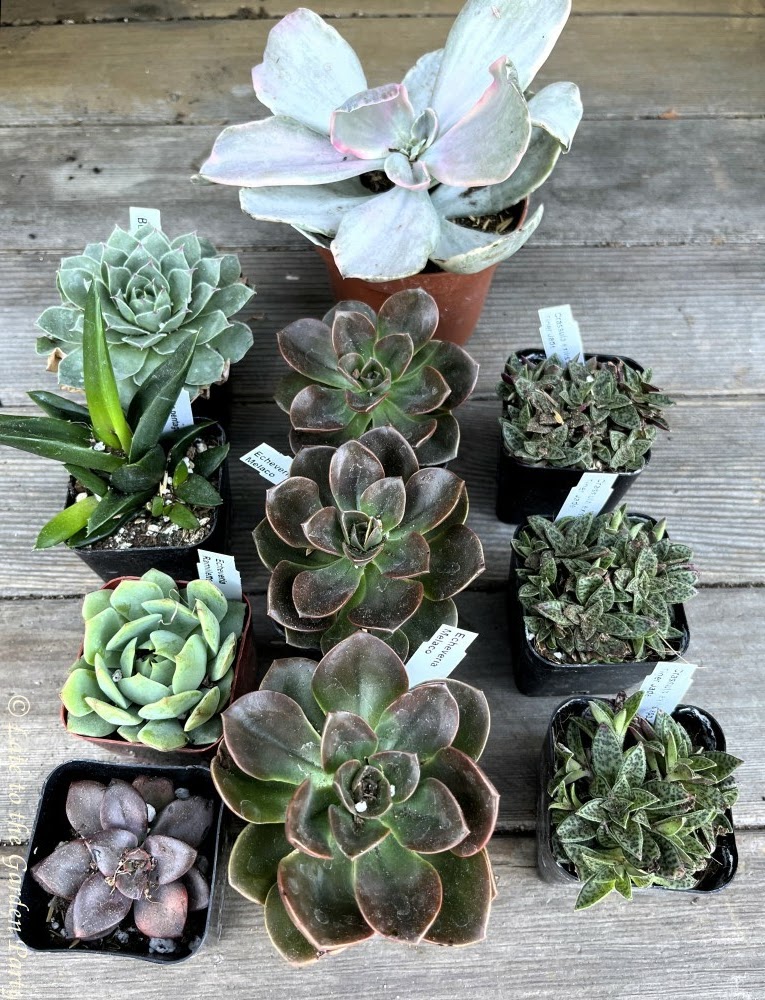
As I tossed some plants in the rush to prepare the area for the plumbing work, I ordered a few replacements by mail.  They're smaller than they may appear in this photo - all but one were in 2-inch pots.

I also bought a flat of Ruschia lineolata 'Nana' (aka dwarf carpet of stars) to fill in around the flagstones.  The dwarf mondo grass I originally used for that purpose never filled in well.

Most of the succulents I had along the fence at the entry to the area were lost in the process of the plumbing project.  I filled in with my go-to Aeonium arboreum and Aeonium haworthii 'Kiwi' cuttings.

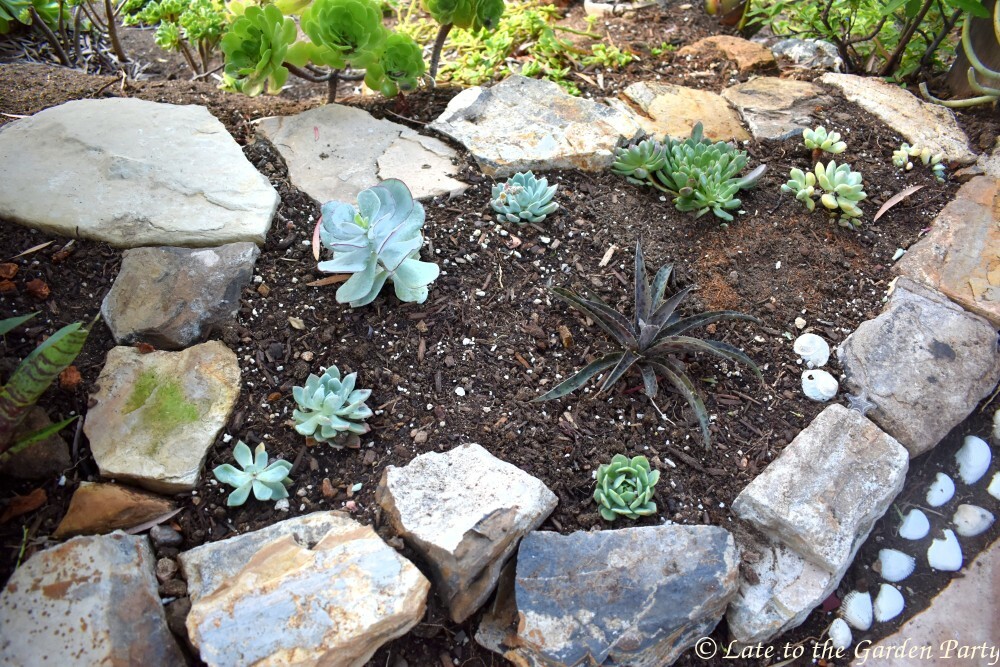
I broke the bed up into 4 segments divided by more rock.  I don't have names for all the plants here; however, this section includes a noID Cotyledon orbiculata, Mangave 'Pineapple Express' and various Echeverias.  I put back the seashells I had around the edges previously but I may replace them later with more Ruschia.

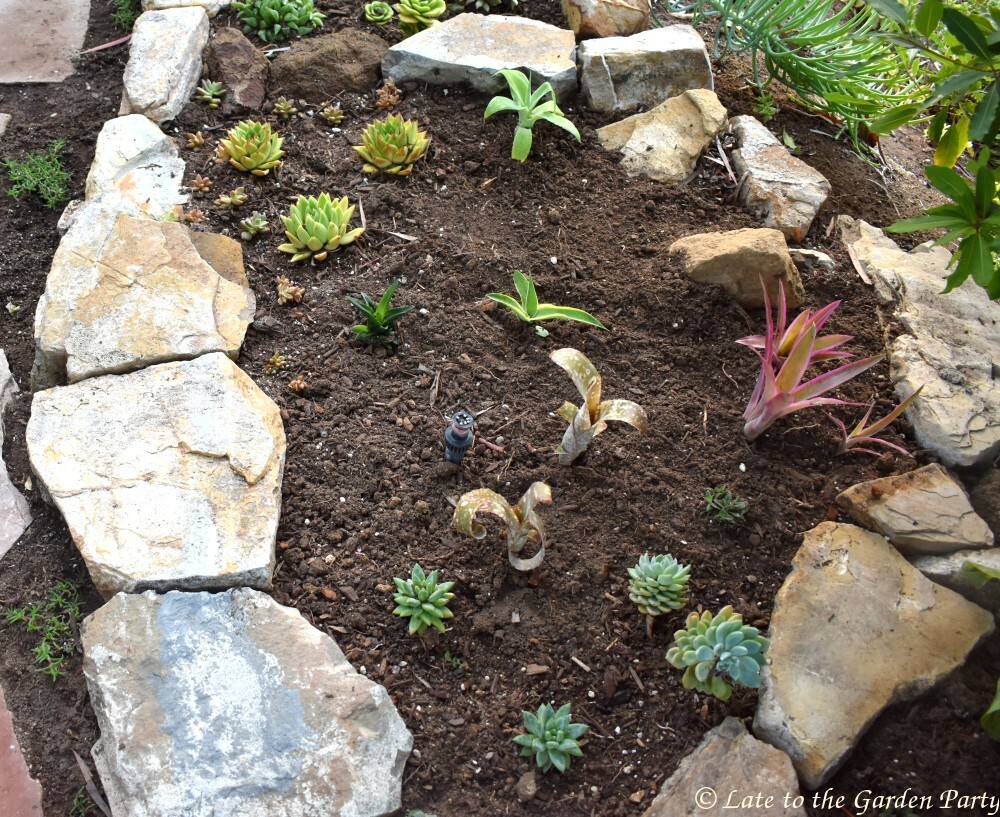
All the plants in this segment of the bed are bromeliads.  The majority of them are offsets of Neoregelia 'Guinea x Pepper', my most prolific bromeliad  The one in the back on the left is Vriesea ospinae var gruberi and the one in the back on the right is Aechmea orlandiana 'Rainbow'. 

This section is a unsatisfactory hodge-podge of plants at the moment, all too small to have an impact.  I threw in an Agave vilmoriana 'Stained Glass' bulbil and an Agave attenuata pup but I may replace both with a larger agave.  There are offsets of Aechmea 'Mend' (the pink-edged bromeliad) and what I think is Quesnelia 'Tim Plowman' plus 3 Echeveria agavoides and a tiny Aloe haworthia pentagona but I can't identify the other plants off-hand.

The last section includes several Haworthia retusa, Aeonium 'Lily Pad', Crassula orbicularis var rosularis as well as some of my tiny new succulents, notably 3 Echeveria 'Melaco' and an Echeveria 'Chroma'

My husband threatened to call bulk-pickup to take the chiminea but he gave in and hauled it to the back of the bed.  (I told him I plan to use it to display Tillandsias and stuck one into the grate in good faith.)  I moved 2 pots back into position too after trimming the broken stems of the surrounding hedge shrubs.

 
Our irrigation problems continued this week.  In the first instance, we discovered that the plumbers had cut through a plastic irrigation pipe when installing the new copper pipe.  After that was fixed and we ran the section of the system that hadn't been functioning, we discovered problems with a valve that wasn't shutting off.  That repair wasn't the end of it, though.  My husband located three other malfunctioning valves and a few broken sprinkler heads.  Once he fixes the last of these, we're hopeful that this will be the end of our irrigation woes for a time; however, the experience has had both of us considering whether a smaller plot with a less complex irrigation system may be preferable in the future.  Meanwhile, I dream of a location that gets rain on a reliable basis.

Blogger was having hiccups last night loading photos as I tried to finish up this post so I'm quitting while I'm ahead with a final photo that has nothing whatsoever to do with the garden.  Best wishes for a relaxing weekend.

The 2 houseplants I had in this basket perished due to inattention.  Pipig decided to take it over.


All material © 2012-2022 by Kris Peterson for Late to the Garden Party

Wednesday, October 5, 2022

Easing into fall garden projects

After the hassles and drama of our latest water leak turned into a wholesale pipe replacement project, I decided to take things a little easier this week by starting on a few smaller projects.  I've already made substantial headway in restoring the succulent-bromeliad bed I had to dig up in preparation for the arrival of the plumbing crew last week but I'm not done there so I'll leave that for a future post.

As we took out plants around our water meter before the plumber arrived - and the plumbers dug up even more - I focused on cleaning up that area first.  The area in question sits along the entrance to our neighbor's driveway so it's something that she sees more often than we do.  I did my best to repair the area using divisions and cuttings of the plants that were removed.

My husband took the "before" photo on the left, which turned out to be especially useful when our neighbor reported that the plumbers had broken one of her sprinklers, conveniently shown in operation in his photo.  As the plumbers were already gone, my husband fixed the sprinkler, while I divided and replanted Agapanthus bulbs, as well as various Aeonium cuttings.

Yesterday, I tackled the bed that runs along the garage facing my cutting garden.  It's needed a refresh for a long time but I put it off as planting anything when summer is at its peak is a fool's errand and, combined with the ban on outdoor watering and our plumbing issues, it made sense to put it off.  Of course, working outdoors during heatwaves isn't much fun either.

Years ago, I planted Aeonium arboreum cuttings at the base of the Camellia on one end of this bed.  They flourished but had become too tall and were flopping over (left photo).  I took cuttings and cleaned them of accumulated dirt and grime and replanted a handful of them, along with some smaller 'Aeonium haworthii 'Kiwi' cuttings from elsewhere in my garden (right photo).

On the other side of the Camellia, I'd planted Aeonium canariensis (aka giant velvet rose), along with a noID Gardenia (left).  In the 9+ years the Gardenia was there, it produced 2 blooms - the plant has no business in my garden so, when I pulled out out the Aeoniums, I pulled out the Gardenia and the rampant Erigeron karvinskianus as well.  I replanted cuttings of the giant Aeonium and more Aeonium 'Kiwi' cuttings (right).  The Erigeron will come back on its own - it's a weed here.

I've no "before" photo of this end of the bed.  It had a mass of messy Crassula muscosa, which we removed before the plumbers arrived.  I replanted it with Aeonium arboreum and 'Kiwi' cuttings because I have more of those than I know what to do with.

This view from the bed's north end gives you and idea of what the entire area looks like, although the Camellia and the first group of Aeoniums aren't readily visible on the other side of the Japanese maple

While cleaning out the pesky Erigeron, I accidentally pulled up part of one Carex 'Evergold'.  I divided the segment and popped 2 pieces into pots to develop more roots.

I still have lots of Aeonium arboreum cuttings to use elsewhere or give away

I expect to use some of the remaining Aeonium cuttings in at least two other areas within the cutting garden.  They're my go-to fillers for difficult spots in the garden.

The Aeoniums at the end of the raised planter on the left need to be pulled and replaced.  The noID Camellia planted next to the house (right) took a beating during the pipe replacement project. Having come with the garden, the Camellias in this bed are well-established but I've found it very difficult to grow much else in this area.  Unless I'm struck with an idea for a drought-tolerant shade plant, I'll probably stick Aeoniums in here too.

My husband's done a lot of work since the pipe replacement was completed.  We discovered that the crew that handled that project inadvertently cut through an irrigation pipe when they were connecting the main pipe to the house, which meant that sixty percent of our irrigation system couldn't run.  My husband dug up the area surrounding the connection and located the break but he contacted the plumber to get someone else out to make the final repairs.  As the new fitting had to "cure" before it was tested, my husband assumed responsibility for backfilling that area a day later.  He also replaced all the gravel he'd pulled up in advance of the pipe replacement project.

I think he'd collected more than 20 bags of gravel, all of which had to be returned to the garden


The plants in the raised planters of my cutting garden are well past their prime and pulling them up in order to prepare my cool season garden is something I plan to tackle later this month.  In the meantime, I'm trying to eke out enjoyment of the plants that are still producing flowers.

After a very long wait, Dahlia 'Fairway Spur' has produced its first flowers

Fall is the busiest time for gardeners in much of Southern California and I expect to share more projects with you over the coming weeks.  I'm trying to pace myself, though.


All material © 2012-2022 by Kris Peterson for Late to the Garden Party

Monday, October 3, 2022

In a Vase on Monday: At least there are still some dahlias

Our water pipe replacement project was up and running with last minute notice from the plumber late Tuesday afternoon.  Another of the plumber's projects was delayed so he was able to fit us in and we scrambled to be ready with our final preparations before the crew arrived early Wednesday morning.  The good news is that they finished in two days instead of the three days projected to complete the job.  The bad news is that, among the usual collateral damage that comes with a project of that scope, the connection that controls sixty percent of our irrigation system was damaged in the process, which we didn't discover until yesterday morning when the system ran for the first time on the water provider's prescribed schedule.  After a couple of hours work, my husband decided that the problem was going to require more physical effort than he was up for so we'll be placing a follow-up call to the plumber's office when it opens this morning.  He was able to identify the nature of the problem and has already sent an email message - with photos - to pinpoint the damage.
My cutting garden (and the other areas) got beat up during the plumbing project but there are still dahlias suitable for inclusion in a vase.  I'd hoped that the big, fat buds of Dahlia 'Fairway Spur' would be ready for inclusion in a vase this week but they need more time.  A few others came through, however.

Dahlias 'Enchantress' and 'Karma Prospero' combined forces to fill a vase, along with a few Zinnia stems

Back view

Top view

Clockwise from the upper left: Acacia cognata 'Cousin Itt', Alstromeria 'Inca Vienna' (left over from last week), noID Angelonia, Dahlia 'Enchantress', D. 'Karma Prospero', Prostanthera ovalifolia 'Variegata', and Zinnia elegans 'Benary's Giant Purple'

I put together a smaller arrangement for the kitchen island.

While most dahlias seem to produce smaller and smaller flowers as the season rolls on, Dahlia 'Summer's End' apparently wishes to go out with a splash with what may be its largest bloom yet

Back view

Top view

Clockwise from the upper left: Agonis flexuosa 'Nana', Dahlia 'Summer's End', Leonotis leonurus, and Zinnia elegans 'Queen Lime Orange'


A slimmed-down collection of leftovers from one of last week's vases was shoved into a small vase for the front entry.

I cut a fresh bloom of Dahlia 'Catching Fire' but the other elements are last week's cuttings.  The flowers of the Australian fuchsia (Correa 'Wyn's Wonder') show up better in this trimmed-down arrangement.  The first time I cut stems of Caladium 'Tapestry', they lasted more than 3 weeks.


We'd made major inroads in putting portions of the garden back together on Friday and Saturday before that activity came to a halt with the new plumbing issue.  I'm focusing on hand-watering now.  It's always something...At least the heatwave is over.

For more IAVOM creations, visit Cathy at Rambling in the Garden.


All material © 2012-2022 by Kris Peterson for Late to the Garden Party