Showing posts with label bromeliads. Show all posts

Friday, October 7, 2022

Putting my bromeliad-succulent bed back together

One of the principal casualties of our recent water pipe replacement was the bromeliad-succulent bed that borders our northwest property line.  Originally created in November 2017 and refreshed two years later, I was forced to dig up all the plants and remove all the rock and flagstones surrounding the bed prior to the arrival of the plumbers tasked with replacing the pipe a couple of feet beneath it.  As the plumbing service fit us in when another of its projects was delayed, I had very little time to take care of that activity so I wasn't as careful as I might have been.

I took my time putting things back together.

The plumbing crew offered to replace the flagstones for us, which was helpful as many of them are very heavy.  They didn't use several of the smaller stones so the path is somewhat narrower than it previously was but that's okay.  I carted in and arranged the rocks that border the bromeliad-succulent bed myself.

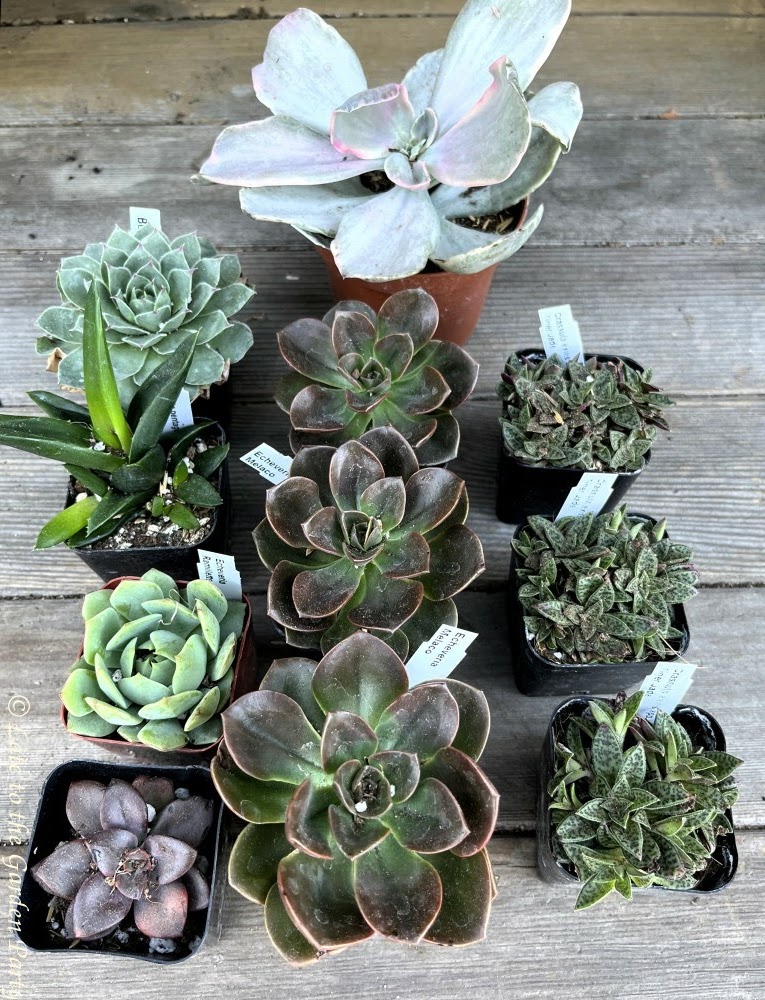
As I tossed some plants in the rush to prepare the area for the plumbing work, I ordered a few replacements by mail.  They're smaller than they may appear in this photo - all but one were in 2-inch pots.

I also bought a flat of Ruschia lineolata 'Nana' (aka dwarf carpet of stars) to fill in around the flagstones.  The dwarf mondo grass I originally used for that purpose never filled in well.

Most of the succulents I had along the fence at the entry to the area were lost in the process of the plumbing project.  I filled in with my go-to Aeonium arboreum and Aeonium haworthii 'Kiwi' cuttings.

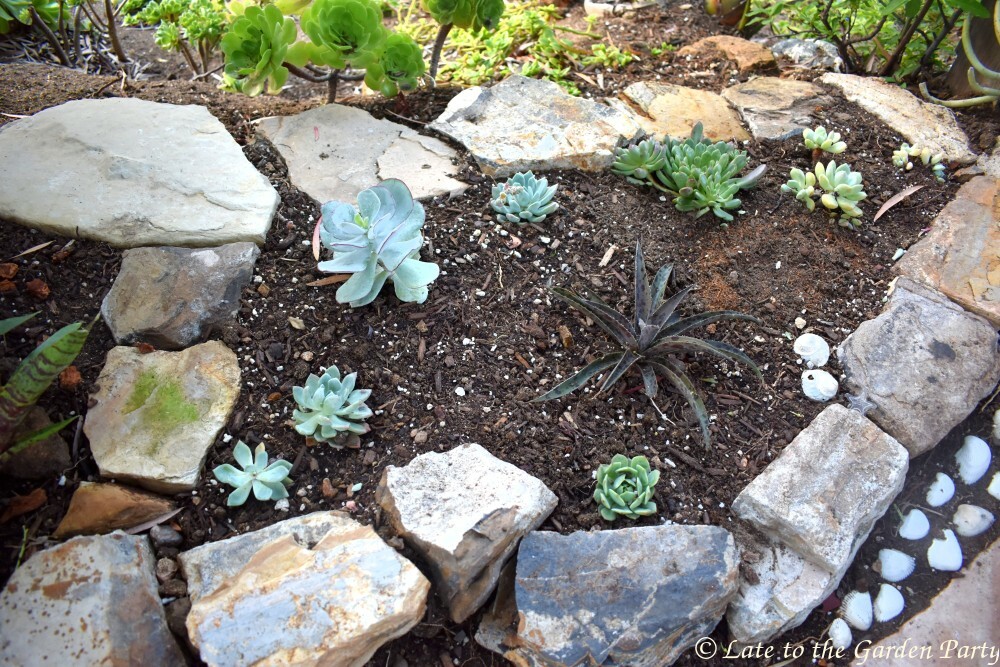
I broke the bed up into 4 segments divided by more rock.  I don't have names for all the plants here; however, this section includes a noID Cotyledon orbiculata, Mangave 'Pineapple Express' and various Echeverias.  I put back the seashells I had around the edges previously but I may replace them later with more Ruschia.

All the plants in this segment of the bed are bromeliads.  The majority of them are offsets of Neoregelia 'Guinea x Pepper', my most prolific bromeliad  The one in the back on the left is Vriesea ospinae var gruberi and the one in the back on the right is Aechmea orlandiana 'Rainbow'

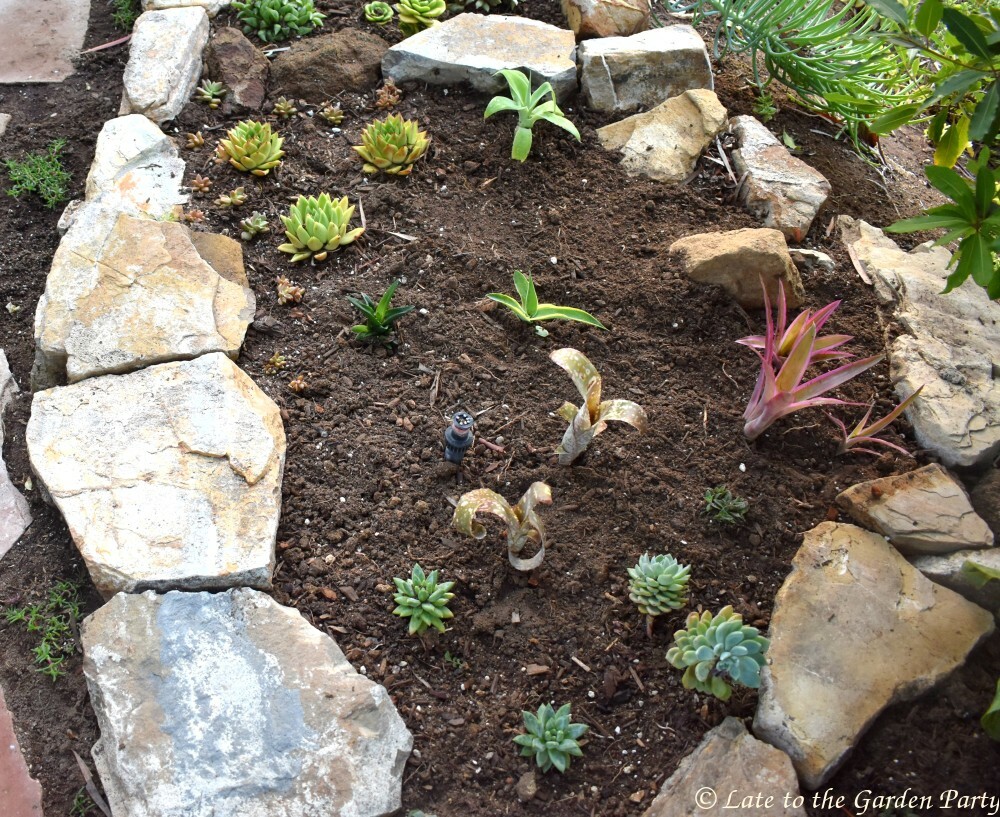
This section is a unsatisfactory hodge-podge of plants at the moment, all too small to have an impact.  I threw in an Agave vilmoriana 'Stained Glass' bulbil and an Agave attenuata pup but I may replace both with a larger agave.  There are offsets of Aechmea 'Mend' (the pink-edged bromeliad) and what I think is Quesnelia 'Tim Plowman' plus 3 Echeveria agavoides and a tiny Aloe haworthia pentagona but I can't identify the other plants off-hand.

The last section includes several Haworthia retusa, Aeonium 'Lily Pad', Crassula orbicularis var rosularis as well as some of my tiny new succulents, notably 3 Echeveria 'Melaco' and an Echeveria 'Chroma'

My husband threatened to call bulk-pickup to take the chiminea but he gave in and hauled it to the back of the bed.  (I told him I plan to use it to display Tillandsias and stuck one into the grate in good faith.)  I moved 2 pots back into position too after trimming the broken stems of the surrounding hedge shrubs.

 
Our irrigation problems continued this week.  In the first instance, we discovered that the plumbers had cut through a plastic irrigation pipe when installing the new copper pipe.  After that was fixed and we ran the section of the system that hadn't been functioning, we discovered problems with a valve that wasn't shutting off.  That repair wasn't the end of it, though.  My husband located three other malfunctioning valves and a few broken sprinkler heads.  Once he fixes the last of these, we're hopeful that this will be the end of our irrigation woes for a time; however, the experience has had both of us considering whether a smaller plot with a less complex irrigation system may be preferable in the future.  Meanwhile, I dream of a location that gets rain on a reliable basis.

Blogger was having hiccups last night loading photos as I tried to finish up this post so I'm quitting while I'm ahead with a final photo that has nothing whatsoever to do with the garden.  Best wishes for a relaxing weekend.

The 2 houseplants I had in this basket perished due to inattention.  Pipig decided to take it over.


All material © 2012-2022 by Kris Peterson for Late to the Garden Party

Friday, September 30, 2022

My garden is a mess...

After waiting two weeks for word on a date to replace 100+ feet of water pipe, we received a call late Tuesday afternoon advising us that, due to a delay on another project, the plumber's team could begin work the following morning.  Luckily, I'd already cleaned out my compost bin and my husband had cleared out and bagged all the gravel in the affected areas.  Unfortunately, I'd held off on pulling up the plants above the existing pipe, planning to take care of that closer to the project's start date.  I thought I'd have more than a few hours prior notice.

This is a photo of the area in question taken for one of my "Coronavirus tourism" posts in 2020.  Some of the plants have changed over the past 2 years but this is probably the clearest photo I have of the planted area affected by the plumbing work.  In addition to a host of small succulents and bromeliads, the area included a large amount of flagstone, rock, a chiminea, and 2 large pots.

My husband and I worked until well after sunset to get the rest of the work done and we were back at it again early the next morning.  He lifted things he had no business lifting this soon after his surgery.  I pulled up all the rock and flagstones I could but I needed his help with some of the heaviest items. 

Miscellaneous stuff stored behind the garage had to be moved into the driveway

I potted the plants worth saving and took cuttings of various succulents.  I moved the bulbils I potted up after receiving an agave bloom stalk from a friend too.

This is the area after it was cleared

We also dug out some of the plants surrounding the pipe connection to the house to clear access.  We tried to be careful of the roots belonging to a well-established Camellia and a star jasmine vine (Trachelospermum jasminoides) but only time will tell if we were successful.


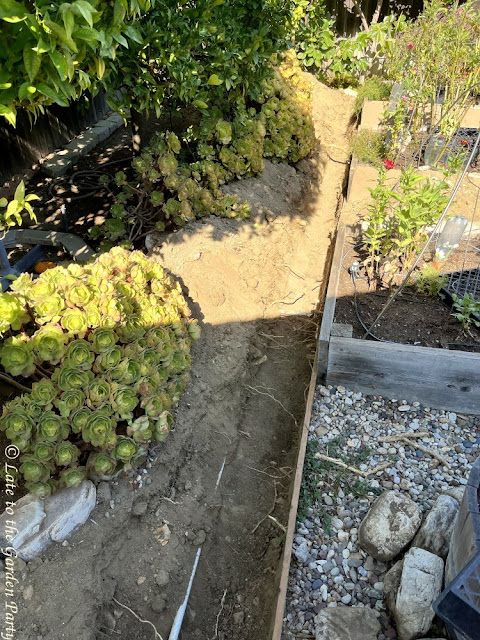
The plumber arrived with two crews right on schedule on Wednesday and promptly got to work.  Trenches were dug, the first pipes were laid, and piles and piles of dirt were everywhere.

Trench extending from the city's water line at the street with the first section of the new pipe

Another trench running the length of my cutting garden adjacent to the raised planters

  
The trench dug to contain the new pipe connected to the house

This was a tricky bit as the plumbers had to tunnel under the concrete brick walkway into the bed on the other side to avoid taking out a section of the walkway

I was actually pleased to see some good-sized rocks among the dirt that accumulated as they dug their trenches.  I can always use more rock in my succulent beds.  Our entire neighborhood was a rock quarry in the 1940s so it's not surprising we still find chunks of it when we dig deep enough.

The good news is that the plumbers were able to complete the job within two days instead of the three originally projected.  Maybe that means my husband and I did more to clear the decks for the plumbers to work than they'd anticipated...

One of the biggest surprises was that a member of the plumbing crew was really into plants, especially orchids and succulents.  He asked my husband for a tour of my lath (shade) house soon after he arrived.  I gave him one of the variegated octopus agave bulbils (Agave vilmoriniana 'Stained Glass') on his first work day and he brought me several plants the next day.  Of course, I needed to reciprocate so I came up with two bromeliad divisions, two agave pups, and a noID Gasteraloe to send him off with.

Here's my haul from the friendly plumber.  The orchid is an Epidendrum.  The Tillandsias are similar to some I have (and don't have names for).  The 2 plants in the pot on the upper left appear to be Orbea variegata.  Based on its label, the plant on the lower left is Lobivia schreiteri (which I understand is now classified as an Echinopsis).  I can only guess about the identities of the other 2 in the clay pots, maybe a Mamillaria and an Echinopsis.


Before the plumbers left, they were kind enough to replace most of the flagstone we'd taken up before they arrived.  Somehow ten of the middling and smaller pieces of flagstone didn't make it into their layout but it still gives me a good start in putting things back in order.  I've already replaced two additional flagstones but, even as the current heatwaves wanes, it was too hot and sticky to do much more after they left.  I'll get started with the remaining cleanup this weekend.

The bagged gravel needs to be spread over the dirt paths surrounding the raised planters in my cutting garden

The remaining flagstones and all the rock formerly within and around the succulent-bromeliad bed needs to be replaced

And then I need to replant the area.  Before returning the plants I saved, I'll probably add cactus mix and pumice to the soil.  As I tossed out some of the smaller and less vigorous plants during our preparation phase, I expect I may need to shop for a few new plants too.


Weekend temperatures are supposed to be noticeably cooler.  I hope so.  I have a lot of work to do.


Best wishes for the weekend, however you're spending your time.


All material © 2012-2022 by Kris Peterson for Late to the Garden Party


Wednesday, July 27, 2022

A prickly project

After hand-watering my cutting garden and fertilizing the dahlias yesterday morning, I decided to tackle a prickly low-reward project I'd put off for months.  It was time-consuming and few people would be likely to notice a difference once I was done but it was something that bugged me almost every time I walked through my front garden, which is generally a couple times a day.

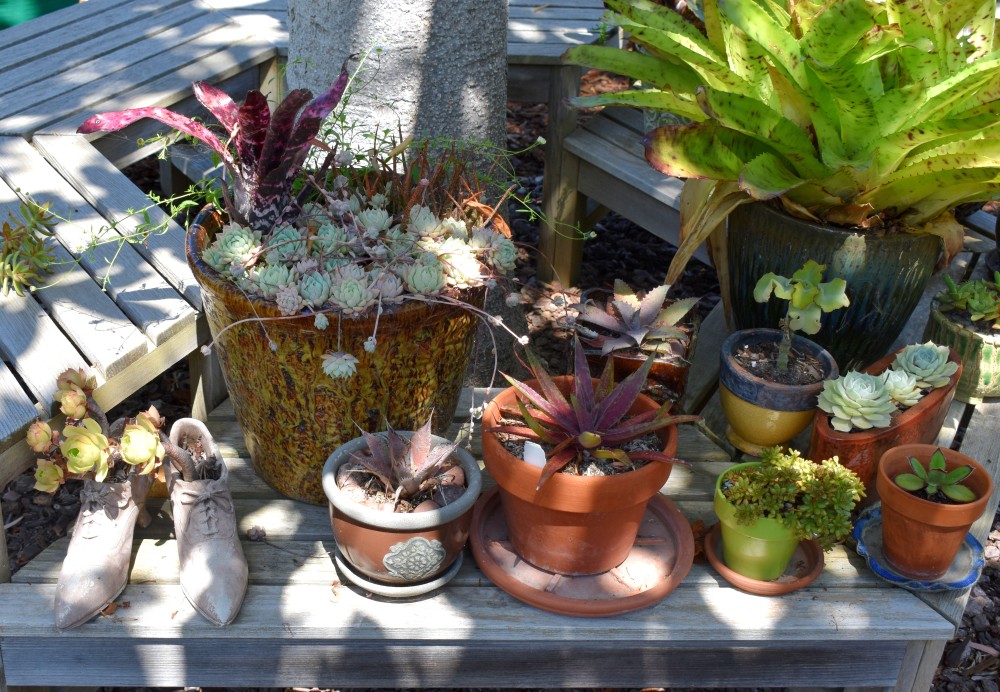
This is part of the seating area/plant shelf that surrounds the Magnolia tree in our front garden.  Pardon the poor quality of the photo but, as it's in partial shade all day, it can't be helped.  I should also acknowledge that the construction is a little odd; however, as I do relatively little sitting in the garden, I dedicated half the structure to potted plants, most of which have been here for years.

The focus of my effort was the bromeliad in the upper right of the preceding photo, Nidularium wittrockia leopardinum.  I picked up this plant at the South Bay Bromeliad Association's sale in August 2016.  It's been in the same pot since I purchased it.  I've pulled out dead leaves at intervals over the years but, as it grew steadily denser, that became increasingly difficult and it started to look mangy.

This is the plant in its "before" condition.  You can see some of the dead leaves hanging over the side.  Dead leaves could also be found in the interfaces between plant clumps.  It's difficult to work with because its leaves are lined all along the edges with sharp spines.

The original plastic pot sat inside of a decorative ceramic pot.  The plant clusters were so densely packed, I had to cut the white plastic pot to free it.

I struggled to cut through the plant clusters to separate them.  Once separated, I peeled away dead and disfigured leaves, ridding the plant on a large number of slugs in the process.  I don't find many slugs (or snails) in my increasingly dry garden but the slugs had found the ideal environment inside the relatively wet interior of the bromeliad.

I replanted 2 plant clusters in another plastic pot, inserting it into the ceramic pot under the Magnolia tree.  I planted the other 2 clusters in another plastic pot, which I slipped inside a terracotta pot and deposited next to the lath house.

I also decided it was time to replant the noID bromeliad a friend gave me a couple of years ago.

The noID bromeliad and its pot arrived already planted.  The pot originally included succulent cuttings as well, some of which I'd removed earlier.  I removed the remaining gangly Crassula stems, then cleaned up the bromeliad, removing its dead leaves.

I repotted the bromeliad in its original container.  I pinched pieces of Echeveria prolifica from another pot to add interest.

I'm planning to harvest more of these Echeveria rosettes for other areas of areas of my garden.  Echeveria prolifica lives up to its name and spreads very quickly.

In addition, I replanted the pair of concrete shoes (shown in the first photo on the lower left) using succulents.

I think the Aeonium arboreum rosettes had been there for more than 2 years.  The shoe containers were a gift from one of my sisters-in-law years ago.

Feeling lazy at this point, I replanted them with Aeonium haworthii 'Kiwi' cuttings.  The hardest part of the process was getting the previous stems out of the shoes without breaking them.

I'd considered dividing the Neoregelia 'Guinea x Pepper' on the north side of the seating area/plant shelf but I simply ran out of steam.  That's a project for another day.

Neoregelia 'Guinea x Pepper' (upper right) may be the toughest bromeliad in my garden.  Most aren't all that happy planted in the ground because my garden overall is so dry, especially this time of year.

I've previously divided this one and planted pieces of it in an area along our north property line, which is probably what I'll do again.  A larger mass of the Neoregelia will have greater impact. 

The cooler temperatures we enjoyed last weekend spilled over into the Monday and Tuesday but we're expecting a slow warm-up as the week continues.  Hopefully, it'll stay within a reasonable range.


All material © 2012-2022 by Kris Peterson for Late to the Garden Party

Wednesday, September 9, 2020

Sherman Gardens (part 2): Focusing on the plants

Last Friday, I published a post on a recent visit to Sherman Gardens, a small botanic garden in Corona del Mar.  That post focused on the Sculptura Botanica exhibit, created by landscaper and ceramic sculptor, Dustin Gimbel.  This post is focused on the plants I photographed during the visit but didn't include in the first post.

One of my favorite areas of Sherman Gardens is the Tropical Conservatory.  I'd be ecstatic to have something of this kind in my own garden but, in addition to the fact that there isn't room for it, maintaining a temperature controlled space like this with a pond would require more time and money than I can imagine.  So I just enjoy Sherman's conservatory on every visit.

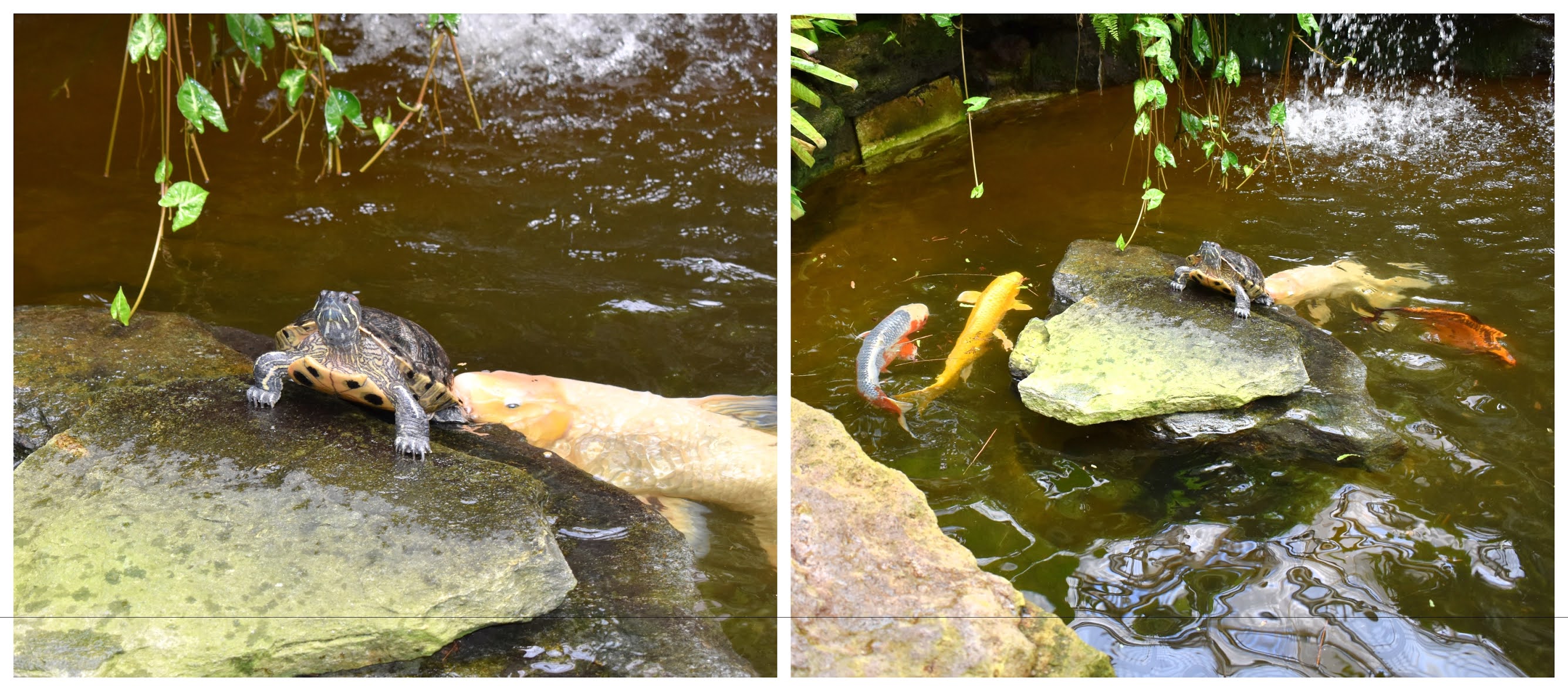
The koi were very active in the pond

Usually, the turtles are already sunning themselves on the flat rocks of the pond but this fellow showed up late and without his companions

This wonderful chenille plant (Acalypha hispida) hangs above the pond

My best guess is that this is Heliconia psittacorum (aka parrot Heliconia)

I loved this, which I think is Heliconia rostrata (aka lobster claw Heliconia)

There are always orchids in this area

as well as a collection of bromeliads

In addition to the bromeliads inside the conservatory, there's a nice display of bromeliads outside its door.

Those I plant in the ground in my own garden never look this good

The flamingo covered in Tillandsias is a regular feature

I also love Sherman's lath-covered shade structure.  In fact, it was the inspiration for my own much smaller lath house, which my husband built for me in December 2017 as a Christmas present.  Mine doesn't hold nearly as much but, like mine, Sherman's is big on begonias.

I didn't even attempt to identify all these plants on this visit


I was charmed by this display, which I think consists entirely of Peperomia of various kinds.  I collected specimens in this genus as indoor plants when I was a kid and I've found myself gravitating to them again in recent years.

Like the Bromeliad Garden, the shade area has wood bird sculpture too, this one of a pelican

From the shade structure, we passed through the Sun Garden and a small courtyard area just inside the garden's north entrance before venturing into the Succulent Garden, another of my favorite areas.

I featured the beds and sculptures in the Sun Garden in my prior post but didn't include photos of the robust passionflower vine.  In addition to flowers, the vines had plenty of developing fruit.

This courtyard contained a wide variety of shade plants too, including the pretty Streptocarpus (aka cape primrose) shown on the right
This vignette in the Succulent Garden, featuring a fan aloe (Kumara plicatilis), bromeliads, and an Agave ovatifolia, is perfect


I fixated on the tree-size Euphorbia here.  After a couple of trips down the rabbit hole that is the internet, I'm still not clear if this is Euphorbia lactea or E. ingens or something else altogether.

This display had me wanting to go to the local stone yard to pick up boulders to redo one of my front garden succulent beds

As we exited the Succulent Garden and turned in the direction of the Central Garden (addressed in my prior post), we checked out the Palm Collection and, beyond that, the Perennial Garden.

I think that's a banana tree on the left and a traveler palm (Ravenala madagascariensis) on the right

Dahlias and other flowers dotted the Perennial Garden

This massive Dyckia in the Mediterranean Garden was impressive

Before leaving, we toured the Fern Grotto adjacent to the south entrance and parking lot.

Tall palm trees (shown in my prior post) soar above the Fern Grotto with cycads and smaller palms planted below them

Ferns and Farfugium filled the area under the shade cover

I have mixed feeling about bonsai plants but I loved this dwarf Ginkgo backed by Farfugium

The plant on the left is a spear lily (Doryanthes palmeri), which I've yet to see in bloom

The only flowering plant I saw in the Fern Grotto was this Medinilla magnifica

We're expecting Santa Ana winds (aka devil winds) here today.  They'll drive temperatures back up again, probably for the balance of the week.  Fingers are crossed they don't intensify the fires here  - or create new ones.  Our garden has already been dusted with ash once this week.


All material © 2012-2020 by Kris Peterson for Late to the Garden Party