Showing posts with label water woes. Show all posts

Friday, October 7, 2022

Putting my bromeliad-succulent bed back together

One of the principal casualties of our recent water pipe replacement was the bromeliad-succulent bed that borders our northwest property line.  Originally created in November 2017 and refreshed two years later, I was forced to dig up all the plants and remove all the rock and flagstones surrounding the bed prior to the arrival of the plumbers tasked with replacing the pipe a couple of feet beneath it.  As the plumbing service fit us in when another of its projects was delayed, I had very little time to take care of that activity so I wasn't as careful as I might have been.

I took my time putting things back together.

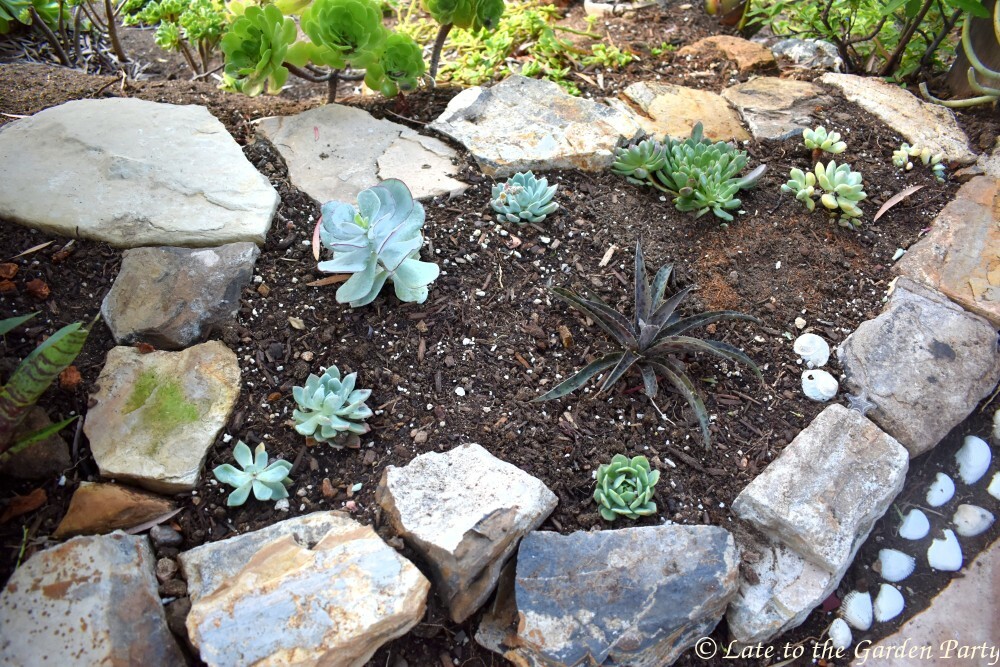
The plumbing crew offered to replace the flagstones for us, which was helpful as many of them are very heavy.  They didn't use several of the smaller stones so the path is somewhat narrower than it previously was but that's okay.  I carted in and arranged the rocks that border the bromeliad-succulent bed myself.

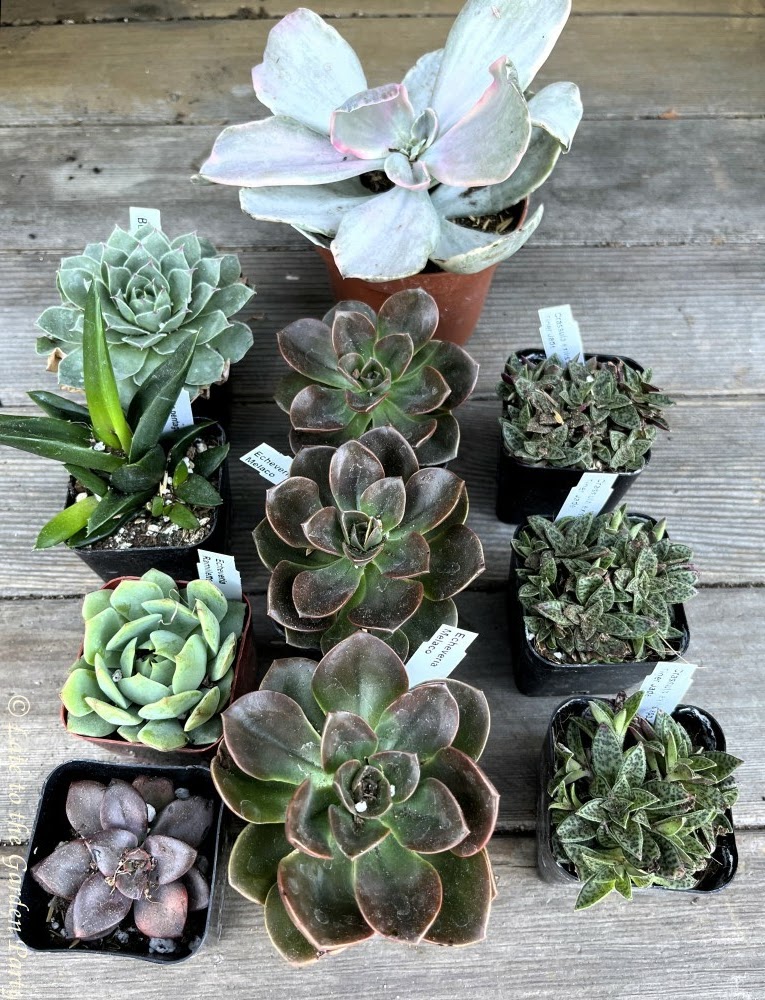
As I tossed some plants in the rush to prepare the area for the plumbing work, I ordered a few replacements by mail.  They're smaller than they may appear in this photo - all but one were in 2-inch pots.

I also bought a flat of Ruschia lineolata 'Nana' (aka dwarf carpet of stars) to fill in around the flagstones.  The dwarf mondo grass I originally used for that purpose never filled in well.

Most of the succulents I had along the fence at the entry to the area were lost in the process of the plumbing project.  I filled in with my go-to Aeonium arboreum and Aeonium haworthii 'Kiwi' cuttings.

I broke the bed up into 4 segments divided by more rock.  I don't have names for all the plants here; however, this section includes a noID Cotyledon orbiculata, Mangave 'Pineapple Express' and various Echeverias.  I put back the seashells I had around the edges previously but I may replace them later with more Ruschia.

All the plants in this segment of the bed are bromeliads.  The majority of them are offsets of Neoregelia 'Guinea x Pepper', my most prolific bromeliad  The one in the back on the left is Vriesea ospinae var gruberi and the one in the back on the right is Aechmea orlandiana 'Rainbow'. 

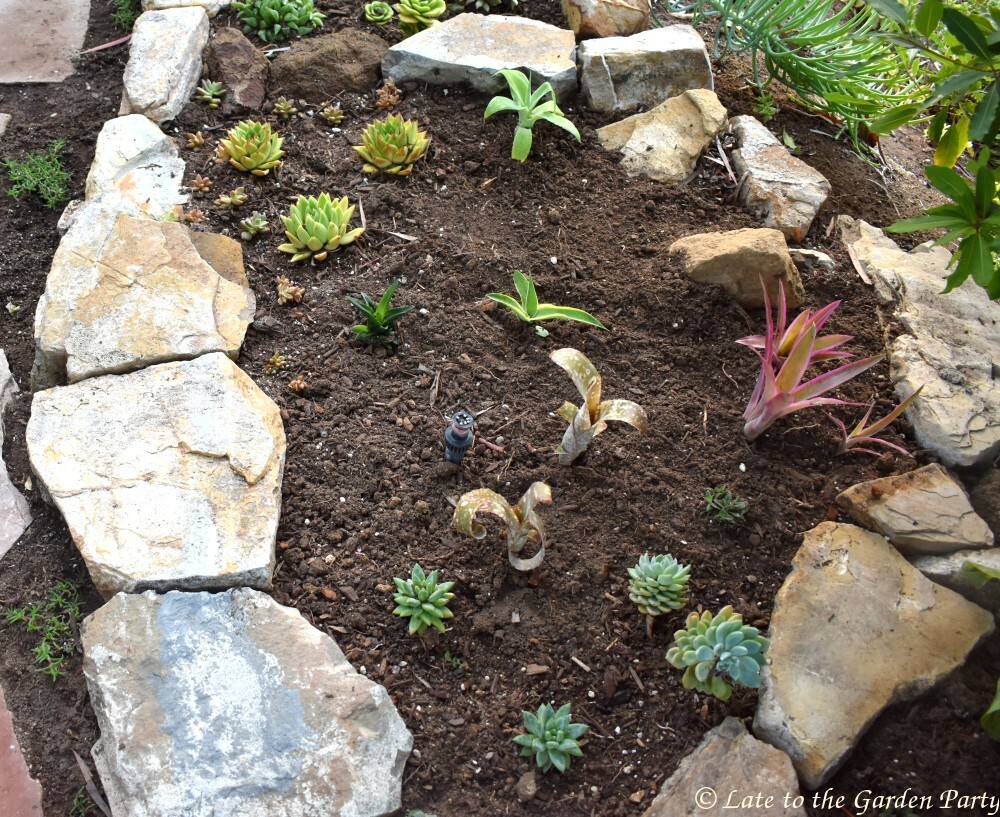
This section is a unsatisfactory hodge-podge of plants at the moment, all too small to have an impact.  I threw in an Agave vilmoriana 'Stained Glass' bulbil and an Agave attenuata pup but I may replace both with a larger agave.  There are offsets of Aechmea 'Mend' (the pink-edged bromeliad) and what I think is Quesnelia 'Tim Plowman' plus 3 Echeveria agavoides and a tiny Aloe haworthia pentagona but I can't identify the other plants off-hand.

The last section includes several Haworthia retusa, Aeonium 'Lily Pad', Crassula orbicularis var rosularis as well as some of my tiny new succulents, notably 3 Echeveria 'Melaco' and an Echeveria 'Chroma'

My husband threatened to call bulk-pickup to take the chiminea but he gave in and hauled it to the back of the bed.  (I told him I plan to use it to display Tillandsias and stuck one into the grate in good faith.)  I moved 2 pots back into position too after trimming the broken stems of the surrounding hedge shrubs.

 
Our irrigation problems continued this week.  In the first instance, we discovered that the plumbers had cut through a plastic irrigation pipe when installing the new copper pipe.  After that was fixed and we ran the section of the system that hadn't been functioning, we discovered problems with a valve that wasn't shutting off.  That repair wasn't the end of it, though.  My husband located three other malfunctioning valves and a few broken sprinkler heads.  Once he fixes the last of these, we're hopeful that this will be the end of our irrigation woes for a time; however, the experience has had both of us considering whether a smaller plot with a less complex irrigation system may be preferable in the future.  Meanwhile, I dream of a location that gets rain on a reliable basis.

Blogger was having hiccups last night loading photos as I tried to finish up this post so I'm quitting while I'm ahead with a final photo that has nothing whatsoever to do with the garden.  Best wishes for a relaxing weekend.

The 2 houseplants I had in this basket perished due to inattention.  Pipig decided to take it over.


All material © 2012-2022 by Kris Peterson for Late to the Garden Party

Friday, September 30, 2022

My garden is a mess...

After waiting two weeks for word on a date to replace 100+ feet of water pipe, we received a call late Tuesday afternoon advising us that, due to a delay on another project, the plumber's team could begin work the following morning.  Luckily, I'd already cleaned out my compost bin and my husband had cleared out and bagged all the gravel in the affected areas.  Unfortunately, I'd held off on pulling up the plants above the existing pipe, planning to take care of that closer to the project's start date.  I thought I'd have more than a few hours prior notice.

This is a photo of the area in question taken for one of my "Coronavirus tourism" posts in 2020.  Some of the plants have changed over the past 2 years but this is probably the clearest photo I have of the planted area affected by the plumbing work.  In addition to a host of small succulents and bromeliads, the area included a large amount of flagstone, rock, a chiminea, and 2 large pots.

My husband and I worked until well after sunset to get the rest of the work done and we were back at it again early the next morning.  He lifted things he had no business lifting this soon after his surgery.  I pulled up all the rock and flagstones I could but I needed his help with some of the heaviest items. 

Miscellaneous stuff stored behind the garage had to be moved into the driveway

I potted the plants worth saving and took cuttings of various succulents.  I moved the bulbils I potted up after receiving an agave bloom stalk from a friend too.

This is the area after it was cleared

We also dug out some of the plants surrounding the pipe connection to the house to clear access.  We tried to be careful of the roots belonging to a well-established Camellia and a star jasmine vine (Trachelospermum jasminoides) but only time will tell if we were successful.


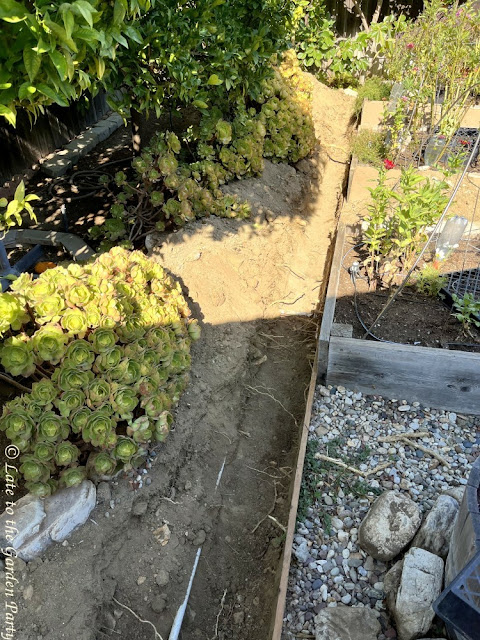
The plumber arrived with two crews right on schedule on Wednesday and promptly got to work.  Trenches were dug, the first pipes were laid, and piles and piles of dirt were everywhere.

Trench extending from the city's water line at the street with the first section of the new pipe

Another trench running the length of my cutting garden adjacent to the raised planters

  
The trench dug to contain the new pipe connected to the house

This was a tricky bit as the plumbers had to tunnel under the concrete brick walkway into the bed on the other side to avoid taking out a section of the walkway

I was actually pleased to see some good-sized rocks among the dirt that accumulated as they dug their trenches.  I can always use more rock in my succulent beds.  Our entire neighborhood was a rock quarry in the 1940s so it's not surprising we still find chunks of it when we dig deep enough.

The good news is that the plumbers were able to complete the job within two days instead of the three originally projected.  Maybe that means my husband and I did more to clear the decks for the plumbers to work than they'd anticipated...

One of the biggest surprises was that a member of the plumbing crew was really into plants, especially orchids and succulents.  He asked my husband for a tour of my lath (shade) house soon after he arrived.  I gave him one of the variegated octopus agave bulbils (Agave vilmoriniana 'Stained Glass') on his first work day and he brought me several plants the next day.  Of course, I needed to reciprocate so I came up with two bromeliad divisions, two agave pups, and a noID Gasteraloe to send him off with.

Here's my haul from the friendly plumber.  The orchid is an Epidendrum.  The Tillandsias are similar to some I have (and don't have names for).  The 2 plants in the pot on the upper left appear to be Orbea variegata.  Based on its label, the plant on the lower left is Lobivia schreiteri (which I understand is now classified as an Echinopsis).  I can only guess about the identities of the other 2 in the clay pots, maybe a Mamillaria and an Echinopsis.


Before the plumbers left, they were kind enough to replace most of the flagstone we'd taken up before they arrived.  Somehow ten of the middling and smaller pieces of flagstone didn't make it into their layout but it still gives me a good start in putting things back in order.  I've already replaced two additional flagstones but, even as the current heatwaves wanes, it was too hot and sticky to do much more after they left.  I'll get started with the remaining cleanup this weekend.

The bagged gravel needs to be spread over the dirt paths surrounding the raised planters in my cutting garden

The remaining flagstones and all the rock formerly within and around the succulent-bromeliad bed needs to be replaced

And then I need to replant the area.  Before returning the plants I saved, I'll probably add cactus mix and pumice to the soil.  As I tossed out some of the smaller and less vigorous plants during our preparation phase, I expect I may need to shop for a few new plants too.


Weekend temperatures are supposed to be noticeably cooler.  I hope so.  I have a lot of work to do.


Best wishes for the weekend, however you're spending your time.


All material © 2012-2022 by Kris Peterson for Late to the Garden Party


Friday, September 23, 2022

What thrived and what died this summer

This summer posed a number of challenges for plants in my garden.  Winter rainfall was low for the second year in a row, leaving us dry even before summer began.  Water restrictions tightened and although I've restricted use of our automated irrigation system to two days a week since 2015, I pulled back further on supplemental hand-watering this year in response to California's worsening drought.  Heatwaves were fewer in number and generally less severe than usual but the most recent one, during which we hit a peak temperature of 106F (41C), hung on for ten days, which was unusual.  Midway through that event, our water provider informed us that we were subject to a 15-day outdoor watering ban due to pipeline repairs.  I stored water for emergency use and scrambled to deep soak what plants I could before the ban took effect.  An unusual tropical rainstorm, spinning off a hurricane in the Pacific, helped significantly by dropping six-tenths of an inch of rain.  So despite my apprehensions concerning the double whammy of a heatwave and a watering ban, the garden came through the experience relatively well (even if the gardener ran herself ragged toting a watering can to and fro). 

I'll start with the plants that showed no discernible ill effects due to the stresses summer posed.

If anything, Acacia cognata 'Cousin Itt' responded positively to the heat.  I've had to cut it back in some areas because it's impeding on paths.

Agonis flexuosa 'Nana' has once again grown so big that it'll require severe pruning later this year

I cut all the Barleria obtusa (aka bush violet) back nearly to the ground after the shrubs bloomed late last year.  They look homely for about a month afterwards, then slowly flesh out.  The plants self-seed freely and I think I should use them more extensively in problem areas.

Three more plants that have shown stamina are: Echium handiense, Helianthemum 'The Bride', and Santolina virens.  I propagated the Echium from cuttings and they're doing well in all 4 locations I planted them.  The 2 Helianthemum, planted in early June, can't be considered well established but they handled summer conditions well anyway.  I've grown Santolina before and don't know why I don't have more of it now.

The self-seeded Polygala fruticosa (aka sweet pea shrub), sometimes sold as P. myrtifolia, has self-seeded freely.  While the seedlings are easy to pull, they're literally everywhere and Cal-IPC has the plant on its watch list.  That said, they exhibited no sign of stress when it was hotter and drier than usual.  If I can manage to keep them contained, they'll make good fillers in problem areas.

Yucca 'Bright Star' responded to the hot, dry conditions by putting up a bloom spike (left).  In addition, a second pup has appeared a couple of feet from the first one sited alongside the stump of one of the original plants.

I was surprised to see foliage of 4 bulbs pop up.  They're Hymenocallis x festalis 'Zwanenberg' (aka Peruvian daffodils), which I hadn't even remembered I'd planted last March.


I didn't even try to take photos of everything that came through summer in good shape - that'd require more space than even my longest Bloom Day posts.  But here's a general list of plants by genus that deserve mention:

  • Abelia grandiflora - 'Edward Goucher', 'Kaleidoscope', and 'Hopley's Variegated'
  • Callistemon - 'Cane's Hybrid' flowered; C. 'Hot Pink', and C. viridiflorus did not
  • Cistus - all but the newest additions flowered as usual
  • Felicia aethiopica
  • Grevillea - all varieties too numerous to name held up, although the flower production of the larger-flowered varieties was impacted by the heat
  • Hebe - 'Grace Kelly', 'Purple Shamrock' and 'Wiri Blush' did well but flowered only lightly or not at all
  • Leucadendron - all varieties, too numerous to name
  • Leucospermum - 'Brandi', 'Goldie', 'Hybrid Spider' and 'Sunrise' finished flowering prior to summer's arrival but foliage was unaffected by summer's heat
  • Lomandra - 'Breeze', 'Platinum Beauty' and 'Tropic Belle'
  • Pennisetum - 'Fireworks', 'Rubrum' and 'Sky Rocket'
  • Phormium - 'Atropurpureum', 'Apricot Queen', 'Maori Queen' and 'Yellow Wave'
  • Tulbaghia violacea
  • Xylosma congestum
  • Most succulents
  • All trees, including citrus


This isn't to suggest that all plants weathered the summer stress well.  There were losses.  It's possible that some plants that look awful right now may come back but I'm not expecting that of all of them.

Aloe 'Moonglow' (left) is twisted and looks miserable but I've seen that in other aloes at the height of summer.  The Aloe maculata x striata to the right of 'Moonglow' in the first photo and Aloe vanbalenii x striata in the photo on the right are examples of other aloes that fared well.

Unfortunately, Anemone hupehensis (now classified as Eriocapitella hupehensis) often looks like this when hit by extreme heat.  This plant's been here since we moved in 10+ years ago.  It'll survive but it's doubtful I'll see any flowers this year.

The Arctotis 'Large Marge' on the left and A. 'Pink Sugar' on the right are probably dead; however, there are other specimens elsewhere that, while looking pitiful, still have life left in them.  This has also happened in prior years - some survive and some don't.

I'm not sure what happened to the Centaurea 'Silver Feather' on the left as it was a more well-established cutting than the one on the right.  The one on the left came up without even a tug.  The 2 plants were within a few feet of one another.

These 2 Coleonema pulchellum 'Sunset Gold' shrubs were also planted within a few feet of one another on either side of the flagstone path that bisects the back garden.  Another of these plants up and died late last summer just like the plant shown on the left here.  I'm not sure it can be blamed on the heat but it's possible that minor differences in the water they received was a factor.  There's some evidence of new growth underneath the shrub on the left so I may try cutting it back rather than just pulling it out.

Erigeron glaucus 'Wayne Roderick' (aka seaside daisy and beach aster) is supposed to be drought tolerant and well-suited to coastal sites but it's not been happy in full sun in my garden.  Our recent heatwave just made it look all the more miserable.  It's moved itself around a bit, perhaps seeking more shade, which is something San Marcos Growers suggests.  I'll try moving divisions of the plant to a more hospitable location.

Summer's heat prematurely turned the leaves of the Ginkgo biloba brown but that happened last year too.  A neighbor's specimen, older and partially shaded by surrounding trees, stays green much longer.  However, as our tree leafed out this past spring with no apparent issues, I'm assuming that it'll do the same next spring.

My roses look worse than ever.  I believe that insufficient water is a bigger issue than the heat.  I'm considering pulling up at least some of them in this area as they've looked worse and worse with each passing year.  Rosa 'Pink Meidiland', in a different area of the front garden, has fared much better and those plants will stay.

Sisyrinchium 'Devon Skies' may want more water than some sellers suggest.  There's a tiny amount of green underneath the brown foliage so I may give it time  to consider if it wants to live.  Note that the Lisianthus (Eustoma grandiflorum) surrounding the blue-eyed grass are already coming back after their earlier summer flush. 

Sideritis cypria (left) looks haggard and didn't bloom at all this year but I think it'll come back.  Westringia fruticosa 'Morning Light' (right) looked burned in spots following the last heatwave but I'm counting on it to improve as temperatures decline.
 

These beds next to the garage in the front garden look horrible.  While many plants (Pacific Iris, hellebores, and Arctotis among them) are hanging on, nothing other than Lomandra 'Platinum Beauty', Lavandula stoechas, and Pittosporum (all outside the frame of these 2 photos) look really good.  The daylilies in this area didn't even bother to bloom this year while Polygala seedlings are popping up all over.  Insufficient water and root competition from the trees and hedge shrubs may be part of the problem but I'm unsure what'll work here.  I'm considering adding topsoil to create berms in selected areas and adding succulents and rocks in others.


Any loss is disappointing but the failures provide useful information.  Will I heed the lessons learned this summer?  That's never certain.  I've already pulled up some of the smaller ephemeral plants I'd planted in late spring and early summer to fill empty spots.  In the case of plants that have at least a chance of coming back, I'm holding off until cooler temperatures prevail before taking any action.  At present, another heatwave is geared up for this weekend and it's expected to run through early next week.

Meanwhile, another problem has emerged, or I should say reemerged.  No, I'm not referring to the water leak issue I wrote about in my last post.  The raccoons are back and their endless search for grubs is becoming a nearly nightly effort.

I found a track of 10 raccoon footprints running across the outdoor rug on the back patio the day after they first pillaged the raised planters in my cutting garden (after I'd hand-watered them of course).  They were back for another session 2 days later.

That's it for me this week.  Best wishes for a pleasant weekend, whatever your weather.


P.S. High Country Gardens is running its semi-annual photo contest and my brother is one of the finalists.  Way to go, Eric!  You can find the finalists' photos here.


All material © 2012-2022 by Kris Peterson for Late to the Garden Party


Wednesday, September 21, 2022

The garden isn't always pretty

I admit that I tend to develop a negative outlook on my garden as summer oh so slowly winds down.  Our long dry spell, which usually starts in April and stretches into late October or November, feels interminable.  Mid-day heat becomes tiresome and I long for cooler nighttime temperatures.  The soil is dry, plants look tired (if not dead), and flowers are sparser.  We've been lucky not to have any fires close by this year but our gusty Santa Ana winds are picking up so the risk of wildfires will intensify until our rainy season arrives.

Early morning is the best time of day, partly because shadows hide the less attractive features of the garden.

Last week I featured sunset photos in a post.  These photos of yesterday's sunrise are brought to your courtesy of my cat, Pipig, who was screeching at us while we were still in bed, apparently due to an unexpected sense of urgency about getting her litter box cleaned.

This photo captured a group of clouds in the northeast.  The hedge needs trimming but I put a hold on all heavy pruning until the outdoor watering ban ended, not wanting to stress plants any further than they already were.

Our temporary outdoor watering ban, required to prevent excessive demands on the water system while the Metropolitan Water District repaired 36 miles of pipeline, was lifted at the start of this week, two days early.  As we're still subject to water restrictions that define the days on which we can run our irrigation system, today was the first day we could do that.  However, my preoccupation with water use continues as our meter shows a slow leak.  While not able to pinpoint the leak's precise location without employing a contractor with acoustic leak detection tools, we were able to isolate the problem to a particular section of pipe connected directly to the city's water line.  We've had two prior pin-hole leaks in the same section of pipe within the past year so we contacted a plumber to replace the entire line from the street to the point it connects to the house.  While the plumber was able to suggest a method to limit the impact to my garden somewhat, there's a lot of prep work to be done.

The pipe in question runs under my compost bins so I started by emptying the one I was currently using.

I stopped adding new material to my compost pile when we decided to bite the bullet and replace the pipe.  It was about half full when I started sifting through it to remove rocks, grubs and the giant bird-of-paradise roots infiltrating the bin from my neighbor's property.  The photos show the bin actively in use (left, midway through the process), the screen I used to sift it (middle), and the empty bin (right).

Even though the bin wasn't full at the start, I managed to fill one and a half trashcans with screened compost

I used it up all too fast on this and one other, smaller area in the back garden

My stubborn husband, who is recovering from surgery and still isn't supposed to be lifting much weight, started tackling removal of a large area of gravel.

This is a fraction of the areas he's already cleared of gravel.  I'd estimate he's about half done.

So far, he's filled 16 bags with gravel.  Regrettably, more than half of them are being stored in my cutting garden.

I still have to dig up a section of bromeliads and succulents I planted along our northern property line.

In addition to the succulents and bromeliads I'll need to put into temporary pots, there's a chiminea, a couple of large pots, and rocks that I'll need to move (somewhere)
 
Among the plants to be moved are those in this lovely little vignette I showed off in an August post

We've received the cost estimate for performing the plumbing work but we don't yet have a scheduled date for the three-day job.  Hopefully, it won't be long.  Whatever water we saved by honoring the 13-day outdoor watering ban is being lost every day that the work's on hold.


All material © 2012-2022 by Kris Peterson for Late to the Garden Party