Saturday, December 15, 2018

Bloom Day - December 2018

The explosion of blooms I'd hoped for following a couple of good rainstorms haven't materialized, at least not yet.  Perhaps it's too cold and the days are too short for that; however, I still have an ample supply of flowers by comparison to many other areas within the Northern Hemisphere.  The dominant color at the moment seems to be pink.

The Hong Kong orchid tree (Bauhinia x blakeana) was hit hard by our horrific July heatwave.  It was showing tentative signs of recovery last month but it's back to its old self this month.  Unfortunately, it's also on the list for a "light" trimming today when my tree service pays its annual visit.  Hopefully, they'll take care of the dead twiggy bits without costing me all its flowers.

The no ID Camellia sasanquas are in full bloom too.  There are 2 varieties in this sheltered area next to the house but both are the same pink color.  The taller variety (shown) is doing particularly well this year.

After more than 2 months of bloom, Leptospermum scoparium 'Pink Pearl' is beginning to wane but it hasn't halted flower production altogether.  It should produce a fresh cycle of bloom in the spring too.

Pentas lanceolata 'Nova' is also showing off


While pink flowers abound, blooms in other colors can also be found.

The flowers of Gomphrena decumbens 'Itsy Bitsy' may be tiny but they're certainly plentiful, even though I cut both plants in this bed back by half less than 2 months ago

I love Erigeron glaucus 'Wayne Roderick' so much I've planted 5 more in the front garden

The Polygala myrtifolia 'Mariposa' here in the back garden seem to bloom on a slightly different schedule than P. fruitcosa 'Petite Butterfly' in the front garden

Not the most dramatic specimen in my garden but I'm very happy with this hybrid Trichostema 'Midnight Magic'.  It's proven to be tougher than the native California woolly blue curls in my garden.

All my Australian fuchsias are blooming but Correa 'Ivory Bells' is my favorite this month.  It looks as good in a vase as it does in the garden.


The rain did seem to jolt the African daisies awake.

This is the first Arctotis 'Pink Sugar' flower, beginning what I hope will be months of blooms

The Gazanias are providing bright spots of color throughout the back garden.  However, most of the hybrid varieties I originally planted are being replaced by simpler self-seeded varieties.

Many of the Osteospermums are also reverting.  The first 2 plants on the left are O. 'Berry White' and 'Summertime Sweet Kardinal' but the next 2 are self-seeded offspring of named varieties.  These plants get leggy and I've been cutting them all back in the hope that the next rounds of rain I pray are coming will provide an even better floral display.


Some plants have been offering color for months now.

Leucadendron 'Safari Sunset' and its noID neighbor continue to provide flower facsimiles 

The Pennisetums ('Rubrum' on the left and 'Fireworks' on the right) still have feathery plumes


Other flowers are only just beginning to make an appearance.

The snapdragons (Antirrhinum majus) are off to a slow start in my cutting garden

I think of Scabiosa caucasica 'Fama Blue' as a summer bloomer but it's produced a lot of buds as we move toward what passes for winter here, all of which have opened one at a time thus far

Blooms on this Abelia 'Chiapas', planted on my sad back slope were a surprise, largely as I'd completely forgotten it was there.  As it's done well in a tough area with almost no attention, I think I need to try propagating it for use elsewhere.


And, not to be forgotten, there are other plants that either bloom year-round here, like the large-flowered Grevilleas, or maintain a lower profile in the garden.  I'm presenting these in my usual collection of Bloom Day collages.

Top row: Lavandula multifida, noID lavender, and Ocimum hybrid 'African Blue Basil'
Bottom row: Plectranthus neochilus, Pyrethropsis hosmariense, and Rosmarinus 'Gold Dust'

Top row: Arbutus 'Marina' (also scheduled for a trim today), Correa 'Wyn's Wonder', and Grevillea 'Ned Kelly'
Bottom row: Hebe 'Wiri Blush', Hemizygia 'Candy Kisses', and Persicaria capitata

Top row: Achillea 'Moonshine' (with shorter stems than its summer blooms), Aloe 'Rooikappie', and Grevillea 'Peaches & Cream'
Middle row: Grevillea 'Superb', Phylica pubescens, and Rosa 'Joseph's Coat'
Bottom row: Russelia equisetiformis 'Flamingo Park', Senna artemisioides, and Tagetes lemmonii


For more December blooms, visit our host, Carol of May Dreams Gardens.  In recognition of the season, I'll close with a fresh spin on a traditional holiday plant.

Poinsettia 'Ice Punch' (Euphorbia pulcherrima 'Ice Punch') in my shade house


All material © 2012-2018 by Kris Peterson for Late to the Garden Party

Wednesday, December 12, 2018

The saddest part of my garden

Alison who blogs as Bonney Lassie recently encouraged bloggers to "tell the truth" about the ugly bits in their gardens instead of showing only the pretty parts. Stepping up to the challenge, I'm providing a close look at my back slope.  I've shown it on occasion, usually in long shots that disguise just how crappy it looks.  Most people who visit my garden never see it at all as it's hidden behind the hedge that lines the main level of the back garden.

At a glance, you might think this gravel path on the northeast side of the house ends at the fence in the background


But, if you walk to the end of that gravel path, make a sharp pivot and look down you'd see this:

All the area to the right of the bay laurel hedge on the left is part of my garden.  My husband and I didn't even know it was there until we discovered it during the course of the final inspection prior to the close of escrow.


The concrete block stairway wasn't there when we purchased the property.  There was just a dirt path, a slippery dirt path.  After I fell a few times, my husband decided we needed to create a safer way of moving through the space.  He hauled in forty-one 50-pound concrete blocks to construct the stairway.

Our property was once part of rock quarry and large rocks can still be found here and there.  My husband had to work around many of these as he set the concrete blocks in place.


I had a lot of plans for the garden when we took possession of the property but the back slope wasn't even on my radar at first.  However, almost from the time we moved in, one thing kept drawing us down to the bottom of the slope.

The lemon tree close to the southeast property line bears fruit nearly continuously.  The only events to halt fruit production were two extreme heatwaves, both of which caused the tree to drop all its fruit nearly overnight.  In each case it took the tree several months to recover but recover it did.


I gradually found myself making small changes in the area.  While I turned a blind eye to the ivy and honeysuckle-covered upper portion of the slope from the beginning, I took tentative steps to plant the lower section after clearing out the weeds that covered the area.  Even though I knew it was foolish from the start, I used the extensive collection of wood and rubber tree rings left by the previous owner to hold the soil in place as I began to add plants.

This photo from February 2015 shows the tree rings I used to hold the soil and my new plants in place

As you might expect, the tree rings have decayed over time.  I've pulled out about three-quarters of them already.


While some of the plants I originally installed rooted well, others did not and, as I begin to fill in the empty areas, another solution is required to prevent further erosion of the soil.  I'm considering erosion control tubes filled with soil or compost but my husband favors a more permanent solution in the form of concrete blocks.   Not only are those are heavy and awkward to carry down that steep stairway, my concern is that they may distract from the plants themselves.  The debate is ongoing.

The bigger issue now is what to do with the upper slope.  Ignoring it was easier when it was the mostly uniform green mass you see in the 2015 photo but extreme heatwaves in 2016 and again in July of this year took a serious toll.

It's not as obvious when viewed from above

as it is when viewed from below.  Earlier this year, I started cutting back the dead ivy and honeysuckle vines but I gave that up when the heat soared, covering the area I'd cleared with cardboard in the hope of preventing weeds and ivy from growing  there.

The slope hadn't yet recovered from the 2016 heatwave when our temperature soared to 110F in July, making things even worse


With one bad knee, this area is far too steep for me to manage myself.  I think I might be able to clear an area of about 5 feet all along the edge of the slope as I started doing earlier this year but there's no way I can eradicate all the ivy and honeysuckle up to the top of the slope.  I've considered hiring a team to remove the troublesome vines but then I'd still have to grapple with the problem of terracing the slope in some fashion to allow replanting and, ivy being ivy, I'm concerned that weeding out new shoots will be a perpetual problem.  If I can clear a workable area along the stairway, I may try planting soft succulents like Agave attenuata and shade-tolerant grasses but I still have to solve the erosion problem.

The area below the stairway was also affected by the heatwaves.  Some plants died outright while others just looked like hell.

From left to right: Euphorbia 'Dean's Hybrid', Pelargonium 'White Lady', and a dead Ribes viburnfolium


I started work on cleaning up the area in late September as our summer heat abated but then I had a run-in with what I believe were fire ants and I was gun-shy about working in the area for awhile.  Prior to the last rainstorm, I went to work down there again, mainly in tidying things up.  I pruned the fig tree; cut back the Centranthus, Euphorbia, and Pelargonium; dug out the dead Ribes and replaced it with a manzanita (Arctostaphylos bakeri 'Louis Edmunds'); pruned the other two Ribes, the bush anemone (Carpenteria californica), and the groundcover lantana; planted Aeonium haworthii 'Kiwi Verde' cuttings and Santolina plugs; and sowed California poppy seeds.  It looks neater, if also very bare.

I'm hoping the Centranthus, Santolina and the small artichoke plants that survived July's heatwave will fill in the bare areas.  There are self-seeded pink evening primroses there too that, given enough rain, may also come back.


In addition to the ivy on the upper slope, the ivy along the property line still needs to be cut back and I have the perennial problem of controlling the Bignonia capreolata vine I inherited.

Ivy creeps up from the neighbor's area (immediately behind the Pittosporum 'Silver Magic' we planted to mark the boundary line after the giant Yucca elephantipes was removed a few years ago).  I cut it back a couple times a year but I should probably tackle it on a bi-monthly basis.

That huge green mound is the Bignonia, which drapes over all 3 properties that meet at this corner.  Given its mammoth trunk, it's possible that the plant was installed decades ago, perhaps before the land was divided into 3 lots.  (The original owner of our place sold off pieces of the property on both sides of ours, leaving us a very odd 6-sided lot.)


I'm not at all sure what I can accomplish in remaking this part of the garden but it's too much space to simply forfeit.  And it does have  it's positive aspects.

The Aeonium arboreum and Agave attentuata I planted in the area have done well, although the Agaves were burned in the July heatwave.  The artichoke I planted a few years ago always comes back and always bears chokes, leading me to plant several more, only 3 of which survived the past very dry summer.  Centranthus (lower left) is virtually a weed here but it's pretty pink and white blooms give the area color in late spring.  The bay laurel hedge is dense and screens most of my neighbor's chain-link fence (even if its suckers are an issue).  The calla lilies (Zantedeschia aethiopica, lower right) reappear reliably once the rains start and, while they didn't flower well this year, I'm hoping for a better performance in 2019.


Well, that's it for the ugliest area of my garden.  Any suggestions?  What would you do to handle soil erosion?


All material © 2012-2018 by Kris Peterson for Late to the Garden Party

Monday, December 10, 2018

In a Vase on Monday: Imitation orchids and faux flowers

As both of last week's vases are still in great shape and as the front entry, normally one of two spots I place a vase is currently showing off a Christmas display, I didn't "need" to create any new vases this week.  But, of course, that doesn't mean I didn't.  My Hong Kong Orchid tree (Bauhinia x blakeana) is one of a dozen trees scheduled for trimming next Saturday so it seemed only prudent to cut a few of those flowers while I still can.

The orchid tree was slow to recover after the horrific heatwave that struck in July but it's finally full of flowers again

View from one side

and the other

This overhead view lets you see almost all the elements at once

Clockwise from the upper left, the vase contains: Bauhina x blakeana, Alternanthera 'Little Ruby', Artemisia 'Powis Castle', Hemizygia 'Candy Kisses', Cuphea hybrid 'Starfire Pink', and Persicaria capitata

The new arrangement found a spot in the master bedroom, one of the few empty spaces available at present


With the new vase occupying the bedroom mantle; a Christmas display in the front entry; last week's orchid and Leucadendron arrangement now in the living room, along with a half-decorated Christmas tree; and last week's teapot arrangement still gracing the dining room table, I didn't have space for any more vases.  However, I stumbled across a new Instagram trend involving decorating with succulents Saturday evening and I decided to give it a try and share the results with you.  Although #succiepotinapot is a Instagram challenge, I discovered it via Pinterest.  I relied on materials I already had on hand, which limited my options, but I still had fun with it.

I used an 8-inch ceramic pot and a 2.5-inch clay pot, creating a bouquet of "flowers" using small specimens of the following succulents: Echeveria agavoides 'Red Tips', E. 'Azulita', E. 'Morning Beauty', E. 'Violet Queen', and Jovibarba heuffelii.  I used cuttings of Crassula pubescens radicans to create leaves.  I stole gravel from my cutting garden to cover the exposed soil.


There are many better succulent pots in a pot arrangements posted on Instagram and Martha Stewart has a post on the Instagram challenge too.

For now, I've moved the pot to my lath (shade) house to keep it out of the way of the tree trimming crew due on Saturday.

I used plastic pot feet to display it on a tilt


Visit Cathy at Rambling in the Garden to see what she and other IAVOM contributors have put together this week.


All material © 2012-2018 by Kris Peterson for Late to the Garden Party

Friday, December 7, 2018

More rain!

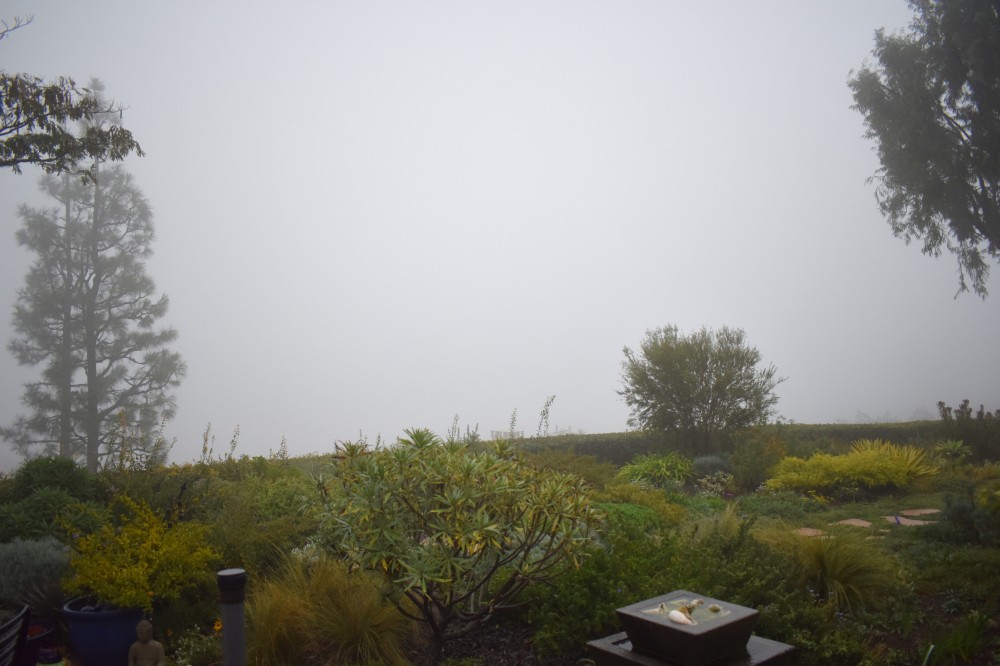
I'd planned another post for today but Mother Nature unexpectedly put on a major show this week and it warranted some attention.  Our third rainstorm of the season moved in late Tuesday, slowly built up steam on Wednesday, and finally gave us a thorough soaking on Thursday before moving eastward.  The rain was heavy at times and, for several hours yesterday, it looked as if we were cocooned in a cloud.

The effect was pretty in an eerie kind of way as neighboring houses simply disappeared

The usually bustling Los Angeles harbor was invisible and also silent

Even the birds were silent but then my failure to refill their feeders may have something to do with that


The clouds gradually lifted late in the afternoon, once again revealing the Los Angeles harbor below us.  As sunlight crept in, a rainbow appeared, arcing over the harbor, and I took my camera outside to capture it.

The rainbow created a complete 180 degree arc but I was unable to get a shot long enough to capture all of it


While I was out and about, I noticed what at first looked like smoke wafting over the fence that separates my cutting garden from the back garden.  Intense sunlight hitting the wet fence was causing water in the wood to evaporate in the form of steam.  I tried to capture the effect with my camera but was only minimally successful.

That fuzzy blur above the top of the fence was stream


As the sun began to dip, a second, fatter rainbow appeared.

You can read about what makes some rainbows look wider than others here if you're interested


And, like the end of any good fireworks display, Mother Nature's performance ended with a stunning sunset.


We got nearly 2 inches of rain over the course of the 3 days, with most of it arriving yesterday.  Our seasonal total to date is 4 inches which already exceeds the paltry amount we got last year.  (Our "rain years" are measured from October 1st through September 30th.)  Unfortunately, the rain caused havoc in the areas recently impacted by fire here.  Mudslides precipitated yet another round of evacuations and for a time snow closed the major highway artery between Southern and Northern California.

Highway 5 is open again but the mountains to the northeast of us were dusted in snow this morning


Today's Los Angeles Times included an article speculating on what this storm, much stronger than originally anticipated, signifies about the balance of our rainy season.  NOAA has been predicting a good chance of a moderate El Niño this year.  The Times referred to this week's storm as indicative of a "wanna-be El Niño" and said that the season suggests a "battle between El Niño and the blob," a persistent patch of warm water in the northeastern Pacific that in years past has prevented rainstorms from reaching Southern California, driving our drought.  That sounds like the title of a horror movie, doesn't it?  We'll hope this particular movie is a bust.  For those of you to the east in the storm's path, I hope it treats you gently.  Best wishes for a pleasant weekend.


All material © 2012-2018 by Kris Peterson for Late to the Garden Party

Wednesday, December 5, 2018

Succor in Succulents

It's been cold here of late.  No, not cold by the standards of those of you awaking to frost decorating your plants or snow blanketing everything in sight, but cold compared to what we're used to here in my area of coastal Southern California.  The color I seek from my garden is largely lacking now too but, buoyed by recent rain, my succulents offer a bright note.

I was surprised to see several Aeonium arboreum this morning suddenly preparing to bloom

This birdbath-style planter I renovated in August is looking better and better

The same could be said of this one, also replanted in August


We got a little light rain last night and expect more this afternoon and tomorrow and, while every rainstorm brings vague hopes of a flower-filled future, I remain mindful that we're still deeply entrenched in drought and likely to remain so as our world's climate leans toward increasing extremes.  In that vein, I've been steadily increasing my reliance on succulents in my garden.  After meeting a friend for lunch yesterday, I took the opportunity to stop in at a nearby nursery specializing in succulents.  Officially, my objective was to find a few Christmas gifts on my list but you will note that I'm not selfless enough to ignore plants that scream "buy me!"

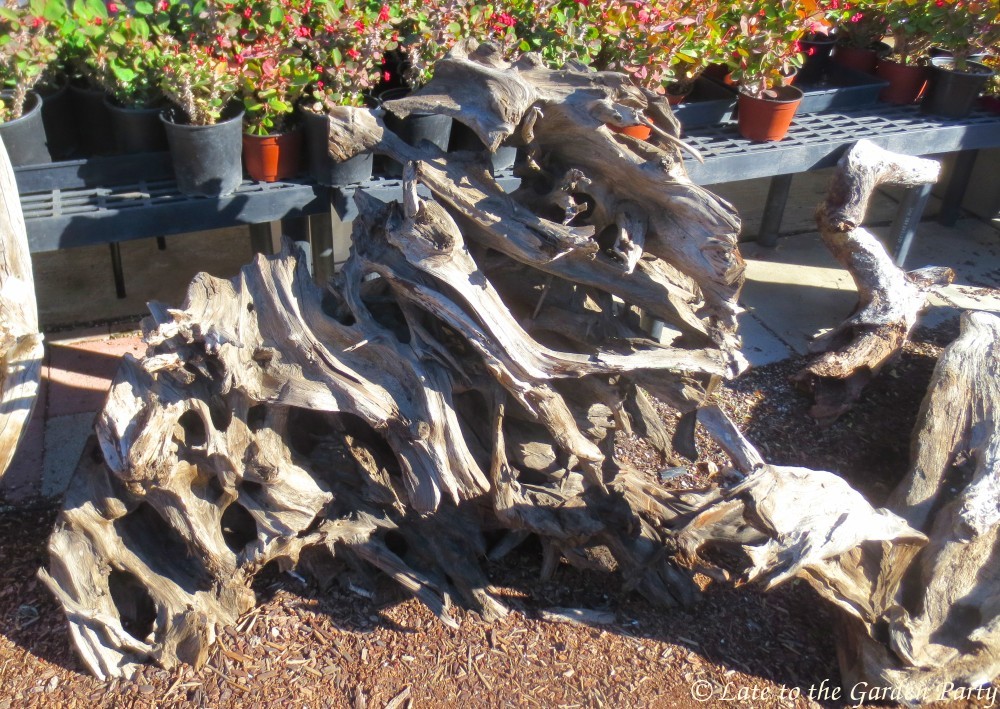
I've been thinking of creating a feature to hold succulents and bromeliads in one area of my garden so I was immediately drawn to the impressive pieces of driftwood lined up near the parking area.

Can't you just see succulents, airplants and other bromeliads tucked into those crevices?

This piece was wider but shorter


Then I checked the price tags and my dream of using something like this in my garden rapidly evaporated - or, more accurately, exploded.  The $720 price tags on these pieces obliterated my half-formed plans.

You will never see anything like this in my garden


However, I did find 2 of the 3 items I had on my Christmas gift list.  And, yes, I did purchase a few things for my own garden too.

This nursery is woefully short on labels but I think what I brought home included, clockwise from the upper left, Echeveria 'Blue Atoll' Haworthiopsis attenuata (aka zebra plant), a succulent I can't identify, what may be Echeveria 'Violet Queen', and Echeveria agavoides 'Tippy'


Holiday gift shopping can get expensive!


All material © 2012-2018 by Kris Peterson for Late to the Garden Party

Monday, December 3, 2018

In a Vase on Monday: From subtle to vivid

This is my one-thousandth post since starting this blog in late December 2012.  I've participated in several memes in that period but none more frequently than "In a Vase on Monday," which I joined in March 2014, so it seems entirely appropriate that this post falls on a Monday.  As it's December, there's less blooming in my garden than usual but, hey, when you''re lucky enough to live in coastal Southern California, there's always something.  Today's vases may be far from the most unique or interesting I've created over the course of well over 200 IAVOM posts but every week I'm still surprised at just how much I can find to cobble together to fill one vase, if not two or more.

My first vase was inspired by the soft cream-colored blooms of Correa 'Ivory Bells'.

The blooms on Correa 'Ivory Bells' are more profuse than those of any of my other Australian fuchsias and the buttercream flowers of the Mimulus (monkeyflower) I picked up several weeks ago complement them perfectly

I added Moroccan daisies (Pyrethropsis hosmarinese)  to the back of the arrangement

The buff color of the ornamental grass's plumes echoes the underside of the Correa's leaves

Clockwise from the upper left: Abelia x grandiflora 'Hopley's Variegated', Correa 'Ivory Bells', Laurel nobilis, Pennisetum 'Fireworks', Pyrethropsis hosmariense, Westringia fruticosa 'Morning Light', and Mimulus 'Jelly Bean Buttercream'


The inspiration for my second vase came from the vivid colors of an orchid bloom spike.

The orchid is reportedly a hybrid combining genes of Oncidium, Odontoglossum, and Miltonia, now classified as Oncostele. (Orchid genealogy makes my eyes cross.)

I picked up the red color in the orchid using Celosia 'Intenz' (shown here at the back of the vase)

and the red flower-like bracts of two Leucadendrons, but I think the variegated foliage of Leucadendron 'Jester'  did more to pull the composition together

Clockwise from the upper left: Celosia argentea 'Intenz', Coleonema pulchellum 'Sunset Gold', Leucadendron 'Devil's Blush', L. 'Safari Sunset', Leptospermum 'Copper Glow', Oncostele 'Wildcat' and, in the center, Leucadendron 'Jester'


For more IAVOM creations, visit Cathy at Rambling in the Garden.


All material © 2012-2018 by Kris Peterson for Late to the Garden Party