Wednesday, July 11, 2018

Sad Summer Story

Most gardeners of my acquaintance here don't celebrate summer.  Summer is not our friend.  By the time summer arrives, it's usually been dry for 3 months and we still face 4 or more months without rain.  Summer's heat makes a difficult situation even worse.  Unlike the beach city I used to live in, our current location on the east side of the South Bay peninsula doesn't benefit from western breezes off the ocean.  It's always been hot in the summer here but last Friday set a record for the 7 and a half years we've lived in this location.  After a pleasantly comfortable May and June, temperatures soared to 110F (43C).  My husband and I took refuge in an air conditioned house but my garden didn't get any relief.

Even with applications of supplemental water before and during the heatwave, the results aren't pretty.  The garden has suffered the impact of scorching heat before but this event matches or exceeds the horrific heatwave of 2016.  This time, the temperature peaked higher; that heat was sustained over a longer period; and it was accompanied by strong dry winds.

As mentioned in my last post, the first sucker punch was the sight of my Acacia cognata 'Cousin Itt'.  Although temperatures moderated in the days following the 110F scorcher, the appearance of these plants has worsened.

Instead of emerald green foliage, 5 of the 6 plants in my garden are covered with bronze-brown leaves.  The plant with no afternoon sun exposure is the only one that's shown no sign of this damage.  The plant shown here has been in place since 2014 and my others were planted in 2012.  None have previously been scorched like this.


As I continued my survey yesterday, I saw this.  I was heartbroken.

The plant in the center of this photo is Metrosideros collinia 'Springfire'.  I'd coveted the tree-like shrub for years and finally planted one 18 months ago.  It'd gained size and flowered well this spring.  It looked fine when I took my wide shot photos earlier this month.  Can it recover?  I'm not sure but I'll give it a chance.


Some plants are just burnt.  Their foliage may look ugly for the rest of the season, but they should recover.

I pruned this Echium webbii of its dead flower spikes last month.   Its new growth fried.  Should I have pruned it sooner, or perhaps later? 

While a lot of Agapanthus flowers fizzled in the heat, most of the normally evergreen foliage held up reasonably well.  However, the clumps in full all-day sun with no wind protection didn't do as well.  It probably didn't help that this is one of the driest areas of the garden.

These large Agave attentuata came with the garden.  They benefit from a good deal of shade from the Arbutus 'Marina' above.  This is the first time I can recall that they've been sunburned.  Other succulents, especially the gold-toned Sedums, are also burnt.

Arthropodium cirratum (Renga Lily) is an evergreen bulb.  The flowers were dying back before the heatwave but the foliage dried out badly in its aftermath.

The Hong Kong orchid tree (Bauhinia x blakeana) usually drops leaves gradually at this time of year as the tree produces new green leaves.  I've never seen them turn gold in place like this.

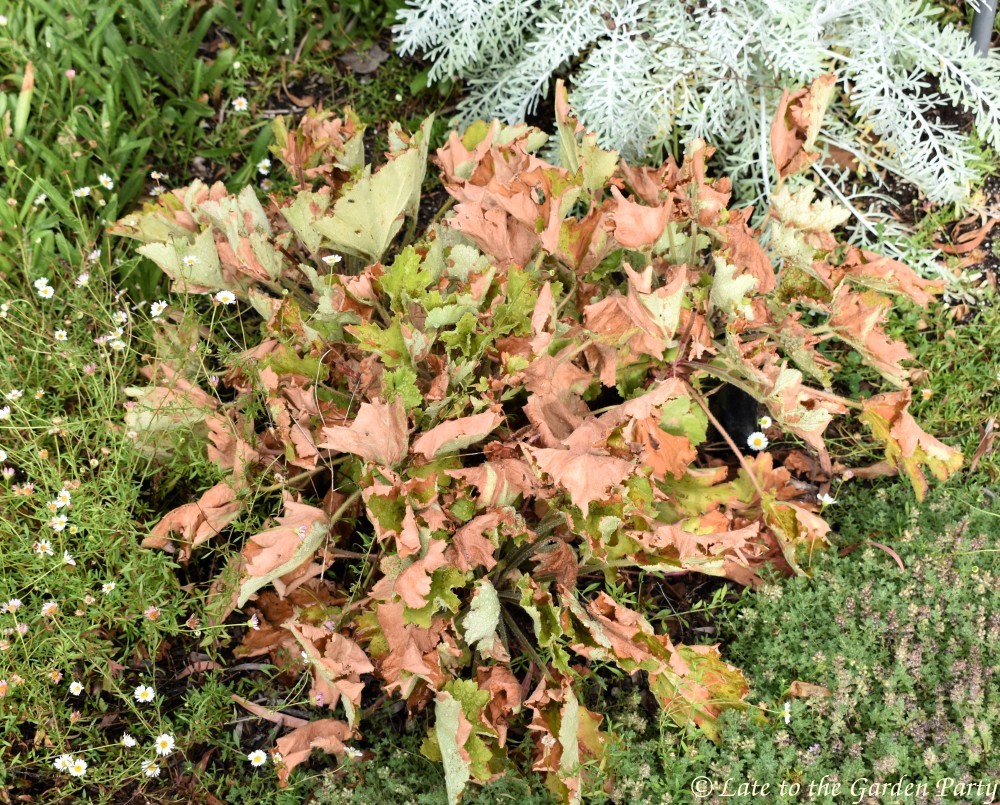
This is Heuchera maxima, a California native.  I'll probably leave the foliage alone until the plant starts producing new growth, much as it pains me to look at it.


A lot of flowers fried.

The Shasta daisies (Leucanthemum x superbum) that looked so good this year shriveled in place but I'm hoping that deadheading them will give me more flowers later in the season.  I don't have the same kind of hope for the Lisianthus (Eustoma grandiflorum) and some of the other flowering plants.


In other cases, the plants themselves were beaten down hard but I still expect them to recover in time.

Sadly, my new lath (shade) house didn't provide my plants with as much protection as I'd like.  I suspect the dry winds were the biggest problem.  The Begonias in particular were hit hard.  This photo shows a noID rex begonia before and after the heatwave.  The plant subsequently lost all but one leaf.  We'll see how the rest of the summer goes but Begonias may be a failed experiment.  Orchids I've had for years were also badly damaged.

Other damaged plants include, clockwise from the upper left: Acanthus spinosus, Alstroemeria 'Indian Summer', Fatsia japonica (shown in the lath house), and Hemerocallis 'Sammy Russell'.  The daylily foliage that turned bright yellow in response to the heat is now turning brown but there are already signs of new green growth.


Unfortunately, there are a few plants that look to be dead, or close to it.

It took me a minute to even identify this plant.  It's ribbon bush (Hypoestes aristata), a plant that grew well in my former garden.  It struggled here even before this heatwave struck and I think I'm going to give it up now.

The loss of some Salvias surprised me.  This is Salvia discolor, which I've had for several years.  Salvia macrophylla, also a long-time resident, is toast as well.


I find it hard avoid becoming fixated on what's ugly but I know I should celebrate the plants that came through the heatwave with their looks intact.  Some look great when viewed from a distance, although a close examination shows signs of stress.

Cuphea hybrid 'Starfire Pink' looked fine from a distance but, viewed up close, I found that its interior foliage was glowing red


Others plants just look great.  It's possible that some of these may show the ill effects later but 4 days out from the heatwave's peak, here are some of the those that were seemingly unfazed by the event.

Agonis flexuosa 'Nana' doesn't even show signs of tip burn on its new foliage

Maybe I haven't previously looked at it closely enough but I'd swear the Corokia x virgata 'Sunsplash' shown here has put on several inches of new growth this week

Unlike Echium webbii, Echium candicans 'Star of Madeira' is unscathed.  It cut back its flower spikes less than 2 weeks ago and it hasn't produced any substantial new growth yet.  It also gets a bit of shade from the nearby Magnolia. 

Gaura lindheimeri laughs in the face of heat.  The Agapanthus in partial shade in the background fared far better than the plants in full sun.

Leptospermum 'Copper Glow' is continuing to pump out sprays of flowers

The plants outside the lath house, like those in the window boxes and Euryops 'Sonnenschein' in the foreground, fared better than some of the plants inside

Leonotis leonurus is finally blooming

Pennisetum advena 'Rubrum' is also producing its first flowers

The gray-leafed Santolinas look perfect

Senecio candicans 'Angel Wings' was drooping at the height of the heatwave on Friday but I gave it a bottle (that dripped water to its roots) and it looks great thus far.  However, my other plant, in a pot near the front door, doesn't look as good.

Trichostema 'Midnight Magic' is blooming happily.  The flowers on the green-leafed Santolina could use some deadheading but the plants themselves are fine.

The 'Bright Star' Yuccas and Leucadendrons are doing just fine.  The first flush of flowers on the Achillea 'Moonshine' are turning beige but that's normal.  All the Gaillardia flowers withered in response to the intense heat but, with some deadheading, new flowers are already appearing.


So, post-heatwave, the garden presents a mix of good with the bad.  I'm trying to look at the event as a learning exercise.  Our temperature today is hovering near 90F (32C) as I complete this post.  We're hoping for slightly cooler temperatures next week but, as summer conditions can extend well into October here, I'm sure the heat will be back.  I just hope that we don't hit 110F again this year - or get any wildfires.


All material © 2012-2018 by Kris Peterson for Late to the Garden Party

Monday, July 9, 2018

In a Vase on Monday: Blast Furnace Survivors

Heat was predicted for the weekend but the forecasts for my immediate area called for temperatures in the low 90sF, which wasn't too ominous.  I gave the areas I thought were at greatest risk extra water and applied some additional mulch on Thursday, thinking that would be sufficient until our irrigation system ran in the wee hours of Saturday morning.  I was wrong.  When we awoke to soaring temperatures on Friday morning, I ran around watering more plants while my husband shuttered the house against the heat.  The air conditioning went on before 10am.  Still, when I left the house to meet friends, I'd no idea just how bad things were going to get.  By the time I got back home mid-afternoon, our temperature had hit 110F (43C) and the humidity was in the single digits.  Strong winds that persisted well into the night made things worse.  At 8:30pm when I went back outside to do more spot watering, it was still 102F and when I went to bed around 11pm the temperature was stuck at 101F (38C).

The temperatures dropped into the low 90sF on Saturday, and Sunday was about the same, but the damage was done.  Flowers shriveled and some plants had outright died.  Even plants in my lath (shade) house were impacted.  Perhaps the biggest shock was the damage done to my Acacia cognata 'Cousin Itt', plants that have survived prior heatwaves without any sign of difficulty.

The tawny bronze color of the leaves here isn't normal and it's worsened since I took this photo.  I've 6 of these large plants scattered about the garden and only the one in the deepest shade is unscathed.  I'm not going to cut the damaged foliage until fall as I assume it'll help protect the foliage underneath from any further heat blasts.


Every time I walked outside, I found further evidence of damage.  I wasn't sure what I would find to cut for a vase and I seriously considered posting a photo of the lemons I picked Friday evening.

During the last horrific heatwave we had back in 2015 2016, my lemon tree dropped every piece of fruit virtually overnight and, although I now give the tree more supplemental water, I feared a repeat of that event.  I'd already gifted bags of lemons to friends that week but I picked buckets more for us and our neighbors Friday evening.


However, while my supply of flowers has been vastly depleted, I was able to find some that made it through the blast furnace undamaged when I surveyed the garden Sunday morning.

Almost all the Lisianthus (Eustoma grandiflorum) blooms were shriveled by the heat but I found 2 in good condition to decorate the front of this arrangement

I dressed the back of the arrangement with one of the few daylilies I found in bloom

The Abelia and Renga Lily blooms shown here were protected by deep shade.  The Artemisia foliage and Allium flowers seemed impervious to the heat.

Clockwise from the upper left, the vase contains: Abelia x grandiflora, Artemisia ludoviciana, Allium sphaerocephalon, Arthropodium cirratum, Jasminium polyanthum, Hemerocallis 'Apollodorus', and, in the center, pink and white Eustoma grandiflorum


Most of my Agapathus look awful and I've already cut down a few dozen flower stalks just because I couldn't stand seeing at them in that state but I found a few in good condition in a relatively shaded area and cut those for a second vase.

The Matilija poppies (Romneya coulteri) at the bottom of the back slope took the heat in stride, although half the blooms I cut shattered before I got them in the vase

The feverfew flowers shown in this back view surprised me - they appeared to bloom in response to the heat!

Top view

Clockwise from the upper left, this vase contains: noID Agapanthus, Abelia x grandiflora 'Hopley's Variegated', Romneya coulteri, noID Lonicera, and unkillable Rosmarinus officinalis.  Included, but not shown in close-up, is the feverfew (Tanacetum parthenium).


I'd foolishly hoped that, after a very dry winter, Mother Nature might favor us with a mild summer.  May and June were unusually cool on average and that gave me an artificial sense of security.  I'm disappointed to say the least and more than a little shocked that our temperature here hit 110F.  I can't recall a temperature that high in the seven and a half years we've lived here.  However, while I the garden sustained some losses, I expect that most of the damaged plants should survive - I just have to face several months of ugliness until they rebound.  Still, I know we're lucky that we haven't been affected by wildfires as many areas in California and the Southwest have.  The only one happy about the weather at the moment are the lizards.


For more "In a Vase on Monday," visit our host, Cathy at Rambling in the Garden.

In addition to this week's vases, one of last week's vases got a face-lift and remains in the front entry.  The dahlia blooms that were in last week's vase reacted badly to the air conditioning but the Lisianthus held up well. 


All material © 2012-2018 by Kris Peterson for Late to the Garden Party

Friday, July 6, 2018

Wide Shots - July 2018

May and June were on the cool side, thanks to a persistent morning marine layer.  We saw the temperatures soar yesterday, nearing 90F at their high point, and we're expecting worse over the course of the weekend before it cools back down a bit early next week.  Still, with much of the nation suffering through nasty heatwaves for what seems like weeks now, I'm counting myself lucky that summer eased in gently here this year.

I took most of this quarter's wide shots on July 2nd, when we were still enjoying the effects of the marine layer.  Last July, I was complaining about returning from the Garden Bloggers' Fling in Washington DC to face a garden singed by a nasty heatwave in late June but this year the garden is looking much more perky in early July.

This is the view from the back patio looking toward Angel's Gate, the entrance to the Los Angeles Harbor.  The red-orange daylilies I inherited with the garden have begun their bloom cycle.  The Mexican feather grass (Stipa tenuissima) is out of control once again.  I'll need to use the cooler early mornings to whip it back into shape.

This is a view of the back garden looking north.  Last July's wide shots post showed the mimosa tree (Albizia julibrissin) in full bloom.  There's no sign of flowers this year and, as you can see, the leaf canopy is still sparse, particularly on the left side.  The difference between the front and back portions of the tree are much more evident in this photo than when viewed  close up.

This is a closer look at the north end of the back garden.  The beds on either side of the path are looking fuller this year.

This is a view of the back garden from the north end looking toward the main patio.  I moved Hemerocallis 'Persian Market'  (shown in bloom) and a couple of other daylilies to the bed in the foreground a few months ago.  I've thrown 3 green-flowered Lisianthus (Eustoma grandiflorum, not yet in bloom) in here too because I can never get enough of these flowers.

This is a closer view of the south side of the back garden.  I'm no longer sure I like that bright gold mass of color in the distance, created by 3 shrubs of Coleonema 'Sunset Gold'.  I may whittle down its size by pulling out one of the shrubs.


Walking south along the flagstone path shown in the photo above brings us to the garden on the south side of the house.  It's gone through a number of transformations since we moved in seven and a half years ago.  Originally dominated by a 60 foot tall Eucalyptus, removed at the behest of a neighbor who claimed it interfered with her view, it subsequently became a succulent garden.

About two-thirds of the plants in this area are still succulents but I've added other drought tolerant species, like Metrosideros 'Springfire' and Hymenolepsis parviflora to add some softness


From the south side garden one can either continue along the flagstone path into the main level of the front garden or take a mulch-covered path down into a lower area adjoining the street.  This month we'll continue on the main level and circle back to the street level on the southwest side later.

This is a view of the front garden looking north toward the driveway and garage.  My ever-blooming Grevillea 'Superb' can be seen on the right.  The Echium candicans 'Star of Madiera' in the distance on the left has just finished its bloom cycle.  The Plectranthus neochilus midway along the path has filled in nicely and blooms well but its strong unpleasant scent may require moving it.

The two Leptospermum 'Copper Glow' on either side of the walkway to the front door have grown huge.  They're just now producing a scattering of small white flowers.  The Agapanthus are still going strong in both the front and back garden but they're starting to look frowzy.

View of the north side of the house's front exterior.  None of my roses have done well this year - several have failed to produce a single bloom - but the climber 'Joseph's Coat' is at least making an effort.


The area on the opposite side of driveway (i.e. the area facing the chimney) is the last area I developed.  It's been slow to come together.

I'm still trying to find the right plants to handle the shifting sun and shade conditions in this area.  I apologize for the poor quality of the photo.

I'm still tweaking the succulent bed tucked into the northwest corner too


If we return to the driveway, passing the garage, we come to the cutting garden.  It's off to a slow start this summer.

My cool season blooms hung on well into April so I was tardy in evicting them to make room for warm season plants.  I also lost several dahlia tubers to rot due to over-watering.  In addition to the dahlias, I've planted Calendula, Zinnia and Helianthus seeds but all of those went in late as well.


Continuing through the gate at the far end of the cutting garden takes us to an area on the northeast side of the property I formerly called my dry garden.  While it's still populated with succulents and other drought resistant plants, calling it my "dry garden" no longer seems appropriate as, with the exception of the cutting garden, the entire property can be called a dry garden.

Removal of one of the guava trees made a big difference in this area.  There are some empty spots, which I've seeded with sunflowers and zinnias as temporary fillers.


The path shown in the photo above leads to the back slope, which is still looking hideous.

I started nipping away at the ivy and honeysuckle growing on the upper portion of the slope a few months ago, then turned my attention to other projects.  Now, it's getting too hot to get much of anything but watering done down there,  Any serious work will have to wait until cooler temperatures return in the fall.

The Pittosporum 'Silver Magic' along the property boundary are filling out nicely, although I'm a bit worried that the Matilija Poppy (Romneya coulteri) is already getting out of control.


Okay, it's time to take you back to the area on the southwest side of the garden, the home of my lath (shade) house.  This is the area I've spent most of my time fussing with the last few months.

The indoor area is filling up, albeit slowly.  Much of my effort has been focused on sprucing up the outside with plants.  I've changed out the contents of the window boxes with more heat tolerant plants and added other plants in the surrounding area.  I'll cover the changes in a separate post soon.

View of the area looking east toward the upper level of the garden
The prettiest blooms in the area right now are found on this Oscularia deltoides


The area is is bordered on the other side by a succulent bed running alongside the street, one of my earliest projects.

With the exception of the tree-like Auranticarpa rhombifolium shrubs towering above it, the bed still looks pretty good.  We took out 3 dying Auranticarpa, which created a gap in the the screening from the street. We planted Xylosma congestum behind the succulents to extend the existing Xylosma hedge but those shrubs have taken their time gaining size and now I'm concerned that I may need to take 2 of the 3 remaining Auranticarpa out.


That's it for this quarter's wide shots of my garden.  I'll close with a photo of my cat Pipig enjoying the garden from inside the house.

If there's a sunny spot in the house, Pipig will find it!


I hope you find a sunny spot to enjoy the weekend too!

All material © 2012-2018 by Kris Peterson for Late to the Garden Party

Wednesday, July 4, 2018

Wednesday Vignette: A murder of crows

Yes, it's the 4th of July, Independence Day in the US, but this post has nothing whatsoever to do with the holiday.  While fireworks have been going off every evening for the past month and I fully expect they'll continue for weeks yet despite the fact that private displays are illegal in this area, I haven't tried to capture any of these with my camera.  Still, happy 4th to all of you in the US!  Let's hope that the political landscape improves in the coming year so we can really celebrate.

My Wednesday Vignette this week concerns crows.  Specifically, large numbers of crows.  Last week, I was sitting at the computer in my home office at twilight when a cacophonous racket distracted me.  Almost simultaneously, a large number of crows, at least three dozen, possibly more, took up perches directly outside in the mimosa tree.  The didn't stay long.  As I located my camera and aimed it in their direction, they started to fly off.  I caught some of them flying out over the back garden's hedge.

I count at least 15 birds in this photo but the number that scattered about was far larger.  A group of crows is commonly called a "murder of crows."


They landed in the trees of nearby neighbors, calling out to stragglers.

They moved as a loose group, with those in the lead stopping at intervals, as if waiting for their cohorts to catch up


Then they congregated on the roof of a neighbor several houses down the road from us, where they hung out for a longer period.

You can see them arranged along the roof line, once again waiting for those behind them to arrive.  I don't think anyone in this house was home as no one appeared outside.  It would have been nearly impossible to miss their cries.

In less than 10 minutes, they dispersed again


They flew off to the south, still calling to stragglers and landing on different perches at intervals until I eventually lost sight of them.

Crows are social birds and commonly roost together at night in large groups.  They also change their roosts from time to time but apparently this usually happens in winter.  I used to take regular morning walks about a mile south to a large park surrounded by a housing development.  One house in that development routinely drew my attention.  Hundreds of crows occupied the area surrounding the house, most in one very large tree, but others spilling out onto telephone and power lines in the same area.  At the time, I wondered if the home's owners had a particular affection for crows, or if there was simply no way to get rid of them.  I know they have a reputation as smart birds but they're also very noisy and as messy as any other bird.  I wondered what I'd do if they ever chose to relocate to my house en masse.  When I first saw them alight in the mimosa tree, I momentarily feared I might have to face that issue as many other people have done.

According to the article I referenced, one group in Oklahoma numbered two million individual birds.  The murder of crows I saw was far smaller.  Why they were on the move in early summer is a mystery but it seems they found someplace other than my mimosa tree to roost.  Or so I hope anyway...

Yesterday, I was drawn to a distinctive cry emanating from atop my peppermint willow tree.  This call sounded like a "gronk" rather than a "caw" and the bird left a calling card behind.  I think this must have been a raven.  Thankfully, they usually travel in mated pairs rather than  groups.


For more Wednesday Vignettes, visit Anna at Flutter & Hum.


All material © 2012-2018 by Kris Peterson for Late to the Garden Party

Monday, July 2, 2018

In a Vase on Monday: Otto continues to thrill

I faced a time crunch in putting together this week's vases so I zipped through my garden more quickly than I usually do on Sunday morning.  The only dahlias blooming in my cutting garden are still those of the 'Otto's Thrill' cultivar I purchased in early June already in bud.   While I'm frustrated by the slow progress of the varieties I planted as tubers, I was pleased to see that 'Otto' had two perfect blooms just waiting to be cut.  As it turned out, they matched up prettily with the pale yellow Lisianthus (Eustoma grandiflorum) the wind had blown flat against the ground in my front garden.  A few other additions and voilà, an arrangement!


The yellow Lisianthus blooms are tinged with pink and the dahlia has yellow accents so the two seemed made for one another

Leucadendron 'Pisa's' heavy cones have been weighing down several of the shrub's branches, begging to be cut, so this was a perfect opportunity use a few

Top view

Clockwise from the upper left, the vase contains: Dahlia 'Otto's Thrill', Crassula pubescens ssp radicans, Fatsia japonica 'Camouflage', Eustoma grandiflorum, and Leucadendron 'Pisa'


The second vase didn't come together as well in my estimation.  I took my inclination to blend flowers too far, creating an arrangement in which the individual blooms had little opportunity to distinguish themselves.


Lots of red tones here but nothing to set them off, either in texture or color

Although the Grevilleas shown in the prior view were mean to be the stars of the arrangement, I think the Lotus berthelotii shown here in the back view makes a stronger statement

Top view

Clockwise from the upper left, the vase contains: Grevillea 'Ned Kelly', Eustoma grandiflorum 'Mint Cocoa' (which fades from a purplish shade to a brownish mauve color), Leucadendron salignum 'Chief', Lobelia laxiflora, and Lotus berthelotii 'Amazon Sunset'


After staring at the arrangement for awhile on my dining room table, I gave it a quick tweak and left it at that.


The tweaked version of the original arrangement is shown on the right.  The addition of the Shasta daisies (Leucanthemum x superbum) adds contrast but now the Lisianthus are lost in the mix.


The first vase sits in the front entry.


For more Monday vases, visit Cathy at Rambling in the Garden.


All material © 2012-2018 by Kris Peterson for Late to the Garden Party