Showing posts with label plant losses. Show all posts

Wednesday, July 11, 2018

Sad Summer Story

Most gardeners of my acquaintance here don't celebrate summer.  Summer is not our friend.  By the time summer arrives, it's usually been dry for 3 months and we still face 4 or more months without rain.  Summer's heat makes a difficult situation even worse.  Unlike the beach city I used to live in, our current location on the east side of the South Bay peninsula doesn't benefit from western breezes off the ocean.  It's always been hot in the summer here but last Friday set a record for the 7 and a half years we've lived in this location.  After a pleasantly comfortable May and June, temperatures soared to 110F (43C).  My husband and I took refuge in an air conditioned house but my garden didn't get any relief.

Even with applications of supplemental water before and during the heatwave, the results aren't pretty.  The garden has suffered the impact of scorching heat before but this event matches or exceeds the horrific heatwave of 2016.  This time, the temperature peaked higher; that heat was sustained over a longer period; and it was accompanied by strong dry winds.

As mentioned in my last post, the first sucker punch was the sight of my Acacia cognata 'Cousin Itt'.  Although temperatures moderated in the days following the 110F scorcher, the appearance of these plants has worsened.

Instead of emerald green foliage, 5 of the 6 plants in my garden are covered with bronze-brown leaves.  The plant with no afternoon sun exposure is the only one that's shown no sign of this damage.  The plant shown here has been in place since 2014 and my others were planted in 2012.  None have previously been scorched like this.


As I continued my survey yesterday, I saw this.  I was heartbroken.

The plant in the center of this photo is Metrosideros collinia 'Springfire'.  I'd coveted the tree-like shrub for years and finally planted one 18 months ago.  It'd gained size and flowered well this spring.  It looked fine when I took my wide shot photos earlier this month.  Can it recover?  I'm not sure but I'll give it a chance.


Some plants are just burnt.  Their foliage may look ugly for the rest of the season, but they should recover.

I pruned this Echium webbii of its dead flower spikes last month.   Its new growth fried.  Should I have pruned it sooner, or perhaps later? 

While a lot of Agapanthus flowers fizzled in the heat, most of the normally evergreen foliage held up reasonably well.  However, the clumps in full all-day sun with no wind protection didn't do as well.  It probably didn't help that this is one of the driest areas of the garden.

These large Agave attentuata came with the garden.  They benefit from a good deal of shade from the Arbutus 'Marina' above.  This is the first time I can recall that they've been sunburned.  Other succulents, especially the gold-toned Sedums, are also burnt.

Arthropodium cirratum (Renga Lily) is an evergreen bulb.  The flowers were dying back before the heatwave but the foliage dried out badly in its aftermath.

The Hong Kong orchid tree (Bauhinia x blakeana) usually drops leaves gradually at this time of year as the tree produces new green leaves.  I've never seen them turn gold in place like this.

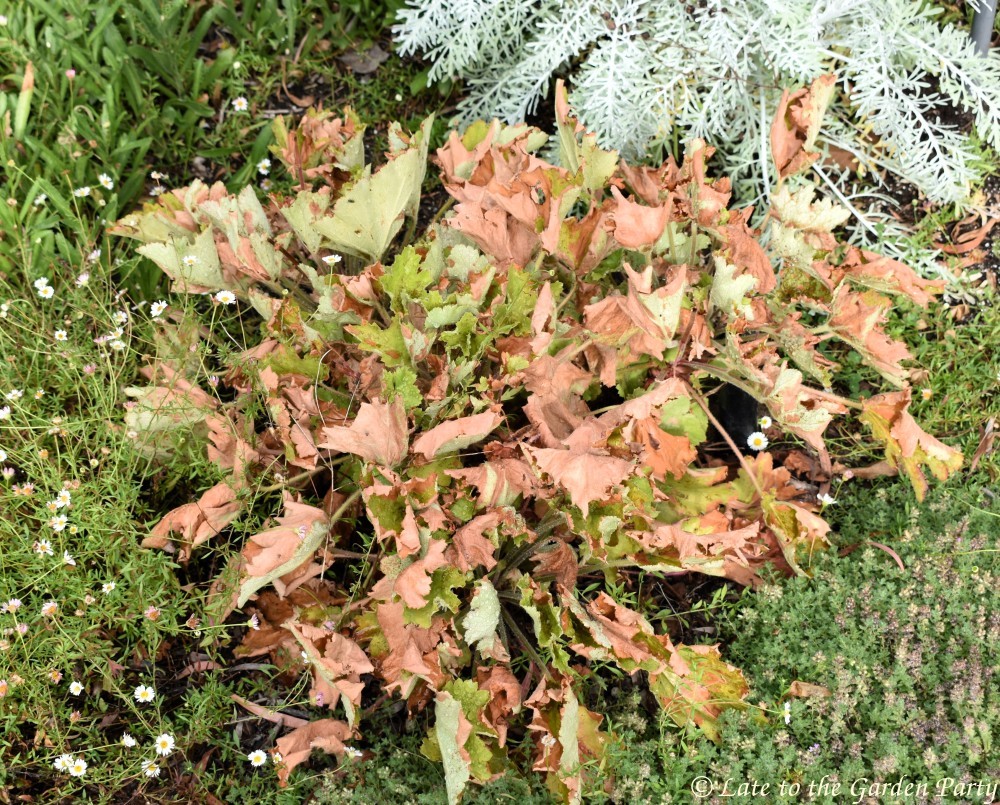
This is Heuchera maxima, a California native.  I'll probably leave the foliage alone until the plant starts producing new growth, much as it pains me to look at it.


A lot of flowers fried.

The Shasta daisies (Leucanthemum x superbum) that looked so good this year shriveled in place but I'm hoping that deadheading them will give me more flowers later in the season.  I don't have the same kind of hope for the Lisianthus (Eustoma grandiflorum) and some of the other flowering plants.


In other cases, the plants themselves were beaten down hard but I still expect them to recover in time.

Sadly, my new lath (shade) house didn't provide my plants with as much protection as I'd like.  I suspect the dry winds were the biggest problem.  The Begonias in particular were hit hard.  This photo shows a noID rex begonia before and after the heatwave.  The plant subsequently lost all but one leaf.  We'll see how the rest of the summer goes but Begonias may be a failed experiment.  Orchids I've had for years were also badly damaged.

Other damaged plants include, clockwise from the upper left: Acanthus spinosus, Alstroemeria 'Indian Summer', Fatsia japonica (shown in the lath house), and Hemerocallis 'Sammy Russell'.  The daylily foliage that turned bright yellow in response to the heat is now turning brown but there are already signs of new green growth.


Unfortunately, there are a few plants that look to be dead, or close to it.

It took me a minute to even identify this plant.  It's ribbon bush (Hypoestes aristata), a plant that grew well in my former garden.  It struggled here even before this heatwave struck and I think I'm going to give it up now.

The loss of some Salvias surprised me.  This is Salvia discolor, which I've had for several years.  Salvia macrophylla, also a long-time resident, is toast as well.


I find it hard avoid becoming fixated on what's ugly but I know I should celebrate the plants that came through the heatwave with their looks intact.  Some look great when viewed from a distance, although a close examination shows signs of stress.

Cuphea hybrid 'Starfire Pink' looked fine from a distance but, viewed up close, I found that its interior foliage was glowing red


Others plants just look great.  It's possible that some of these may show the ill effects later but 4 days out from the heatwave's peak, here are some of the those that were seemingly unfazed by the event.

Agonis flexuosa 'Nana' doesn't even show signs of tip burn on its new foliage

Maybe I haven't previously looked at it closely enough but I'd swear the Corokia x virgata 'Sunsplash' shown here has put on several inches of new growth this week

Unlike Echium webbii, Echium candicans 'Star of Madeira' is unscathed.  It cut back its flower spikes less than 2 weeks ago and it hasn't produced any substantial new growth yet.  It also gets a bit of shade from the nearby Magnolia

Gaura lindheimeri laughs in the face of heat.  The Agapanthus in partial shade in the background fared far better than the plants in full sun.

Leptospermum 'Copper Glow' is continuing to pump out sprays of flowers

The plants outside the lath house, like those in the window boxes and Euryops 'Sonnenschein' in the foreground, fared better than some of the plants inside

Leonotis leonurus is finally blooming

Pennisetum advena 'Rubrum' is also producing its first flowers

The gray-leafed Santolinas look perfect

Senecio candicans 'Angel Wings' was drooping at the height of the heatwave on Friday but I gave it a bottle (that dripped water to its roots) and it looks great thus far.  However, my other plant, in a pot near the front door, doesn't look as good.

Trichostema 'Midnight Magic' is blooming happily.  The flowers on the green-leafed Santolina could use some deadheading but the plants themselves are fine.

The 'Bright Star' Yuccas and Leucadendrons are doing just fine.  The first flush of flowers on the Achillea 'Moonshine' are turning beige but that's normal.  All the Gaillardia flowers withered in response to the intense heat but, with some deadheading, new flowers are already appearing.


So, post-heatwave, the garden presents a mix of good with the bad.  I'm trying to look at the event as a learning exercise.  Our temperature today is hovering near 90F (32C) as I complete this post.  We're hoping for slightly cooler temperatures next week but, as summer conditions can extend well into October here, I'm sure the heat will be back.  I just hope that we don't hit 110F again this year - or get any wildfires.


All material © 2012-2018 by Kris Peterson for Late to the Garden Party

Friday, August 26, 2016

August 2016 Favorites

It's the last Friday of the month, when Loree of danger garden calls for gardeners to celebrate the plants that earned their favor this month.  August is a month when the plants here hunker down and wait for better days so finding stand-outs isn't easy.  Even though our summer temperatures have been milder than they were in late June and extra irrigation has generally perked things up, the plants I'm drawn to at the moment are mostly those I've already featured within the last few months.  But a few plants are deserving of notice.

Ozothamnus diosmifolius, planted in November 2015, is finally living up to my expectations.

The Australian native isn't in flower at this time of year but I really didn't buy it for the flowers

I love its erect form which makes me think of a miniature pine tree

Also known as rice flower, it's often grown for its flowers, shown here in a photo taken back in April


Leucadendron salignum 'Chief', planted in January 2013, fulfilled its promise long ago while its companion, Leucadendron 'Ebony', planted some 8 months later, has been slower to develop.  The two are finally beginning to play off one another as I'd envisioned.

Leucadendron 'Ebony', a sport of L. 'Safari Sunset', has gained size at last this year, although its growth is uneven.  At maturity, 'Ebony' should grow 3-4 feet tall, or about half the height of 'Chief'.  I trim  'Chief' back each year but have yet to trim 'Ebony'.

L. 'Chief' makes great use of the late afternoon sunlight

In contrast, L. 'Ebony' is dark and moody


Lantana camara 'Irene', planted from 6-packs in May 2015, is at last providing the pops of color I'd imagined around the base of the Pennisetum in the back garden.  Although it's a drought tolerant plant, it needed the boost it got from additional irrigation to produce more than a flower here and there.

Lantana camara 'Irene' has pretty multi-colored flowers which play off both the reddish pink of the Pennisetum 'Fireworks' to the left and the orange Agastache behind.  Hibiscus trionum (to the right) recently made a surprise reappearance after dying off last year.  Considered a noxious weed in some areas of the country, it doesn't present an issue here.


The succulents can be depended upon to look good year round but two earned special recognition this month.

Crassula perfoliata falcata (aka airplane plant) produced its first bright red bloom

Although relatively small, Agave parryi patonii draws my attention every time I pass it.  I love those exaggerated leaf imprints.  It's produced a couple of pups but I don't think I can manage to get them out intact without digging up the entire plant.


Unfortunately, I also had a major loss this month.  My Leucadendron galpinii, a relatively recent purchase, dropped dead in record time.

It lasted less than 2 months in the backyard border, despite the extra water I provided to help it get established


I was excited to find this plant in a one-gallon container for the first time and, perhaps foolishly, decided to go ahead and plant it in the backyard border in July rather than waiting for more hospitable weather.  Even more foolishly, I planted it in the same location as the Adenanthos sericeus I'd lost earlier.  Tracing the history of plants in this area, I realized these aren't the first losses in the same area.  I previously lost both a Prostanthera ovalifolia and a Philotheca myporoides in the same general vicinity.  Based on my (somewhat patchy) records, all seem to have expired relatively quickly.  I'm going to test the soil to see if that provides clues to what's going on.

So as not to end on that sour note, here's a photo of the lovely Pennisetum 'Fireworks' in my back garden.  I think they look even better than they did in last month's favorites post.  Pop over to Loree's site for more August favorites.


All material © 2012-2016 by Kris Peterson for Late to the Garden Party

Saturday, July 23, 2016

The good, the bad and the ugly

This morning we woke to hazy skies.  I was initially delighted at the idea that the morning marine layer had returned as that usually brings our temperature down and, after days of highs in the low 90sF, that was welcome.  But the light was peculiar.

This was the view from our backyard, looking out over the Los Angeles Harbor and the Vincent Thomas Bridge leading to Long Beach.  The sepia color isn't a photographic trick but rather the result of a mix of fog and smoke.


Although we couldn't smell smoke here (and still can't), it quickly became apparent that the hazy sky couldn't be attributed solely to fog.  There's another brush fire burning in the Angeles National Forest.  It started yesterday afternoon and has already covered 11,000 acres, necessitating evacuations.  A cool-down is expected in the area this evening, which I hope will help firefighters bring the fire under control.

THE GOOD

The hazy, tinted light added a glow to my garden, making things look better than they did in the harsh light earlier this week.

View from the northeast corner of the house looking south

The dry garden on the southeast side of the house is currently getting regular irrigation.  The Leucadendrons ('Ebony' and 'Chief') and Coprosma 'Plum Hussey' add a touch of red color to what is mostly a green space at this time of year.

After more than a year in the garden, Leucadendron 'Safari Sunset' (left) is finally gaining size.  The 3 Acacia cognata 'Cousin Itt' under the tree continue to thrive after 3 years in the ground.


All the Leucadendrons are looking good.

Leucadendron 'Wilson's Wonder' continues to be one of the stars of my garden


And so is Callistemon 'Cane's Hybrid'.

Planted in the backyard border from a one-gallon container just over a year ago, I'm so happy with 'Cane's Hybrid' that I'm wondering where I could put another one.


I refilled the bird feeders, which made the birds happy.

It's fortunate that I picked up birdseed on the way home yesterday as the greedy creatures are going through it at a record rate.  They're also pleased that the fountain is back on - we had an extended power outage yesterday and they kept landing on the fountain, squawking about the water being shut off.


THE BAD

But even taking the lousy air quality out of the equation, all isn't entirely well here.  While I've been hiding inside during the current heatwave, the tent caterpillars took over both my perennial lupines, leaving devastation in their wake.

I thought I had the infestation under control but I clearly did not.  I've been reluctant to use pesticides but today, after cutting back the branches destroyed by the caterpillars and removing all I could find, I sprayed the plant with insecticidal soap.  I'm not sure it'll do anything but I'm worried that the plant may already have trouble recovering from the damage the caterpillars have done.


THE UGLY

Meanwhile, despite amping up my irrigation, the heat and drought have continued to take a toll on selected plants, leading me to conclude that more will have to be replaced this fall.

This Coleonema pulchellum 'Sunset Gold' showed signs of distress months ago but I wasn't able to uncover the cause.  The plant is beyond help now.

In contrast, this C. 'Sunset Gold', also situated along the driveway, is doing fine 


In other cases, after years in place, a few plants have just proven themselves unsuited to the combination of intense summer heat, low winter rainfall, and restricted irrigation that is currently a fact of life here.

The 3 Hebe 'Variegata' planted in the back border 5 years ago all look like this.  While they generally look better in spring after being cut back, their summer appearance has become unacceptable.

The 3 Phormium 'Dark Delight' in the back border, all of which currently look like that in the photo on the left, are also pale imitations of their former selves, as shown in the photo on the right.  None of the red-colored Phormiums or Cordylines in my garden seem to hold up well under summer conditions here.


I've already begun scouring my garden books for ideas on appropriate replacements.  If you have any suggestions, please pass them along!

Now, having dispensed with the bad and the ugly, I'll end with a more pleasant image of what's good in the garden.

A skipper hanging out on a pink Eustoma grandiflorum bloom


Wherever you are, I hope the weekend brings comfortable temperatures, soft breezes and clean, smoke-free skies.


All material © 2012-2016 by Kris Peterson for Late to the Garden Party