Showing posts with label critters. Show all posts

Wednesday, November 5, 2025

Further steps to manage our fire risk

"Zone zero" is back in the news here.  California passed its "zone zero" law in 2020 with the intention of creating five feet of "ember-resistant" areas surrounding homes located in very high fire risk areas.   The State's Board of Forestry and Fire Protection was tasked with creating regulations and timelines for implementing the law by January 2023.  That due date came and went as discussions moved to the back burner.  I vaguely recall some general discussion of the topic back then but the wildfires in Southern California in January reignited the sense of urgency to publish the regulations and get moving on implementing them in 2026.  However, according to an article published in the in the Los Angeles Times on November 3rd, the discussion remains heated and the current deadline of December 31, 2025 is likely to be missed once again.  Among other things, critics believe the emphasis on healthy, well-irrigated plants may be overblown and actions to harden homes would be more meaningful.  They point out that there's little scientific research to demonstrate which actions with respect to plants are effective in controlling ignitions of home structures.  In addition, while it could be relatively easy to regulate landscaping around new homes, it could be difficult to impose the same regulations on existing homeowners who could face significant financial burdens to alter their hardscaping and landscapes.

I recently learned that my own house is in a "green" zone due to a reappraisal of fire risk zones in my area.  At present, our property isn't subject to any regulations the State eventually adopts, which I assume includes those related to "zone zero."  So why do I care about the pending regulations?  I care because some homes in my own neighborhood do fall into high risk zones and it's hard to understand how fires affecting homes within a few minutes walking distance wouldn't present a real threat to my own home.  In addition, I've seen what wildfires can do.  My in-laws lost their home of twenty years to a wildfire in 1993.  And I'm nervous every time residents living around us set off illegal fireworks.

According to the LA Times article, even "zone zero" critics agree on certain aspects of the regulations under discussion, including the need to remove wooden structures attached to a house.  We previously removed a wooden arbor on the south side of our house but this week my husband and I agreed to address two other such structures.  The fence bisecting the north side of our garden is the first of these.

I thought my husband was going to contact the contractor we used when we renovated our house in 2019 to seek help or a referral to do the work but, just an hour or so after we spoke, I discovered he's already jumped in and started on the fence!

The fence's gate and its connection to the house is gone but the effort involved reinforced the need for outside help with removing the rest of the fence and the second project

The fence itself is beefier than it may look at first glance.  There are multiple posts backed by wood planks on both sides.


These photos show the new views without the gate.  The one on the left is looking roughly northwest into my cutting garden.  The one on the right shows the east side area looking at the spa with a view of the Port of Los Angeles in the distance.

This is what's left of the gate and the boards that had connected the fence to the house itself

Views of the west and east sides of the fence that remains.  At its end, our fence connects to another wood fence that separates our property from than of our neighbor on the north side,

Blending the cutting garden with the north-side dry garden may be a challenge, albeit not insurmountable.  My most immediate concern is whether the 2 tall Leptospermum 'Pink Pearl' shrubs can remain there.  I love them but they'll look even more awkward with the fence gone.  As it is, they already crowd with the persimmon tree (Diospyros 'Fuyu') on the west side of the fence.


The other area of concern is the arbor attached to the front of the house.

Our contractor argued in favor of taking this arbor down when we renovated the house in 2019 but I objected because I felt it provided a sense of enclosure.  It offers a little shade but no real cover from the elements.
 
My husband sees signs of rot in the wood and, when I looked at the overhead beams I was surprised to see what I believe is lichen growing on them

The wood mulch surrounding the Magnolia tree in the front garden should probably go too, although some critics question the necessity of that.  There was grass there when we moved it but it didn't thrive even with the heavy watering the prior owner gave it and we took it all out.  I've tried a couple of groundcovers there with limited success as competition with the tree's roots is fierce.

Photo of the area in question taken in early October.  Before I take the step of hauling in gravel, maybe I'll try adding something like Carex divulsa (aka woodland sedge) in spots there first.


I'm not entirely happy with the area I cleared at the back of our house outside the living and dining room windows earlier this year; however, I've finished tweaking it for the time being.  As the plants settle in and fill out, I may feel better about it.

I added more succulents; replanted the Helleborus 'Phoebe' that'd been choked out by a massive Arthropodium cirratum; added one of the divisions from that Arthropodoium; and planted a few more burgundy-flowered ivy geraniums (Pelargonium peltatum)


Meanwhile, I continue to be plagued by critters doing their own work in my garden.

While the skunk hasn't been since Halloween, the raccoons are back digging up my beds and stealing persimmon fruit.  My cat alerted me to their return Monday night and I thought I'd chased them away but I was wrong.  The 'Fuyu' persimmons are all but gone but I've been harvesting the prolific 'Hachiya' persimmons in hope of giving them away.  The raccoons decided that dumping the first bucket I'd collected was easier than climbing the tree.

And the gophers have returned to the back garden now that all my old sonic devices are dead.  I've thrown balls of nasty-smelling gopher repellent into the holes but I probably need more of those and possibly a few new sonic devices to send them elsewhere. Where are the coyotes when they could be helpful?!


As may be apparent, I'm feeling a little overwhelmed at the moment.


All material © 2012-2025 by Kris Peterson for Late to the Garden Party

Friday, October 31, 2025

Happy Halloween?!

I'm finding it hard to get excited about the holidays this year given that every news release leaves my head spinning and sends my blood pressure up.  Halloween isn't my favorite holiday in any case but I usually invest a little time decorating for it mid-month.  This year, I just pulled out a few things yesterday.  Our neighborhood isn't teaming with children to begin with but there are more now than there were when we moved in and I didn't want to disappoint those that show up on the 31st.

My decorations, such as they are, arranged in the front porch area


Last year, the neighborhood offered a lot more decorations for kids to enjoy, including one house with a front yard full of blow-up monsters and the like.  This year, there's nothing like that going on.  I noted only four houses with any kind of decorations and they were all low-key.

Spiders and ghosts on a front gate

I liked the little bats surrounding this front door.  Two other houses sported scarecrows.


I wasn't aware that chocolate prices have gone through the roof, which puts its own edge on the holiday.  I'd forgotten to pick up candy on my last trip to the market and asked my husband to get two bags while he was out.  He mentioned their price to me when he got home.  We didn't "need" two bags of candy as we're unlikely to have that many Halloween visitors but I like to leave the leftovers for delivery people during the holidays.

According to an NBC news report, cocoa prices that had typically ranged from $2K to $3K per metric ton reached $10K earlier this year.  Tariffs have impacted the candy production supply chain but crop diseases in West Africa attributed to climate change are a bigger factor as that region of the world produces 70% of the world's cocoa.


Meanwhile, my own garden offered me some spine-chilling sights I could've done without.

I noticed that 2 of the 5 Agave desmetiana 'Variegata' I planted here as pups in 2019 are in the process of developing their own bloom stalks.  As the others are approximately the same size and were installed at the same time, there's a good chance they may follow on the heels of the first 2, which means I'll probably face an entire do-over of the area in 2026.

My persimmons are ripening fast but the critters are getting to the fruit even faster.  The Diospyros 'Fuyu' offered a much smaller crop this year and the critters have taken most of them.  The fruit of the 'Hachiya' variety is more plentiful but less appealing to most people as it's very astringent until it's mushy.  Once both persimmon varieties are riper, I'd planned to give them away in November with a variety of plants and some of the leftover candy.

I'd assumed that raccoons were digging holes up all over my garden but on Wednesday night I discovered that a skunk may be responsible.  My cat alerted me to its presence and I turned on the outside light nearest this bed and caught photos of it at work with my cell phone.  My photos make it appear they were taken in daylight but it was close to 10pm.

Banging on the window briefly sent the skunk packing but he almost immediately returned.  I risked a spraying by going out on the patio to create more noise before heading to bed but I suspect he returned after I left.

The next morning, I discovered the skunk had done a thorough job of turning up the soil and pulling out entire plants in that bed and others even though I'd previously pinned hardware cloth over much of the bare soil.  I spent nearly an hour cleaning up after it yesterday morning.

I also discovered that the bloom stalk of this Yucca 'Bright Star' has stressed out the plant.  I expect I'll end up removing it once the flowers are spent.

In spite of news reports and the price of chocolate, I hope you find some reasons to smile this Halloween, be it a piece of candy or a child's smile.  In the US, the clocks roll back this weekend and I'm looking forward to that!


All material © 2012-2025 by Kris Peterson for Late to the Garden Party

Wednesday, November 22, 2023

New plants and new challenges

Seedlings and new bulb foliage are just beginning to emerge in my cutting garden.

Tiny larkspur (Consolida ajacis) and more robust sweet pea (Lathyrus annuus) seedlings have made an appearance, along with the first of the love-in-a-mist (Nigella papillosa) seedlings (not shown).  The Anemone coronaria bulbs are also beginning to produce foliage.


Unfortunately, the opossums have also been having a field day with the cutting garden.

I covered most but not all of the surface of the cut garden beds, leaving open spaces around some of the edges and the foxglove plugs.  The opposums took advantage of the smallest openings.  I've since filled in the uncovered areas with more mesh and I've used a lot more lawn staples to keep the mesh more firmly in place.


Fall is the best time to plant in my climate and I've been filling in empty spots elsewhere in the garden too.

With the dahlias removed from this barrel, I added Alternanthera 'Choco Chili', Argyranthemum 'Grandaisy 'Dark Pink', Calibrachoa 'Supercal Cherry', and a noID Digitalis purpurea.  I left the Dianthus planted there last year in place.

I finally planted the 2 native Heuchera maxima I'd ordered earlier from Annie's Annuals and potted up, after cutting back the original Heuchera,  These don't have the colorful foliage of the newer hybrid Heucheras but they're tough plants.  Freesia foliage is already coming up here and elsewhere in the garden.

I added a dozen plugs of the annual Pericallis hybrid commonly known as Cineraria to fill in the spaces between Euphorbia characias 'Black Pearl', the emerging Dutch Iris, and a few other plants.  Formerly classified as a Senecio hybrid, Cineraria are a cross between Pericallis cruenta and P. lanata.  I've always loved their colorful daisy flowers, which grow well in partial shade if protected from snails and leafminers.

I decided to try more Arthropodium cirratum (aka Renga lilies) in this area under the ornamental pear tree.  In my experience, these plants tolerate dry shade well.  Rather than dividing some of my existing plants, I took the easy route and ordered 3 from Annie's Annuals & Perennials.  Before planting, I also supplemented the soil with homemade compost.  Self-sown seedlings of Polygala myrtifolia are filling in the empty spaces between them.
Clockwise from the upper left, I also planted Achillea millefolium 'Sonoma White' (3), Muhlenbergia capillaris (1), Osteospermum hybrid '4D Sunburst' (3), and Rubus calycinoides (4).  All but the Osteospermum came from Annie's.  Rubus is an interesting groundcover said to grow 4 inches high and 4 feet wide.


I'm always adding new succulents too, including 2 Aeonium escobarii and another well-priced Mangave 'Aztec King'.  The Aeonium develops a well-formed clump, which you can see here.  The Mangave replaces a Kalanchoe that wasn't happy in one succulent bed in my back garden.

I potted up all the new Hippeastrum bulbs I purchased by mail order too.  On the left are 'Aphrodite', 'Exception', 'Elvas', and 'Zombie'.  On the upper right are 'Lemon Star', 'Emerald', and 'Evergreen' and on the lower right is 'Apricot Parfait', already out the gate.


I've continued to chip away at cleaning up the back slope too.  Working in the garden has been a distraction from worrying about my cat, Pipig.  We've paid two visits to the vet this month.  During the second, the vet took an x-ray and concluded that her current hacking cough could be attributable to either a reemergence of the cancer she was treated for in 2019 or pneumonia.  The vet's sent her record to a veterinary cancer specialist and, in the meantime, we're trying antibiotics.

She's 17 years old now but I'm having a hard time facing the prospect of her loss.  In any case, I want to ensure she's as comfortable as possible during whatever time she has left.

She read the signals of an impending trip to the vet (which is now a 40-minute drive in each direction) and she took refuge on the top shelf of her catio.  My husband's assistance was required to get her down.  She wasn't at all pleased.


I haven't slept well in over a week.  Hopefully, we're dealing with bacterial pneumonia and the antibiotic will do the trick.  Pipig, my patient husband, and I could use some rest over the long holiday weekend.


All material © 2012-2023 by Kris Peterson for Late to the Garden Party

Wednesday, September 6, 2023

Moving ahead with fall garden projects

We've had a blessedly cool stretch of weather and I've plunged ahead with more of the garden projects I've had on my mind for many weeks.

The first involved the removal of the Echium webbii I featured in a foliage post last month.  It had reached the stage in which it had more bare woody branches than foliage and I felt it needed to be replaced.

The before photo on the left indicates what an important place it held in my back garden landscape.  The photo on the right following its removal shows how empty the area is without it.  The replacement Echium webbii in the middle foreground was received by mail order in a 4-inch pot.  I checked my photo archive to verify that it's the right plant as the foliage looks very different than that of the mature plant.  I found other photos showing that it bulked up well within 6 months.

As the new plant (shown right in a closeup photo) looked a little sad, I hedged my bets by taking cuttings from the mature plant before I took it out (left).  I wasn't successful in getting earlier cuttings of this particular Echium to take but maybe I'll get at least one plant from the 10 cuttings I took.  I also ordered a backup plant from the grower this week.


I've never been really happy with the roses on the west side of the driveway I inherited with the garden.  Over the years, I've reduced the water I provide to all my plants (with the exception of those in my cutting garden) in response to our perpetual issues with drought.  These roses have looked worse with each passing year and even the extraordinary level of rain we received this year wasn't enough to improve the situation.  I finally made the difficult decision to remove them in favor of more drought-tolerant plants.  I've retained the rose bushes on the east side of the driveway that have managed to get by with what they receive from the the irrigation system twice a week during our extended rain-less season.

Two of the 6 almost dead roses are shown in the top 2 photos.  The (admittedly poor) photo on the bottom left shows the bushes before they were taken out.  I think the soil was too sandy and fast draining for the roses and soil supplements hadn't cured the problem.  Following removal of the roses I added 3 lavender plants (Lavandula angustifolia) I had on hand to a couple I already had in place.  I'll probably add more lavender and Moroccan daisies (Pyrethropsis hosmariense) in this area.


I removed a bloomed-out Mangave 'Bloodspot' this week as well.

'Bloodspot', purchased in 2015, was my very first Mangave.  It bloomed 3 times and died out in the middle, producing pups in the process.  I divided the clump and got 5 viable pups, although I ended up keeping only the 4 largest ones.

I planted 2 of the pups at the base of the faux bird bath in my cutting garden, shown in the top 2 photos.  One pup went back into the spot the mother plant had occupied (bottom, left).  The last one replaced the sad succulents that formerly occupied the frog pot (lower, right).


In addition to the frog pot, I replanted another pot that was looking sad after two years of long, hot summers.

I replanted this Talavera-style pot with an Echeveria agavoides 'Gilva', a few small cuttings of Aeonium haworthii 'Kiwi', and a few noID cuttings I took from elsewhere in my garden


The Aeoniums I removed from the bed in my back garden last week went out on the street for another giveaway.

I wasn't sure how attractive passers-by might feel about the Aeoniums, especially as I've given these away before.  I potted up the 'Kiwi' cuttings in 4-inch pots in an effort to increase their appeal but I just dumped the Aeonium arboreum cuttings into plastic pots and hoped for the best.  As of last night about one-third of the Aeonium arboreum rosettes and half the 'Kiwi' pots had found new homes.  I'll leave them out another day before dropping the leftovers in my green recycle bin.


The garden has provided a few surprises this week too.

Two more Dahlias showed up: 'Fairway Spur' on the left and 'Enchantress' in the middle.  The third photo is a noID Plumeria a neighbor gave me 2 years ago after rescuing it from someone's trash can.

I discovered this fellow under an outdoor rug on our back patio when I was adjusting the rug to eliminate a wrinkle.  I'm not sure which one of us was more startled.  The snake sped away quickly once uncovered.  An Instagram commenter identified it as a two-striped gartersnake (Thamnophis hammondii).


Another warm-up is expected from Friday through Monday so I'm making the most of all the opportunities I have to work in the garden this week.  Household chores are on hold until those temperatures soar once more and I'm compelled to hole up in the house again.


All material © 2012-2023 by Kris Peterson for Late to the Garden Party

Wednesday, November 23, 2022

The nerve!


Of late, other than birds, the only critters I've seen in the garden on a regular basis have been bunnies.  Way too many bunnies.  The raccoons and the possums have paid regular visits of course but they restrict these to the dead of night so what I see is just the wreckage they leave behind.  I haven't even seen many squirrels, although the occasional sight of half-buried unripe guavas and persimmons suggests they've paid a stealthy visit or two as well.  Last week I complained to my husband that the abundance of bunnies suggested the absence of their usual predators.  The very next day he saw one of the missing predators in the middle of the day, trotting through our back garden seemingly without a care in the world as shown in the following video.


My husband said the coyote walked nonchalantly through the garden and down our back slope into the canyon.  He pulled the video off our security camera later but he advised me of the sighting immediately afterwards and, hearing the next door neighbor's Pomeranian dogs barking their heads off, I hurried to alert her.  She lost one dog to a coyote years ago and I didn't want her to lose another.

Coyotes used to be nocturnal.  We'd noticed that they'd extended their hours on both the front and back ends of their prior nighttime schedules but this was the first time I'd seen one out and about during the noon hour.  You'll note that he knew exactly where our fountain is too!

Coincidentally or not, I haven't seen a bunny in the garden since the coyote's reappearance last week.


All material © 2012-2022 by Kris Peterson for Late to the Garden Party

Wednesday, August 31, 2022

One way to clear a slope...

Monday, as I headed home from the grocery store, I noticed wire fencing along a stretch of the main road I couldn't recall seeing before.  I also got a quick glimpse of what I thought were a couple of dogs behind the fence as I sped by.  It struck me as odd but my brain quickly moved on to other things and I didn't give it any further thought until the next day as I headed home from a doctor's appointment and once again noticed the fencing.  This time the "dogs" I thought I'd seen on Monday came more clearly into focus.

Goats!
 

Lest you think this is unusual, I can tell you it isn't.  Although I haven't seen a herd of goats quite this close to my neighborhood before, they're often used to clear brush on our peninsula, especially in connection with fire prevention efforts.  You can find a video of a larger group hard at work in 2021 here.

I went home long enough to pick up my camera before heading back.  In retrospect, it would have been smart to have picked up my telephoto lens too but, when parking in this area proved to be a bigger issue than I'd anticipated, I decided it would be best to quickly snap a few shots and be done with it before I got a ticket.  Had the weather been cooler, I'd have walked the four miles round trip there and back but yesterday was the first day of what forecasters are predicting may be the worst heatwave of the summer season so that prospect wasn't at all appealing.

He looked at me as if saying: "Are you talking to me?"

"What do you want?"

"You're interrupting my chewing."

Losing whatever interest he had in me, he turned back to business


Two other goats were equally hard at work but the large majority were congregated in the shade at the top of the slope along the fence taking a break.

Another industrious goat

This one paid me no attention whatsoever

I believe the fence represents the perimeter of the local middle school.  There's a large level area that's been used by utility companies off and on over the years between this area near a public library and the school's entrance, which is a quarter mile or so away, so I'm not sure who's responsible for it.

There was another group of goats further along the road of roughly equal size but the angle of the sun prevented me from getting a good photo of them.  I'd guesstimate that this herd totaled 30-40 individuals.  On numerous occasions, I've seen a woman walking a small crew of 4-6 goats, presumably leading them to or from small brush clearing assignments but there are services that hire out the animals en masse to clear larger areas.  Fire Grazers is one of the most prominent but I've no idea where these particular goats came from.  One source I found claimed that thirty goats can clear a half-acre area within three to four days.  The goats will eat all kinds of brush, including poison ivy.  Electrified fencing is often used to protect them from predators and prevent them from wandering off, and shepherds and guard dogs are often part of the package.
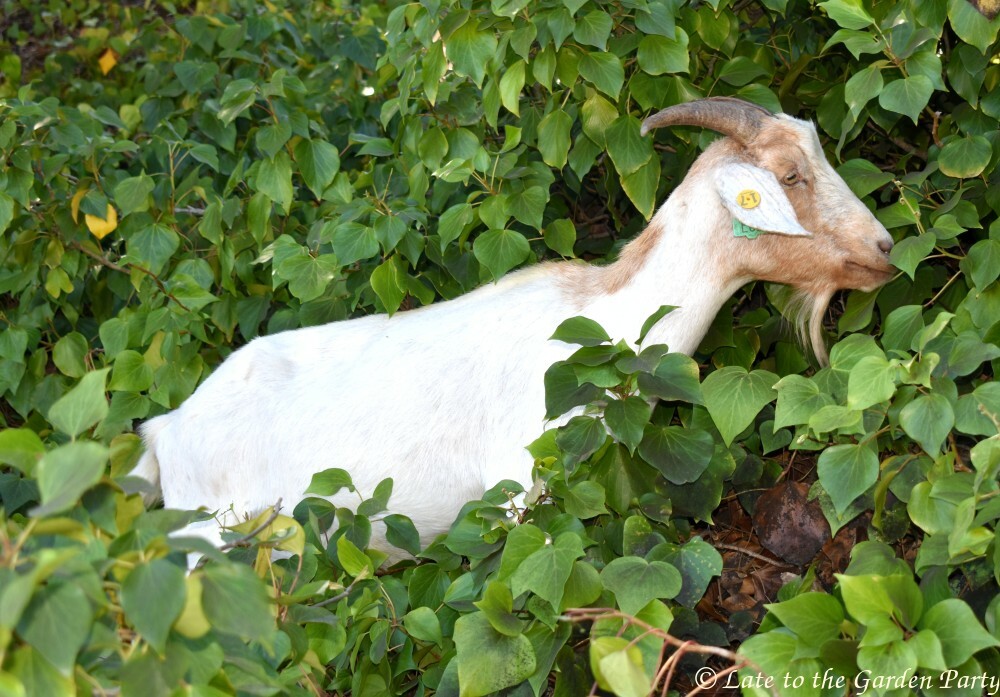
I hope the goats aren't bothered by the heat!  It looks as though it could take them a few more days at least to clear that slope along its entire stretch.  I have a couple more trips that will take me along the same route later this week and I'll be sure to check their progress.


All material © 2012-2022 by Kris Peterson for Late to the Garden Party