Showing posts with label propagation. Show all posts

Wednesday, October 8, 2025

What happened?!

I walked into my lath house to water my shade plants and discovered that one of my three Epiphyllums (aka orchid cacti) had fallen from its pot.  All three were mounted in relatively small pots attached to the side of an upper shelf to allow their leaves to dangle freely.

The other 2 Epiphyllums still sit neatly in their pots


I've never labeled these plants and I mixed up the order in which they were placed when my husband was renovating the lath house this summer so I'm not absolutely sure which is which but, based on the color of its foliage, I believe the one that lost its perch was 'King Midas'.

For lack of another place to put the uprooted plant, I dropped it into a shady spot in an empty container nearby
  
This photo shows a sparse root system at its base

So what made it fall to the ground while the pot remained in place?  The photo above suggests that it didn't have a deep root system.  We've been getting frequent bouts of high winds so that, along with its very long leaves, may have been enough to carry it aloft without a strong root system to hold it in place.  The soil in that pot was also unusually wet, which can't be the result of rain (as we've only had a trace amount) but then perhaps I overwatered it myself during a prior spin through the lath house.  The pots do have reservoirs at their base, although that's never been a issue in the five-plus years I've used them.  (I checked the other two pots to make sure they were okay, which they were; however, both the other Epiphyllums can probably use pruning too.)

The next question is: what should I do with the plant?  It produced lovely, if not prolific, flowers for me in the past.

I took a photo of this flower in mid-June when the pot was sitting under the Magnolia tree while my husband was busy with his lath house repairs


I've never propagated an Epiphyllum so I decided to make an experiment of it.  First, I pruned the plant with the intention of repotting it once I get another bag of succulent mix.

Mother plant after pruning


I watched a couple of videos on propagating Epiphyllums before cutting the best of the pruned pieces to the appropriate size (i.e. no longer than six inches).  I intend to let the cuttings callus over before giving two different approaches to growing them a try.

The most common approach is to plant the callused cuttings in moist but free-draining soil but another video poster advocated rooting the callused stems in water before potting them


If you've tried either of these approaches with Epiphyllums, let me know.


All material © 2012-2025 by Kris Peterson for Late to the Garden Party

Wednesday, July 27, 2022

A prickly project

After hand-watering my cutting garden and fertilizing the dahlias yesterday morning, I decided to tackle a prickly low-reward project I'd put off for months.  It was time-consuming and few people would be likely to notice a difference once I was done but it was something that bugged me almost every time I walked through my front garden, which is generally a couple times a day.

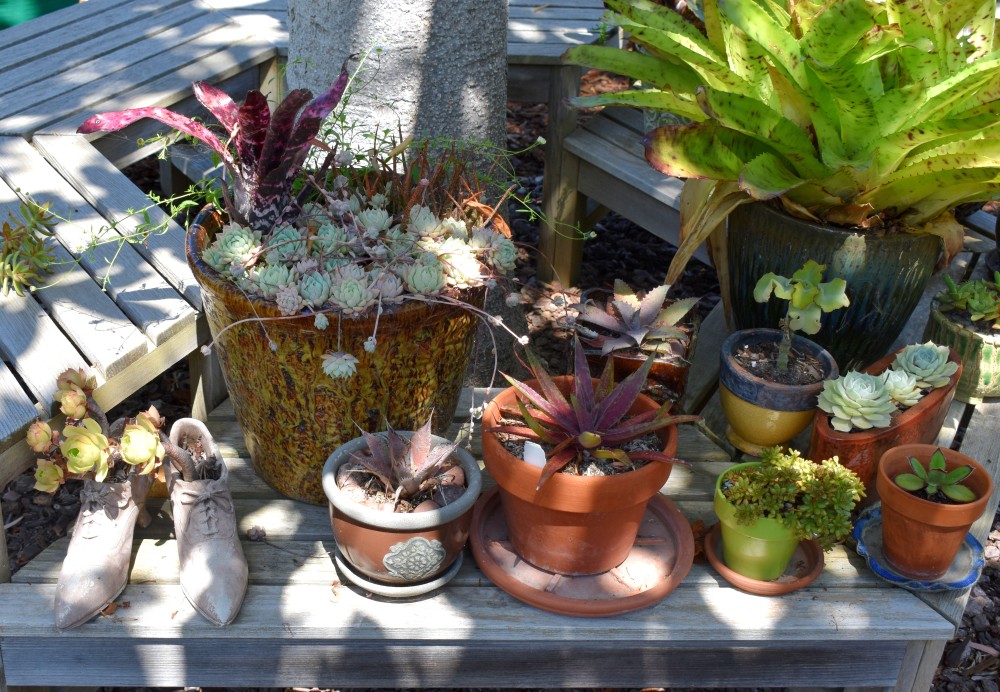
This is part of the seating area/plant shelf that surrounds the Magnolia tree in our front garden.  Pardon the poor quality of the photo but, as it's in partial shade all day, it can't be helped.  I should also acknowledge that the construction is a little odd; however, as I do relatively little sitting in the garden, I dedicated half the structure to potted plants, most of which have been here for years.

The focus of my effort was the bromeliad in the upper right of the preceding photo, Nidularium wittrockia leopardinum.  I picked up this plant at the South Bay Bromeliad Association's sale in August 2016.  It's been in the same pot since I purchased it.  I've pulled out dead leaves at intervals over the years but, as it grew steadily denser, that became increasingly difficult and it started to look mangy.

This is the plant in its "before" condition.  You can see some of the dead leaves hanging over the side.  Dead leaves could also be found in the interfaces between plant clumps.  It's difficult to work with because its leaves are lined all along the edges with sharp spines.

The original plastic pot sat inside of a decorative ceramic pot.  The plant clusters were so densely packed, I had to cut the white plastic pot to free it.

I struggled to cut through the plant clusters to separate them.  Once separated, I peeled away dead and disfigured leaves, ridding the plant on a large number of slugs in the process.  I don't find many slugs (or snails) in my increasingly dry garden but the slugs had found the ideal environment inside the relatively wet interior of the bromeliad.

I replanted 2 plant clusters in another plastic pot, inserting it into the ceramic pot under the Magnolia tree.  I planted the other 2 clusters in another plastic pot, which I slipped inside a terracotta pot and deposited next to the lath house.

I also decided it was time to replant the noID bromeliad a friend gave me a couple of years ago.

The noID bromeliad and its pot arrived already planted.  The pot originally included succulent cuttings as well, some of which I'd removed earlier.  I removed the remaining gangly Crassula stems, then cleaned up the bromeliad, removing its dead leaves.

I repotted the bromeliad in its original container.  I pinched pieces of Echeveria prolifica from another pot to add interest.

I'm planning to harvest more of these Echeveria rosettes for other areas of areas of my garden.  Echeveria prolifica lives up to its name and spreads very quickly.

In addition, I replanted the pair of concrete shoes (shown in the first photo on the lower left) using succulents.

I think the Aeonium arboreum rosettes had been there for more than 2 years.  The shoe containers were a gift from one of my sisters-in-law years ago.

Feeling lazy at this point, I replanted them with Aeonium haworthii 'Kiwi' cuttings.  The hardest part of the process was getting the previous stems out of the shoes without breaking them.

I'd considered dividing the Neoregelia 'Guinea x Pepper' on the north side of the seating area/plant shelf but I simply ran out of steam.  That's a project for another day.

Neoregelia 'Guinea x Pepper' (upper right) may be the toughest bromeliad in my garden.  Most aren't all that happy planted in the ground because my garden overall is so dry, especially this time of year.

I've previously divided this one and planted pieces of it in an area along our north property line, which is probably what I'll do again.  A larger mass of the Neoregelia will have greater impact. 

The cooler temperatures we enjoyed last weekend spilled over into the Monday and Tuesday but we're expecting a slow warm-up as the week continues.  Hopefully, it'll stay within a reasonable range.


All material © 2012-2022 by Kris Peterson for Late to the Garden Party

Wednesday, July 6, 2022

Agave 'Blue Glow' reproduction

I've joked on and off about my fear that all the 'Blue Glow' Agaves in my south side garden will bloom at once.  Agaves are monocarpic, which means that they die once they bloom.  'Blue Glow', a hybrid of Agave attenuata and Agave ocahui, forms a solitary rosette and doesn't normally produce pups either at its base or by runners, except on occasion if it's grown in a pot where its development is constrained.  According to my records, I planted five of the seven plants I have in that area between September and November 2014.  I added one more in September 2015.  I've no record as to when I planted the seventh specimen but my guess is that it can't have been longer than a year later.  I purchased all my plants from small pots before they ballooned in popularity - and price.

All 7 of my 'Blue Glow' Agaves are shown in this photo, along with several 'Blue Flame' Agaves.  The latter are prolific puppers.  Most of the 'Blue Flame' plants are pups of the original plant I added to the bed in 2016.


Estimates of the life span of Agave 'Blue Glow' vary from seven to fifteen years.  If I assume my plants were at least a year old at time of purchase, they range from seven to nine years old at present so my fears about blooms in my near-term future aren't unreasonable.  I spotted a 'Blue Glow' in bloom in a neighbor's garden a couple of weeks ago and it was noticeably smaller than my largest plant.

My neighbor's 'Blue Glow' with developing bloom stalk in mid-June

Photos of the bloom stalk taken yesterday.  There are no flowers yet.
 

I took a close look at my 'Blue Glows' a couple days ago and my apprehension inched up a couple of notches.

There's no sign of a bloom stalk but something looked off with the large plant in the background, warranting a closer look

Can you see it?  Look closely at the right side of the plant in the rear.

This closeup photo shows two pups developing not from the plant's base but from its side!  I'm taking this as evidence that this Agave is preparing to bloom.

Closeup of the larger of the 2 pups


As mentioned, this Agave doesn't usually produce pups but it may do so when it blooms.  Blogger friend Hoover Boo at Piece of Eden has had experience with with these 'Blue Glow' off-shoots and I'm taking lessons from her description.  As there's no apparent way to remove the developing pups from the Agave's side at this stage, I'm going to leave them alone and hope I can remove and plant them after the mother plant blooms out.  I'm hoping that I'll also get bulbils (plantlets) from the flower stalk, which seems to be the most reliable way to propagate these Agaves.  Another site I checked mentioned coring the Agave to force its production of pups but, on the theory that my plant is nearing bloom stage, that seems counter-productive.


As a postscript, while taking updated photos of my neighbor's blooming agave, I also took a few photos of the house next door that recently installed a new landscape.

This was a view of the new area back in mid-June, as shown in a prior post

Updated photos featuring more plants and a nice blanket of mulch.  In addition to the Mexican feather grass (Nassella tenuissima) and Lantana planted during their first round, the landscapers added large noID Agaves in 4 areas, blue chalksticks (Senecio mandraliscae), purple heart (Tradescantia pallida 'Purpurea') and mother-in-law's tongue (noID Sansevieria).


It'll be interesting to see how this garden develops.


All material © 2012-2022 by Kris Peterson for Late to the Garden Party