Showing posts with label Yucca elephantipes. Show all posts

Friday, January 9, 2015

Homage to a Yucca

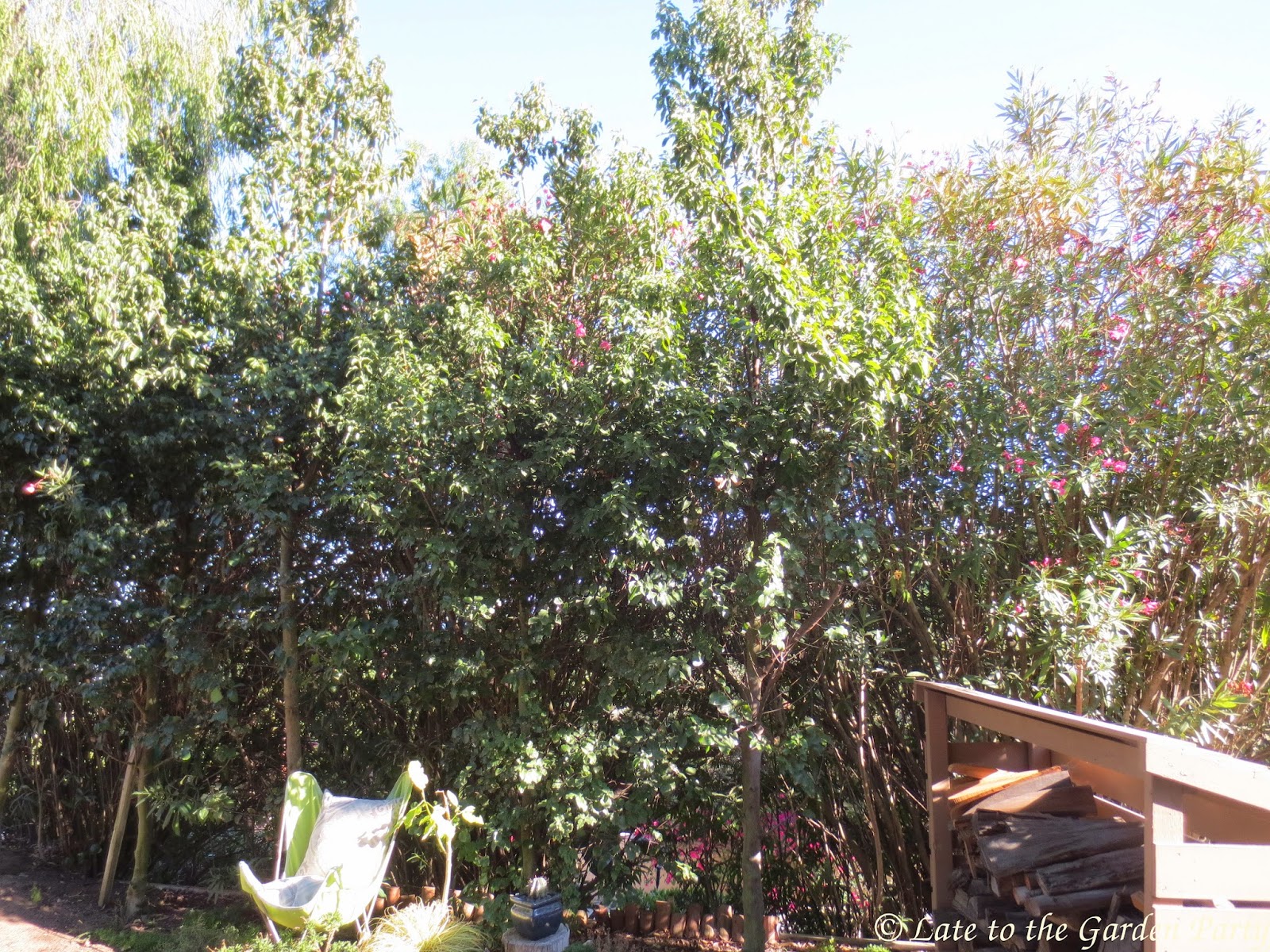
Last month I published a post recounting the sad story of the Yucca elephantipes (aka Y. gigantea) seated at the bottom of our back slope on the boundary between our property and that of a neighbor.  After watching the Yucca grow taller and spread further along the slope, my husband tried to trim it back.  That effort, and the Yucca's resilience in making a quick comeback, led my husband to declare war on the plant (much as he'd done many years ago with a Bougainvillea that, no matter how frequently it was trimmed, grew out across the driveway at our old house to scratch the car he'd painstakingly converted from gas to electric power).  When our neighbor came by to discuss the possibility of cutting the Yucca back, my husband mounted a campaign to remove it.  Although he has been known to blink at what I spend on plants, he didn't blink at the price quoted to cut the massive plant down to 2 feet.  (I, on the other hand, nearly had an apoplectic fit.)  Even the neighbor was surprised when we informed him that we (I'm using the royal "we" here) wished to proceed.

In about 6 hours, the Yucca went from this:

Yucca, photographed looking down onto the back slope in November 2014


To this:

The same area, photographed December 5, 2014


No one was happy about how the landscape service left the Yucca.  Instead of 2 feet tall, it was between 4 and 5 feet tall in places.

The huge, irregular stumps left behind


In addition to being ugly, the stumps were too tall to cover with soil to speed decay and prevent the plant from growing back.  Yet, they were also too low to provide privacy between the 2 properties.  A representative from the landscape service quoted another choke-worthy fee to cut the stumps flush with the surface of the soil.  We agreed to the plan but recently got another quote from a different tree service representative, who claimed his team could get a stump grinder down the slope to eliminate the risk of regrowth, something the original service claimed was impossible.  We accepted his proposal.

The new team arrived on Tuesday, just as I was leaving for the day.  My husband told me that getting the stump grinder down the relatively steep slope proved more difficult than anticipated by the new service.  Fortunately, the neighbor on the other side of us agreed to allow us to move it through the back of her property.


With that obstacle removed, the team got to work.  I came home that evening to find the work half-done, with the crew scheduled to return early the next morning - in exchange for a still larger fee.

The scene at the start of the second day of work

The lattice and pots beyond the stumps sit on the neighbor's property

The tree service increased their price, in part, due to our request to also grind out the small stumps higher on the slope, off-shoots of the original Yucca (circled area)


After another 9 hours of work on that second day, all that was visible was sawdust and mud:

View of area as of January 8, 2015

The sawdust left behind after grinding the stumps is fluffy and very moist, creating a spongy surface, which may take a while to dry out


Now what remains is to determine what we should plant to create a new screen between the 2 properties.  I've proposed planting 3 Pittosporum tenuifolium 'Silver Sheen' but the neighbor has yet to respond.  Although we believe the Yucca, or most of it anyway, was inside our property line, I want to ensure that the neighbors are comfortable with the choice.  They've told us the Yucca was already tree-height 34 years ago when they moved in and I know the wife was upset by its removal.  The privacy issue is also greater for them - we're impacted only when we're on the back slope but they face the newly bare area every time they go into their backyard.  The Pittosporum, a handsome if unexciting plant, has the advantage of being fast-growing, reaching a height of 6 feet in as little as a year.  In a group of 3, it should provide an effective screen, while allowing light and air to move easily through it.  It's also moderately drought tolerant.

While I do like the increased light and improved views of the harbor from the back slope, I'm nonetheless sad to see the Yucca reduced to a soggy mass of dust.  And I know that the hummingbirds and I will miss the flowers.


But I can always visit the handsome, well-maintained Yucca elephantipes at the local botanic garden, just 5 miles away.


 All material © 2012-2015 by Kris Peterson for Late to the Garden Party

Tuesday, December 30, 2014

Second Blogiversary Retrospective

Yesterday was the second anniversary of my first blog post.  In 2013, blogging was mostly a distraction from turbulence in my personal life.  In 2014, it became more pointedly about the garden itself: what I liked and didn't like about it, what I planned to change, how those changes were implemented, and the challenges we faced along the way.  All through the process, I appreciated the comments, suggestions, commiseration, and support I received from those of you who do me the honor of reading my posts.  When I started blogging I never anticipated the sense of community the process creates.  That has become the most important impetus for continuing.

As I looked back on this year's posts, I realized just how much has happened in the garden this year, some of which was planned but much of which was not.  In some cases what started as small decisions, made without much deliberation, led unintentionally but perhaps inevitably to much bigger projects.  Pruning the unsightly Pittosporum hedge along the street is a case in point.  That hedge bugged me from the time we moved in 4 years ago.  However, for the first 2 years, I left the pruning to the garden service that took care of the lawn.  In 2013, I cut back a few of the hedge's shrubs.  The new growth looked better so, in January 2014, I took things a lot further.  Too far, as it turns out.  Portions of the hedge haven't recovered.  But, on the plus side, cutting back the hedge led to the creation of a street-side succulent bed, allowing me to significantly expand my already burgeoning succulent collection.

From left to right: Hedge before pruning; hedge after pruning; wide view of succulent bed; and a close-up


While I was busy mutilating the hedge, my husband decided that the wood-fired "snorkel spa" we inherited with the house wasn't worth the effort required to maintain it.  He dismantled it, we cleared out the gravel beneath it to open up yet another planting area, and my husband made a patio table out of the spa's wood shell, giving us a new seating area in the backyard.

From left to right: Original spa; dismantlement in process; cleared bed; area after planting (September); and completed patio table


Taking out the grass on the south side of the house in 2013 had created a choppy flow from that area into the backyard.  To address that we decided to extend the small bed surrounding the fountain in the backyard to form a connection to the south side yard.  That work began in February.  The new area was planted in March and April.

Counterclockwise from top left: Area prior to project; work begins; additional soil is delivered; bed ready for planting; initial planting (March); and the new bed at the end of May


With the creation of the extended fountain bed and the bed formerly occupied by the spa, the remaining grass area in the backyard became more of a pathway than a lawn.  We removed another semi-circle of lawn next to the north end of the patio in September to improve the flow of that pathway (and give me still more space for ornamental plants).

From left to right: Area before lawn removal; after lawn removal; and after planting (October)


As the summer progressed, we accepted the difficulty of maintaining our front lawn in the face of California's severe drought.  Rather than try to restore the half-dead lawn, we elected to take it out.  The grass was removed in September but my husband and I spent much of our free time in October and November digging out grass roots, sod netting, and rocks; adding soil amendments; and laying flagstone paths.  Planting began in December and is ongoing.

Counterclockwise from top left: Early stage of soil preparation; what one neighbor referred to as a burial mound; one of 2 topsoil deliveries; laying the flagstone paths; the area to the left of the front walkway after planting; and, on the top right, the partially planted area to the right of the front walkway


Along the way:

I lost my beloved garden companion, Ming, in March after a long struggle with a disease we couldn't defeat

I faced regular visits by raccoons (aka Satan's minions) who tore out virtually every plant I put in, often more than once (Note: As shown on the far right, I finally captured a photo of one of the cheeky culprits on Sunday night outside the dining room window)

We lost the privacy provided by the huge Yucca elephantipes that sat on the boundary between us and a neighbor: the first 2 photos on the left were taken before the Yucca was cut down and the last were taken afterwards (Further work on the 4 foot tall stump is planned for mid-January)


So what will 2015 Bring?  I'm not sure but I suspect our garden will continue to change, along with our expectations of it.  Whatever those changes may be, I hope you'll continue to join me on the ride.

Upper left: Sunset photographed from the front yard; Small photos: Views snapped from the backyard over the course of 2014


All material © 2012-2014 by Kris Peterson for Late to the Garden Party

Thursday, December 11, 2014

The best laid plans

As the saying goes "the best laid plans of mice and men often go awry."  In my last wide shots post, I mentioned my husband's desire to dispatch the Yucca elephantipes (aka Y. gigantea) sitting along our back slope and bordering our neighbor's property.

View of Yucca elephantipes from the top of the stairway leading down the slope

View of the Yucca from my home office window showing its extension above the hedge behind the backyard border


The Yucca was more than 20 feet tall and still growing. Wherever a branch touched soil, it took root, which over time allowed the Yucca to extend the entire width of the slope.  The neighbor obtained  a cost estimate for cutting it down to 2 feet (61 cm), which we agreed to cover despite some misgivings on my part.   Last Friday, the work began just after 7am.


The process viewed from my office window after the chainsaws started up

Going...

Going...

Gone.  With the Yucca out of the picture, I could see the Vincent Thomas Bridge from my office window even through the fog


After the main branches were cut, the workers attacked the stumps; however, after a time I noticed that they'd been silent for awhile.  I was surprised to discover that they'd left without touching base with me or the neighbors.  Here's what I discovered when I tromped down the slope.


The stumps left behind are well over 4 feet (1.2m) tall and greater than 8 feet (2.4m) wide, with additional stumps extending up the slope


I knew the stumps would be a problem but it looks even worse than I'd anticipated.  My husband had planned to drill holes in the stumps and cover them with mulch to encourage decomposition but, at their current height, that would be difficult.  We knew we were going to need to plant the area around the stumps to restore privacy for both us and our neighbors but, at the moment, we're not even sure how to proceed.

In the short-term, the neighbor who contracted the work has asked the tree service to return to see what they can do to clean up and level the stumps.  Assuming that can be done, I expect we'll proceed with the plan to promote decomposition.  (These plants are notoriously difficult to kill.)  I may try planting groundcover in the cavities between the stumps and one or more trees or shrubs alongside them to create a visual break but selection will need to involve the neighbors.  My husband is willing to install a fence but we're not yet sure how the neighbors feel about that option.

Meanwhile, the neighbor on the other side of our property at the bottom of the slope is ecstatic because her vegetable garden now has plenty of sun.  We've got a lot more light too, albeit at the cost of privacy in that area.  The neighbors also took out 2 pine trees and cut back a variety of shrubs, giving us a broader view of the harbor both from the bottom of the slope, my office and the backyard patio.  So, there are some pluses to accompany the minuses.


 All material © 2012-2014 by Kris Peterson for Late to the Garden Party

Wednesday, October 8, 2014

Unplanned Changes

Looking out my home office window one morning recently I saw this:


Then, when I took photos of my backyard for my wide shots post on October 1st, I saw this:


The beautiful - and dying - pine trees aren't on our property.  They belong to the next door neighbor, whose property extends beneath ours.  The neighbor visited us last Friday to let us know that 2 of his 4 pine trees in our line-of-sight will be coming out.  One is almost dead due to an attack by a pine beetle and the other is susceptible to the same scourge.  At the same time, the neighbor wants to cut back the oleander shrubs that align his driveway and, possibly, cut down the Yucca elephantipes that serves as a fence of sorts between his backyard and ours.

It turns out that the oleander officially belongs to us, which came as a surprise as it's largely invisible from the inside of our property.  Another shrub backs the oleander on our side, mostly screening it from view.  I'd assumed that this marked the edge of our property but the oleanders, which can only be accessed from the neighbor's driveway, are ours.  Why someone installed a hedge within a hedge here, I don't understand.  I also don't understand why the dividing line between the properties was designed in this fashion but, as the houses were built in the 1950s and the original owners are long gone, there's no one to provide an explanation.

View of the oleander shrubs from our side

View of the same oleanders from our neighbor's driveway


Ownership of the Yucca is unclear.  Both my neighbor and my husband would like it cut down because the plant is out of control.  Everywhere a branch touches the ground, it roots.  What was once a single plant is now a 20+ foot tall Yucca forest running down the slope, intersecting both properties.

View of the Yucca elephantipes from our backyard

View of the Yucca from the back slope after my husband cut it back in June


We're still waiting for an estimate on the Yucca's removal but the initial off-the-cuff estimate the neighbor received was very high as the plant must be hauled away in pieces - apparently, the wood is too dense to grind on-site.  Given it's placement along a relatively steep slope, we also can't get heavy equipment in to assist with the removal and the stump can't be ground - it would probably have to be poisoned.  How we'll create a separation between the 2 properties post-removal is also a question.  All I can say is ugh!


All material © 2012-2014 by Kris Peterson for Late to the Garden Party


Tuesday, October 8, 2013

My favorite plant this week: Yucca elephantipes

At least I think this Yucca is Y. elephantipes (aka Y. gigantea).  It's another plant that came with the garden.  It grows all over the hills in this area of Southern California.  At the moment, it's also in bloom everywhere I look so it's hard to ignore.  The flowers, some of which I can see from my home office window, are downright spectacular.


Not that it's easy to get a close-up picture of the flowers.  The pictures above were taken from a distance.  The yucca sits on the side of our slope, dividing our property from that of one of our neighbors.  Actually, it may be more appropriate to say that it sprawls along the side of the slope.

Yucca, photographed from the top of the stairs that run down to the bottom of our slope

The tree has multiple trunks and appears to have spawned progeny, although it's hard to make out where one tree stops and another starts.  Ivy covers the base and lower portion of the trunks.

Thicket created by ivy and other plants grows up the trunks of the Yucca


Cleaning up this area is a future project.  A neighbor told me that there are a lot of squirrels and rats living in the area surrounding the yucca, which is off-putting.  And the fact that the tree borders the property of a neighbor complicates things - it's not even 100% clear to me which one of us owns the  yucca as the property line is fuzzy.

In the meantime, I enjoy the flowers.  Yucca elephantipes is hardy in USDA zones 9b-11 (Sunset zones 12,13, 16, 17, 19-24, H1 and H2).  It's native to Mexico and Central America and grows fast to 15-30 feet tall and 8 feet wide.

This is my contribution to Loree's favorite plants meme at danger garden.