Showing posts with label Phlomis fruticosa. Show all posts

Monday, May 14, 2018

In a Vase on Monday: Getting back in the groove

I missed out on "In a Vase on Monday" last week as I was in Texas for the Garden Bloggers' Fling.  I threw together a vase mid-week because I'm now so used to having fresh flowers in the house, it didn't feel like home without them.  Although I'm still trying to catch up on the back-log of items on my "to-do" list, taking time to put together another couple of vases on Sunday was just part of getting back in the groove heading into the new week.

Alstroemeria 'Claire' provided the impetus for the color scheme of my first vase.

The color combination here is a departure from my usual reliance on complementary colors.  The burgundy specks in the Alstroemeria's petals prompted me to include red elements to punctuate the white and yellow flowers.

The tall spires of Sideritis syriaca cypria (aka ironwort or Cretan mountain tea) were a last minute addition

In addition to the Sideritis, the Dr. Seuss-like flowers of Phlomis fruticosa (Jerusalem sage) and Salvia lanceolata (rocky mountain sage) gave the arrangement a quirky touch I liked

Clockwise from the upper left, the vase contains: Alstroemeria 'Claire', Antirrhinum majus 'Black Prince', Coprosma repens 'Plum Hussey', Phlomis fruticosa, Salvia lanceolata, and Sideritis syriaca cypria.  The burgundy-flowered snapdragons have lovely dark, almost black, foliage, which unfortunately doesn't show up in the arrangement.


I saw lots of pretty larkspurs during our garden tours in Texas so it was a natural choice for my second vase this week.  My plants were grown in my cutting garden from seed my brother harvested from his garden last year.  I've never grown larkspur before and wasn't sure it would do well here but it germinated and grew without any problem in my well-watered raised planters.  I'll definitely sow it again this coming fall.  (Thanks Eric!)

I'd thought the foxgloves would be the dominant feature in this vase but, when I discovered just how much this new vase could hold, I added a hefty stem of the mid-blue Delphinium to the mix

Back view

This was another hard vase to photograph from above, even standing on a chair

Clockwise from the upper left, this vase contains: noID Delphinium planted from plugs, Consolida ajacis (aka Delphinium ambiguum) grown from seed, Digitalis purpurea 'Dalmation White', Coleonema album, and Coriandrum sativum (aka cilantro that's bolted) 


I'd intended to place the tall vase on the dining room table but I'm so in love with my first vase this week that I had to have it where I could admire it with my breakfast so I swapped the positions of the two vases.

The vase on the right is a new one, picked up at West Elm when I attended the South Coast Plaza Spring Garden Show late last month.  I pulled one of the cat figurines I collected years ago as an accent.


All material © 2012-2018 by Kris Peterson for Late to the Garden Party

Monday, March 16, 2015

In a Vase on Monday: No Fuss Bouquet

Despite our current unseasonable heat (or maybe because of it), there's a lot in bloom in my garden at the moment.  But heat makes me cranky and, this week, I didn't want to spend a lot of time futzing with my creation for "In a Vase on Monday," the meme hosted by Cathy at Rambling in the Garden.  On the theory that the beautiful blooms of 'Grevillea 'Peaches and Cream' wouldn't last long with dry Santa Ana winds blowing and temperatures above 90F (32C), I cut one of those blooms for my vase, the first time I've ever done so.  As there were a lot of blooms on G. 'Superb', I cut one of those too.  Then I grabbed stems of a few other plants and, plopping them in a vase, called it done.


I could have added Narcissus perhaps, or yellow Freesia or orange Bulbine or peach Gaillardia but I stood pat with the following plants, collected during a 5-minute spin outside (in the miserable heat):

  • Anagallis 'Wildcat Mandarin'
  • Gaillardia x grandiflora 'Goblin' (or maybe 'Arizona Sun' - they look the same to me)
  • Grevillea 'Peaches & Cream'
  • Grevillea 'Superb'
  • Phlomis fruticosa
  • Prostanthera ovalifolia 'Variegata'


Anagallis 'Wildcat Mandarin', planted last spring is perennial here

Gaillardia 'Goblin' is a trifle bedraggled but the stem has a few buds I hope will open to follow this one

The mature bloom of Grevillea 'Peaches & Cream' is on the left and the less mature bloom of G. 'Superb' is on the right

Phlomis fruticosa, a very Seussian flower, is just coming into bloom throughout the garden

Prostanthera ovalifolia was the first foliage plant to catch my eye


I didn't spend time fussing with the arrangement and I didn't create any secondary arrangements with cast-off stems because there weren't any.  A sunny creation, sent by my subconscious to put me in a less cranky mood perhaps, it sits on the dining room table as my breakfast companion.


Please visit Cathy at Rambling in the Garden to see what she's put together this week.  Link up and share your vase if you've put together something with makings from your own garden.


All material © 2012-2015 by Kris Peterson for Late to the Garden Party

Monday, May 19, 2014

In a Vase on Monday: Agapanthus takes the lead

Blooming Agapanthus dominate my garden at the moment, both in sheer numbers and in the perfection of their flowers.  These plants came through our two May heatwaves completely unscathed, which cannot be said for the majority of plants in my garden.  They were the obvious selection to go "In a Vase on Monday" as my contribution to the weekly meme hosted by Cathy at Rambling in the Garden.


I inherited dozens of clumps of Agapanthus (presumably A. praecox orientalis) with the house.  The majority are a medium blue but some are light blue and there are a few white ones.  I picked 2 stalks of the medium blue variety and one pale blue.  I accented these with a few stems of Arthropodium cirratum (aka Renga Lily), which I used in my bouquet 2 weeks ago.  A good many of these flowers dried up in the heat and wind last week so I thought I'd best use them while I can.  Other accents included 2 varieties of Leucanthemum x superbum (aka Shasta Daisy), Tanacetum parthenium 'Aureum' (aka golden feverfew), and Phlomis fruticosa (aka Jerusalem Sage).

The blooms of the Phlomis peaked in mid-April.  There are only a few of these Dr. Seuss-like blooms left in the garden now.  I wanted a punch of yellow to complement the blue and white of the other flowers but I wasn't sure these fuzzy flowers would fit the bill; however, I liked the whimsy they added to the arrangement.


The Leucanthemum x superbum 'Snow Lady' shown with the Phlomis in the picture above have relatively short stems but I liked the way they complemented the Jerusalem Sage better than the taller, ruffled variety of Shasta Daisy I cut first.  The ruffled variety was relegated to the back of the arrangement with the golden feverfew.


The arrangement sits on the dining room table, where I enjoyed it while eating breakfast.


If you have a bouquet from your garden you're enjoying this Monday, post a picture on your blog and link in with Cathy at Rambling in the Garden.  You can find her composition here, along with links to other contributing gardeners.


Tuesday, April 15, 2014

Bloom Day - April 2014

Our winter and spring temperatures have been "unseasonably warm" according to weather forecasters, although much the same thing was said last year.  I wonder when these conditions cease being termed "unseasonable" and instead become the new normal?  Our spring got off to an early start, especially in relation to the parts of the country hit by the miserable "polar vortex" but, when I looked back at last April's post, I find that most of the flowers blooming now were also blooming then.

For a change of pace, in collecting photos for this month's Bloom Day post, I focused more on plant combinations and less on individual flowers.

Acanthus mollis "Summer Beauty, backed by Osteospermum ecklonis '3D Silver,' a staple in my garden, and white Argyranthemum

A lone Adenophora potaninii is surrounded by Euphorbia 'Dean's Hybrid' and self-sown Alyssum - more Adenophora have seeded in the vicinity of this one but none of these seedlings have formed flower spikes

Alstroemeria (no ID) with Osteospermum '3D Silver' make a strong showing in the backyard

Aquilegia 'Spring Magic' with unnamed Violas and Osteospermum '3D Silver'

Arctotis 'Pink Sugar, surrounded by Convolvulus sabatius 'Moroccan Beauty,' is clashing with the early blooms of self-sown Gaillardia 'Arizona Sun' 

Centranthus ruber, a weed here, blooming on the slope with Oenothera speciosa, another weed, Euphorbia 'Dean's Hybrid' and self-sown Alyssum (Lobularia maritima)

Cuphea x ignea 'Starfire Pink' is paired with Geranium 'Tiny Monster' here

Erysimum linifolium 'Variegatum' with Osteospermum 'Lemonade'

Another Erysimum, this time accompanied by Osteospermum '3D Silver' and Tulbaghia violacea

Sun-tolerant Fuchsia 'Mrs. J.D. Fredricks' with pink Argyranthemum and Cuphea 'Starfire Pink'

Eeek!  An early-blooming orange Hemerocallis (no ID) clashes with the pink Alstroemeria, which has yet to make its seasonal exit


This unnamed Iris germanica, blooming almost a month earlier this year than last, doesn't mix especially well with the bright pink Alstroemeria nearby 

Leptospermum scoparium 'Pink Pearl' got the only solo shot in this post, although, if you have a discerning eye, you might notice the white Centranthus peaking out from behind

Limonium perezii backed by Lavandula dentata in the dry garden

Unidentified Pelargonium peltatum with pinkish California poppies, photographed in full sun, the only time to catch the poppies with open petals

Unidentified Pelargonium (originally mislabeled as 'Katie') and more Cuphea 'Starfire Pink'

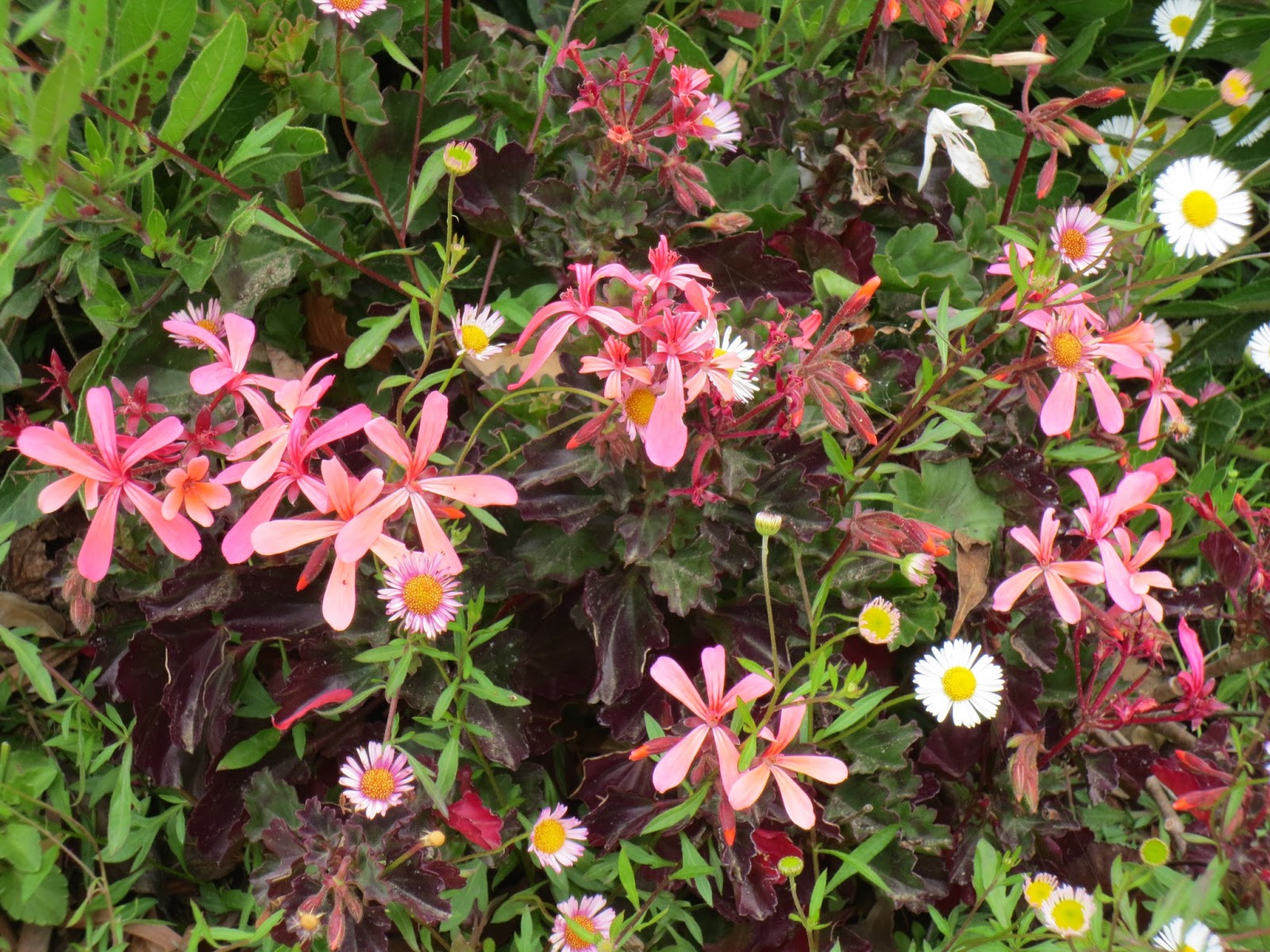
Assorted Pelargoniums blooming on the slope alongside pale pink Oenothera speciosa, bleached out even when photographed on a cloudy morning

A sea of Phlomis fruticosa with yellow Argyranthemum and a few Euphorbia 'Ascot Rainbow' in the background

'Ebb Tide' rose, producing its first blooms, with annual Linaria

Sisrynchium bellum 'North Coast' and a sunburned Pericallis, which has not enjoyed our excessively warm temperatures

Salvia 'Mystic Spires' with Lobelia and one of the few remaining Anemones

Dainty Wahlenbergia 'Blue Cloud' with Erigeron karvinskianus, another weed-like plant here, and Geranium 'Tiny Monster'

Sweet peas (Lathyrus Odoratus 'Perfume Delight') fill one of the planters in my vegetable garden (with some snapdragons tucked in behind) 


Hemerocallis and Iris are producing blooms here and there - the heaviest bloom periods for these plants are still to come.  They, and the Arthropodium cirratum and Agapanthus, both already gearing up for what is usually a late spring appearance, will probably dominate my garden during the next month.  For what's currently on display in gardens throughout the US and elsewhere in the world, please visit Carol at May Dreams Gardens by clicking here.

Thursday, February 27, 2014

My favorite plant this week: Phlomis fruticosa

Phlomis fruticosa has begun its spring bloom cycle and, while the flower power of this evergreen shrub is likely to increase over the coming weeks, its bright yellow blooms are already hard to ignore so I've given it status as my favorite this week.   I inherited 12 of these drought-tolerant shrubs with the garden - there are 6 in the front yard in 2 groups of 3 plants each, where the yellow flowers bloom in accompaniment with the blue flowers of the Ceanothus hedge, and 6 more in the backyard, again in 2 groups of 3, backed by the orange-tinged foliage of the Xylosma hedge.


The shrub, which grows 3-4 feet (0.9-1.2 meters) tall and wide, gets woody and needs to be cut back hard in the fall to keep it in shape.  I'm afraid I did a sloppy job of that this past fall so my specimens aren't in tip-top shape this year; however, my sloppy pruning hasn't significantly impacted blooming.  The flowers are unusual.  They form bell-shaped whorls around a central stem.  If dead-headed after the spring bloom cycle, they'll rebloom on new growth in the summer, although my experience is that the second bloom cycle is lighter.


The leaves are a nice gray-green color.  While they're usually described as woolly, they feel more like suede to me.  The leaves resemble those of some Salvias, which accounts for the common name of Jerusalem sage, but the plant is actually in the mint family.

Phlomis fruticosa grows in full sun to light shade - most of mine get at least some shade during the warmest part of the day.  Those in the shadiest locations are the slowest to bloom.  The shrub is said to be hardy to 15-20 degrees Fahreneheit (-9.44 Celsius).  They can be grown in USDA zones 7a-11 (Sunset zones 3b-24).  They like some summer water in warmer areas.

The Jerusalem sage is my favorite plant this week.  Please visit Loree at danger garden, our host for the weekly favorite plants meme, to see her current favorite and link to other gardeners' contributions.

Monday, April 15, 2013

April Bloom Day

Spring is well underway in Southern California.  There's a lot in bloom.  While the spring bulbs have mostly finished up, many of the other plants I showed last month are still in bloom.  I'll try not to repeat myself too much.

In the front yard, the roses have just started to bloom.

I have no ID on this rose but I'd love to get more

This 'Joseph's Coat' climber was attacked by aphids last month but is now recovering

6 'Pink Meidiland' shrub roses growing in my front beds are all coming into bloom

Other new bloomers in the front garden include 2 Pelargoniums and an annual Schizanthus:

Pelargonium x hortorum 'Tweedle Dee' (I think)

Pelargonium 'Georgia Peach'

Schizanthus pinnatus

In the side yard, all 12 of the Phlomis fruticosa are now in full bloom.

Phlomis fruticosa blooming in a shade bed
I added annual Nemophilia menziesii to what was once a shade bed, which is in full sun since removal of our 60 foot Eucalyptus tree.  The area is buffeted by daily winds and, as a result, these plants lean to one side.

Nemophila menziesii (Baby Blue Eyes), photographed from its good side

The same Baby Blue Eyes photographed from their bad side

I recently added yet another Osteospermum, one of my go-to groundcover plants, to the side yard to complement my Acacia cognata 'Cousin Itt' (not shown here).

Osteospermum hybrid 'Sunny Amanda' 

A fuchsia is already blooming in a pot on the small patio on the side of the house.

Fuchsia 'Deep Purple" in pot

The border in the back yard has been undergoing a face lift since fall began as I try to figure out what plants do well here.  Over the past several months, I've added plants, moved others and pulled out still others.  A few are on probation.


This Alstroemeria, shown in last month's post, is a keeper

This Alstroemeria, positioned 10-12 feet from the other one, is also a keeper
This daylily, a dormant variety (no ID) positioned right next to the Alstroemeria shown above, is already showing its first blooms, presenting a troublesome color clash

Aquilegia hybrid 'Spring Magic,' put in last year, came back with a bang this spring

I put this Arenaria montana (sandwort) in as an edging plant last year from a 6-pack but pulled most of it when it failed to perform.  It looks great this year and I want more!

I just added this Cosmos 'Double Click."  I've admired photos of it in catalogs and, when I found it by chance, had to try it out.

This 'Ebb Tide' rose is new.  The color nicely echoes the Cuphea shown below, which is planted in front of it.

Cuphea aff. Aequipetala with Nemesia that returned from last year

Prostanthera ovalifolia 'Variegata', added last year as a foliage accent, is blooming for the first time

Erysimum linifolium 'Variegatum' is a workhorse that looks good in and out of bloom

One of my new favorite Osteospermums, 'Zion Copper Amethyst' sits in the "warm" color section of my long back border

Ixia, planted last fall, are the only spring bulbs just coming into bloom.  I like how it complements the Abelia 'Kaleidoscopes' planted nearby

The "dry garden" on the other side of the house also has a lot of blooming plants, although some of these could be construed as weeds.

Centranthus ruber and Zantedeschia both spread like weeds

Cuphea ignea 'Starfire Pink" behaves itself but Geranium incanum does not

More Geranium incanum, paired here with Thymus 'Pink Chintz'

My favorite Euphorbia, 'Dean's Hybrid,' is "flowering"

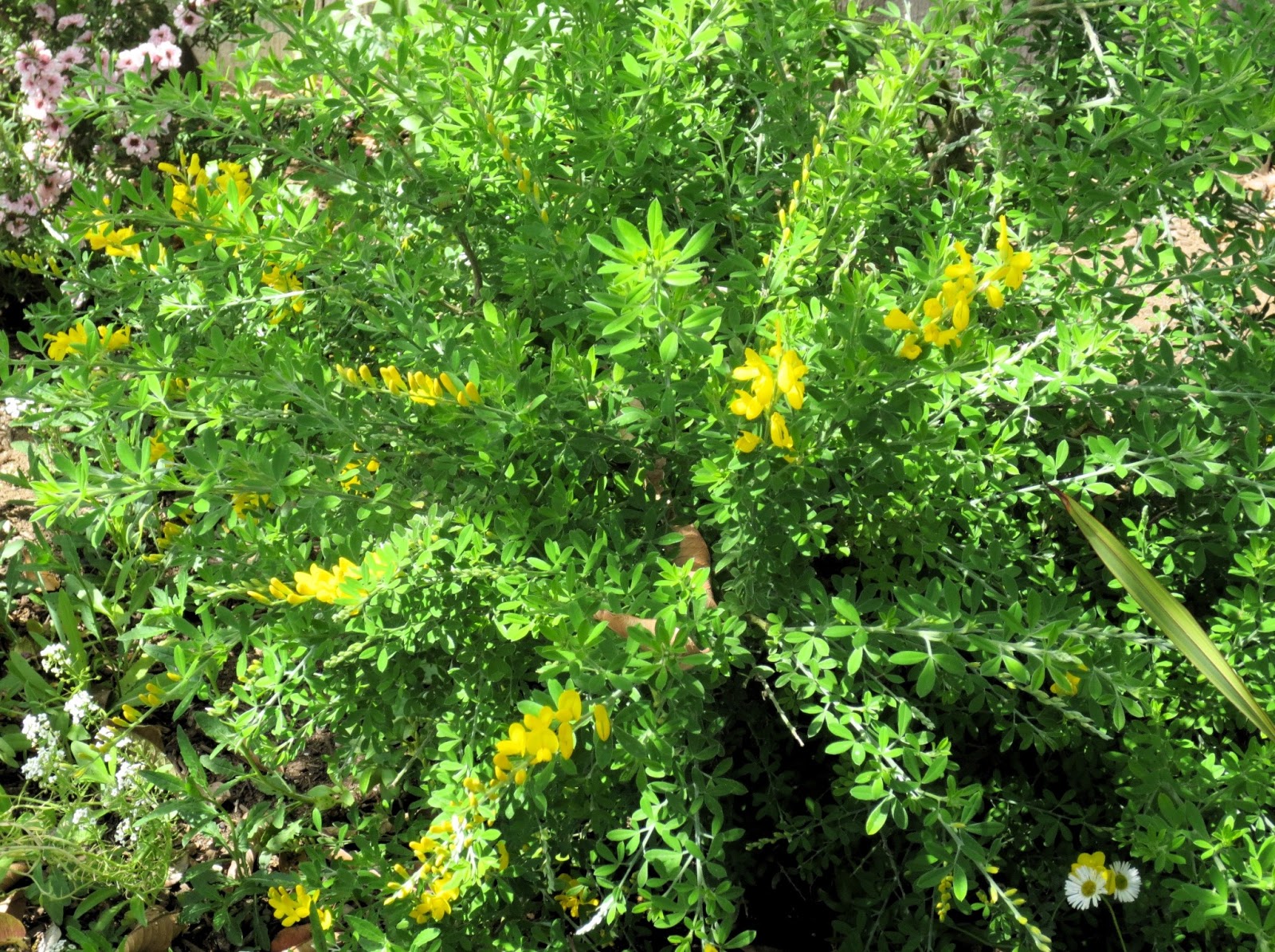
Genista canariensis

Bearded Iris inherited from a prior owner

Leptospermum scoparium 'Pink Pearl," which began blooming in January, is still in bloom!

Oenothera speciosa 'Siskiyou' (aka Pink Evening Primrose) spreads like a weed, albeit a pretty one

The California poppies, planted last year from seed, are in full bloom in my vegetable garden.

Eschscholzia californica

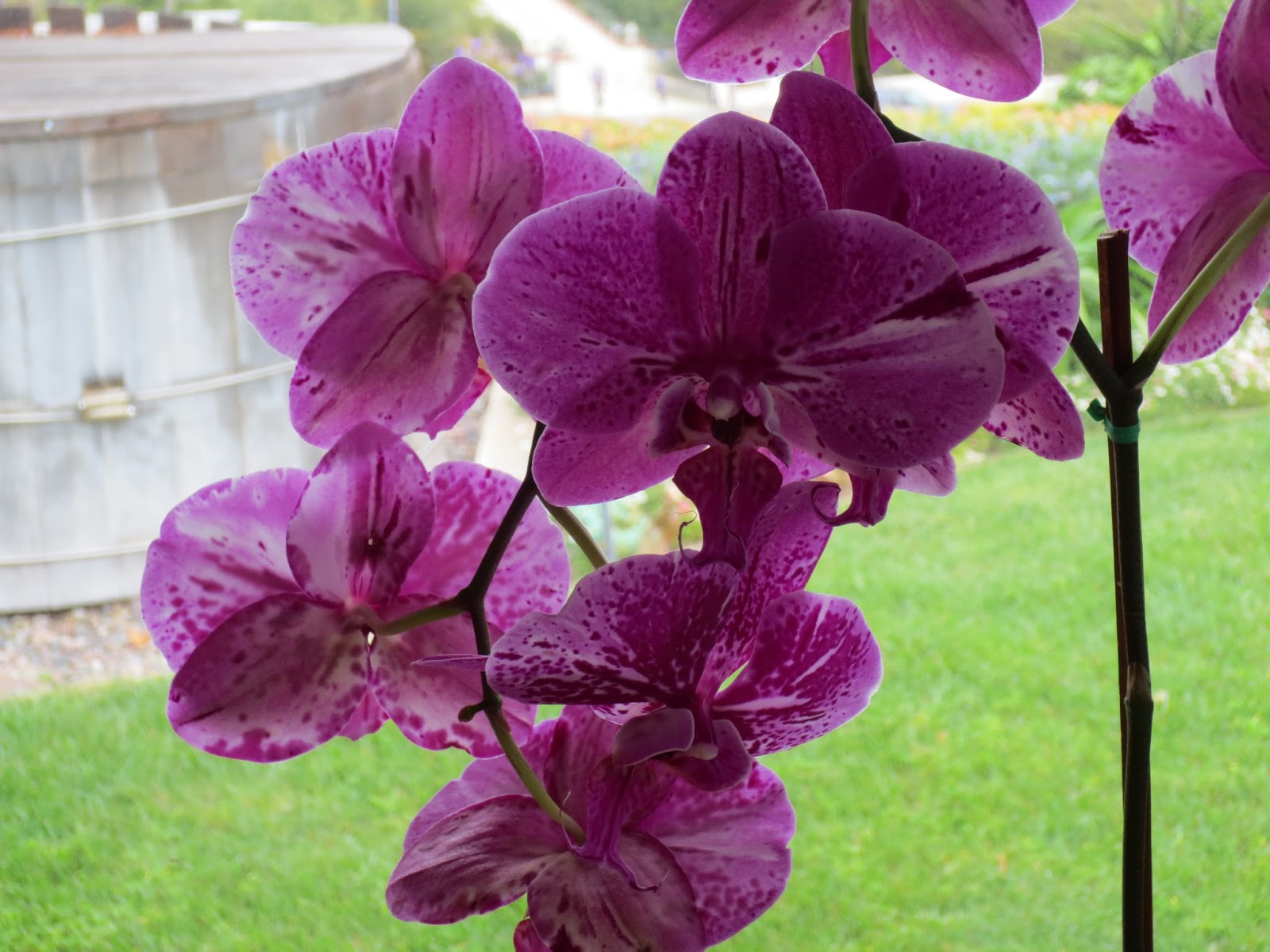
I even have an orchid blooming in my home office.

Orchid, an anniversary gift from my husband in February, is still going strong

Today is Garden Blogger's Bloom Day.  You can view more blooms at Carol's May Dream Gardens site.